Le Pouf: Fashion and Social Satire in the 1770s-1780s

By Landis Lee

Today, in the twenty-first century, hairdressers cut, color, and style the hair, and have to keep up with the latest trends in order to keep their customers happy and looking fashionable.  The same holds true for late eighteenth century hairdressers in England and France.  They were dressing their costumers with an elaborate style known as the pouf. It was made of the woman’s real hair and various accoutrements, which could include such things as false hair, powder and pomade.  The hair was also decorated with such adornments as flowers, ribbons, pearls, and feathers.

Seeing  fashion plates of poufs, and reading  first- hand accounts of them, I begin to think that these late eighteenth century hair styles are probably the most extravagant, if not elaborate, hairstyles in the history of fashion.  They represent an idea of fashion being non-sensible. Fashion plates from the Galerie des Modes from the years 1778-1787 offer a wonderful source for the fashionable styles of the pouf in its own time period.
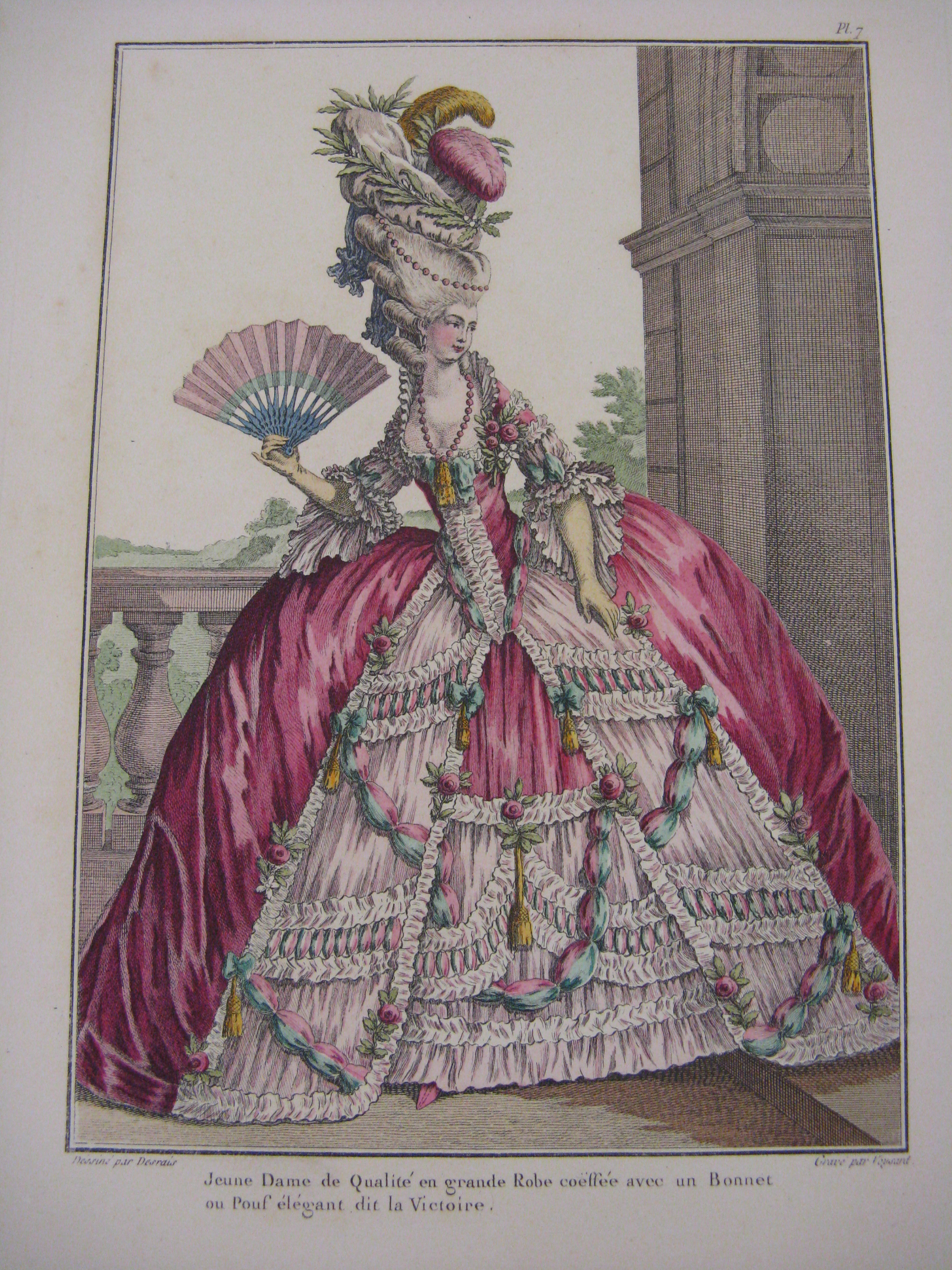
Pouf a la Victoire. Source: Galerie des Modes. Special Collections and FIT Archives
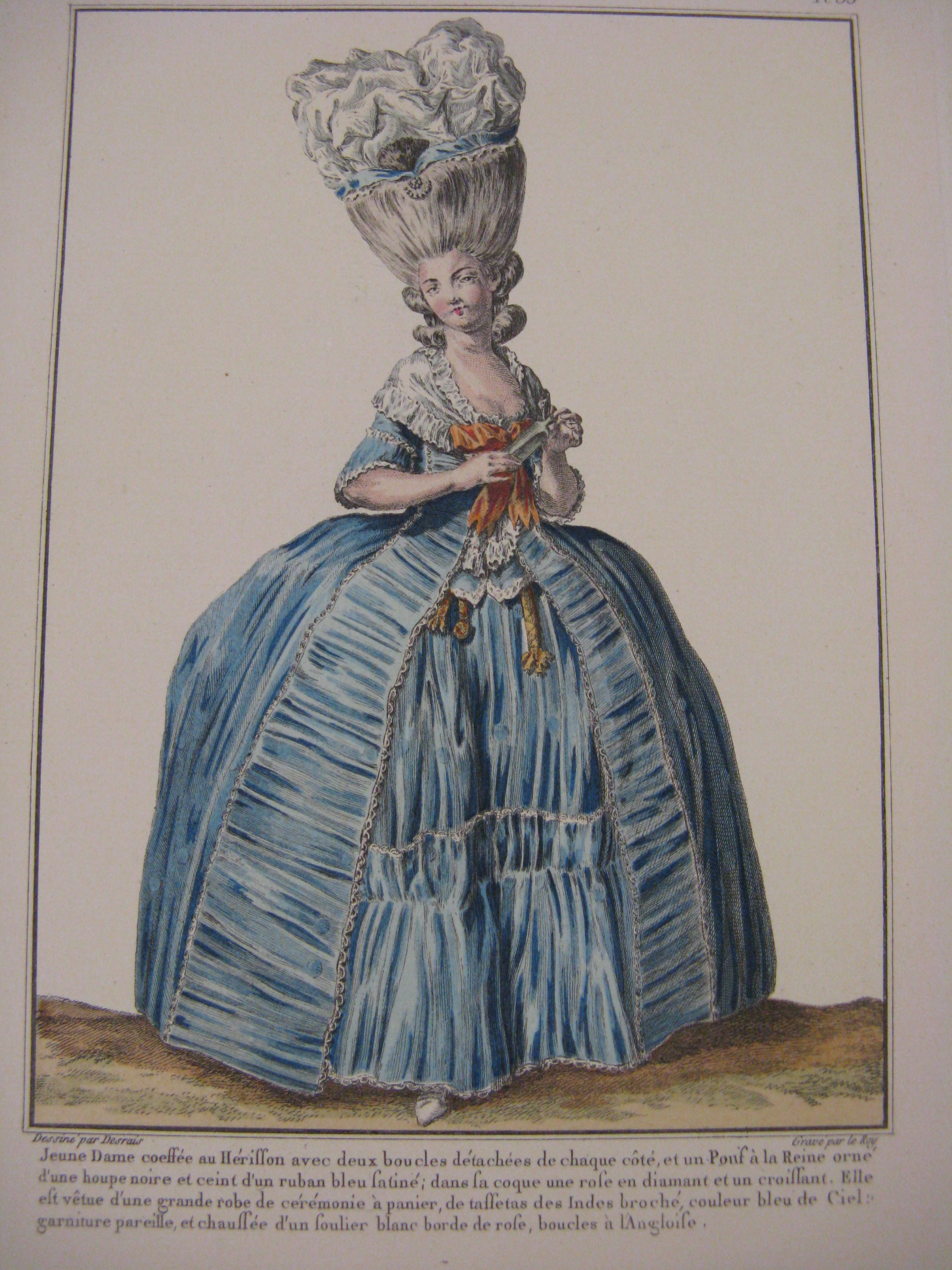
Pouf a la Reine. Source: Galerie des Modes. Special Collections and FIT Archives

The poufs of the 1770s and early 1780s are characterized by extreme height and many decorations, often the adornments on top of the hair are as high as the hair itself. Many styles were named and presented in fashion plates. One style that captures the attention was called La Belle Poule worn in 1778 in honor of the French war ship of the same name that won a naval battle that year and included a miniature version of the ship perched on the hair. Other popular styles included the pouf aux sentiments that could show personal interests or events of the wearer, or the pouf a la circonstance which were inspired by crazes, like ballooning or other events such as plays, war victories and even the storming of the Bastille.  Rose Bertin (marchandes des modes to Marie-Antoinette) created many pouf a la circonstance, which not only showed off her craft and talent, but also how she was able to catch when fashions would change. Other styles included adornments of vegetables, flowers, ribbons, jewels, and feathers.

To hold all these excessive and cumbersome decorations, the hair had to be very high and very carefully put together.  In order to achieve this style, the hair was piled over of some sort of padding of wool, cotton, false hair, or horsehair.  The hair was then powdered, and pomade was applied.  The hair, along with the pouf ornamented with such things as feathers and flowers, must have made even walking cumbersome for the lady wearing it.

In her memoirs Madame de la Tour du Pin, lady in waiting for Marie Antoinette, writes of wearing the pouf: 

fashions of that day made dancing a form of torture…hair dressed at least a foot high, sprinkled with a pound of powder and pommade which the slightest movement shook down on the shoulders, and crowned by a bonnet known as a ‘pouf’ on which feathers, flowers and diamonds were piled pell-mell – an erection which quite spoiled the pleasure of dancing.  A supper party, on the other hand, where people only talked or made music, did not disturb this edifice.
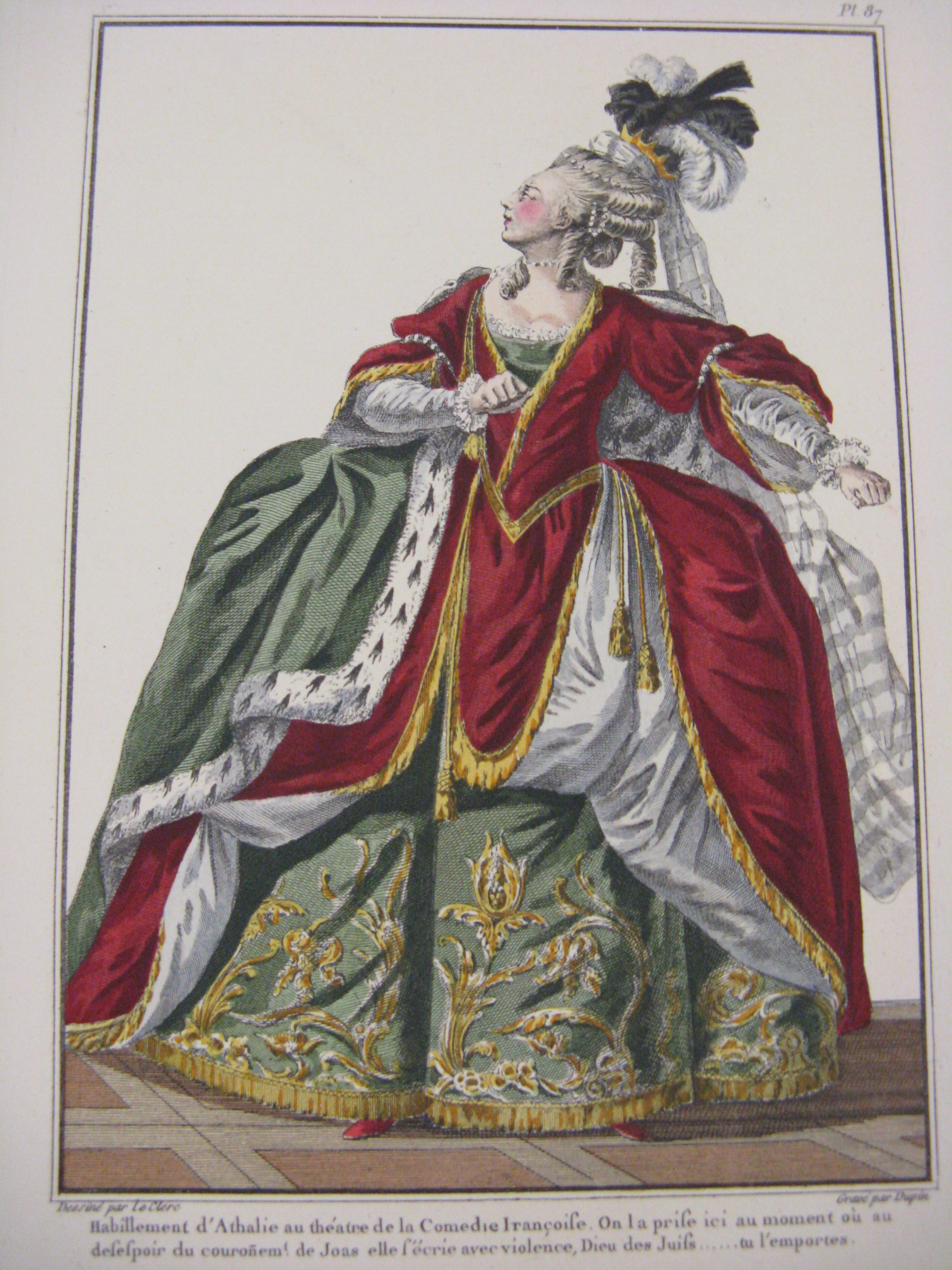
 

Fashion plate. Source: Galerie des Modes. Special Collections and FIT Archives

The pouf’s heyday was in the 1770’s and maybe the very beginning of the 80’s, in terms of extravagance and constantly changing styles. Hairdressers, such as the famed Leonard, rose to the level of celebrity at this time.  The majority of hairdressers were men, including Leonard, who was self-described as “an Academician in Coiffures and Fashion.” He was probably the most famous hairdresser of all time.  He coiffed Madame du Barry, succeeded another well-known hairdresser Le Gros, and in 1780, he took over for Larseneur as the “coiffeur-valet” for Marie-Antoinette.

Another well-known figure in the fashion world and in the world of the pouf was not a male or a hairdresser by trade, but a marchande des modes, named Rose Bertin.  Mlle. Bertin, mentioned briefly earlier with the creations of the pouf a la circonstance, had clients of nobility, probably the most famous one being Marie-Antoinette.  In February 1776, a group of six merchant guilds decided that women of certain guilds (embroiderers, hairdressers, and fashion-makers) could be included into this group of mastership.  Rose Bertin was a member of the fashion-makers guild, officially called The Guild of Makers and Dealers in Fashion – Feather-Dealers and Florists of the City and Suburbs of Paris; and was head of the guild for a year from October 1776 to October 1777.  The guild choosing Mlle. Bertin as master showed her prominence and success in the trade world in Paris.
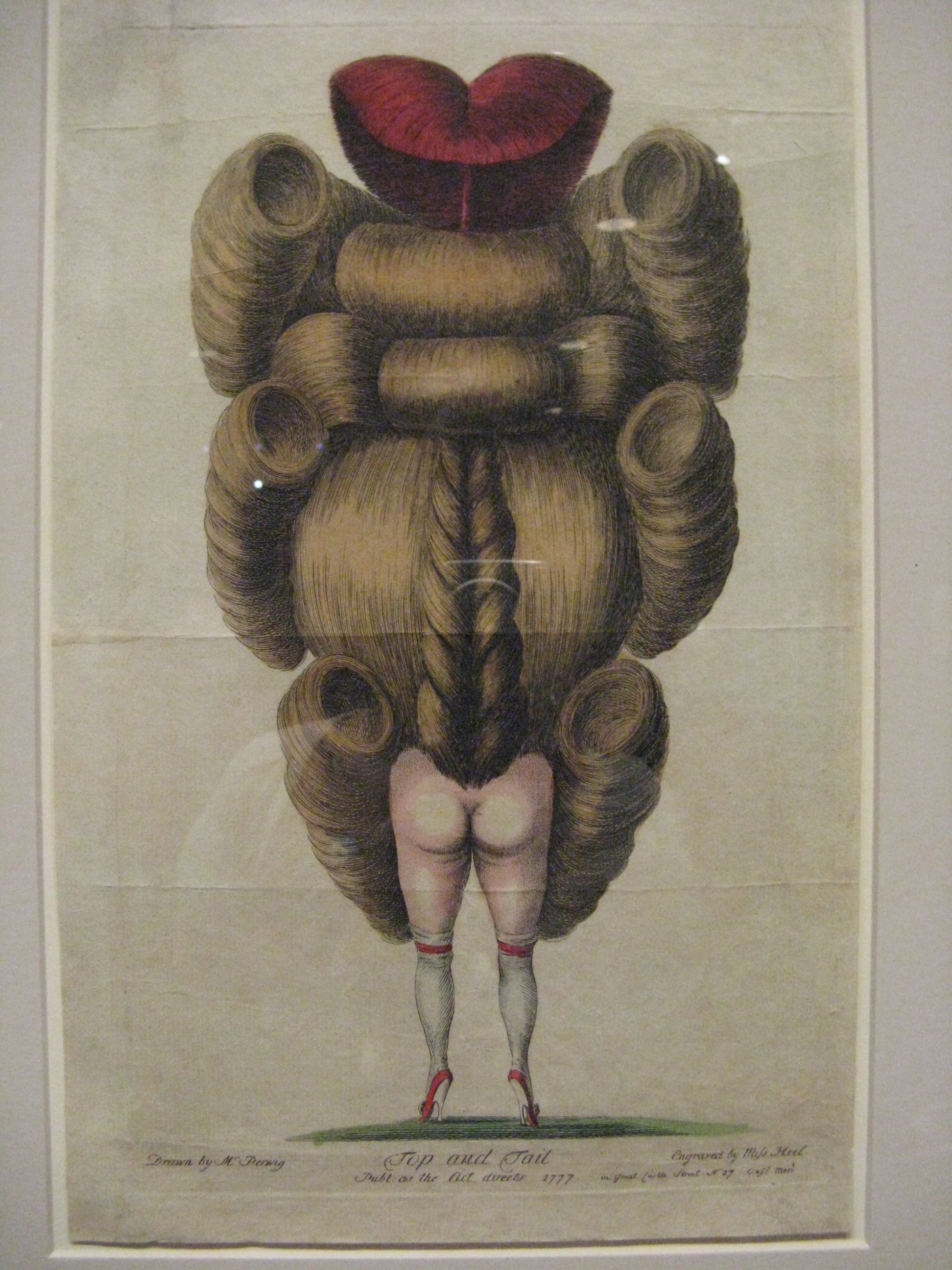
Top and Tail, British caricature 1777

Poufs were such extreme styles, and their contemporaries appear to have loved to criticize and satirize them.  They certainly were not easy to wear given, not only their enormity, but also all of the accoutrements that went into making one, as shown by the earlier quote from Madame de la Tour du Pin’s memoirs.  It is written in the secondary literature that women’s head-dresses and hair were so high at a point that they could not properly fit into their carriages. In his letters Horace Walpole, British art historian and politician of the eighteenth century, has a very stiff opinion about fashion of the 1770s and 1780s.  On September 8, 1782 he writes:

Fashion is always silly, for, before it can spread far, it must be calculated for silly people; as examples of sense, wit, or ingenuity could be imitated only by a few


The print above was shown at The Metropolitan Museum of Art’s exhibition of caricatures. It shows only the back view of an elaborately done pouf and the derriere and legs of a woman with stockings, garters, and high heels.  This print is a satirical image reminiscent of actual fashion plates such as these seen above from the Galerie des Modes.  The caption written by the museum says that this print suggests that the followers of this fashion were brainless.

The French print Le Triomphe de la Coquetterie (below0), also from the same exhibition, shows two women with incredibly elaborate poufs piled enormously high with larger than life feathers, many flowers and pearls.  These women are standing on two platforms in the middle of a pool jousting to win an impossibly large and elaborate head-dress in the middle of them.  Two other women have already been defeated with one in a rowboat, looking like she has just been pulled from the water with her pouf ruined; and another being pulled from the water bald-headed with her head-dress floating in pieces in the water.  The women spectators have unrealistically high and elaborate poufs themselves of all shapes and sizes larger than their person.  The inscription, written in French, on the bottom chides the women (the coquettes) for their frivolity in fighting over an item of fashion, and asks them if they would do the same for wisdom and virtue.
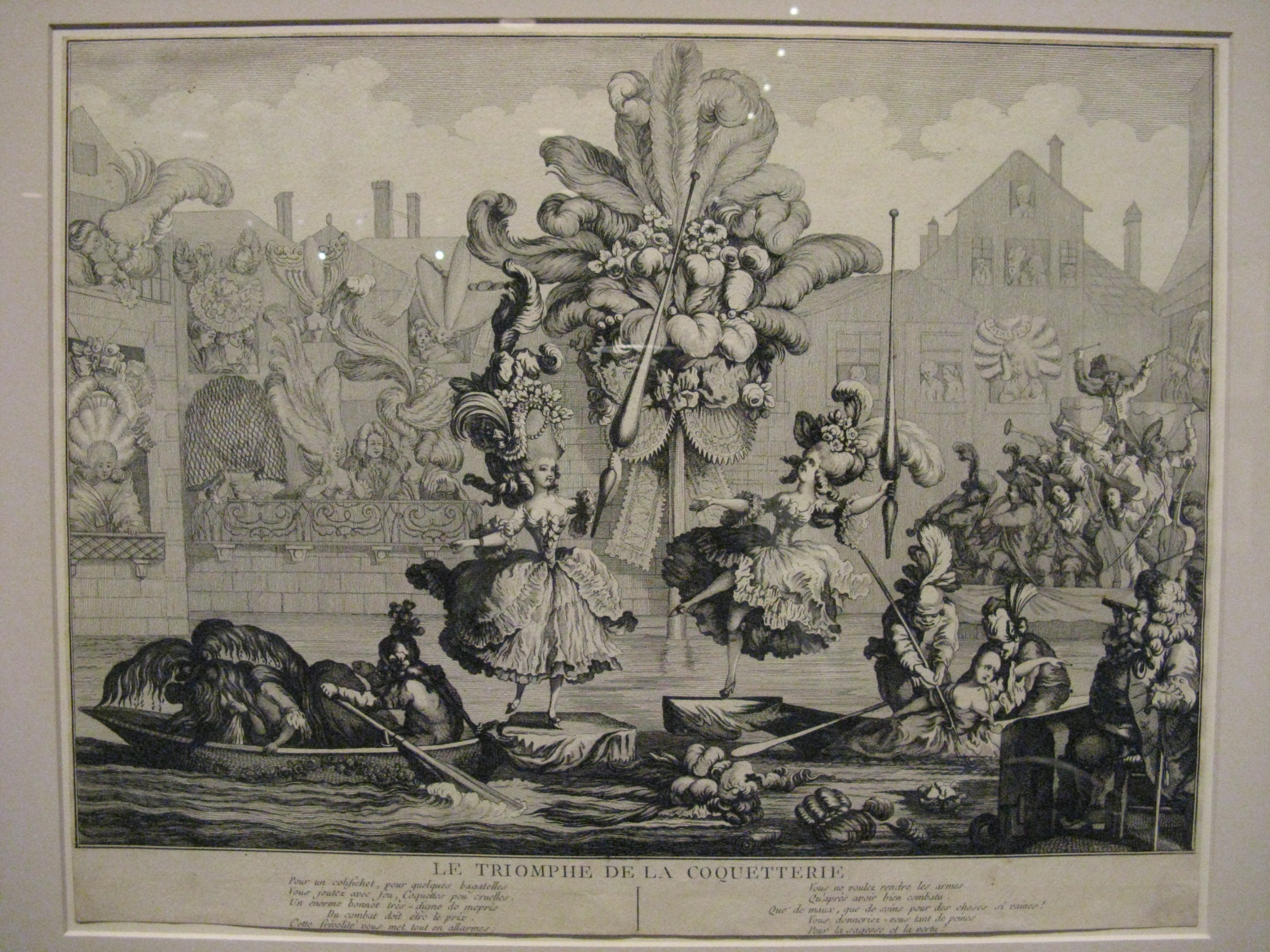
Le Triomphe de la Coquetterie, French, ca. 1780

Caricatures offer a great source of society’s view of the elaborate pouf outside of the fashionable world.  Whether one liked the pouf or not, they were fantastic hair styles with respect to the extravagancies and elaborateness they achieved; the like of which, I suggest, has not been seen in fashion since.  The pouf was possibly the most extravagant hair style in fashion, of all time, and I would suggest, continues to fascinate us today.


Selected Bibliography

Cornu, Paul.  Galerie des Modes et Costumes Francais: dessinesd’apres nature 1778-1787.  Paris: E. Levy,1912.

Corson, Richard.  Fashions in Hair: The First Five Thousand Years.  London: Peter Owen Ltd., 1965.

Gouvernet, Henriette Lucie Dillon (Madame de la Tour du Pin).  Memoirs of Madame de la Tour du Pin. Translated and edited by Felice Harcourt.  New York: McCall Publishing Co., 1971).

Langlade, Emile.  Rose Bertin: The Creator of Fashion at the Court of Marie Antoinette.  Translated by Dr. Angelo S. Rappoport.  New York: Charles Scribner’s Sons, 1913.

Ribiero, Aileen.  The Art of Dress: Fashion in England and France 1750 to 1820.  New Haven: Yale University Press, 1995.
Posted in Research | Tagged , , , , , , , , , , | 2 Comments

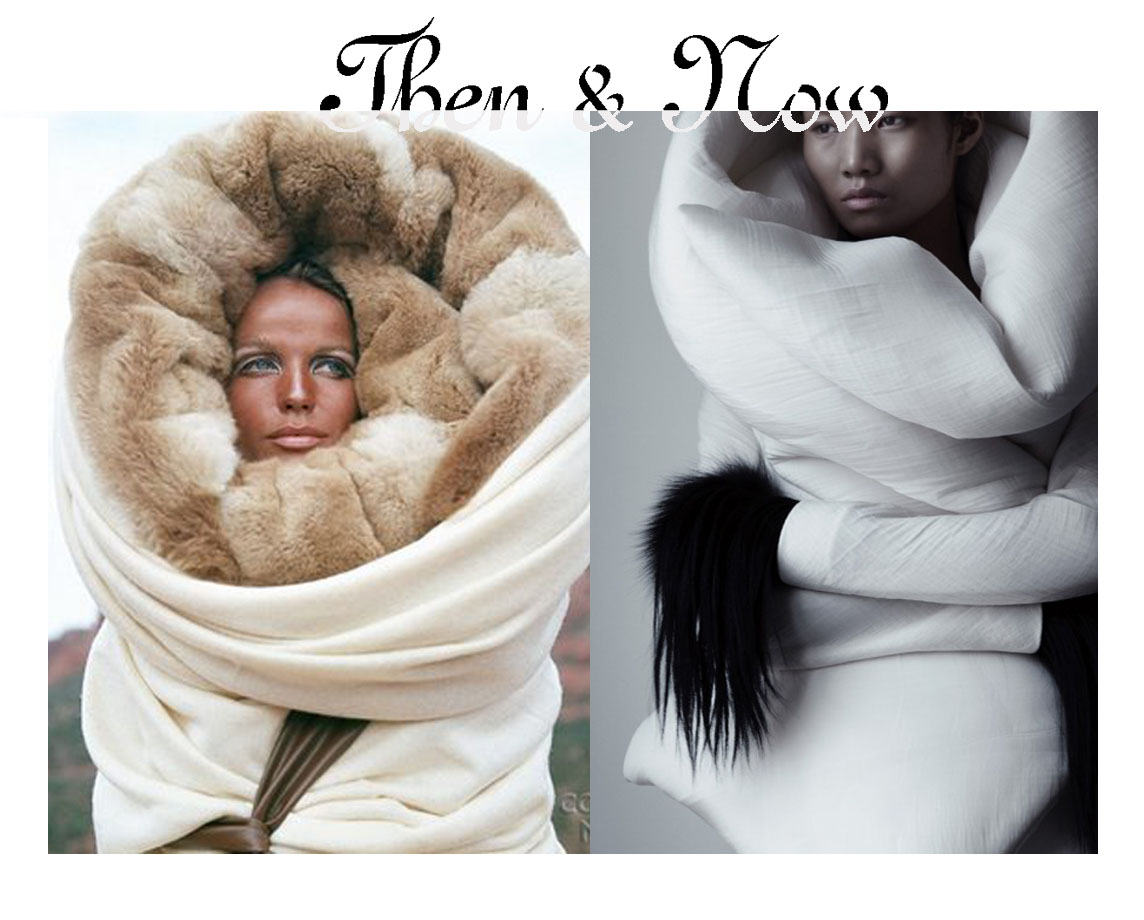
Then & Now

(left) Veruschka photographed by Franco Rubartelli, styling by Giorgio di Sant’Angelo. Vogue,1968. (right) design by Qui Hao, photographed by Matthieu Belin, 2011. from the blog Fiercer Than You.

Posted in Then&Now | Tagged , , , , , | 1 Comment

Interview with Allegra Ceci, Archive Materials Coordinator at Coach Leatherware

Today we bring you an interview with Allegra Ceci, Archive Materials Coordinator at Coach Leatherware Company, and graduate of our program.

Keren Ben-Horin: Please tell us a little bit about your work at Coach Leatherware Archives

Allegra Ceci: As archive materials coordinator, I manage the archive of  fabric and hardware. At Coach we also have a product archive of samples of bags and smaller leather goods, going back to the early 1940s when the company started. The archive was built out to include hardware and fabric swatches, blankets, and yardage.

KBH: What are your responsibilities?

AC: I work with designers on inspiration, if there is something they want to put on boards for creative presentation, if they want to look on a sample of color.  I also work with the fabric engineers who want to revisit something they once made, or run again, or do in a different color or in a cheaper fabric content.

KBH: After graduation, what was the path that led you to the job you have today?

AC: When I started the program at FIT I wanted to do costume design, I did some freelancing in theater doing wardrobe, and I hated it. I thought I’d love it, but I didn’t like it at all. Then I got an internship working at Calvin Klein, helping them organize their archive. It turned into a full time job and then downsized to a part time job. I did that for almost five years.  From there I moved to Coach about a year and a half ago.

KBH: While you were in school, did you imagine yourself working in a corporate archive?

AC: No. I knew the program has a focus on museum background, which I liked, because I love historic costume and textiles, but I never thought I will be doing an archive job, especially in a corporate environment. It is interesting that a corporate archive is very product driven, so the archive exists for the sake of history only in part, the other part is to generate revenue for the company, indirectly. One of the problems is that archives take money from the company, they do not make money. They don’t generate money like retail does, so a corporate archivist must find ways to support the company and the development of products, at the end of the day it is always profit driven.

KBH: What does your day- to -day work entails?

AC: Our archive is totally internal, so mostly I do cataloguing and manage loans for Coach employees.  Someone might come down and they want to see everything we have done in nylon in the past two years. So we pull out everything in nylon and they take what they want, and I check it out.

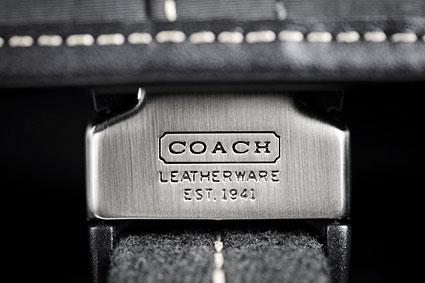
Coach Leatherware Archives

KBH: How do you think the program prepared you for the job you do now?

AC: It made me appreciate order and being very organized. Being super- super detail oriented, almost obsessively detail oriented, is very helpful when you have huge collections.  It also helped me to notice the details of the collections, how it can change and to know how to keep things organized.  It is very important when you have large collection like the Calvin Klein Archives of about 50,000 objects and Coach Archives which in the fabric archives alone include about 20,000 swatches and 1,000 pieces of hardware.

KBH: Is there a specific object from the Coach Archive you particularly remember or like?

AC: At coach they appreciate and love the history of the company, I think it is because coach is an old company, and its past is so much part of its identity that people who work  here are appreciative of it, I find not all companies are like that. I like that they update their regular logo jacquard and add metallic hearts or other fun patterns for younger markets.

KBH: What was your background before you started the program at FIT?

AC: I went to Bard college and did a program called integrated arts where you combined one of the art departments, either film or visual art, with one of the traditional disciplines. I did studio art and history.

KBH: Did you have any special fields of interest while in the program?

AC: I did the curatorial track and I liked looking at social roles and identities, and how people showed that through costume and fashion. I did my thesis on Inuit fashion and the way it is related to western culture. When I took the Dress in World Textiles class I found it was one of the only groups we studied that didn’t have any knit or woven textiles. It was all animal skins, and I thought that was so interesting. I got a book out of the library, called “Our Boots,” it was a big catalogue of Eskimo and Inuit footwear. After that I saw an old silent film from the 1920s called Nanook of the North, which I loved- and I knew this would be my thesis, I wanted to know all about how they make their clothing, how it related to the environment, how in crazy, extreme condition and so little resources they made such beautiful expressive clothing. One of things I found was that in so many indigenous cultures,  once they become westernized and once they start to incorporate aspects of global economy, a lot of their traditional crafts diminished, changed, or evolved so you don’t see the heritage anymore. But I found that in the case of Inuit culture that wasn’t the case, they retained a lot of culture and heritage.

KBH: Why do you think?

AC: I think because the environment is so extreme that when Europeans were going and trading and forming relationships with the Eskimos they would have to dress like them, or they would die. To survive they had to adopt the local dress. It is a great way to see the cultural exchange and how it evolved over time, you can even see how the culture would take western ideas but keep it very of their own mind set.

Our Boots: an Inuit Women's Art by Jill Elizabeth Oakes

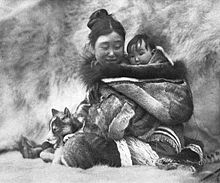
image from the silent film Naoonk of the North, 1922

KBH: Tell us about the research, where and how did you find materials?

AC: It was hard to find objects and materials. Some history books include it, but there is not a lot of information about current dress. I did a lot of web research, and I actually contacted designers and companies in Canada that make traditional clothing. I also took a trip to Alaska for two weeks to visit different museums, galleries, and boutiques, and to meet designers and talk to them. In the Museum of the North, at Fairbanks, for example, I found a beautiful pair of boots a student has made. The boots looked like Converse high-tops, but they were made of local skins, and ornamented with dyed porcupine quills and beads in a pattern of a local flower. The student used a traditional appliqué technique dating back to the 1800s, it was so beautiful. I found a lot of objects where the tradition of arts and crafts technique was combined with western ideas and influences.

KBH: What advice would you give to someone who just graduated from the program?

AC: Not to be discouraged, even though the job market looks so challenging, stick with it, there are enough things for everyone to do. Everyone can bring something unique.

KBH: Thank you Allegra!

AC: My pleasure!

Posted in interviews | Tagged , , , , | 5 Comments

The Study of Dress in European Paintings- Lucas Cranach the Elder

For our class of History Through the Nineteenth Century we were asked to analyze dress in a chosen painting from the 1400s to the 1800s with the aim to determine if the painter could be considered a valuable source for the study of fashion. You might remember my own research of the work of Rembrandt. Today we bring you the research of Landis Lee, on the work of German painter Lucas Cranach the Elder.

Judith with the Head of Holofernes by Lucas Cranach the Elder

By Landis Lee

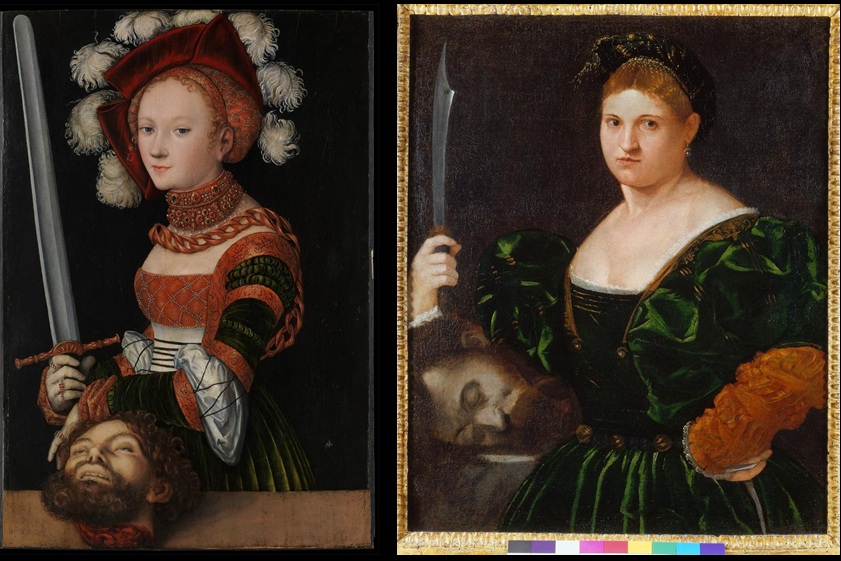
Lucas Cranach the Elder, Judith with the Head of Holofernes ca. 1530 The Metropolitan Museum of Art

The artists  real name was Lucas Sunder or Lucas Maler and he attained the name of Cranach after his native town, Kronach.  Not much is known of the first 30 years of his life before the earliest pictures attributed to him show up. His early style was in the Gothic tradition and became softer with rounder lines.He painted religious images but he also completely stepped out of the religious sphere by painting more classical themes. In addition, he also made engravings, illustrations to Protestant teachings, and he became the picture-maker of the Reformation.

The painting Judith with the Head of Holofernes depicts the Old Testament story of Judith who lived in a town that Holofernes and his army besieged.  Holofernes had too much wine at a banquet and passed out and Judith beheaded him to save her city.

Judith is shown here with the severed head of Holofernes as an early 16th century fashionable German woman. Underneath her dress she is likely wearing a long linen chemise.  The chemise is showing through other parts of the dress; because it is visible through the laces on the stomach area, it is likely that no corset is being worn.  Judith is also likely wearing several layers of petticoats underneath her dress.

The dress is an example for the typical segmentation of the body of this period, achieved by segmented clothing.  The bodice has a panel, possibly made of velvet or silk, with a diamond design on it.  Other than the panel, the bodice is open except for laces showing the chemise underneath.  The sleeves are made of green velvet with piccadilles (slashed ends at the edge of a garment) around the shoulder, arm and wrist, as well as a gold and bronze silk with black embroidery or brocaded velvet.  The sleeves are made of two parts attached with laces and showing the sleeves of the chemise.  The skirt is made of the same green velvet as the sleeves.

Judith’s hat  is made of red velvet with big slashes and feathers tilted on the head.  One, or possiblly two necklaces made of metal, jewels and pearls are hanging from the bottom.  She also has the German- style metal chain around her shoulders.

Lucas Cranach the Elder, Venus Standing in a Landscape, 1529 Musee du Louvre

Cranach’s nude entitled Venus Standing in a Landscape, is an example for the fashionable body of the period. The body is elongated with sloping shoulders, small breasts that are fairly far apart.  Cranach  emphasized  the rounded abdomen, giving the appearance of pregnancy- a desirable body image of that time. In relation to the torso, the legs and arms are long, and the color of the skin is very pale and marble-like. All of these features indicate that Cranach depicted fashionable body rather than a natural one.

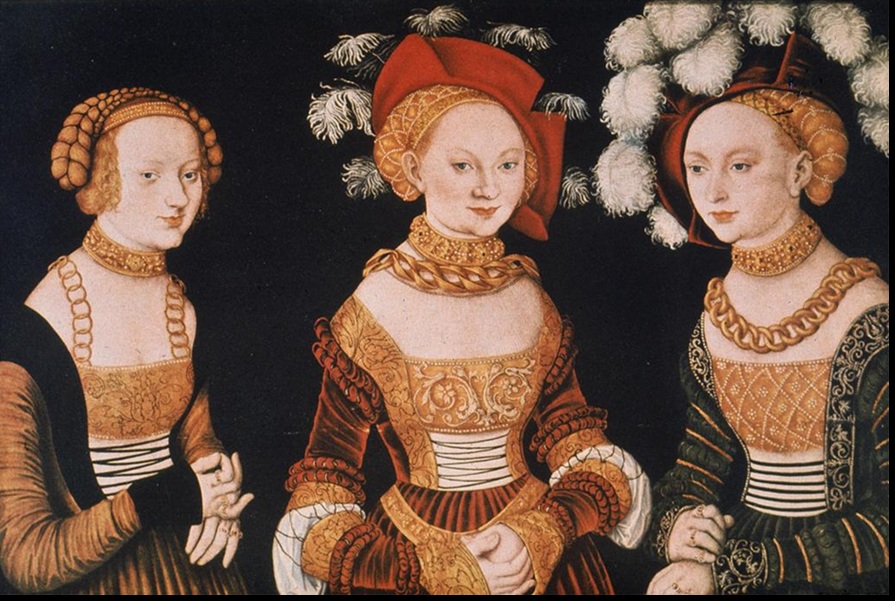
Below is a painting done by Cranach from the 16th century showing three fashionably dressed German women.   They are each wearing style of dress similar to that worn by Judith, with small variations. Like Judith, they too have paneled bodice with laces, showing the chemise.  The dresses are made of velvet and possibly some embroidered silk. While the lady in the middle is wearing segmented sleeves (the chemise showing through at the elbow), the two other ladies are wearing one piece sleeves. In addition, the two women on the right also wear metal chains in German style.

Lucas Cranach the Elder, Three Young Ladies, 16th C. Kunsthistorisches Museum Wien

When comparing the two paintings, it is clear that Judith resembles the woman in the middle. Since it was common for artists to use the same model for different paintings,  it could very well be the same woman sitting for both paintings.

On the left: Judith with the Head of Holofernes Ca. 1530 Cranach the Elder; on the right: Pordenone, Judith with the Head of Holofernes, Ca. early 16th C, Private collection, Milan

The  painting of Judith with the head of Holofernes that was done by Giovanni Antonio Pordenone (Italian 1484-1539) is an example for the contrast between the German and Italian fashion of the same period.  The Italian Judith is wearing a dress of green velvet with large sleeves at the shoulder continuing down to the elbow where the sleeves are made of gold velvet with piccadilles.  The bodice of the Italian Judith goes down to the waist, ruffles around the wrists and the neckline.  Some similarities exist, like the soft pale skin and red hair, the square neckline, and of course the richness of the textiles. However, the body itself, and the way the clothes segment it, clearly illustrate that each artist depicted the fashionable dress and body of his native country.


Posted in Research | Tagged , , , | 1 Comment

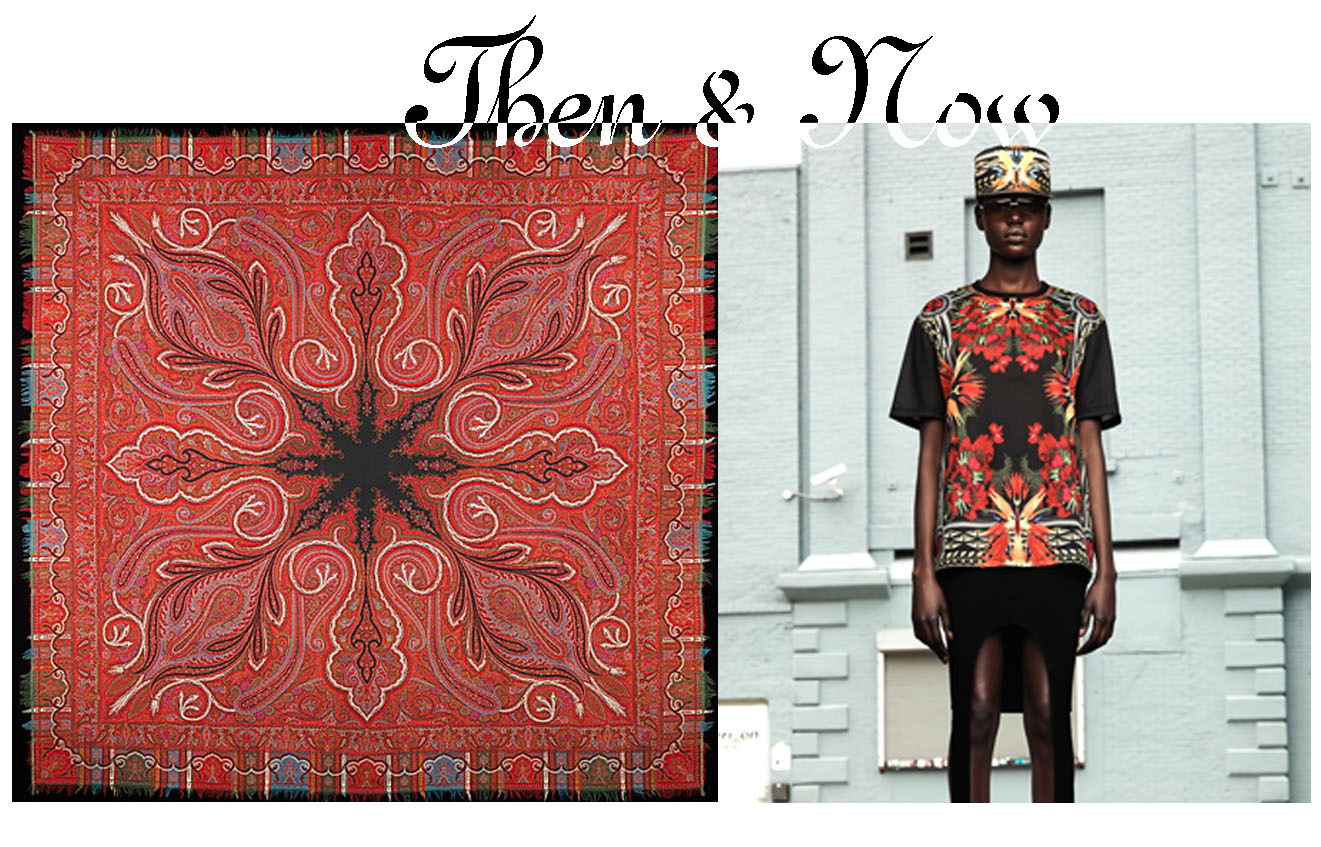
Then & Now

(left)Paisley Shawl,  Scottish, ca.1870. The Metropolitan Museum of Art. 2009.300.2326 (right) Givenchy Resort 2012, model Ajak Deng, image from style.com

Posted in Then&Now | Tagged , | Leave a comment

Upcoming exhibitions at MFIT

It’s almost time for the annual exhibition curated by the graduates of our programs in conjunction with MFIT. The exhibition, titled, Youthquake! The 1960s Fashion Revolution, will open March 6. It will include more than thirty garments, accessories, and videos, and will feature works of fashion designers such as  Yves Saint Laurent, André Courrèges, and Giorgio di Sant’Angelo.

Bob Dylan by Harry Gordon, paper, 1968, England, gift of Estelle Ellis. Museum at FIT

All the details here

Another exciting exhibition will open in the large gallery downstairs, February 10th. Impact: 50 years of the CFDA was conceived by CFDA president Diane von Furstenberg, and curated by Patricia Mears and Fred Dennis.  The exhibition will include approximately 100 garments and accessories designed by CFDA members, winners, and nominees in the past fifty years, among them Halston, Norman Norell, Pauline Trigère, Geoffrey Beene, Bill Blass, Rudi Gernreich, Bob Mackie, James Galanos, Diane von Furstenberg, Oscar de la Renta, Marc Jacobs, Donna Karan, Ralph Lauren, Calvin Klein, Tom Ford, Michael Kors, Tommy Hilfiger, Isabel Toledo, Rodarte, and Proenza Schouler.

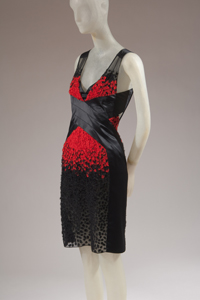
Narciso Rodriguez, embroidered silk dress worn by Michelle Obama on election night 2008, Spring 2009, USA, lent by Narciso Rodriguez.

All the details here

Posted in Exhibition | Tagged , , , , | Leave a comment

1900-1910: The Reign of The Lingerie Dress

In the book, The Perfect Lady, Willet C. Cunnington describes the period from 1900 to 1910 as the “reign of lingerie,” and indeed fashion magazines in these years, and especially in summer months, show many examples and variations of the so-called “lingerie dress”- a style of dress adorned with embroidery, lace, pin tucks, ruffles and ribbons which was inspired by the chemise gown, as part of an eighteenth- century revival.

However, the first decade of   the twentieth century is also marked by a gradual yet radical change in fashionable body and dress, helmed by French couturier Paul Poiret. So while the style of the lingerie dress remained fashionable throughout this period, the proportions, waistline, hemline and sleeves were gradually transformed to reflect the change in taste.

The lingerie dress was worn at summer garden parties, the races, or at other promenade activities, as beautifully illustrated in a photograph taken by the beach in New York,1905.

On the right a lingerie dress worn with shoes and belt in contrasting color; on the left, lingerie shirtwaist worn with bow tie in contrasting color. Women at the beach, 1905. Source: NYPL Digital Gallery, image ID 833235.

Fashion publications, like Harper’s Bazar, gave readers detailed instructions and guidelines for reproducing Paris models at home. Just how dominant was this style, in an array of fabrics, and as many colors, is evident from the following excerpt from an article in Harper’s Bazar, April 1909:

The lingerie dress is one of the most vitally important item of the summer outfit, and if it is to be embroidered by hand it must be begun early. The model shown here is suitable for handkerchief linens, muslins, and for thin silks, and will make a charming liberty silk gown for a youthful bride.
 

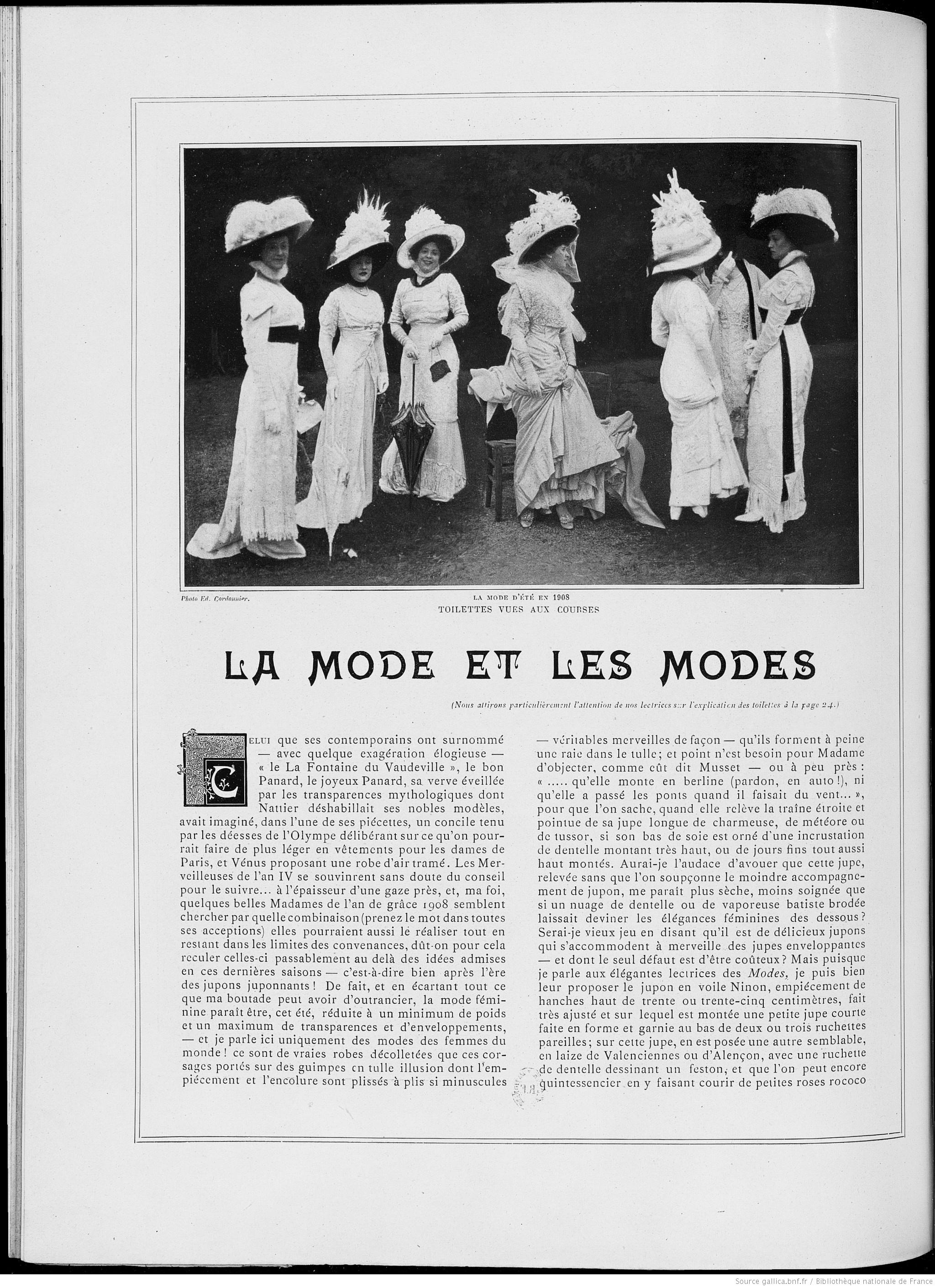
Another example for the supremacy of the lingerie dress as the correct attire for socializing in summer afternoons appeared in the French publication Les Modes in April 1904 (below). The three ladies in the photograph, taken at the races, are all wearing lingerie dresses lavishly adorned with ruffles, embroidery and lace. Yet, they are more formally dressed than the ladies on the beach, with matching long gloves, lingerie parasols and elaborate summer hats.

Correct attire for socializing at the races; lingerie dresses with matching long gloves, lingerie parasols and hats decorated with flowers, feathers and ribbons. Source: Les Modes, A4, N40. April 1904, page 15.

A wonderful example that might have been worn on such occasion is in The Metropolitan Museum of Art’s Costume Institute (below). This afternoon dress, from the House of Doucet, dated by the museum 1900-1903, is a fine example of Doucet’s liking for pastel colors, delicate laces, ruffles and over-all lingerie-like style of dress. Jacques Doucet was one of the leading couturiers to emerge at the last quarter of the nineteenth century, along side Jeanne Paquin and the already established Charles Fredrick Worth. Doucet was an avid collector of eighteenth century art so it is only fitting that he would also take part in the revival of the chemise gown which was favored from the end of the seventeenth century and through the better part of the eighteenth century.

House of Doucet Afternoon Dress, 1900-1903. Designer: Jacques Doucet (French, Paris 1853–1929 Paris). Brooklyn Museum Costume Collection at The Metropolitan Museum of Art, Gift of the Brooklyn Museum, 2009. 2009.300.579a, b.

The Doucet dress is made of rose printed chiffon decorated with fine off-white lace and ruffles, and a velvet sash in vivid turquoise color. It seems that many lingerie dresses (usually in white, off- white or pastel color) were accessorized with lively colors. A fashion report in Harper’s Bazar, September 1908 supports this:

Such color combinations as Napoleon blue tights and slippers with buff cloth dress, or green under champagne color, or again, cherry color under mole shades, are among the combinations shown in advance importations.
 

A fashion plate from the publication L’Art et la Mode, March 1906 (below), illustrates another interesting variation. The drawn figure is shown on a background of light blue and ocher watercolor; a trace of the same light blue is shown on the dress itself. This effect might just be the work of the illustrator, however the caption below reads: “UNLINED VALENCIENNES GOWN WITH SEPARATE SILK SLIP”, and the light blue strokes seem to emerge from under the skirt and along the torso and the upper part of the sleeve. This pale shade of blue is similar to the coloring of the rose print of the Doucet dress, and is in accordance with the fashionable pastel palate favored by designers of the late nineteenth and early twentieth century, like Doucet himself.

Unlined Valenciennes Gown with Separate Silk Slip. Source: L’Art et la Mode, March 1906, plate 1696. Special Collections and FIT Archives.

Additionally, Harper’s Bazar article titled “Embroidered Parasols,” June 1909, shows that a touch of color to an all -white outfit was quite fashionable:

In these days of dainty lingerie, the lingerie parasol holds its own, and a few designs are shown that may easily be reproduced at home… Fig. 4 is attractive in either a heavy linen with no lining, or again the sheer linen lawn, with colored silk lining giving a tinge of color to the outside. The design of flowers, leaves, and dots is the French embroidery, the edge being a heavy buttonholing. The centers of the flowers are eyelets, allowing the silk to show through.
 

During the long “reign of lingerie” styles were subtly adjusted, trimmings updated, and proportions shifted. The photograph below appeared in Le Figaro-Modes in June 1904; it is an example for the influence of Art Nouveau, not only in the floral motifs characteristic to the movement in France, but also in the curvaceous silhouette. In the late 1890s the fashionable body was shaped by the “monobosom” corset. The new corset forced the upper body forward and lower body backwards, creating a sort of s-shaped silhouette, in perfect harmony with the aesthetic of Art Nouveau.

Lingerie dress showing the influence of Art Nouveau. Source: Le Figaro- Modes, 15 June, 1904, page11. Special Collections and FIT Archive.

Between the turn of the century and the end of the first decade the fashionable body gradually changed – from a rounded, curvaceous figure enforced by stiff corsets and heavy petticoats to a slimmer, elongated shape attained by softer, smoother undergarments.

In lingerie dresses the design details, such as ribbons and lace insertions, segmented the body in a way that emphasized the desirable fashionable silhouette. Whereas earlier in the decade the body was divided into several horizontal planes- emphasizing the shoulder, hip, cinched waistline and swirling skirt, in the later years of the decade the placement of trimmings is used to elongate and slim the shape. In the second half of the decade the style of trimmings also changed. If at the begging of the twentieth century fluffy ethereal ruffles, gathering, ruching and other dimensional decorations were used, from about 1907 fashion magazines show more and more afternoon dresses with flat trimmings such as embroidered ribbons, pin-tucking and lace.

Since a shift in silhouette naturally demands a change in accessories, the new slim figure was balanced out with wide brim hats, usually heavily decorated. Although these enormous hats were often ridiculed, the labor and attention invested in them mark the beginning of what many consider the “golden age” of millinery, which stretched through the first half of the twentieth century. It is important to note that hats were essential feature of respectable dress through the centuries, and were mandatory for socializing outdoor at this period.

Big hats were worn over equally big hairdos. The hair, properly pulled back and upward, was sometimes reinforced by false hair pads (“transformations”), which also helped to stabilize the long pins that were necessary to anchor the massive, excessive hats. The result was a voluminous head that appeared so large it made the neck seem longer, the shoulders smaller and the body slimmer and more elongated.

Dress for the races. This is a wonderful example of how lingerie dresses were accessorized- with matching lingerie parasol, large hair style and even larger straw hat decorated with matching trimmings. It is also interesting to note that to emphasize the model’s columnar figure, she is photographed standing next to a Roman type column. Source: Les Modes, A8, N92, August 1908.

Lingerie dresses worn at the races on one afternoon in the summer of 1908. Source: Les Modes, A8, N92, August 1908.

It is evident that although the lingerie dress and the setting in which it was worn remained virtually unchanged throughout the first decade of the twentieth century, the style and desirable figure certainly transformed. There is a sharp contrast between the exaggerated, excessive style of the earlier examples to the sleek, modernized style of the later ones- the earlier examples stylistically belong in the nineteenth century, while later examples face the new century. With the appearance of modern designers, like Coco Chanel, this dainty, ultra-decorated style seemed old-fashioned in comparison to the new, clean and streamlined style of dress.


Selected Bibliography
Font, Lourdes. Deihl, Nancy. Poulson, Ann. Gero, Cassandra. McMahon, Beth, and Sauro, Clare.  “Fashion: Categories of design” In Grove Art OnlineOxford Art Online
Font, Lourdes, and Grace, A. Trudie. The gilded Age: High Fashion and Society in the Hudson Highlands 1865-1914. Cold Spring, NY: Putnam County Historical Society & Foundry School Museum, 2006.
de Marly, Diana. Dress in North America. New York: Holmes & Meier,1990.
Byrde, Penelope. A Visual History of Costume: The Twentieth Century. London: Batsford, 1986.
Gee , Malcolm and Grimaud ,Pamela Elizabeth, “Doucet, Jacques.” In Grove Art OnlineOxford Art Online
Poulson, Ann, “Classicism in fashion.” In Grove Art OnlineOxford Art Online
 
 
Posted in Research | Tagged , , , , , , , , , , , | 9 Comments

January Treasure of the Month:The Golden Age of Pochoir

By Cassidy Zachary 

In the 1910s and 20s, there was an outpouring of luxury, limited-edition publications which utilized a hand-stenciling technique known as pochoir (French for “stencil”). The technique, which consisted of built-up layers of gouache paint or watercolor, produced some of the most stunning images of art and fashion history. Marketed to the wealthy elite, the labor-intensive pochoir process was used in publications that were prohibitively expensive to the average consumer. The exclusivity of these publications served only to heighten their appeal.

Fashion illustration by George Barbier, from Modes et manieres d' aujourd'hui, 1914.

Fashions by Paul Poiret as illustrated by A.E. Marty for the Gazette du bon ton, 1922.

The works featured here represent a small sampling of the pochoir technique as represented in the Department of Special Collections and FIT Archives at the Fashion Institute of Technology. The collection contains over sixty publications that feature the pochoir method, many among the most rare and valued in the world. Pochoir was employed in fashion magazines, but also in artist and designer portfolios, as well as in numerous books on poetry and other literature.

Illustration by Paul Iribe for Les Robes de Paul Poiret, 1908.

Illustration by Paul Iribe for Les Robes de Paul Poiret, 1908.

The self-proclaimed “King of Fashion,” leading Parisian haute couturier Paul Poiret commissioned artist Paul Iribe to illustrate this limited-edition luxury portfolio of his work entitles Les Robes de Paul Poiret in 1908.  Speaking to its exclusivity, only 250 copies of this album were produced. Avant-garde designer and fashion revolutionary, Poiret was one of a handful of haute couturiers who changed the face of fashion at the beginning of the twentieth century by introducing un-corsetted, high-waisted silhouettes into their designs. The revolution extended to fashion illustration, largely pioneered by Poiret’s Les Robes de Paul Poiret, who sought a new way of presenting fashion fitting for the artist that he considered himself to be. The publication itself, as presented by a distinguished designer and in the pochoir technique, was instrumental in elevating fashion illustration to an art form. This alliance was confirmed when the album was exhibited in the art gallery Le Salon d’Automne in 1909. Les Robes de Paul Poiret set a new standard for fashion illustration that inspired artists, couturiers, and publishers alike. It ushered in a new era of luxury fashion publication that lasted until the early 1930s.

Illustration by Enrico Sacchetti for Robes et femmes, 1913

Illustration by Enrico Sacchetti for Robes et femmes, 1913

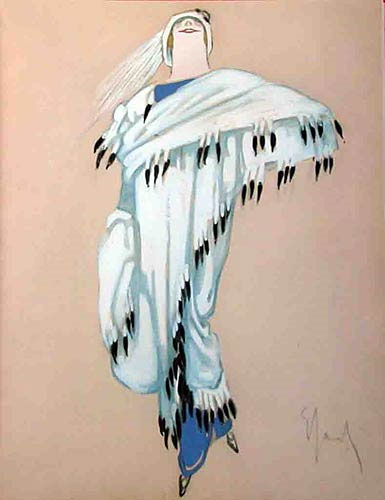
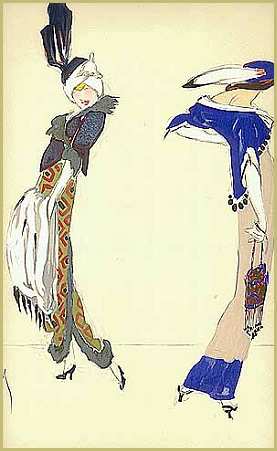
Robes et femmes, illustrated by Enrico Sacchetti, was a satirical intepretation of the contemporary trends in fashion, which many deemed to be ridiculous and offensive to good taste. The avant-garde designs of couturier Paul Poiret appear to have been the main source of parody in Sacchetti’s illustrations which depict feathered turbans and wide, hooped tunic dresses–all of which resemble Poiret’s Eastern-inspired designs of the time. The album was printed in a limited edition of 300.

Dress by Paul Poiret as illustrated by George Lepape for Gazette du bon ton, 1920.

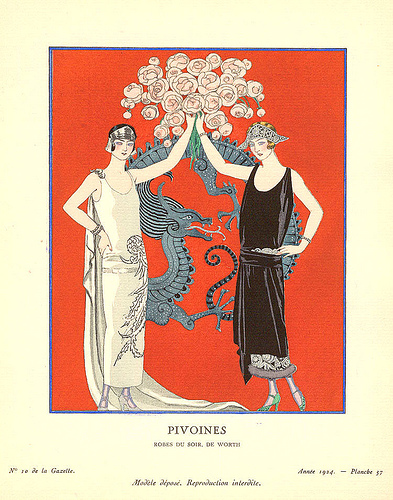
Dresses by the House of Worth as illustrated by George Barbier for Gazette du bon ton, 1920.

Gazette du bon ton: arts, modes & frivolités became the premiere fashion publication of its day, running from 1912 until 1925 (with a six year break for WWI). The monthly journal was sponsored by seven of the most important Parisian designers: Poiret, Redfern, Paquin, Doucet, Doeuillet, Cheruit and Worth. Inspired by Poiret’s two deluxe pochoir albums, Vogel sought to create a fashion magazine that would similarily merge art and fashion. The first issue announced the intention of the magazine:

“When fashion becomes an art, a fashion magazine must itself become an arts magazine…. It will offer, on the one hand, the most recent models to emerge from the ateliers of the rue de la Paix and, on the other hand, in the painters’ watercolours, that fashion sense, that charming and bold interpretation that is their hallmark. Artists of today are in part creators of fashion: what does fashion not owe to Iribe, who introduced simplicity of line and the oriental style, or to Drian, or Bakst.”
 

The magazine featured designs by both couturiers and the artists themselves. Every issue included seven fashion plates rendered in pochoir by the leading artists of the day including Siméon, Charles Martin, Drian,  G. Lepape, Bonfils, Boutet de Monvel, G. Barbier, Umberto Brunelleschi and Leon Bakst.

Cover of Art. Gout. Beauté. August, 1922.

Dresses by Lucien Lelong in Art. Gout. Beauté. October, 1922.

Art, goüt, beauté. Feuillets de l’élégance féminine was a monthly French fashion magazine published by the Maison Albert Godde and Bedin (A.G.B.), a French silk manufacturer that catered to the couture industry. It was in the taste of other luxury fashion magazines of the time, such as Le Gazette du bon ton, in that it employed the pochoir method to present stylized illustrations of the latest fashions from the leading couturiers of the day. Art Gout Beauté–a clever use of the company’s initials–grew out of a free eight-page bulletin published by the company prior to the war that featured couture creations that utilized the company’s fabrics. As many pochoir publications of the time, the magazine was marketed towards a wealthy upper class, as suggested by the high price of subscription, as well as the couturiers and luxury businesses advertised in its pages. Published from 1921 until 1933, the magazine featured creations from the greatest couturiers of the day, including Paul Poiret, the House of Worth, Jenny, Jean Patou, Lucien Lelong and Jacques Doucet.

FIT’s Gladys Marcus Library Department of Special Collections and FIT Archives

Special Collections and FIT Archives acquires, preserves, and provides access to a wide range of primary research materials in their original formats across many languages and geographical spectra. Formats include and are not limited to: manuscript collections, scrapbooks, audio and video oral histories (some with transcriptions), sketches, illustrations, monographs, journals, digital files, and other media.

Subjects include primarily the apparel industry, fashion, regional costume, textile design, the textile industry, the FIT Archives, and, to a lesser extent, art, architecture, and interior design. All acquisitions support one or more curricula offered at FIT. Department personnel are committed to supporting original research of FIT students, faculty, and personnel, as well as designers and researchers from the apparel and textile fields and other industry professionals.

For more information, call 212 217.4360; email fitlibrary.sparc@gmail.com; or visit www.fitnyc.edu/library/sparc.

Posted in Treasure of the Month | Tagged , , , , , , , , , , , , , , | 2 Comments

Ha, the good old days

Read this fantastic article by Bob Colacello for Vanity Fair.

Posted in Uncategorized | Tagged | Leave a comment

Tomorrow at Brooklyn Museum

1920s Style with Lisa Padovani, Kyle Ericksen, and Jan Reeder
Thursday, Janaury 12, 7 p.m.

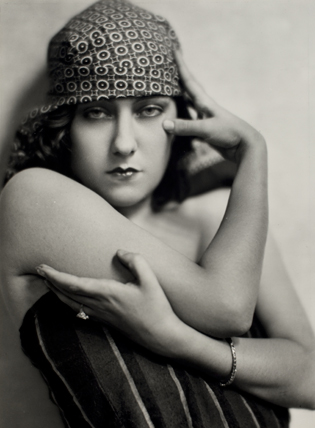
Nickolas Muray (American, 1892–1965). Gloria Swanson, circa 1925. Gelatin silver print, 12 3/4 x 9 3/8 in. (32.4 x 23.8 cm). George Eastman House, International Museum of Photography and Film, Rochester, New York, Gift of Mrs. Nickolas Muray. © Estate of Nickolas Muray

In this discussion, inspired by the styles featured in the exhibition Youth and Beauty: Art of the American Twenties, fashion photographer Kyle Ericksen,Boardwalk Empire (HBO) costume designer Lisa Padovani, and curator Jan Reeder of the Brooklyn Museum Costume Collection at the Metropolitan Museum of Art will explore changing styles and body ideals.

more details, here.

Posted in Exhibition | Tagged , , | Leave a comment