What They Wore- The Study of Dress in European Paintings

For our class of History Through the Nineteenth Century we were asked to analyze dress in a chosen painting from the 1400s to the 1800s with the aim to determine if the painter could be considered a valuable source for the study of fashion. I chose the painting Portrait of a Woman by Rembrandt from 1632, currently on view at the European Paintings gallery in The Metropolitan Museum of Art.

Rembrandt Van Rijn (1606-1669) Portrait of a Woman, probably a Member of the Van Beresteyn Family, 1632 Oil on canvas 44 x 35 in. (111.8 x 88.9 cm) The Metropolitan Museum of Art. Credit Line:H. O. Havemeyer Collection, Bequest of Mrs. H. O. Havemeyer, 1929 29.100.4

Some fashion historians argue that Rembrandt cannot be considered a reliable source for the study of dress, because he so often used costume rather than fashion to dress the subjects of his paintings. After Amsterdam was striked by a massive economic depression in the 1650s Rembrandt had to sell most of his possessions, an inventory of his includes not only the many paintings and prints he so avidly collected, but also the Near-Eastern and historical dress, which we know he used in his paintings. However the scholar Marieke De Winkel, who dedicated an entire book to the study of dress in Rembrandt’s work, believes that dress in his work is a topic greatly neglected within the massive research done on Rembrandt over the years.

Before I go into the details of the portrait I chose, it is important to consider Rembrandt’s own portraits. During his long career he created many self-portraits that can suggest some clues to his relationship with fashion. De Winkel concludes that through costume differences in function between self-portraits can be determined. Many self-portraits of Rembrandt’s are actually tronies, paintings in which the identity of the model is not of primary importance. In the portrait below from c. 1629 for example, De Winkel points to the fact that he has lovelocks, a hairstyle that was fashionable in France, England and Germany in the beginning of the 17th century, but was very rare for Dutchmen. In addition, within a short period of time in the late 1620s he depicts himself with different hairstyles in various lengths.  It is unlikely that his hair and appearance could have changed so much in such a short period of time.

Rembrandt Van Rijn, Self-portrait with Gorget, C. 1629, Germanisches Nationalmuseum, Nuremberg

Shortly after his move to Amsterdam, Rembrandt created two portraits of himself in fashionable dress. In the seventeenth century, successful painters could break through social conventions and dress above their station. In other examples from contemporary painters it is only the attributions of their profession that distinguishes them from their clients.  Rubens, for example, often show himself in the most fashionable dress. For Rembrandt this is the exception, he often chooses to appear in casual everyday working clothes rather than formal dress like his contemporaries.  It is possible that he made this exception with an aim to establish himself as portrait-painter once he moved to Amsterdam.

In this painting from 1632 Rembrandt wears a fashionable broad brim hat, black velvet cloak, black doublet and white falling ruff with red cord tying at the neck. Rembrandt Van Rijn, Self-portrait, 1632, The Burrell Collection, Glasgow

Rubens, Peter Paul (1577-1640) Rubens with His Wife Helena Fourment and Their Son Peter Paul, c. 1639 Oil on wood, Metropolitan Museum of Art

An example of self-portrait in work clothes. Rembrandt Van Rijn, Self-portrait, c.1655, Kunsthistorisches Museum, Vienna

Rembrandt was an avid collector of art and it seems that many of his self-portraits were based off of engraved portraits of sixteenth century artists. In the example shown here Rembrandt depicted himself wearing an historical sixteenth century bonnet.  It had huge immediate impact and his followers depicted themselves wearing the same type of hat. Within time, and through today, the beret became the attribute of the painter in general.  The historical dress for Rembrandt, it seems, was a way to present himself as part of the tradition of Dutch and German masters of the past.
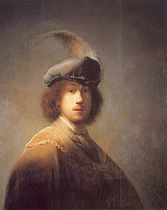
. In historical, sixteenth century dress. Rembrandt Van Rijn, Self-portrait, 1629, Isabella Stewart Gardner Museum, Boston

So, it might seem fair to say that Rembrandt was not un-aware of the impact of dress, and that he made conscious decisions of dress when he depicted himself. With this in mind I examined his nude sketches.

Rembrandt Van Rijn (1606-1669) Diana Bathing, 1630

Rembrandt Van Rijn (1606-1669) Naked Woman Seated on a Mound, 1631 178 x 162 mm, etching

To modern eyes these bodies, with their short stocky legs and huge bellies, might seem repulsive- especially when the face looks so young, but here is how in 1658 a desirable woman in a Van Dyck portrait was described: “ A goodly plump, fat, well favoured, well formed figure[…]full and fat fleshed shoulders, plump breasts, well coloured, and altogether able to endure a mans handling” (William Sanderson). So in fact the body Rembrandt is depicting is the most desirable, fashionable figure that echoes the most desirable, fashionable dress in the 1630s- one that has ripples of luxurious rich silk satin gathered around the belly.  When we examine another nude, created about twenty years later, we can see how Rembrandt captures the change in fashionable dress.
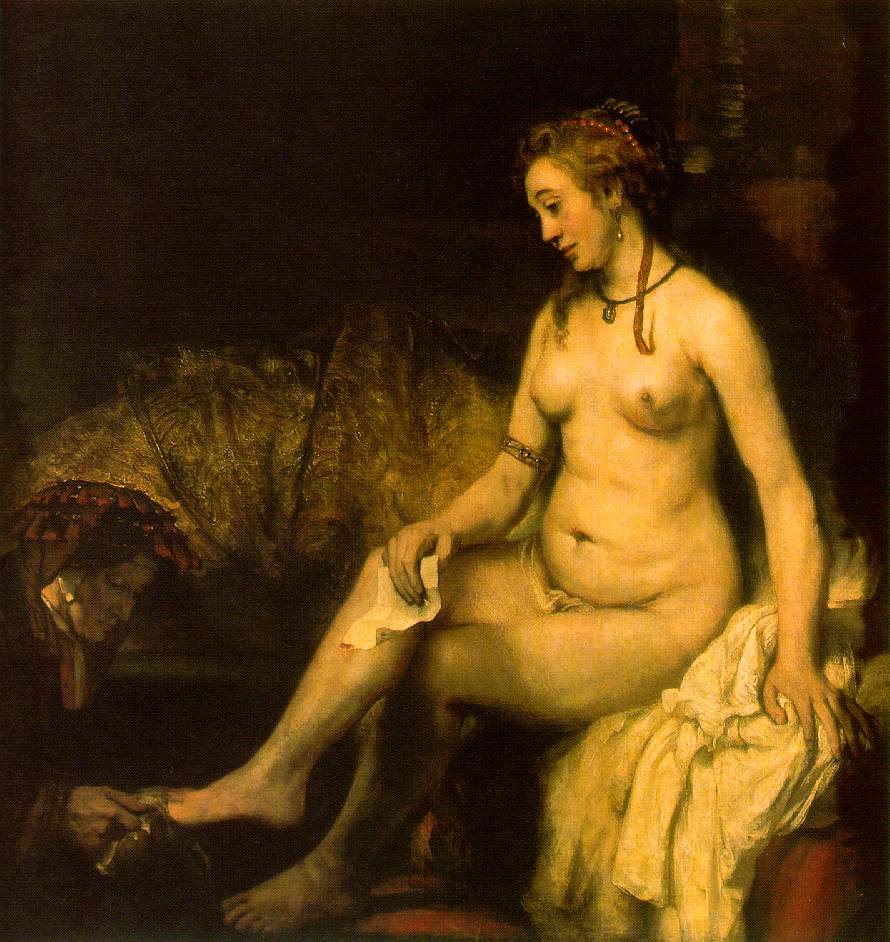
Rembrandt Van Rijn (1606-1669) Bathsheba at Her Bath, 1654

The breasts are smaller and far apart, the belly is much smaller and the waistline is raised. Anne Hollander also points out to the slight awkward posture of the legs- after about 1610 the farthingale was replaced by heavy skirts that made the spreading of the legs necessary, which in turn was depicted in art as a desirable feature.

Example of the Spanish Farthingale, an undergarment that was fashionable during the sixteenth century

The first clue to what was worn directly on the body and under the clothes can be found in the two earlier nudes. The two figures are sitting on their chemise. The cuff of the white linen chemise can be clearly seen on the one from 1630. Over the chemise a stiffened bodice was worn, probably made also of linen and boned with wood. Then a wide rich skirt was worn. Sometimes in order to achieve a fuller figure several layers of skirts were worn under the dress. The stiffened bodice was hidden under a stomacher following the same shape, which extended over the skirt. In Portrait of a Woman from 1632 the sitter is wearing a black silk brocade dress with a matching skirt.  The very wide sleeves are slashed vertically and decorated with ribbons at the elbow.  The waist is also bound by similar ribbon. The bottom of the stomacher has flaps edged with black braid. And the cuffs and collar are made with fine white linen and decorated with beautiful delicate lace.

While the rest of Europe begun to trade the stiff ruff for a fallen ruff in Spain and Holland the ruff became even more enormous. The scholar James Laver notes that is ironic that the Dutch so bitterly fought to gain freedom from Spain, yet the Spanish style continued to be an influence in the Netherlands long after it was no longer fashionable in the rest of Europe. However another portrait, also from Rembrandt, that was done only a year later is showing a similar dress only with a fallen collar. Really, what it is showing us is that at this period in the Netherlands these two styles co-existed.
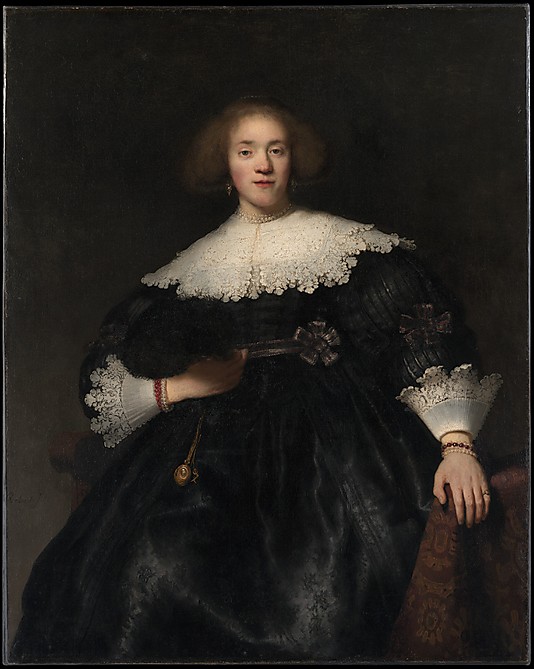
Rembrandt Van Rijn (1606-1669) Portrait of a Young Woman with a Fan, 1633.Oil on canvas 49 1/2 x 39 3/4 in. (125.7 x 101 cm) The Metropolitan Museum of Art . Credit Line: Gift of Helen Swift Neilson, 1943. 43.125

In a portrait of the Bas family, a wealthy family of merchants, this can be seen clearly. Note the young wear fallen collars, while the elders still wear the stiff large ruffs.  In the Netherlands once fashionable status symbols were no longer considered fashionable by young or trend-setting groups at court they were adopted by individuals who wished to project a kind of conservative chic.
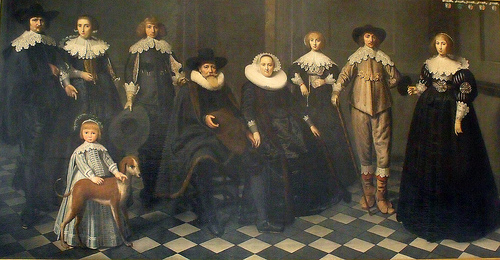
Dirck Santvoort (1569-1637) Family of Dirck Bas Jacobsz, c1635 Amsterdams Historisch Museum

In the Portrait of a Woman from 1632, the sitter may have chosen a more conservative style in order to present herself as a serious and respectable woman. When we examine the two similar portraits again we can see that other than the collar, the two ladies actually wear very similar style. The ribbons are placed at the same position on the body, they both hold black ostrich feathers fan that was considered extremely fashionable and luxurious and they both have strands of pearls on both wrists. They also have similar hairstyle: the forehead is very high and the hair is pinned so it echoes the silhouette of the dress- it widens to the sides. The sitter from 1632 is thus not un-fashionable, and her dress and accessories certainly add to the sense of luxurious fashionable appearance.

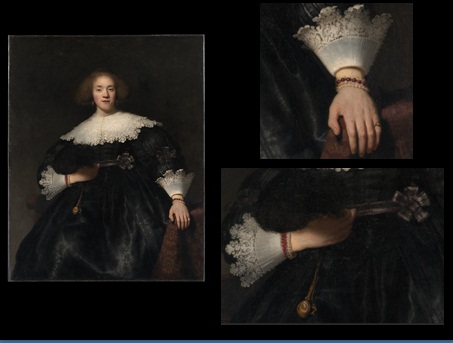
In conclusion when we study the dress in contemporary portraits by Rembrandt it is important to consider it in context- the age of the sitters as well as their social and religious station are crucial to reading their dress correctly. How we read dress in his paintings relies on the propose of the work, paintings depicting contemporary persons in real, actual clothes  should be distinguished from historical paintings, in which Rembrandt draw from other sources or used costumes he owned.  However, when Rembrandt re-creates historical figures in historical dress he is still depicting a contemporary body.
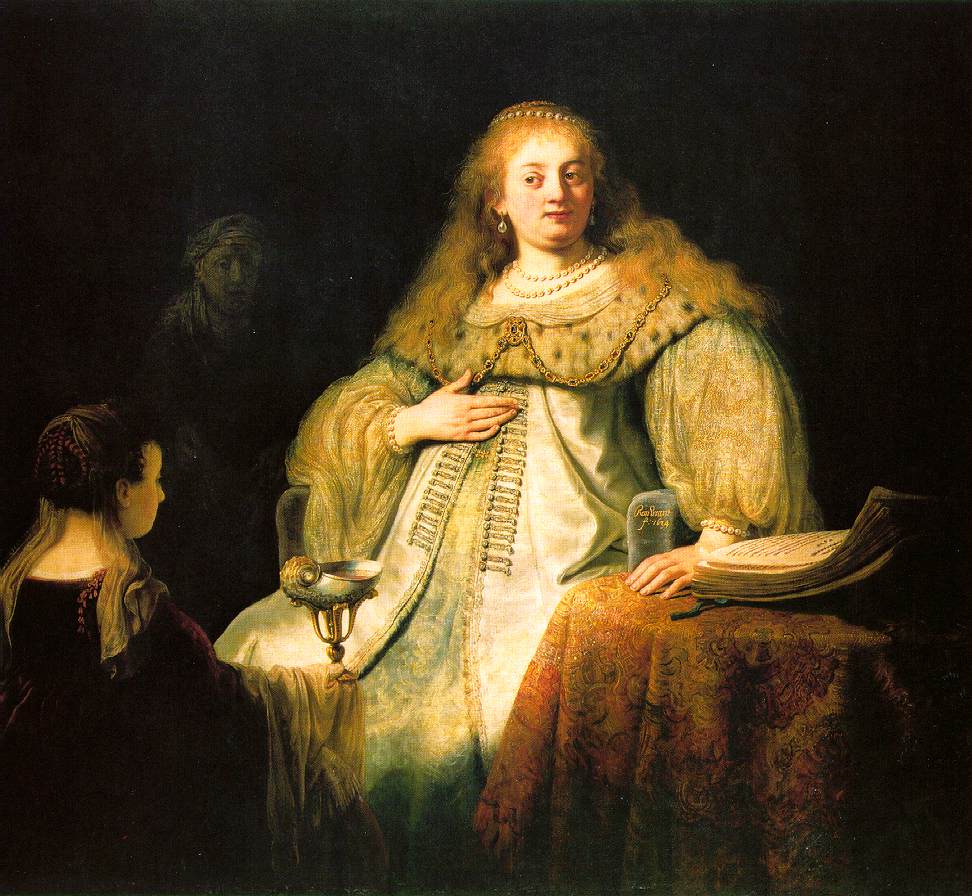
A fashionable body in historical dress. Rembrandt Van Rijn (1606-1669) Artemisia, 1634 Oil on canvas 142 cm × 152 cm (56 in × 60 in) Museo del Prado, Madrid

In the painting above it is the posture of the sitter that tells us in which period it was painted. The spreading of the legs, the width of the body and the hands: one the table and one across the body almost as if holding a fan- all suggest 17th century fashion. So while some scholars easily dismiss Rembrandts as un-useful source for the study of fashion I hope I showed that in context a lot can actually be learned from his work.

Posted in Uncategorized | 2 Comments

New Exhibition: Incomparable Women of Style

Incomparable Women of Style

Selections from the Rose Hartman Photography Archives, 1977-2011

On View in FIT’s Gladys Marcus Library
November 4, 2011-January 20, 2012

(text from press release)Photographer Rose Hartman has been chronicling iconic moments in fashion, style, and culture for more than 30 years, capturing New York City nightlife, fashion shows, parties, clubs, and openings. From Studio 54 to the Mudd Club to Chelsea art galleries today, Hartman’s career has yielded a treasure trove of material that portrays incomparable women of high fashion, street style, and New York City society through the eye of a social documentarian.

Jerry Hall and Andy Warhol at Studio 54, 1977.

Presented by the Fashion Institute of Technology’s Gladys Marcus Library Department of Special Collections and FIT Archives, the exhibition will be on view from November 4, 2011, through January 20, 2012. This exhibition is the first large-scale installation in the library and celebrates Hartman’s generous gift of her entire photography archives to FIT.Incomparable Women of Style: Selections from the Rose Hartman Photography Archives, 1977-2011 will display more than 60 photographs, including rare vintage silver prints developed by Hartman in her home studio, as well as some of her most well-known work reproduced on a large scale.

The women shown in these photographs are a varied selection of style icons. Bianca Jagger, Jerry Hall, Bethann Hardison, Margaux Hemingway, and Nan Kempner were shot at Studio 54 in the late 1970s. Diana Vreeland, Isabella Blow, Anna Wintour, Grace Jones, Vivienne Westwood, Naomi Campbell, Betsey Johnson, Donna Karan, Iris Apfel, Isabella Rossellini, Lauren Hutton, Paris and Nicky Hilton, Courtney Love, Madonna, and Diane von Furstenberg, among many others, were captured at fashion shows, design studios, the Costume Institute Gala at the Metropolitan Museum of Art, art galleries, backstage at fashion shows, and on the street.

Apollonia backstage at Bill Kaiserman, c. 1979.

A group of never-before-seen images of New York City’s underground style icons will also be presented. These are the Fashionistas, as Hartman calls them, whose style drove high fashion from the city’s club scene in the late 1970s and early 1980s into the mainstream.

The exhibition will begin with the story of Hartman’s transformation from an English teacher to a sought-after photographer given access to the most exclusive clubs, parties, and events. The exhibition will proceed to show the breadth and diversity of her career through the women of style that she has photographed at New York City’s of-the-moment events.

First will be a selection of her most well-known—and well-dressed—subjects. However, the exhibition will not be limited to women from the best-dressed list. Rather, the definition of a “woman of style” will be expanded to include the designers who created style, the models who wore it best, and the young women who originated trends as they dressed to impress their club-going friends.

With a special focus on the span of Hartman’s career, the show also will trace Hartman’s unique position as a working photographer who successfully weathered the transition from analog to digital. While carting around a camera, rolls of film, and a hand-held flash in 1977, Hartman still managed to capture candid shots at Studio 54 and behind-the-scenes photographs of fashion shows before press was widely invited to cover the pre-show preparations. From slides to jpegs, Hartman’s body of work serves as a time capsule of the photographic process that FIT’s Special Collections is fortunate to be able to share with student researchers and fashion scholars.

Kristen McMenamy and portrait, at a Vogue issue release party at a gallery in Soho.

A companion book, Incomparable: Women of Style, will be published by ACC Publishing Group (London/New York) in fall 2012.Incomparable Women of Style: Selections from the Rose Hartman Photography Archives, 1977-2011 is curated by Anna Yanofsky, a Master of Arts candidate in FIT’s Fashion and Textile Studies: History, Theory, Museum Practice program, in conjunction with Rose Hartman, and under the guidance of Karen Trivette Cannell, MLS, assistant professor and head of Special Collections and FIT Archives. Research and technological assistance has been provided by Hartman interns Danielle McGhee, John Utsey, Jr., and Eva Shuman. Additional assistance has been provided by department personnel Juliet Jacobson, Clara Berg, and Chris Arena and department intern Gilit Cooper.

Exhibition Hours
Monday–Thursday, 8 am–10 pm #
Friday, 9 am–6:30 pm #
Saturday, 10 am–5 pm #
Sunday, 12–9 pm
Admission is free and open to the public.

Enter at the Shirley Goodman Resource Center, located on the southwest corner of Seventh Avenue at 27th Street. By showing FIT Security a valid picture ID, visitors will be given a same-day library pass. The library is located on the 5th floor, where the exhibition begins.

FIT’s Gladys Marcus Library Department of Special Collections and FIT Archives

Special Collections and FIT Archives acquires, preserves, and provides access to a wide range of primary research materials in their original formats across many languages and geographical spectra. Formats include and are not limited to: manuscript collections, scrapbooks, audio and video oral histories (some with transcriptions), sketches, illustrations, monographs, journals, digital files, and other media.

Subjects include primarily the apparel industry, fashion, regional costume, textile design, the textile industry, the FIT Archives, and, to a lesser extent, art, architecture, and interior design. All acquisitions support one or more curricula offered at FIT. Department personnel are committed to supporting original research of FIT students, faculty, and personnel, as well as designers and researchers from the apparel and textile fields and other industry professionals.

For more information, call 212 217.4360; email fitlibrary.sparc@gmail.com; or visitwww.fitnyc.edu/library/sparc.

Posted in Exhibition | Tagged , , , , , , | 1 Comment

Exhibition: Harper’s Bazaar: A Decade of Style

Harper’s Bazaar: A Decade of Style

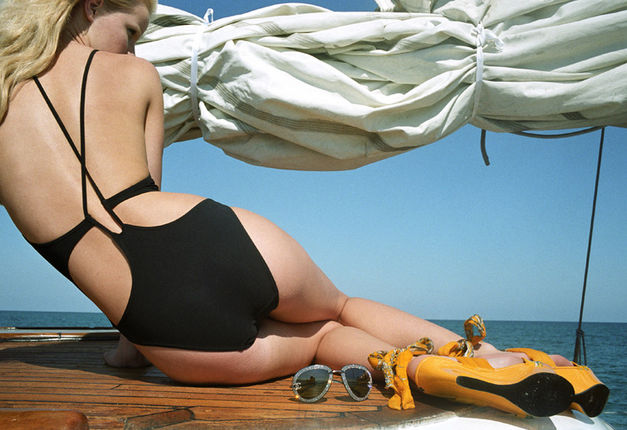
Ralph Gibson, Caroline Winberg (Harper’s Bazaar, May 2005)

at the International Center of Photography, September 9-January 8, 2012

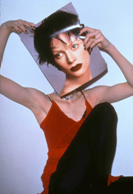
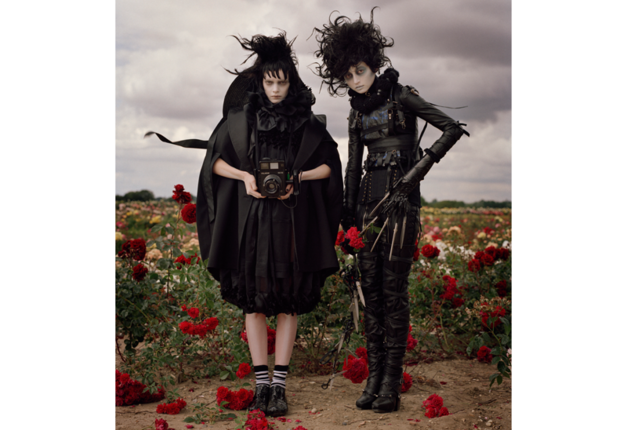
(from the exhibition’s website) In the ten years since Glenda Bailey became Editor in Chief of Harper’s Bazaar, she and Creative Director Stephen Gan have carried on the magazine’s tradition of publishing high-impact photography. This exhibition distills that decade into a choice group of nearly thirty images by some of the most important photographers working today, including Peter Lindbergh, Jean-Paul Goude, David Bailey, William Klein, Patrick Demarchelier, Sølve Sundsbø, Tim Walker, Mario Sorrenti, Hiro, Melvin Sokolsky, and Karl Lagerfeld. Among the artists represented are Nan Goldin, Ralph Gibson, and Chuck Close. Along with inventive fashion images in a wide range of styles, from classic to cinematic, there are vivid portraits of designers Marc Jacobs, Karl Lagerfeld, and Diane Von Furstenberg, and celebrities like Daphne Guinness, Lady Gaga, and Julianne Moore. To emphasize the work’s original context and the magazine’s award-winning design, issues in vitrines will display extended stories as well as Bazaar‘s high-impact subscribers’ covers. ICP Guest Curator Vince Aletti previously co-organized ICP’s dramatic “Year of Fashion” in 2009, including the shows Avedon Fashion 1944–2000,Weird Beauty: Fashion Photography Now, and This Is Not a Fashion Photograph.

Tim Walker, Untitled (Harper’s Bazaar, October 2009)


Posted in Exhibition | Tagged , , | Leave a comment

Exhibition: Hats: An Anthology by Stephen Jones

Hats: An Anthology by Stephen Jones

Graham Smith. Pirelli Tire. London, 1985. Velvet and net. Courtesy of the Victoria and Albert Museum, Given by Mrs. Wenda Parkinson, T.480-1985. © V&A Images

(from the exhibition’s website) Hats: An Anthology by Stephen Jones—a collaboration between the Victoria and Albert Museum in London and Stephen Jones, the world’s foremost hat designer—is at the Bard Graduate Center (BGC) in New York City from September 15, 2011 to April 15, 2012. It is the first venue in this country. The exhibition, which had over 100,000 visitors at the V&A, displays more than 250 hats chosen with the expert eye of the master milliner.

On display are hats ranging from a twelfth-century Egyptian fez to a 1950s Balenciaga hat and couture creations by Jones and his contemporaries. To show the universal appeal of wearing hats, Jones has chosen a wide variety of styles such as motorcycle helmets, turbans, berets, and a child’s plastic tiara. There also are hats worn by celebrities such as Madonna, Brad Pitt and Keira Knightley. For the special exhibition at the BGC, the curators have arranged for loans particularly relevant to the United States, including Babe Ruth’s baseball cap, Mouseketeer ears, Estee Lauder’s turban, Halston bunny ears worn by Candace Bergen to Truman Capote’s Black & White Ball, and the top hat worn by President Franklin Roosevelt to his fourth inauguration. There is also a display of work by contemporary New York milliners: Ellen Christine, Rod Keenan, Eugenia Kim, Lola, Jennifer Ouellette, Albertus Swanepoel, and Patricia Underwood.

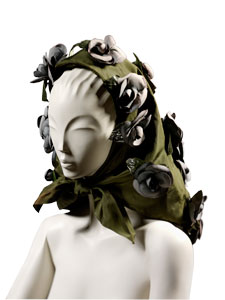
Mitzah Bricard for Christian Dior Veil with flowers Paris, ca. 1955 Silk Victoria and Albert Museum, T.163-1974 © V&A Images

Stephen Jones said: “I was honored when the V&A asked me to curate an exhibition about hats. I had so much fun finding unique head decoration in the most interesting of places. This exhibition draws on millinery collections world-wide and is truly an eclectic and exciting anthology of hats from the last millennium to the present day.”

Stephen Jones spearheaded the fashionable revival of British millinery in the early 1980s. Using unusual materials and daring designs, his exquisitely crafted hats have pushed the boundaries of hat design forward for more than three decades. Jones has collaborated with many leading fashion designers including Marc Jacobs, Comme des Garçons, and Christian Dior. He has worked with many celebrity clients including Diana, Princess of Wales, Dita von Teese, Mick Jagger, and Rihanna, and has made hats for the filmsAtonement, Elizabeth: The Golden Age, Coco avant Chanel, and W.E.

The exhibition is divided into several sections that reveal the practice of creating hats, how they are worn, by whom, and how they are presented to the client.

Inspiration, the first section, looks at how common themes such as exoticism, modernism, and the natural world have inspired countless designers. It shows historic and contemporary interpretations of hat types such as the tricorn, bowler, baseball cap, bonnet, skullcap, and many more.

Creation shows how hats are made and the traditions, innovations, and practices at the heart of millinery. This area is set up like a milliner’s workroom, with patterns, sketches, materials, and millinery blocks.

The Salon reflects the milliner’s public showcase, featuring spectacular hats that reveal the craft at its sartorial best. On display are designs by Philip Treacy, Bill Cunningham, Mr. John, Lily Daché, Mitza Bricard for Christian Dior, Misa Harada for Yohji Yamamoto, and Chanel.

In The Client, visitors can see hats worn by famous clients including Sarah Jessica Parker, Mick Jagger, Brad Pitt, Cecil Beaton, members of the British royal family, and avid collectors such as Isabella Blow and Italian Vogue’s Anna Piaggi. Also on display will be iconic headwear such as Marlene Dietrich’s beret and Andy Warhol’s wig.

The exhibition also features a selection of archive film footage plus a film showing a couture hat being made in Jones’ atelier.

Posted in Exhibition | Tagged , , | Leave a comment

Exhibition Review: Daphne Guinness

By Fiona Tedds

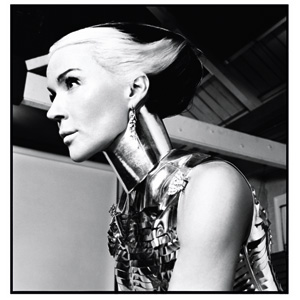
‘I don’t do event dressing, because every day is an event.’ Daphne Guinness.

Daphne Guinness. Dress and collar, Gareth Pugh. Harper's Bazaar, March 2011. Photograph: David Bailey

 In a world where the art of getting dressed is often overlooked, it is thrilling to know that so long as people like Daphne Guinness exist, it will never be forgotten. Working with Valerie Steele, Ms Guinness has curated a spectacular exhibition at the FIT museum, displaying over a hundred extraordinary garments from her own collection. With a love of fashion and a passion to explore it as an art form, Daphne Guinness is that rare bird; a woman whose personal style is fearless, delightful and exquisite.

The exhibition is inhabited by an eerie sensation and presided over by Ms Guinness herself in the form of a holographic image, which is suspended in the air like a mercurial angel. The dramatic garments are divided into six sections and besides being viewed head-on, they can also be seen from other angles through a fine gauze, like ghosts at a cocktail party. Mirrors are everywhere, further adding to this dysmorphic sense of unease.

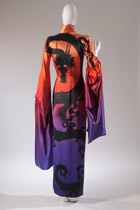
Dress by Alexander McQueen for Givenchy. Photograph by the Museum at FIT.

It is probably for her more extreme and disturbing outfits that Daphne Guinness is known and the influences of the late fashion editor Isabella Blow and the designer Alexander McQueen, who also committed suicide, are very much evident. The sequin and bugle-beaded catsuits by McQueen both beg to be stroked whilst suggesting the serpent-like qualities of the wearer. The black feather cape that surrounds one and the gossamer cocoon that encases another further lend to the idea of Daphne Guinness as an otherworldly creature.

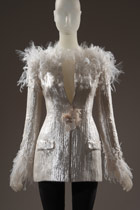
Jacket by Karl Lagerfeld for Chanel. Photograph by the Museum at FIT

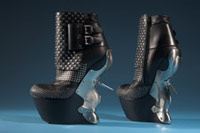
A Gareth Pugh black leather pant-suit covered in metal nails – so perfect for a date with a fakir – is part of an section entitled ‘Armour’ and it would seem that whilst Ms Guinness demands our attention with her elaborate clothing, she also sets herself apart, protected by metallic surfaces, jewels and leather. The dizzying height of her shoes literally put her on another plane and this is all part of her allure as a style icon; she both hides and reveals, maintaining a sense of mystery whilst communicating a strong sense of self.

Boots by Alexander McQueen. Photograph by the Museum at FIT

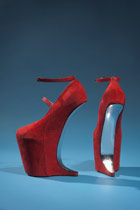
Red suede shoes by Nina Ricci. Photograph by the Museum at FIT

Not all the outfits on display are so paradoxical. The dazzling cut of jackets and suits by Karl Lagerfeld and Azzedine Alaia  are breath-taking and the engineering involved in a pair of cream silk bias-cut pants by Rick Owens is inspired. But it is the combination of all these elements that truly give a sense of Daphne Guinness – part elegant masochist, part educator and patron of the art of fashion.

Daphne Guinness
The Museum at FIT 27th street @ 7th ave
September 16, 2011 – January 07, 2012


Posted in Exhibition | Tagged , , , , , , , , | Leave a comment

Books Books Books

This fall there is abundance of new fashion-related books:

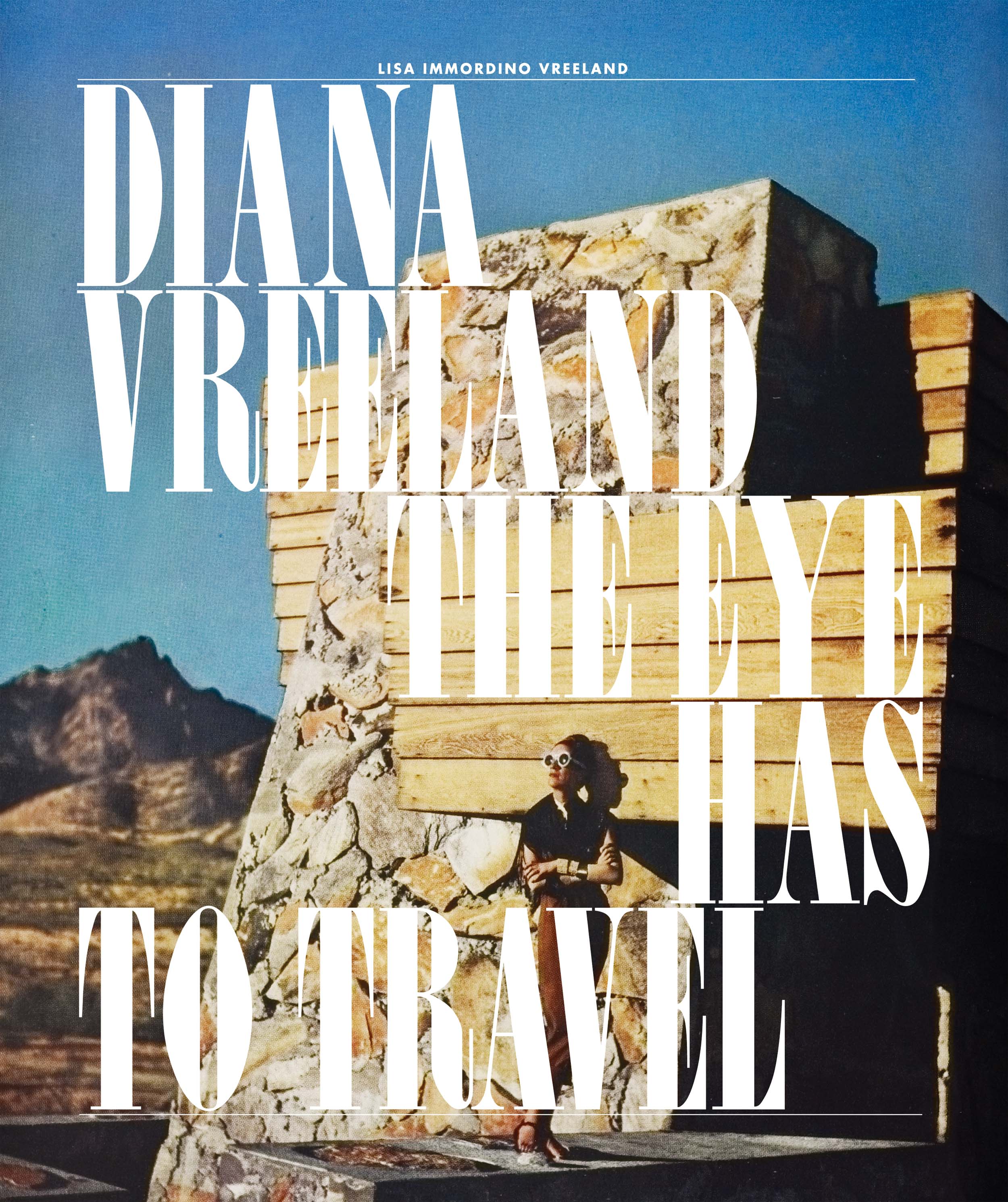
Diana Vreeland: The Eye Has to Travel (Abrams)

Written by Lisa Immordino Vreeland, who also produced a documentary about Diana Vreeland and is married to her grandson Alexander.

About the book (from publisher): Called the “High Priestess of Fashion,” Diana Vreeland (1903–1989) was an American original whose impact on fashion and style was legendary. Beginning in 1936, when she became a fashion editor at Harper’s Bazaar, Vreeland established herself as a controversial visionary with an astonishing ability to invent and discover fashion ideas, designers, personalities, and photographers. She was a memorable writer with a vivid personality and a talent for coining aphorisms. Diana Vreeland: The Eye Has to Travel chronicles 50 years of international fashion and Vreeland’s rich life. With more than 350 illustrations, including original magazine spreads and many famous photographs, this intensely visual book shows fashion as it was being invented, and how Vreeland shaped American taste through her superb vision.


The Impossible Collection of Fashion (Assouline) 

By Valerie Steele

About the book (from publisher): From Poiret to Pucci, Doucet to Dior, Vionnet to Valentino, Valerie Steele, director and chief curator of the Museum at the Fashion Institute of Technology (MFIT), selects the one hundred most iconic dresses of the twentieth century. This magnificent collection, while certainly subjective, is sure to receive gasps of pleasure as well as of surprise. Steele’s selection, hand-picked for this luxury volume presented in a linen clamshell case with a cutout metal plate, astounds in every regard. Comes with a complimentary Assouline canvas tote bag.

you can also see a slideshow with some examples from the book here

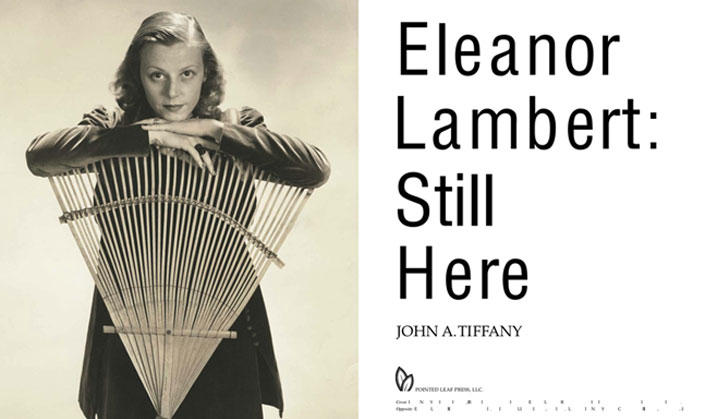
Eleanor Lambert: Still Here    (Pointed Leaf Press)

By John A. Tiffany

About the book (from publisher): Eleanor Lambert: Still Here is the definitive monograph on the achievements of the extraordinary woman who changed fashion history, putting American fashion on the map in a culture once wholly dominated by European design and traditions. Written through the eyes and experiences of John A. Tiffany, who not only worked for Miss Lambert but who had access to a trove of archival materials that have never been published before, including dazzling fashion photography accompanied by their never-before-seen original press releases written by the legendary Miss Lambert herself, this book will provide the fashion-obsessed and many others with a behind-the-scenes account of a woman who gave life to the industry as we know it today.

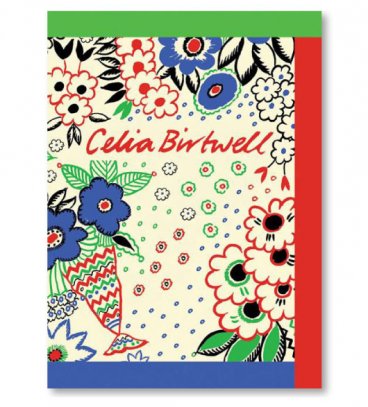
Celia Birtwell (St. Martin’s Press)

By Celia Birtwell with Dominic Lutyens

The book is a visual survey of textile designer and illustrator Celia Birtwell’s fifty years long career. In the 1960s she worked with her husband, fashion designer Ossie Clark. They continued to collaborate on a series of successful collections through the 1970s. Ms. Birtwell is also a close friend and muse of painter David Hockney who depicted her, her husband and their cat in a famous portrait. Ms. Birtwell continues to operate today, including her home collection and two collections she produced for Top Shop.

Mr and Mrs Clark and Percy. David Hockney, 1970-71

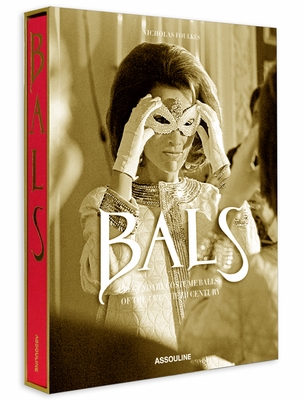
Bals: Legendary Costume Balls of the Twentieth Century (Assouline)By Nicholas Foulkes

About the book (from publisher): From the twilight of the Romanov dynasty through les années folles of Art Deco Paris to the jet-set seventies, Bals explores the nine most exceptional private costume parties of the twentieth century. The most lavish, beautiful book ever produced on the subject, Bals features social commentary both by and about the colorful characters—Truman Capote, Cecil Beaton, and others—who immortalized these extraordinary events, as well as first-person narratives by Jacqueline de Ribes, Hélène David-Weill, and Marisa Berenson.

Posted in Uncategorized | Tagged , , , , , , , , , , , , | 1 Comment

New Exhibition: Charles James: Genius Reconstructed

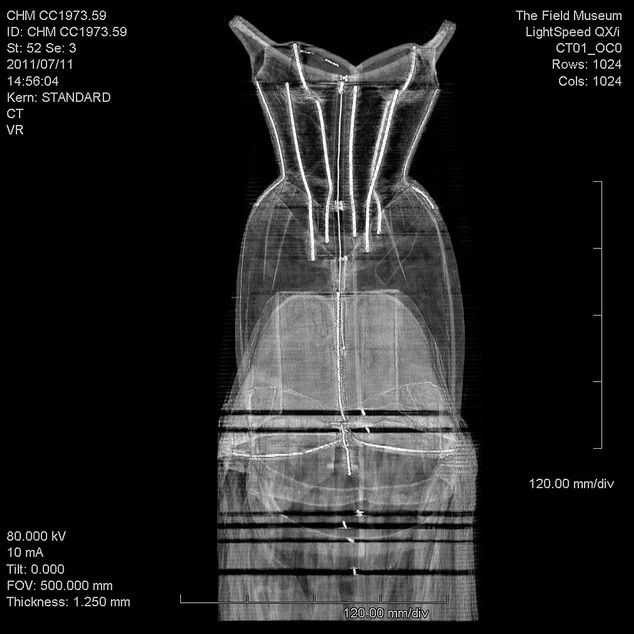
Digital Image of Charles Jmaes dresss from CT scan at the Field Museum. © Chicago History Museum

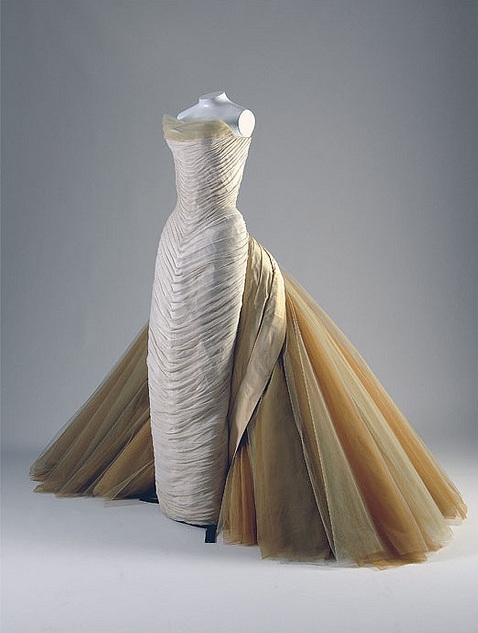
On October 22nd the Chicago History museum will open the exhibition Charles James: Genius Reconstructed curated by Timothy Long, who I interviewed here last year. The exhibition features fifteen iconic dresses from the museum’s collection. Out of these dresses four were re-created, allowing the visitors to admire their construction for which James is most known. His dresses are often made of a sculptured, rigid bodice, almost capable of standing on its own, combined with an enormous billowing skirt.

"Butterfly," 1954 Charles James. Known as the “Butterfly” dress, this gown is made of 25 yards of peau de soie and nylon netting and weighs 17 pounds. Worn by Mrs. John V. Farwell III. © Chicago History Museum

Some of the richest women in America were his devoted costumers and close friends, like the oil heiress Millicent Roger, and he had a dress form made for each of them in exact measurements. That did not stop him from changing the forms if he did not find the clients figure to be perfect. James had a volatile personalty and hot temper, and would sometimes take years to complete a dress, which for him was a study of perfection rather than a consumer product.The exhibition explores the allure of Charles James through  examination of his ability to balance engineer-like skills with artistic intuition.

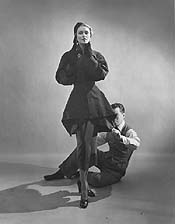
Charles James with a Model. Photograph by Cecil Beaton, 1943.

Charles James: Genius Reconstructed on display at Chicago History Museum from October 22‚ 2011‚ through April 16‚ 2012. more details here

Posted in Exhibition | Tagged , , | 1 Comment

October Treasure of the Month

Bonnie Cashin Sketch Collection

At Special Collections and FIT Archive

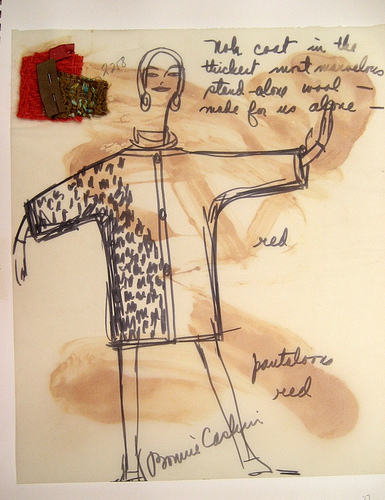
Bonnie Cashin Sketch- "Noah Coat". "Noh coat in the thickest most marvelous stand-alone wool- made for us alone" Signed by Cashin. Fall 1966 or Spring 1967. US.NNFIT.SC.81.1.1.21.27

Bonnie Cashin, born in Fresno, California in 1908, had a very successful costume and clothing design career spanning sixty years. Cashin began designing for herself at an early age, working as an ‘apprentice’ for her mother Eunice, a custom dressmaker and dress shop owner. Moving back and forth from California and New York, she had designed for dance companies, film in Hollywood, uniforms for the WWII effort and ready-to-wear. By the time Cashin left Hollywood and came back to New York in 1949, she had been designing for over twenty years.

Bonnie Cashin Sketch- "Crusader" ensemble. "Pantaloons for the crusader." Leather dress #1269 over wool jersey, jersey head covering, open only where slashed for the eyes and the length of the face and slim pants #1270 which are jersey from the waist down to just above the knees and leather down to the ankle flaring to cover shoes; signed by Cashin. Fall 1966 or Spring 1967. US.NNFIT.SC.81.1.1.21.6

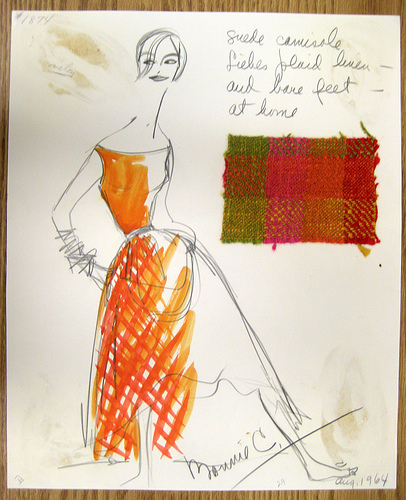
Bonnie Cashin Sketch- Dorothy Liebed Skirt. Full skirt in Liebes plaid linen and suede camisole #1874 "Suede camisole Liebes plaid linen- and bare feet- at home" Signed by Cashin dated "Aug. 1964" US.NNFIT.SC.81.1.1.16.2.29

In 1951 she started Bonnie Cashin, Inc declaring herself independent from the garment industry. She began working with Philip Sills, of Sills and Co. in 1952, for the 1953 fall season. By then she was known for her ability to use design ideas and take inspiration from her extensive travels and unusual sources, far removed from the fashion world, as well as her creative use of unusual textiles. Cashin designed for many other businesses while she was working with Sills. Cashin received both the Coty Fashion Critics Award and Neiman Marcus Award in the same year, 1950. She went on to receive a second and third Coty Award in 1961 and 1968. In 1972 she was inducted into the Coty American Fashion Critics Hall of Fame. She also received the Leather Industries American Handbag Designer Award in 1972 and 1976.

Bonnie Cashin Sketch- Ensemble with Liebes Lurex. "Athena" sketch using Liebes Lurex; signed by Cashin. US.NNFIT.SC.81.1.1.6.1.8

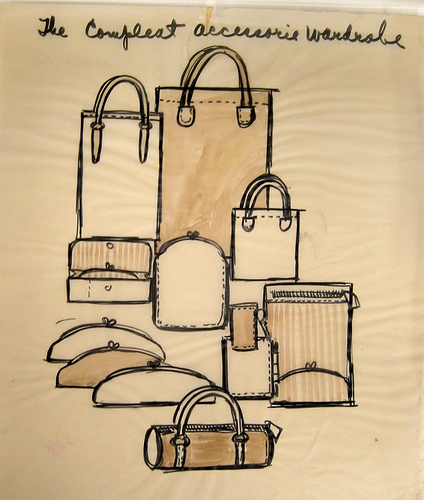
Bonnie Cashin Sketch- "accessories wardrobe". Bonnie Cashin "Cash and Carries" for Coach. Collection of totes, wallets, clutches and key cases, "The Compleat Accessorie Wardrobe". US.NNFIT.SC.81.2.1.2.14

The Department of Special Collections  and FIT Archives acquires, preserves, and provides access to a wide range of primary research materials in their original formats, including archives, scrapbooks, oral histories, fashion sketches, illustrations, books, journals, and other items. Subjects include the apparel industry, fashion and regional costume, textile design and the textile industry, the FIT Archives, and, to a lesser extent, art, architecture and interior design. Department personnel are committed to supporting research by FIT students and faculty as well as designers and researchers from the apparel and textile field, other industry professionals, and scholars.

In order to view these original works or other Special Collections material please email us at fitlibrary.sparc@gmail.com for an appointment.

Posted in Treasure of the Month | Tagged , , , | 1 Comment

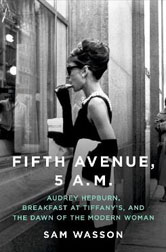
Fifth Avenue, 5 Am: Audrey Hepburn, Breakfast At Tiffany’s, and the Dawn of the Modern Woman

Tonight  at The Tenement Museum Sam Wasson will talk with James Sanders on his wonderful book Fifth Avenue, 5 Am: Audrey Hepburn, Breakfast At Tiffany’s, and the Dawn of the Modern Woman 


details here


Posted in Uncategorized | Leave a comment

links links links

*Holland Cotter, New York Times art critic on NY fashion week:Fashion at the Line of Beauty

*100 years of East London Fashion

*  The Cheerless Life of The Umbrella Maker, C. 1853


Posted in Uncategorized | Leave a comment