Check out this post from Sarah Scaturro, graduate of our program, on her experience at Haiti, conserving Vodou textiles. Fascinating stuff!
http://cooperhewitt.org/blog/2011/08/23/haiti-cultural-recovery-project-part-1

Check out this post from Sarah Scaturro, graduate of our program, on her experience at Haiti, conserving Vodou textiles. Fascinating stuff!
http://cooperhewitt.org/blog/2011/08/23/haiti-cultural-recovery-project-part-1

Claribel Cone, Gertrude Stein, and Etta Cone in Settignano, Italy, June 26, 1903 The Baltimore Museum of Art: Dr. Claribel and Miss Etta Cone Papers, Archives and Manuscripts Collection, CG.12
This last Saturday I finally found the time to visit the exhibition Collecting Matisse and Modern Masters: The Cone Sisters of Baltimore at The Jewish Museum. If you haven’t seen it yet, I truly recommend you do before it closes September 25th.
Sisters Dr. Claribel (1864–1929) and Miss Etta (1870–1949) Cone of Baltimore were two of the twelve children of a German-Jewish immigrant couple Herman and Helen Cone (Khan). The Cones made their fortune in grocery business and later in textile. Their Baltimore social circle included Gertrude and Leo Stein who not only immensely influenced the sisters’ taste and art collection but also personally introduced them to Matisse and Picasso. The sisters became patrons of these two artists and dedicated their life to collecting art and beautiful objects.

Pablo Picasso (Spanish, 1881-1973) Self-Portrait (Bonjour Mlle Cone), 1907 Pen and brown ink 8 5/16 x 5 1/2 in. (21.1 x 14 cm) The Baltimore Museum of Art: The Cone Collection, formed by Dr. Claribel and Miss Etta Cone of Baltimore, Maryland, BMA 1950.12.481 © 2011 Estate of Pablo Picasso / Artists Rights Society (ARS), New York Gift from Picasso to Etta Cone, January 7, 1908
According to The Jewish Museum’s website the collection, which was donated to the Baltimore Museum of Art in 1949, includes approximately 3,000 objects such as paintings, drawings, decorative art, jewelry and textiles the sisters acquired in their travels around the world. The sisters’ nephew Edward T. Cone is quoted describing their Baltimore’s Marlborough Apartments where the collection was housed as:
“really a collection of collections, and in the Marlborough one could see them all—if one had weeks to spend. There were pictures, to be sure: oils, water colors, drawings, prints. There were sculptures: marble, bronze, wood. There were rugs and furniture. There were laces, shawls, textiles and fabrics of all kinds. There were antique jewelry and objets d’art. And all these were used, they were enjoyed, they were lived with.”
The exhibition which occupy the museum’s ground floor is beautifully designed and the curators did a wonderful job in bringing to life the sisters’ unique identity and taste. Each of the six rooms is either dedicated to a period or a theme from the collection. The wall texts are excellent, and although quite lengthy they are interesting, easy to read and highlight the key theme of each room (and this is from someone who hardly never reads more than the first few sentences of a wall text, at best).

Henri Matisse (French, 1869–1954) Standing Odalisque Reflected in a Mirror, 1923 Oil on canvas 31 7/8 x 21 3/8 in. (81 x 54.3 cm) The Baltimore Museum of Art: The Cone Collection, formed by Dr. Claribel and Miss Etta Cone of Baltimore, Maryland, BMA 1950.250 © 2011 Succession H. Matisse / Artists Rights Society (ARS), New York Purchased by Etta Cone, September 1, 1923

Henri Matisse (French, 1869–1954) Large Odalisque with Striped Pantaloons, 1925 Crayon-transfer lithograph with scraping 28 1/16 x 22 11/16 in. (71.3 x 57.6 cm) The Baltimore Museum of Art: The Cone Collection, formed by Dr. Claribel and Miss Etta Cone of Baltimore, Maryland, BMA 1950.12.155 © 2011 Succession H. Matisse / Artists Rights Society (ARS), New York
It seems textiles played important part in their life. The curators often remark on the sisters Victorian style of dress (in contrast to their avant-garde taste in art), and some of the objects on display are remarkable Bobbin laces and textiles from around the world. It is also interesting to note that their favorite artist, Matisse, is known for his beautiful and expressive rendering of textile, most obvious in his Odalisques.

Black Chantilly Bobbin Lace Fan Leaf, 1908 France or Belgium Silk 23 1/2 x 8 in. (59.7 x 20.3 cm) The Baltimore Museum of Art: The Cone Collection, formed by Dr. Claribel and Miss Etta Cone of Baltimore, Maryland, BMA 1950.2010.21
The objects in the exhibition are a testament to the Cone Sisters passion and dedication. It underlines their visionary taste. The show is recommended to anyone who loves art, textile and beauty and to those who need reminding that following your heart can be very rewarding.

Etta Cone at age 18–19 wearing a riding outfit, late 1880s. The Baltimore Museum of Art: Dr. Claribel and Miss Etta Cone Papers, Archives and Manuscripts Collections, EC.1

Claribel Cone as a resident physician, Blockley Almshouse, Philadelphia, c. 1891–1892 Gilbert Studios, Philadelphia, PA The Baltimore Museum of Art: Dr. Claribel and Miss Etta Cone Papers, Archives and Manuscripts Collections, CC.2
Daphne Guinness
Museum at FIT, Special Exhibitions Gallery
September 16, 2011 – January 7, 2012
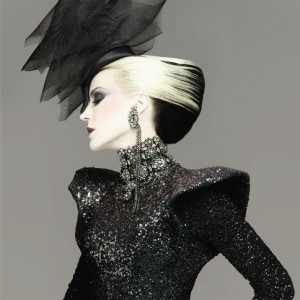
While there have been many exhibitions devoted to great fashion designers, only a few have focused on individual women of style. Yet certain singular women play a crucial role in fashion. Known as fashion or style icons, they are a special type of fashion insider, one who not only inspires designers and brings their clothes to life, but actually creates a look that affects the way other people dress and/or think about dressing.
Daphne Guinness, one of today’s most original fashion icons, is the subject of the upcoming exhibition Daphne Guinness at The Museum at FIT. Opening on September 16, 2011 and on view through January 7, 2012, the exhibition will feature approximately 100 garments and accessories from Guinness’s personal collection, plus films, videos, and images, of and by her.
From her platinum-and-black striped hair to her towering 10-inch heels, from her to-die-for couture collection to her amazing jewelry, Daphne Guinness completely embodies the rarified personal style of a fashion icon. “She is one of the – if not the – most stylish women living,” says designer and film director Tom Ford. Her fans in the blogosphere describe her as “the ultimate fashion fantasy.”
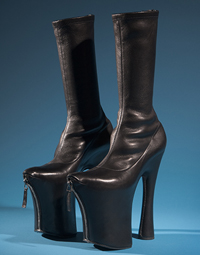
Boots by Alexander McQueen. From the collection of Daphne Guinness.
Daphne Guinness will reveal how Guinness, who is not only a serious collector of couture but also a creative force in her own right, uses fashion to transform herself. As her friend, art historian, John Richardson, puts it: “She’s the object of her own creativity. Her persona is her own masterpiece.”
Although Guinness has inspired some of the world’s greatest couturiers – from Karl Lagerfeld to Valentino – she says that she is “not a muse,” but more like “a bee” flitting from one designer to another. This is proven by the array of designers whose work will be on display. A close friend of the late Alexander McQueen, the exhibition will include more than two dozen McQueen garments which have never been displayed. Also featured will be extraordinary haute couture from Chanel, Dior, Givenchy, Lacroix, and Valentino, as well as demi-couture by Azzedine Alaia, Tom Ford, Dolce & Gabbana, and Rick Owens, and futuristic styles by young designers such as Gareth Pugh. Clothes that Guinness has designed herself will show her love of uniforms.

Dress by Chanel. From the collection of Daphne Guinness.
Another exhibition highlight will be a wide range of extraordinary accessories, many of which were created in collaboration with Guinness. These include Philip Treacy’s hats and Shaun Leane’s “armor” jewelry, not to mention towering platform shoes made especially for her by Christian Louboutin and Noritaka Tatehana.
Several of Guinness’s films will be shown, including The Phenomenology of the Body (which explores the politics of clothing), Mnemosyne (which was inspired by her perfume), and Tribute to Alexander McQueen, as well as numerous images and videos.
Daphne Guinness will be co-curated by Daphne Guinness and Valerie Steele, director and chief curator. of The Museum at FIT, with the assistance of Fred Dennis, senior curator of Costume. The exhibition’s design, by Ken Nintzel, will be inspired by Guinness’s New York apartment.
The exhibition will be accompanied by a book, also titled Daphne Guinness, written by Valerie Steele and Daphne Guinness, and published by Yale University Press. All royalties from sales of the book will benefit the Fashion Institute of Technology.
The museum’s annual Fashion Symposium will take place on November 3-4, 2011 in conjunction with the exhibition, Daphne Guinness. The topic of the symposium will be “Fashion Icons and Insiders.”
*****Text from the exhibition webpage
Illuminating Fashion: Dress in the Art of Medieval France and the Netherlands
Morgan Library and Museum
May 20 through September 4, 2011

Delilah Shearing Samson's Hair (detail), by the workshop of the Boucicaut Master. Bible historiale; France, Paris, ca. 1415–20. Pierpont Morgan Library, MS M.394, f. 112 (detail). From section 3: "Luxury in a Time of Madness, 1390–1420."
This exhibition will explore the evolution of fashionable clothing in Northern Europe—from the fashion revolution of the early fourteenth century to the dawn of the Renaissance. Drawn from the Morgan’s collections, over fifty illuminated medieval and Renaissance manuscripts and early printed books are featured.
The nearly 200 years just prior to the Renaissance in Northern Europe constituted a fertile era for fashion, a period in which clothing styles changed rapidly, often from one decade to the next. The exhibition examines the role of social customs, cultural influences, and politics—such as the Hundred Years’ War, the occupation of Paris by the English, and the arrival of the Italian Renaissance—in shaping fashion.
The exhibition also demonstrates the richness of symbolism in medieval art and how artists used clothing and costume as codes to help viewers interpret an image. In these works of art, what people wear is a clue to their identities and moral characters.
To dramatize these fashions, four recreated ensembles replicating clothing depicted in the exhibition will be on view. The garments were made using period hand-sewing techniques and authentic materials—including silk velvet, gold brocade, linen, straw, and ermine.

Orange houpeland (velvet) lined with fur (synthetic ermine) and with a belt (wool and silk), worn over a gold cote hardy (silk brocade), with hair in temples (silk, velvet, straw) with a veil (linen). Re-creation designed by Corinne Roes of Atelier Mette Maelwael, The Netherlands, after the Hours of Catherine of Cleves; Utrecht, The Netherlands, ca. 1440 (MS M.917, p. 65).

****Text from the exhibition webpage
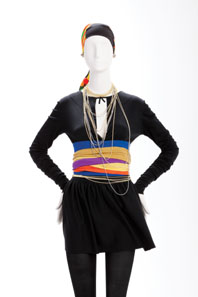
Phoenix Art Museum presents the first ever Museum retrospective to highlight the extraordinary ingenuity of American designer Giorgio di Sant’ Angelo. The winner of two Coty Awards and two Council of Fashion Designers of America honors, Sant’ Angelo’s notable three-decade career generated a wide array of collections, including Gypsy (1969) andNatives of the Americas (1970), all of which were innovative for their pioneering use of stretch fabrics and powerful expression of the era. Featuring more than 40 ensembles and accessories, the exhibition spans the late 1960s through the early 1990s and provides a stunning overview of Sant’ Angelo’s influence and legacy.
“Sant’ Angelo was an artist with the exceptional ability to see beyond the established fashion norms, creating designs that were revolutionary in every sense – from the fabric, to the cut, to his interpretation of cultural influences. His dynamic creativity defined him as a designer and his ingenious use of stretch fabrics went beyond high fashion to influence the look of mainstream clothing,” commented exhibition curator, Dennita Sewell. “This exhibition brings to new light the magnitude of Sant’ Angelo’s influence and his continued impact on fashion designers and stylists working today.”
Giorgio di Sant’ Angelo is drawn from Phoenix Art Museum’s extensive fashion design archive, the Texas Fashion Collection, UCLA archives and private collections. In addition, the exhibition will feature never-released, original footage of runway shows and interviews, photographs and sketch books.
Exhibition Overview
Giorgio di Sant’ Angelo (1933-1989) rose to prominence during the late 1960s with his exuberant and colorful accessories and collections. With an eye for fantasy, Sant’ Angelo created expressive collections that merged his own Latin upbringing with gypsy, Aztec, American Indian and Asian influences among others. Eclectic mixes of vibrant fabrics with rich ornamentation were combined in free-body designs to reflect his ideas of modern sensuality. By reversing the role of stretch fabrics from innerwear to outerwear, he revealed the shape of the natural body as a modern fashion fundamental. “Silhouette as we’ve known it, as something imposed by fashion is finished. The only silhouette for 1971 is the body,” he proclaimed.
Throughout the 1970s, Sant’ Angelo’s designs became more streamlined to reflect the changing times and the active lifestyle of the modern woman. Easy to pack, easy to fit, easy to wear his clothes were both contemporary and practical. Always a step ahead of the fashion industry, Sant’ Angelo’s very feminine collections of the 1980s had a soft–edge, mixing gossamer weight stretch fabrics with lace and chiffon in layered body-aware designs that transformed with the movement and individuality of the wearer. The body suit was the foundation upon which he built layers such as the sarong skirt in a vibrant rainbow of colors.
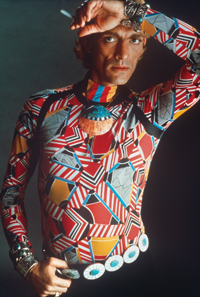
image credit:Barbara Carrera and Giorgio di Sant’Angelo, 1968. Courtesy of Martin Price.
Born Count Jorge Alberto Imperatrice di Sant’ Angelo e Ratti di Desio in Florence, Italy, he was raised in Argentina and Brazil and trained as an architect and industrial designer in Italy. He studied art, ceramics and sculpture in Spain and France, under Pablo Picasso among others. In 1962, he was awarded an animation fellowship at Walt Disney Studios in California but soon relocated to New York City and began freelancing in a wide range of design areas including industrial, textile, interiors and jewelry. His experimental Lucite jewelry and accessories caught the attention of Vogue editor Diana Vreeland who commissioned him to style and create works for fashion editorials. In 1967, Sant’ Angelo collaborated with photographer Richard Avedon to create the now iconic image of Twiggy with a flower drawn on her eye that ran on the cover of the July issue of Vogue. His fashion career came to the fore with the July 1968 issue of Vogue which featured an eight page editorial of model Veruschka, his lifelong muse, photographed by Franco Rubartelli in the Arizona desert. Sant’ Angelo clothed her by wrapping yards of colorful fabrics, fur and ropes in looks that defined the color and texture of the nomadic hippy look in high fashion. Reacting against the boxy shapes of established fashion, Sant’ Angelo’s clothes presented a new fluidity and flattering sensuality in fashion. His private clients included celebrities such as Lena Horne, Mick Jagger and Diana Ross who were attracted to Sant’ Angelo’s exaggerated, glamorous and highly original designs and his youthful passion for life.
Sant’ Angelo was known to say, “I am not a fashion designer but an artist who works in fashion—an engineer of color and form.” His wide reach across design areas reflected his myriad of talents and viewpoint of fashion as a total lifestyle. He was among the first designers to encompass elements in home furnishings and environmental fragrances which are now industry standards.
*****Text from Phoenix Art Museum website
Dressed to Play: Sporting Clothes, 1870-1900
August 7 – October 24, 2011
The Alice Austen House Museum – Staten Island, NY
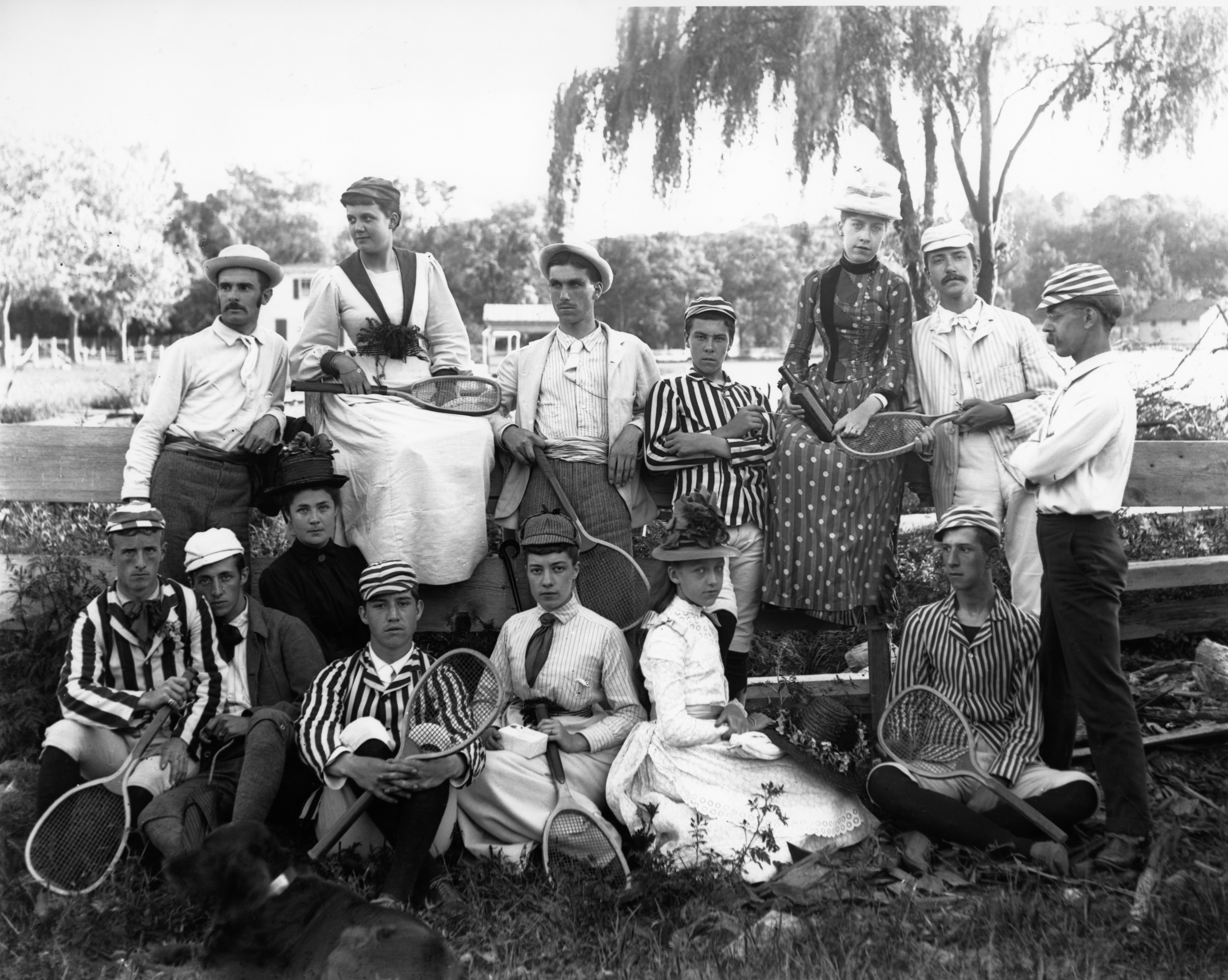
Tennis players on Staten Island Photograph by Alice Austen 1892 Collection of the Alice Austen House Museum
The exhibition was curated by Jessica Barber and Audrey Chaney, both recent graduates from the M.A. Fashion and Textile Studies program at the Fashion Institute of Technology.
During the late nineteenth century the American public became increasingly interested in leisure sports. The medical community began to feverishly promote healthy lifestyles, and newspapers and magazines helped to disseminate the benefits of new sporting activities to the masses. Although sporting activities allowed for both genders to participate in tennis, hiking, and bicycling, social decorum required that they clothe themselves in attire that was specific to the activity but also adhered to late Victorian moral standards. While far less formal than ordinary attire, these garments still followed the accepted rules of fashion. This exhibition showcases the ways in which Americans dressed themselves for play from 1870 to 1900.
The clothing worn for sport at this time greatly resembled the styles of morning dress worn in everyday life. Ensembles worn for croquet and ice-skating were constructed with elaborate drapes over bustle cages during the 1870s and 1880s, while giant, puffed “gigot” sleeves adorned sporting shirtwaists and jackets during the mid-1890s. Despite newfound social freedoms experienced through sporting activities, few concessions were made for the comfort of female players in particular: decency still required that corsets be worn, even while swimming and sea bathing. However, activities such as bicycling and gymnastics allowed for the adoption of garments that were rejected by most of society in previous decades, such as bifurcated skirts and Bloomers (or “Turkish trousers,” as was the preferred term). These early activity-specific garments laid the foundation for the separates that we now know as “active sportswear” in the fashion industry.
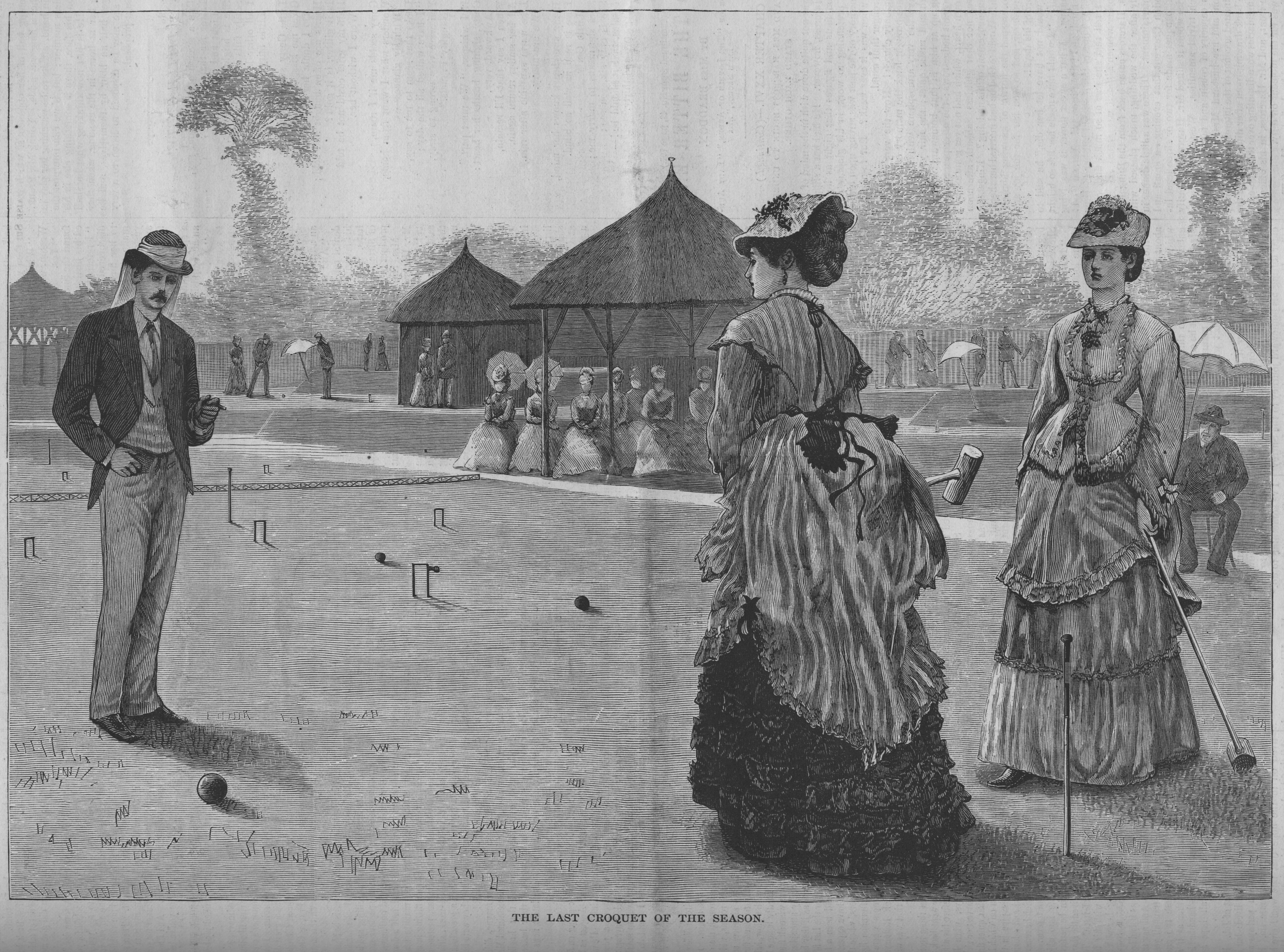
Tear sheet “The Last Croquet of the Season” Harper’s Bazar, November 2, 1872, p. 721 Courtesy of Fashion Institute of Technology| SUNY, FIT Library Dept. of Special Collections and FIT Archives
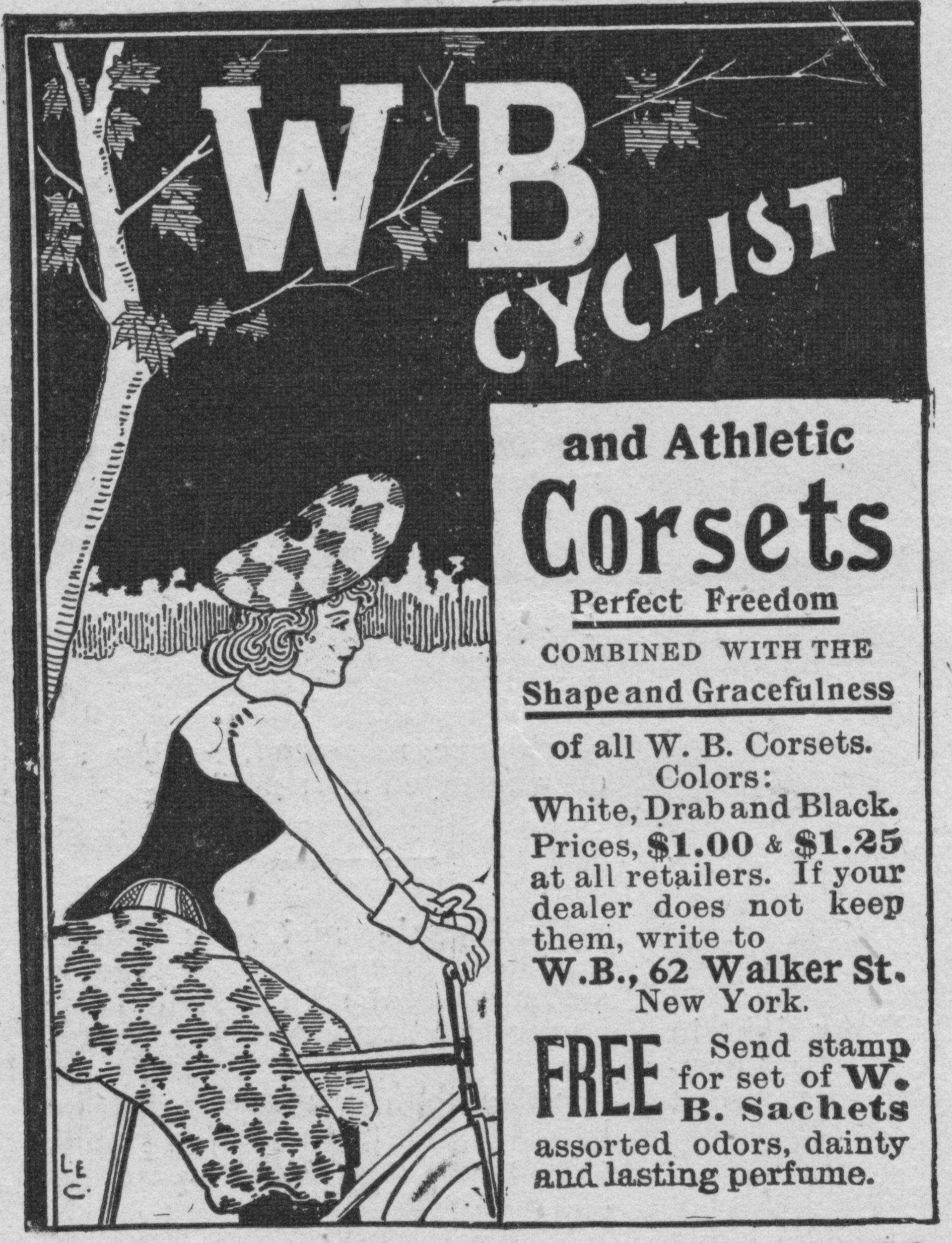
Tear sheet Advertisement for W.B. cyclist and athletic corsets Harper’s Bazar, March 21, 1896, p. 263 Courtesy of Fashion Institute of Technology| SUNY, FIT Library Dept. of Special Collections and FIT Archives
Alice Austen, one of America’s first and most prolific female photographers, not only captured these leisure activities on film, but also participated herself. She was a master tennis player, sailor, hiker, and horsewoman. And wherever she went, and whatever she did, she brought her camera. Her photographs of adults and children at play are the center of this exhibition. Tear sheets from fashion periodicals, advertisements, and newspaper articles from the time period, such as Harper’s Bazaar and Godey’s Lady’s Book, supplement Austen’s images. In addition, the exhibition includes two fully dressed mannequins: a woman’s croquet ensemble from circa 1884, and a bifurcated bicycling skirt and shirtwaist from circa 1895 and 1902, respectively. All garments are borrowed from the Graduate Study Collection at The Fashion Institute of Technology.

Tear sheet “Sport and Outing Costumes for Riding, Bicycling, Yachting, and Golf” Harper’s Bazar, March 12, 1898, p. 221 Courtesy of Fashion Institute of Technology| SUNY, FIT Library Dept. of Special Collections and FIT Archives
****Text by Jessica Barber
Lucile Ltd. wedding dress sketches

Lucile was the professional name of Lady Duff Gordon (1863-1935), one of the first British fashion designers to attain an international reputation. Rising to fame near the turn of the 20th century she opened branches of Lucile Ltd. in New York, Paris, and Chicago. She is frequently acknowledged as one of the first designers to train professional models and present live fashion shows. These events were invitational tea-time “mannequin parades” that employed theatrical lighting, music, souvenir gifts and programs. The dresses, which she called “gowns of emotion”, were listed in the programs using descriptive names like The Sighing Sound of Lips Unsatisfied or The Bleeding Heart. Lucile created complete ensembles accessorized with bags, shoes, and even parasols. She is best known for layered, draped garments departing from the restrictive corsetry and boned bodices common at the time. Her designs harmonized with the spirit of the new century of modernism and reform. The hallmarks of her design were colorful fabrics and generous trimming with sprays of hand-made flowers or ribbons, but she also added daring elements such as slit skirts and plunging necklines. A gown, she said must simply “express the wearer’s taste and individuality.” She dressed film and stage actresses and her celebrity clientele included Mary Pickford and Irene Castle. Lucile took advantage of opportunities for commercial endorsement, lending her name to advertising for shoes, perfume, and other luxury goods. She was the first to create a diffusion line, teaming with Sears Roebuck in 1916 to produce a mail order catalogue of ready to wear clothing. Lucile also wrote a weekly fashion column for the Hearst paper and monthly columns for Harper’s Bazaar and Good Housekeeping magazines. Lady Duff Gordon constructed Lucile as a cosmopolitan identity, created through clothing designs, and writings and endorsements as an arbiter of taste and style. Lucile Ltd. was a pioneer in the fields of public relations and lifestyle merchandising. Although these sketches were made after Lady Duff Gordon had relinquished control of Lucile Ltd. they still display her influence of elegant, modern design.

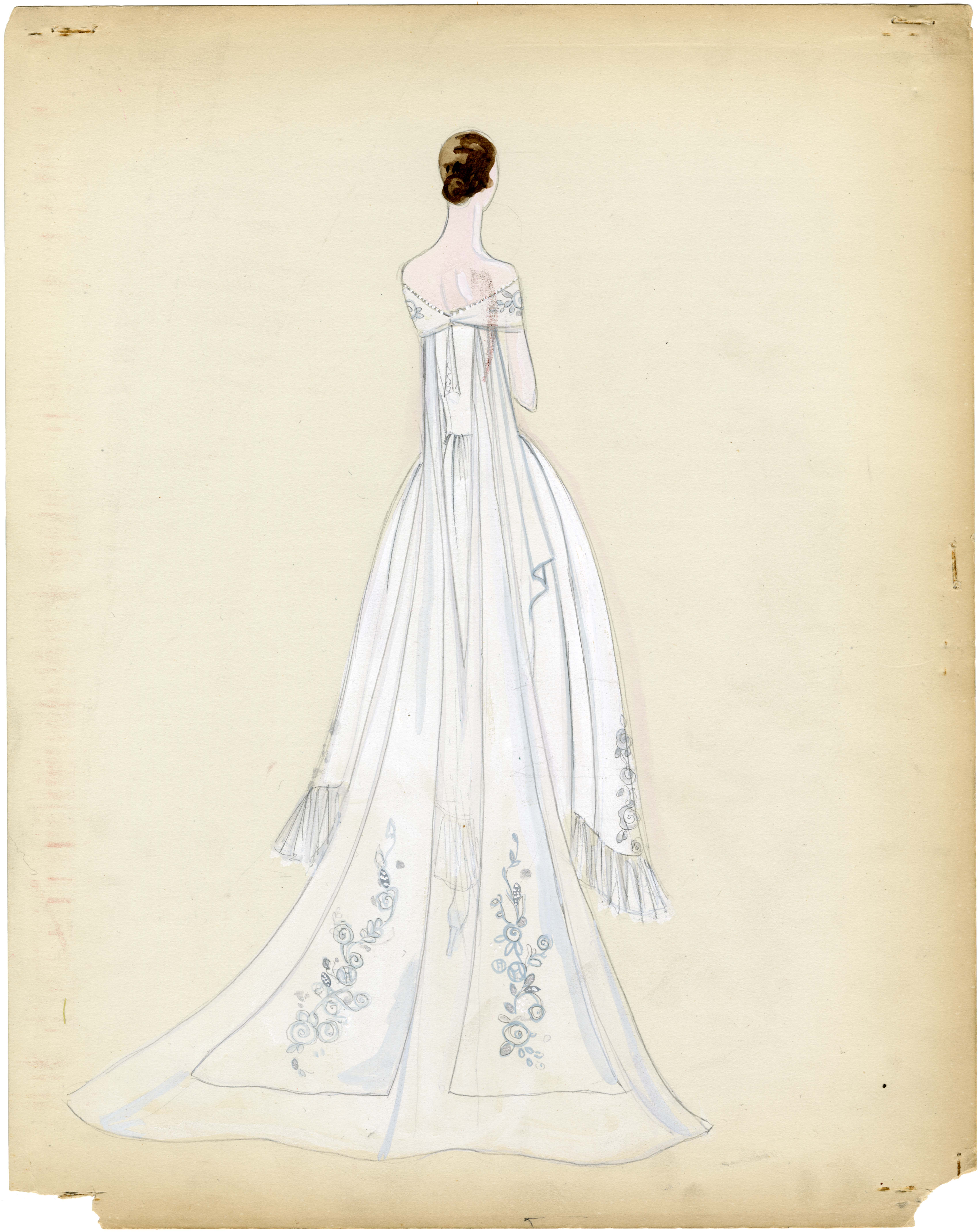
These digital prints are reproductions of original sketches of wedding dresses from the 1920s housed in the Lucile, Lady Duff Gordon collection in the Department of Special Collections and FIT Archives. The collection was arranged and described by Ashley O’Brien in the summer of 2010. It is comprised by approximately 11 linear feet of sketches, photographs, scrapbooks, and clippings.
The Department of Special Collections is and FIT Archives acquires, preserves, and provides access to a wide range of primary research materials in their original formats, including archives, scrapbooks, oral histories, fashion sketches, illustrations, books, journals, and other items. Subjects include the apparel industry, fashion and regional costume, textile design and the textile industry, the FIT Archives, and, to a lesser extent, art, architecture and interior design. Department personnel are committed to supporting research by FIT students and faculty as well as designers and researchers from the apparel and textile field, other industry professionals, and scholars.
In order to view these original works or other Special Collections material please email us at fitlibrary.sparc@gmail.com for an appointment.
CALL FOR PAPERS
Textiles and Politics
Textile Society of America 13th Biennial Symposium
Abstracts Due: October 1, 2011
The Textile Society of America invites paper proposals for its upcoming symposium, Textiles & Politics, to be held in Washington, D.C. September 19-22, 2012. We seek presentations from all textile-related disciplines and interdisciplinary areas, including but not limited to anthropology, art, art history, conservation, cultural geography, design, economics, ethnic studies, history, linguistics, marketing, mathematics, political science, and theater. TSA encourages both organized sessions and individual papers from scholars, researchers, artists, gallery and museum professionals, and others from around the world. Symposium proceedings will be published early in 2013.
The theme of Textiles & Politics befits the symposium venue in the U.S. capital and will generate a lively discussion about the ways politics influence the aesthetics, production, materials, uses, and myriad other aspects of textiles.
For further information about the 2012 symposium, TSA membership, and to submit a proposal, please visit: http://www.textilesociety.org/symposia_2012.htm.
Thanks for all of you who sent your family portraits. The winner of the book Alexander McQueen: Savage Beauty was randomly selected.
And the winner is…..

– Hazel Llanes


 ON PINS AND NEEDLES