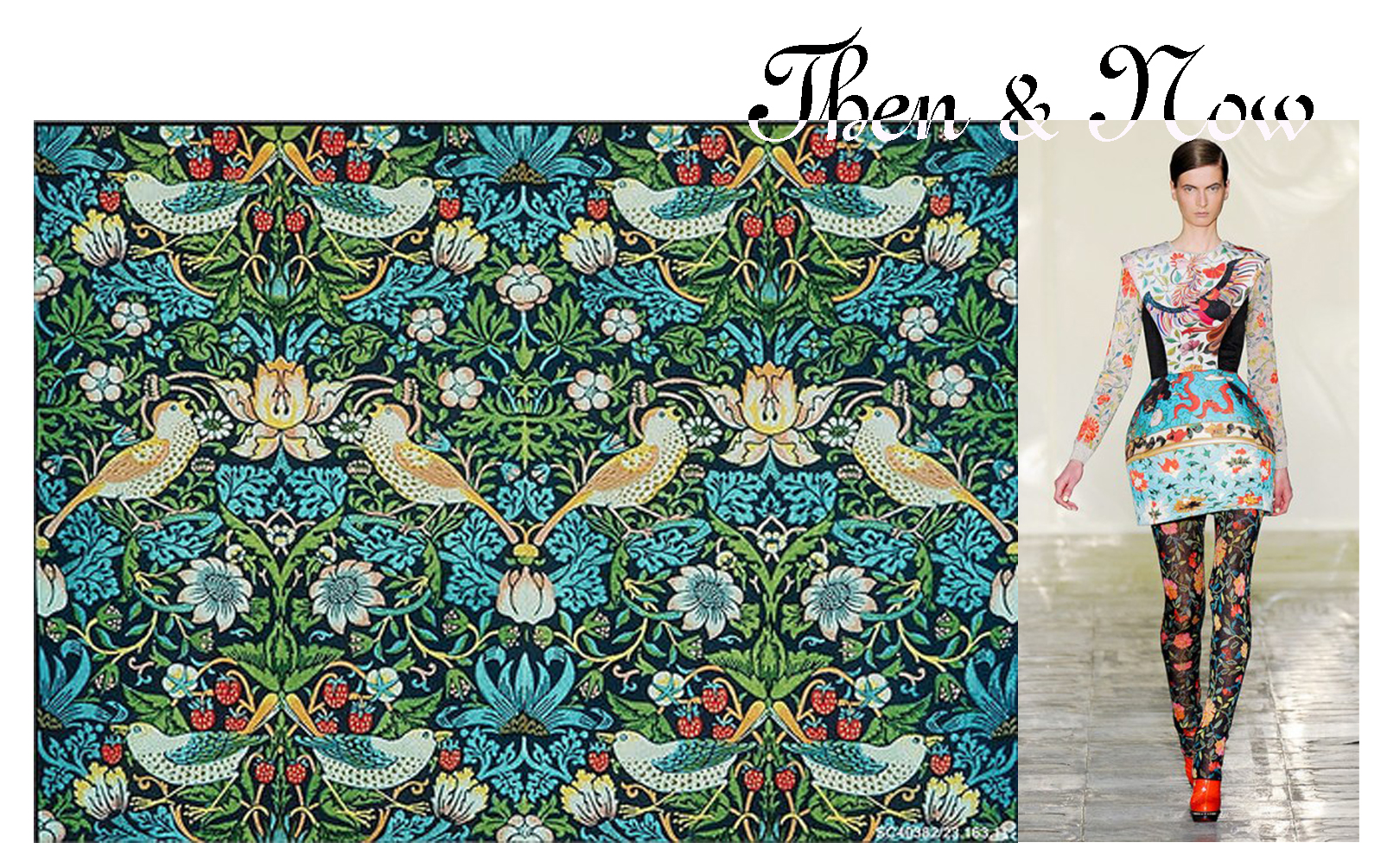
(left) William Morris, Strawberry Thief, 1883. MET; (right) Mary Katrantzou, Fall 2011 rtw.image from fiercerthanyou.com

(left) William Morris, Strawberry Thief, 1883. MET; (right) Mary Katrantzou, Fall 2011 rtw.image from fiercerthanyou.com

(left) Jerome Mendelson. January 1, 1942. Life Magazine. Photo: Marie Hensen. (right) Anthony in Tartan suit. Fashion editorial published in L’Uomo Vogue, December 1981. Photo: Amy Arbus.
I came across this wonderful picture on the funny website awkwardfamilyphotos.com
 which of course made me think of the famous scene in ‘The Sound of Music’, in which Maria makes clothes for the kids out of curtains.
 I’ve seen this film countless times, and this scene is not only my favorite it was also a great influence on my interest in fashion and clothes. Today the idea of reusing fabric is even more relevant as many designers and brands raise issues of environment-friendly fashion. personally I doubt commercial fashion can ever be “green.” The reason I find these two images so appealing is they present individuals who chose a uniformed appearance to distinct themselves as a group. And they do it in a charming and playful way.
Check out this video, from the exhibition Rodarte: States of Matter at MoCA. The show runs through June 5th and includes twenty objects in black and white from Rodarte’s previous collections, as well as several ballet costumes from the film Black Swan.
check out this link for some images from the upcoming Alexander McQueen exhibition at the MET which opens May 2nd.
 By Christian Hernandez
 When studying the history of fashion, the breadth of potential people and companies to study is vast since, to the pleasure or disdain of historians, the amount of history only increases with time. But what about those who’s names time has forgotten? As a graduate student it is not uncommon to come across names that are less easy to research. Rather than using it as an obstacle I see it as a treasure hunt.
If I were to tell you the last names Ferrè, Fath, Ferragamo, Fortuny or Ford, you could possibly guess all of their first names; Gianfranco, Jacques, Salvatore, Mariano, and Tom respectively. But what about Falkenstein? If you can’t then that is of no surprise. Most people don’t know that Arthur H. Falkenstein was, at one time, shown side by side with Charles James, Hattie Carnegie and Mainbocher in Virginia Pope’s coverage as a fashion journalist for the New York Times. In the press his name was always given in full, sometimes with his middle initial included, even though his label only listed his last name. Why his name hasen’t stood the test of time like his contemporaries remains to be found, but from what I gather, he wasn’t as much of a public figure, keeping to his studio and serving his clients, unlike Mainbocher, who let the fashion world know of his presence from his times as the Paris fashion editor for American Vogue, and then as the editor of the Paris edition of Vogue.

Virginia Pope New York Times Article comparing Mainbocher to Arthur Falkenstein. September 27th, 1942
There is very little information out there on Arthur Falkenstein. Even his birth and death dates remain a mystery to me. In my research I came across 6 obituaries and one engagement notice that mention an Arthur Falkenstein, although never one for the man in question. I believe that these are for at least three if not four or more Arthur Falkenstein’s that lived in New York area. After many hours of continuous hunting I will resign myself to the fact that all I can find for a date range is that he was active during the late 1930’s to the beginning of the 1950’s. He may still be alive for all I know, although if that is the case, he is close to if not past 100 years old.
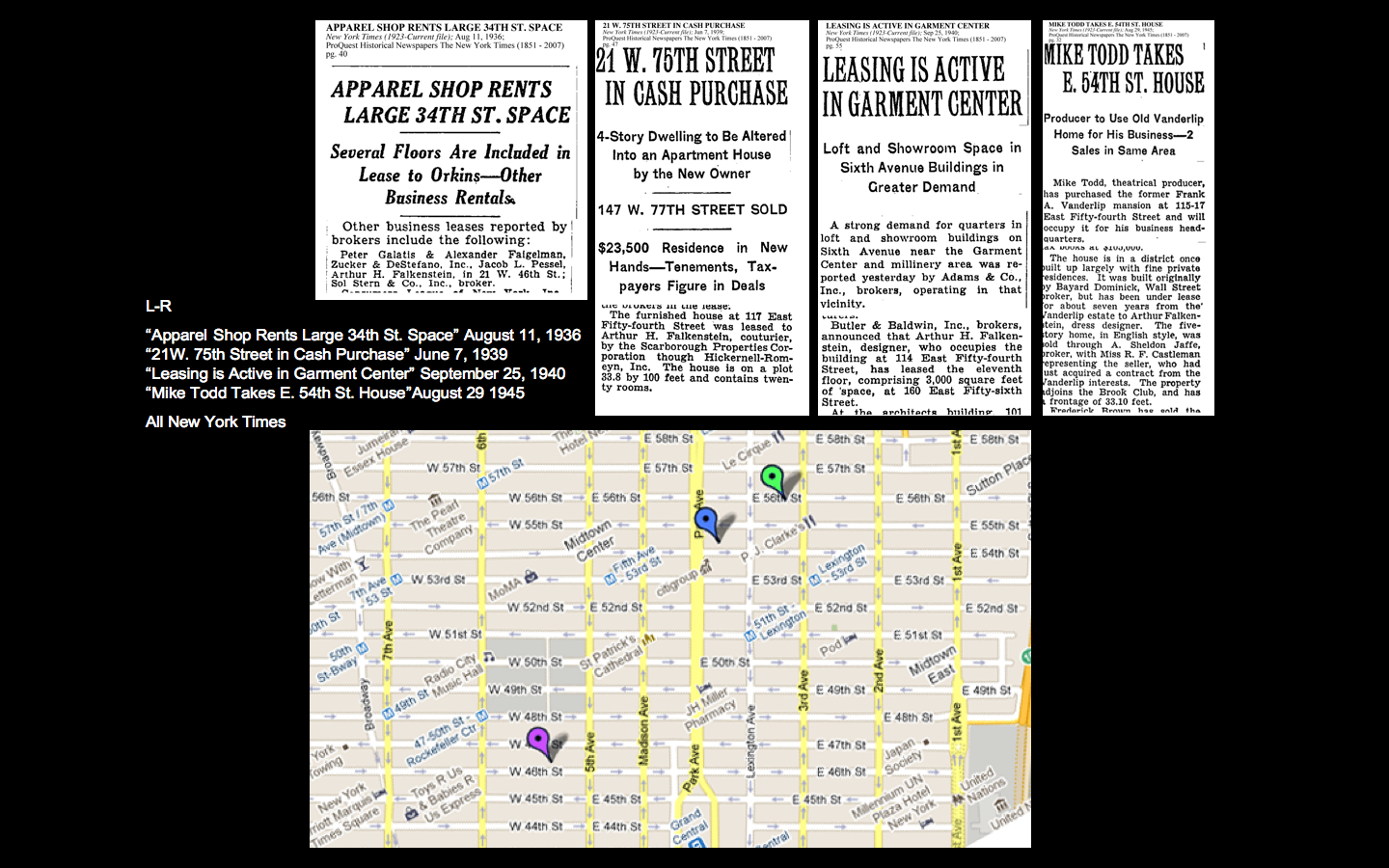
A second question, which is more easily answered, is where he worked . According to four articles I could find in the New York Times, he moved into his West 46th and 5th street storefront in 1936 (purple marker). Three years later in 1939 he moved into a small house on East 54th and Park (blue marker). The following year he either moved his storefront or expanded to a second location at East 56thand Third (green marker). And at the closing of the war in 1945 the building he was living in at East 54th and Park was sold to Mike Todd, a theatrical producer. I have not visited any of these location yet but I will be in the near future.

Arthur Falkenstein coat from the Metropolitan Museum of Art, c.1948
These little nuggets of information are only really useful when playing a rousing game of “name all the fashion designers you can” but I bet that there are a few Falkenstein’s hiding in closets, attics and shops all across the US just waiting to be found. His clothing can be found in museum collections (FIT, MET, LACMA) and being sold online in various places. Not to sound like an investigator, but if you or anyone you know has any information on Arthur Falkenstein, please contact me at cmhyyz@gmail.com. Although my project is over I am still on the hunt for more information.
The pursuit of ideal beauty in any given culture has historically involved some modification of the human body. The practice of manipulating flesh for the sake of beauty spans the whole of human history, and many myths regarding the lengths to which women will go to achieve perfection exist throughout the body of fashion studies. Perhaps no other era has spawned more controversies on the subject of figural distortion than the late nineteenth century. It was during this time that the centuries-old practice of wearing what was later termed the “corset” became the subject of serious health concerns, due in part to the practice of tight-lacing among a minority of the fashionable population. This paper will examine myths about the corset that originate from this period of the undergarment’s history, which label its wearers as frivolous, vain, and willing to undergo surgical procedures in the pursuit of an ideal figure. These negative perceptions persist in twenty-first century popular culture despite a lack of medical evidence. This paper will also explore ideas about the corset as a signifier of feminine power and eroticism in the history of fashion. How has the “corset” changed – in name and symbolism – and how have our clouded perceptions contributed to the mythology of this misunderstood undergarment?

fragile or powerful? The corseted body
Undressing the Fashionable Myth Symposium. Saturday May 7th, Robert Lagary Board Room, Marvin Feldman Center 9th Floor, Seventh Ave at 27th street.
This event is free and open to the public. To register please call 212-217-4319 or email gradrsvp@fitnyc.edu
Ancient Greek costume has also been an inspiration for fashion since the Renaissance. Most of the information that we have on the costume of the Ancient Greeks is derived from stylized renderings on painted pottery or statues, or from translated texts in which dress is incidental to the topic. Many academic texts that deal with the fashions of antiquity refer back to earlier works on the subject, meaning that some “facts” can be traced back to scholarly papers from the late Victorian era, which have been accepted as truth without the evidence being given a fresh look.
Many of the design elements traditionally considered Greek – or rather “Grecian,” as the fashion press tends to say – derive from a misunderstanding of Greek art, taking the functional for the decorative or the particular for the general. In a sense, we have created our own “Greek style” which bears little relation to historical tradition.
“The Greek Myths of Fashion” addresses the myths created by nineteenth-century archaeologists and art historians and those created by twentieth-century fashion designers: both arising from misconceptions, but spreading in different ways and filtering into the mainstream consciousness of history.
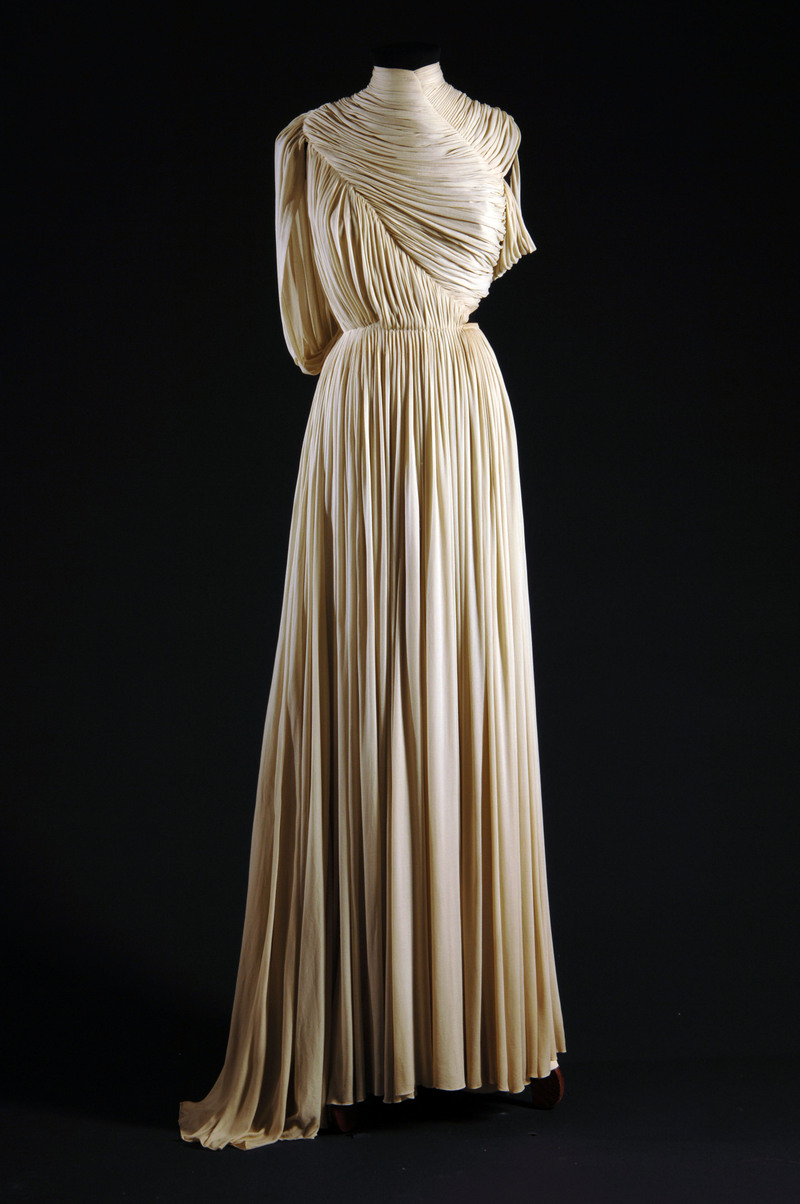
Is this what the Greeks really wore? Alix (Madame Grès) Evening dress of ivory silk jersey, 1938. Collection of Hamish Bowles
Undressing the Fashionable Myth Symposium. Saturday May 7th, Robert Lagary Board Room, Marvin Feldman Center 9th Floor, Seventh Ave at 27th street.
This event is free and open to the public. To register please call 212-217-4319 or email gradrsvp@fitnyc.edu
Couture or Not Couture?
Undressing the Fashionable Myth SymposiumSaturday May 7th,Robert Lagary Board Room, Marvin Feldman Center 9th Floor, Seventh Ave at 27th street.
This event is free and open to the publicTo register please call 212-217-4319 or email gradrsvp@fitnyc.edu

Eleanor of Toledo (and detail), 2006, inspired by a ca. 1545 portrait of Eleanor and her son Giovanni de’ Medici by Agnolo Bronzino in the collection of the Galleria degli Uffizi, Florence. Photo: René Stoeltie.
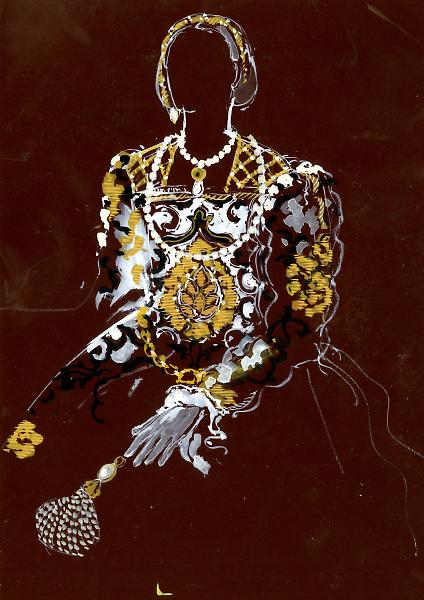
Isabelle de Borchgrave, sketch for Eleanor of Toledo, 2006, inspired by a ca. 1545 portrait of Eleanor and her son Giovanni de’ Medici by Agnolo Bronzino in the collection of the Galleria degli Uffizi, Florence. Photo courtesy Créations Isabelle de Borchgrave

Portrait of Eleanor of Toledo and her Son, Giovanni de Medici, c.1544-45 (tempera on panel) by Bronzino, Agnolo (1503-72) tempera on panel 115x96 Galleria degli Uffizi, Florence, Italy
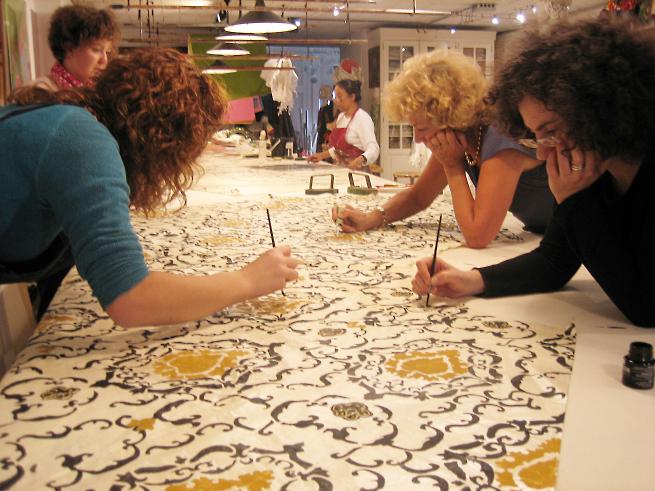
Isabelle de Borchgrave and studio collaborators at work on a piece inspired by Agnolo Bronzino’s portrait of Eleanor of Toledo, 2006. Photo: Courtesy Créations Isabelle de Borchgrave
***All images are from the Legion of Honor website, too see more from this exhibition go to http://legionofhonor.famsf.org/legion/exhibitions/pulp-fashion-art-isabelle-de-borchgrave


 ON PINS AND NEEDLES