Mystery Monday

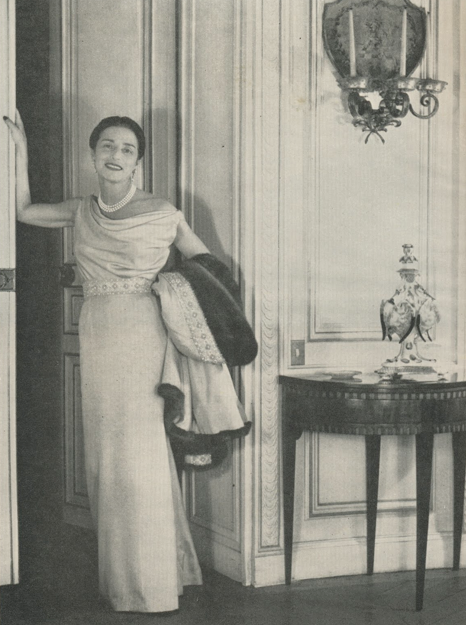
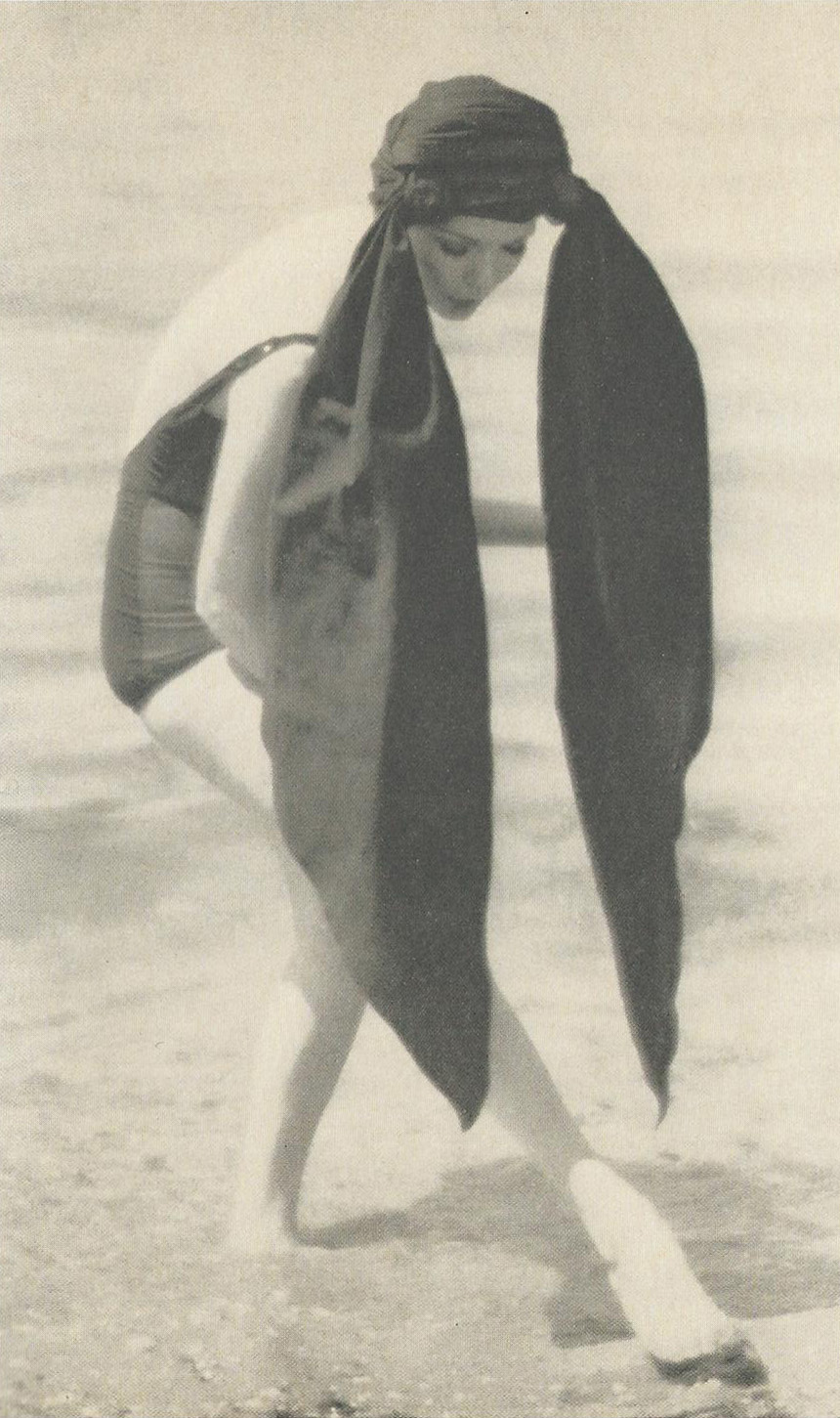
I am inspired by successful, intelligent women who work tirelessly yet always look fabulous. How do they stay si soignées?

Here’s this week’s mystery:Who is this elegant woman? What was her profession?

Think you know, readers? Submit your guesses below; we’ll post the answer on Thursday!

Posted in Mystery Mondays | Tagged | 2 Comments

Fashionista Friday – Women Suffragists of the United States

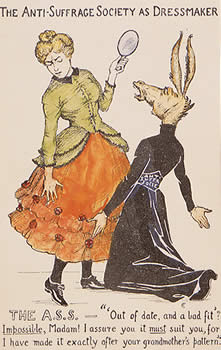
A woman is fitted in a woefully out-of-style crinoline. “The Anti-Suffrage Society as Dressmaker,” Suffrage Atelier, ca. 1909-1912, Museum of London.

Although this image is from the English women’s suffrage movement, the message still pertains to its American counterpart: as unbecoming as an old fashion is, so are asinine outdated social rules.  Just as fashion progresses, so does society, and in the nineteenth century the women’s suffrage movement worked towards advancement.

In the United States, 1920 was the first year when millions of women exercised their right to vote.  The women’s suffrage movement had had its seeds planted nearly one hundred years earlier, prior to the advent of the Civil War. It is impossible to say that woman’s suffrage had a style of its own, but Fashion has a way of permeating social movements, feminist women’s rights endeavors included.

Within the timeframe between the 1850s and 1920, women’s fashion went through many changes: bulky petticoats gave way to the cage crinoline; skirt shapes shifted from voluminous circles to grand ellipses; the bustle grew, then contracted, then returned, then slimmed for good; sleeves puffed higher and wider; backs were swayed; skirts were hobbled; a tiny bit of ankle dared to show itself.  Fashion went through its own motions, and a woman could not be labeled as pro- or anti-suffrage simply based on her clothing.

Many women’s rights activists were quite anti-fashion.  Elizabeth Cady Stanton, one of the most influential women’s rights reformers, claimed that fashionable dress was an acceptance of female oppression.  Sojourner Truth, a freed slave who joined the women’s rights movement, remarked “What kind of reformers be you, with goose-wings on your heads, as if you were going to fly, and dressed in such ridiculous fashion, talking about reform and women’s rights? ‘Pears to me, you had better reform yourselves first.”

Perhaps one of the most well-known quirks in women’s fashion in the nineteenth century is due to Amelia Bloomer, a women’s rights activist, who boldly began wearing wide, billowing trousers gathered at the ankle with a short, full skirt over them.  The look was ridiculed in the press.  Whether it was viewed as immoral, ugly, or in conflict with the view of what a woman’s place in society should be, it was not widely copied and did not catch on to the mainstream.
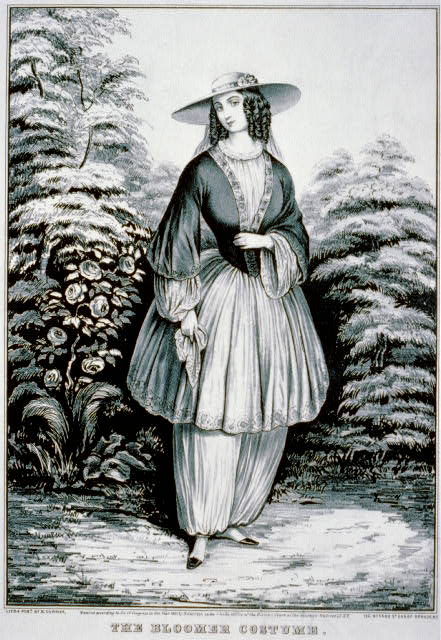
Woman in Bloomer costume, 1851, Library of Congress.

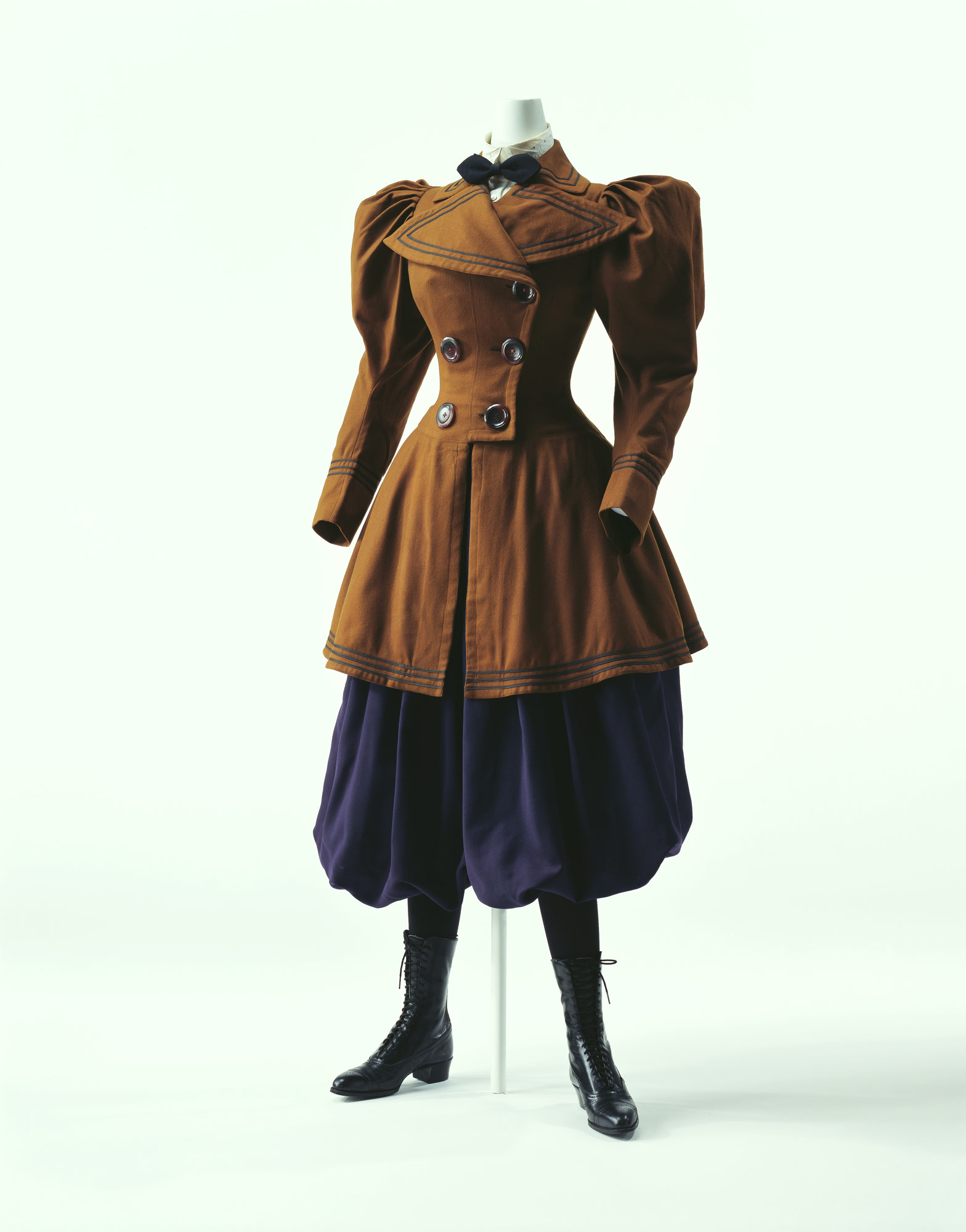
The women’s suffrage movement was derailed by the Civil War, which shifted focus to other areas of social reform.  By the 1890s, the United States ushered in the Progressive Era, and the concept of the New Woman was introduced—a woman who worked in an office, sought higher education, and participated in active sports—and women’s fashions reflected their changing place in society.  Daywear lost its frills and furbelows and became more tailored, similar to menswear.  University students favored skirts with a shirtwaist.  And the sports craze of the 1890s gave way to the acceptance of calisthenics-appropriate attire for women who golfed, played hockey and tennis, and bicycled in public.  Trousers and knickerbockers were accepted as appropriate wear for women while engaging in sports.
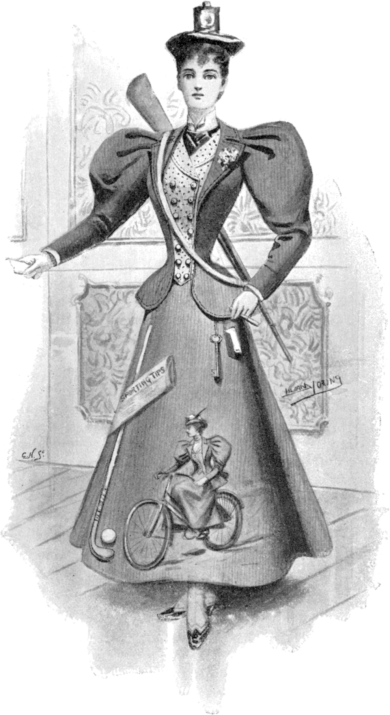
“New Woman” Fancy Dress Costume, Fancy Dresses Described, 1896.

Cycling costume, American, c. 1895, Kyoto Costume Institute.

By the 1910s, women were granted limited voting rights in a few Western states.  Across the Atlantic, Paul Poiret was making advances in fashion that had not been seen—namely in the form of long, corset-less silhouettes and hobble skirts with hems so tight they impeded the gait.  “I freed the bust and shackled the legs,” he is said to have boasted.

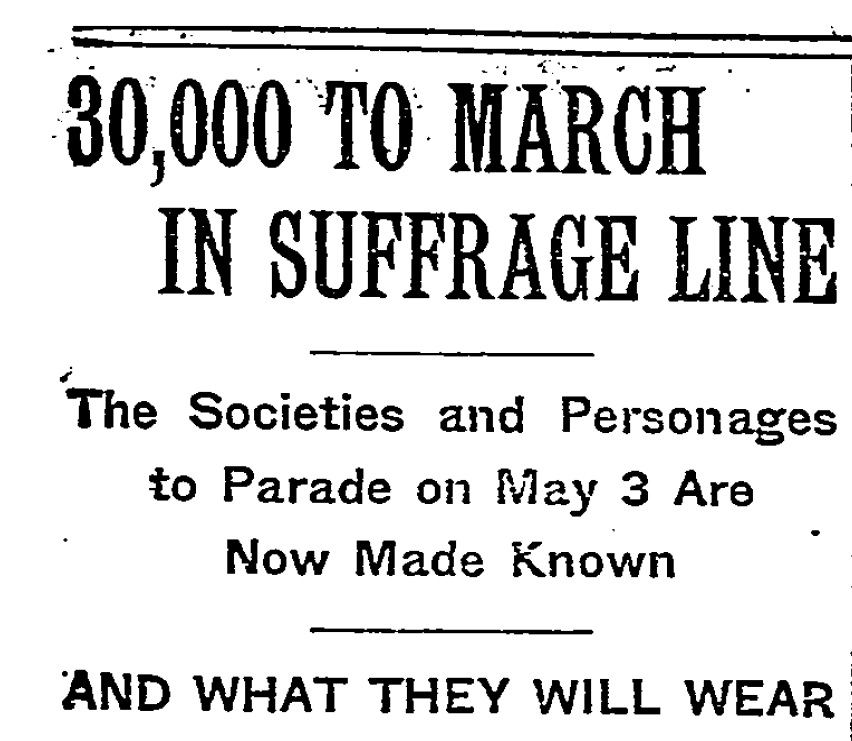
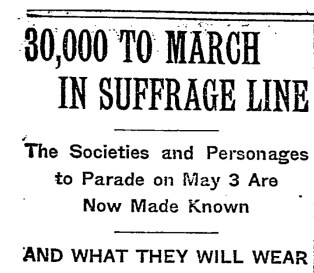
Poiret’s designs may have prevented women from taking great strides, but not their ability to march.  Women by the thousands gathered at parades to demonstrate for women’s suffrage, the largest being in New York City in 1913, when 30,000 gathered to march up Fifth Avenue.  According to this New York Times headline of April 25, 1913, what they were wearing was clearly of great concern.
World War I served as the final push to pass the Nineteenth Amendment to the Constitution, ensuring that women in all fifty states had the right to vote.
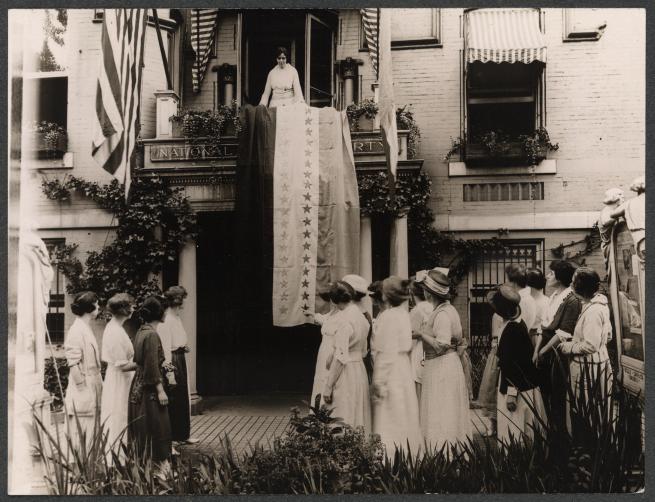
Photograph of Alice Paul standing over ratification banner hanging from the balcony of the National Woman’s Party headquarters, with members watching outside the building below. August 18, 1920. Library of Congress.

In the United States, next Tuesday is Election Day, and however you choose to cast your ballot, take a moment to remember the women who fought long and hard for that right.  Just make sure your fashionable sleeves fit into the booth!

“A Squelcher for Woman Suffrage. How Can She Vote, When the Fashions Are So Wide, and the Voting Booths Are So Narrow?” Anti-suffrage cartoon, Puck, 1896, Library of Congress.

Resources
Butler, Mary G.  “The Words of Truth: Sojourner Truth Speeches and Commentary.”  Sojourner Truth Institute.  http://www.sojournertruth.org/Library/Speeches/Default.htm (accessed November 1, 2012).
Cunningham, Patricia A.  Reforming Women’s Fashion, 1850-1920: Politics, Health, and Art.  Kent, OH: Kent State University Press, 2003.
“Fashioning the New Woman: 1890-1925.” DAR Museum.  http://www.dar.org/museum/musnews.cfm (accessed November 1, 2012).
Finnegan, Mary Margaret.  Selling Suffrage: Consumer Culture & Votes for Women.  New York: Columbia University Press, 1999.
Holt, Ardern.  Fancy Dresses Described, or What to Wear at Fancy Balls. 6th ed.  London: Debenham and Freebody, 1896.
Poiret, Paul. King of Fashion: The Autobiography of Paul Poiret. 1931. London: V&A Publishing, 2009.
Posted in Fashionista Friday | Tagged , , , , , , | 6 Comments

Mystery Monday: The War Hero and His Wellingtons

Rain boots, galoshes, wellingtons… an invention of Arthur Wellesley!

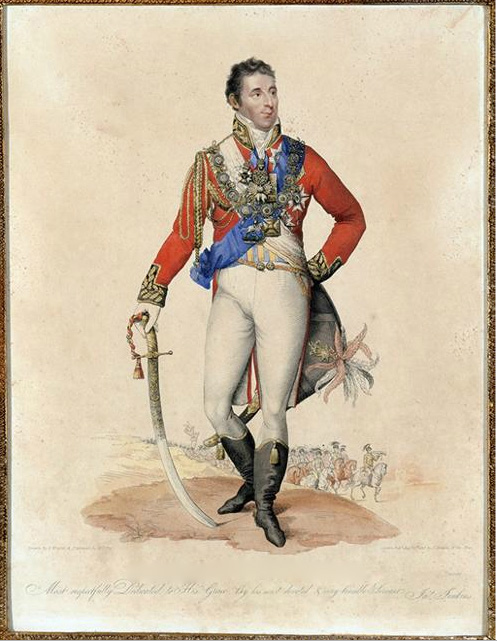
Fry, William Thomas. Portrait of the Duke of Wellington, 1815. Color engraving, 50 x 40 cm. Image from Réunion des Musées Nationaux, Art Resource, New York.

According to the Victoria and Albert Museum, “Wellingtons first appeared at the time of the Napoleonic Wars, when the army became more socially visible and military costume influenced fashionable dress. Another boot with military links was the Blucher, a laced boot named after the Prussian General Gebhart von Blücher, who played a decisive role alongside Wellington in the Battle of Waterloo in 1815” (2).

Arthur Wellesley, the Duke of Wellington, is a well known military hero, politician and womanizer. On the evening of his most famous military victory, The Battle of Waterloo, he wrote the following: “It has been a damned nice thing – the nearest run thing you ever saw… ‘I never took so much trouble about any Battle and never was so near being beat” (1). This victory brought him success and recognition, and apparently, some sartorial admirers.

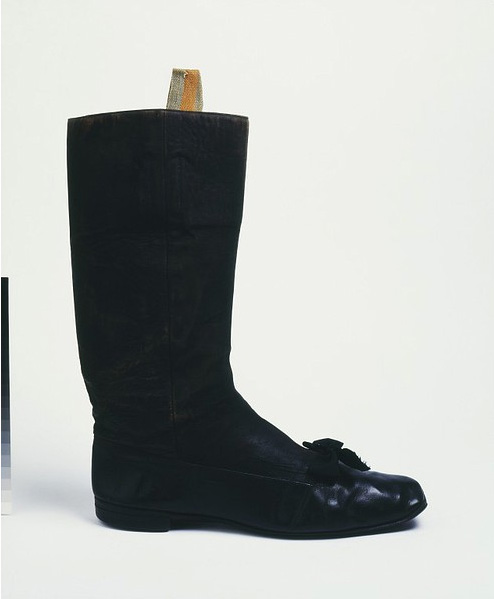
According to legend, the wellington boot is a variation of an 18th-century Hessian military boot. Sometime after the Battle of Waterloo, Wellesley directed his shoemaker, Hoby of James’ Street, to create a boot more suitable for the newly stylish trousers. This new, tailored boot still rose to the knee, but the new slim cut, sans trim, fit suitably under the trouser leg. Made of calfskin, the boot was nicknamed the “wellington” and men in Wellesley’s social circle, the gentlemen of England, soon adopted it into their wardrobes, possibly seeking to emulate the famed war hero.

In The Whole Art of Dress, a book published in 1830,  a cavalry officer cites the origins of the Wellington: “This boot is invented, doubtless, for the mere purpose of saving trouble in dress; for without attending to silk stockings or the trouble of tying bows, you have merely to slip on the boots and you are neatly equipped in a moment” (2).

As the wellington gained popularity, new versions of the boot were created, including the dress wellington, a style suitable for evening.

Dress Wellington, c 1840. Black leather, with suede leg and silk bow, hand- and machine-sewn. From the Victoria and Albert Museum.

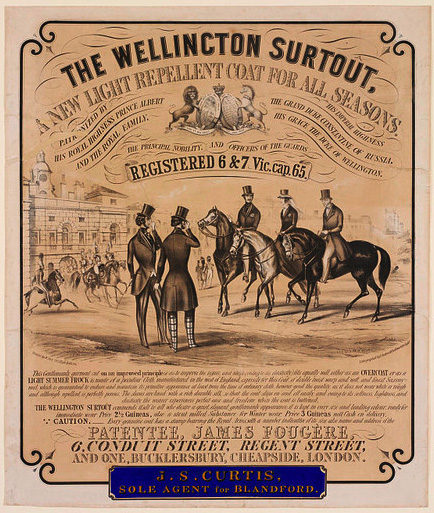
By the 1840’s, the name wellington had become ubiquitous for an all-weather garment of quality. The Victoria and Albert Museum collection includes this poster:

Sexton (lithographer) Dix, W. (printer). Poster, The Wellington Surtout,1845. Tinted lithograph printed from two stones with added hand-lettering. From the Victoria and Albert Museum.

According to the museum, “This early example of a lithographic poster advertises a men’s raincoat. It depicts a young Queen Victoria and Prince Albert accompanied by the Duke of Wellington riding past Horse Guards, invoking royalty and celebrity to sell the product…. The poster includes descriptive text extolling the technical qualities of the raincoat. The Wellington Surtout appears to be a successor to the 18th century water-repellent ‘hard’ tartan overcoats. It may have been a more stylish alternative to the coats made from rubberised cloth invented in the 1820s” (2).

After the 1840s, wellingtons continued to grow in popularity, changing from calfskin to rubber. This practical, waterproof design brought the stylish boot back to the battlefield, where soldiers wore wellingtons in the wet and cold trenches of World War I and in inclement weather during World War II. The boot remains a wet weather classic, appearing intermittently in fashion magazines throughout the twentieth century. A few years ago, wellingtons again became a fashionable rainy day necessity; especially prized were those bearing the Hunter label.

So, lest you falsely believe that the marriage of celebrity and fashion is a recent invention, remember Arthur Wellesley — politician, womanizer, military hero, celebrity, and fashion plate. He is just one of many!

Notes:
1. “Arthur Wellesley, the Duke of Wellington” http://www.spartacus.schoolnet.co.uk/PRwellington.htm
2. “Search the Collections” http://collections.vam.ac.uk/
Posted in Mystery Mondays | Tagged , | Leave a comment

Mystery Monday

As Hurricane Sandy arrives, and those of us on the East Coast prepare to wait out the storm (and perhaps wade through the aftermath), here’s another mystery for you:

Who is this dapper gentleman? What fashion accessory bears his name?

Submit your guesses below; we’ll reveal the answer on Thursday.

Posted in Uncategorized | 2 Comments

Fashionista Friday: Alice Vanderbilt in Fancy Dress

Alice Vanderbilt as “Electric Light.” March 26, 1883.  Dress by House of Worth.

Halloween is fast approaching—do you know how you’ll be dressing up?  Perhaps you’ll take a cue from Alice Vanderbilt and go as Electric Light.

Or follow the lead of this young lady, who “daringly assumed the character of a ‘lady brigand’, carrying mock pistols and a rifle”:

“Lady Brigand” Fancy Dress. Ca. 1890-1900. Manchester Galleries.

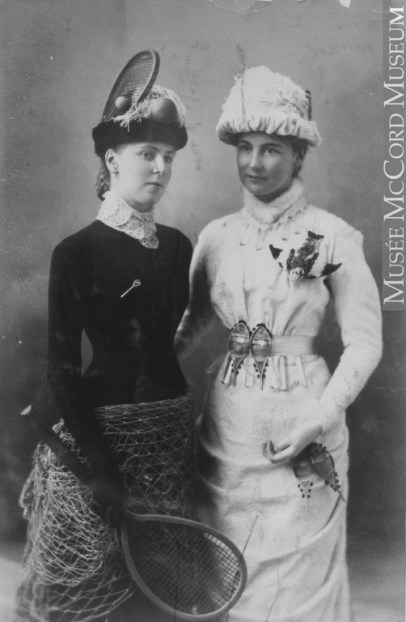
Or Miss Allen and friend, who went as Tennis and Winter:

Miss Allan and friend as “Tennis” and “Winter.” Montreal, QC, 1881. Musee McCord.

The practice of dressing in disguise has been around for centuries, but these days we tend to mostly relegate the practice to Halloween, and to other festivals and holidays such as Purim and Carnivale/Mardi Gras to a somewhat lesser extent.

In the nineteenth century, fancy dress parties were quite the rage, and no holiday was necessary to throw one.  Thomas Hales Lacy published two volumes of Lacy’s Dramatic Costumes in the 1860s, one for men and one for women, with over 200 plates each of “historical, national, and dramatic costumes.”  Ardern Holt’s Fancy Dresses Described was published in no less than six editions between 1879 and 1895.  Holt offers hundreds of fancy dress ideas with suggestions on how to create the costume and on whom it might be especially flattering; these books were supplemental to the fancy dresses offered for sale at Debenham’s department stores.  Contemporary fashion publications, such as Godey’s and La Mode Illustrée also celebrated the art of fancy dress.

Ideas ranged from historical, such as Renaissance Italianite:

“Italian Lady—1550” fancy dress. Lacy’s Dramatic Costumes: Female. 1865.

Or an animal, such as a bat:

“Bat” fancy dress. La Mode Illustrée. 1887.

Or a completely abstract concept, such as air:

“Air” fancy dress. Fancy Dresses Described. 1887.

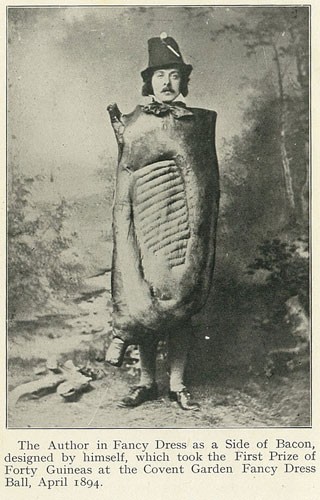
Men dressed up, too.  This gentleman attended a party dressed as a side of bacon.

Remarkably, for the most part, fancy dress didn’t depart much from typical nineteenth century silhouettes (the above bacon example notwithstanding)—the figures were still properly corseted and bodices and sleeves reflected what had been in vogue at the time.  Suggestions to the identity of the fancy dress came in the form of appliques, collars, masks, and color choices, not necessarily a change in the cut of a typical garment.

However, while in fancy dress, it was acceptable to appear in public in a shorter skirt than a proper floor-length dress, with the ankle and maybe a little bit of calf showing.  It’s amusing that the Victorians allowed a little more of the human form to show while in costume—much the same way that today, Halloween is synonymous with wearing costumes that show a lot of skin!

But of all the creative and fun Victorian fancy dress suggestions, why would I pick Alice Vanderbilt as your featured Fashionista for this Friday?  I guess I can’t resist the decadence of a one-time use dress created by the House of Worth!

Resources
Holt, Ardern.  Fancy Dresses Described, or What to Wear at Fancy Balls. 5th ed. London: Debenham and Freebody, 1887.
Lacy, Thomas Hale.  Lacy’s Dramatic Costumes: Female.  London: Samuel French, 1865.
La Mode Illustree.  January 9, 1887.
Posted in Fashionista Friday | Tagged , , , , | 5 Comments

Mystery Monday: Halston, The Hat Man

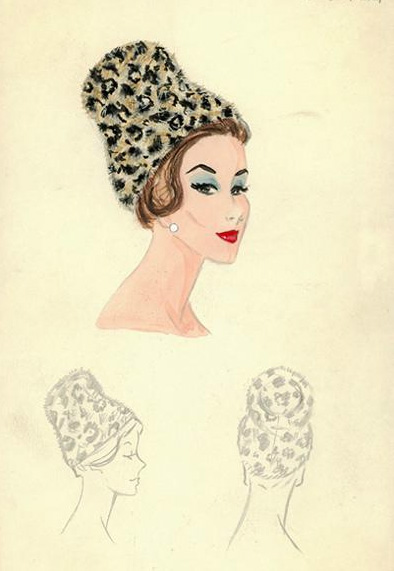
Halston for Bergdorf Goodman. Sketch of a leopard skin shaped toque, Fall 1960. Pencil and watercolor, 5.5″ x 7″. From The Halston Hats Collection at the FIT Library Department of Special Collections.

Cloche hats, toques, doll hats, and snoods…yes, this is one of Halston’s designs!

When many of us think of Halston, we think of heady perfume, sultry synthetics and Studio 54.  Most of the world remembers Halston for his designs and his luxurious lifestyle, but before the sequins, glamor, and star-studded parties, there was only the young Roy Halston Frowick, an ambitious young milliner.

Born in Des Moines, Idaho in 1932, Halston showed an aptitude for sewing and for design at an early age. He attended the University of Indiana but never graduated, and in 1952, he moved to Chicago to explore career opportunities. While in Chicago, “Fro” studied at the Art Institute while working as a window dresser. In 1953, Fro was given the opportunity to work alongside a hair stylist, André Basil, who provided a small space in his elegant salon for Fro to create and sell hats. The press soon discovered Fro, renaming him Halston as they reported on his latest designs. In 1956, Lily Daché discovered Halston, and noting his talent, later brought him to New York to work in her millinery studio.

Halston for Bergdorf Goodman. Black, red and green doll hat with front knot and veil, Fall 1959. Pencil and watercolor, 5.5″ x 7″. From The Halston Hats Collection at the FIT Library Department of Special Collections.

In 1958, less than a year after moving to New York to work with Lily Daché, Halston was promoted to co-designer, but left to work at Bergdorf Goodman.  To Halston, a hat was “a covering which is supposed to make you glamorous, exciting, and more interesting than anyone else.” Bergdorf Goodman was the perfect place for the ambitious designer, who created whimsical styles for celebrities and socialites until 1966, when his first clothing collection premiered in June.

Halston Studio for Luksus. Black feathered crest shaped hat, 1960s. Pencil and watercolor, 5.5″ x 7″. From The Halston Hats Collection at the FIT Library Department of Special Collections.

“From the early to the mid-sixties, Halston’s style in millinery was both well and widely documented on the covers and in the editorial sections of Harper’s Bazaar and Vogue. In most cases, his designs were dramatically oversized and overscaled with what one journalist called ‘sky-rising silhouettes’; yet they also incorporated the remarkably clean and simplified lines that defined his later fashions.”  – from Halston [Mears and Bluttal], page 27

Halston Studio. Large snood shaped hat of oversized fuzzy pompoms in contrasting colors, 1960s. Pencil and watercolor, 5.5″ x 7″. From The Halston Hats Collection at the FIT Library Department of Special Collections.

Halston Hats on covers of Harper’s Bazaar, April 1963 and April 1964. Found in Halston.

Halston headpiece. Harper’s Bazaar, July 1962. Photo: Martin Munkacsi. Found in Halston.

One of his more familiar designs is the pillbox hat he created for Jackie Kennedy Onassis.  She became a life-long client, sending him letters, like this request for a dress in a particular hue:

Letter from Jacqueline Kennedy Onassis to Halston, 1976. Collection: Andy Warhol Museum. Found in Halston.

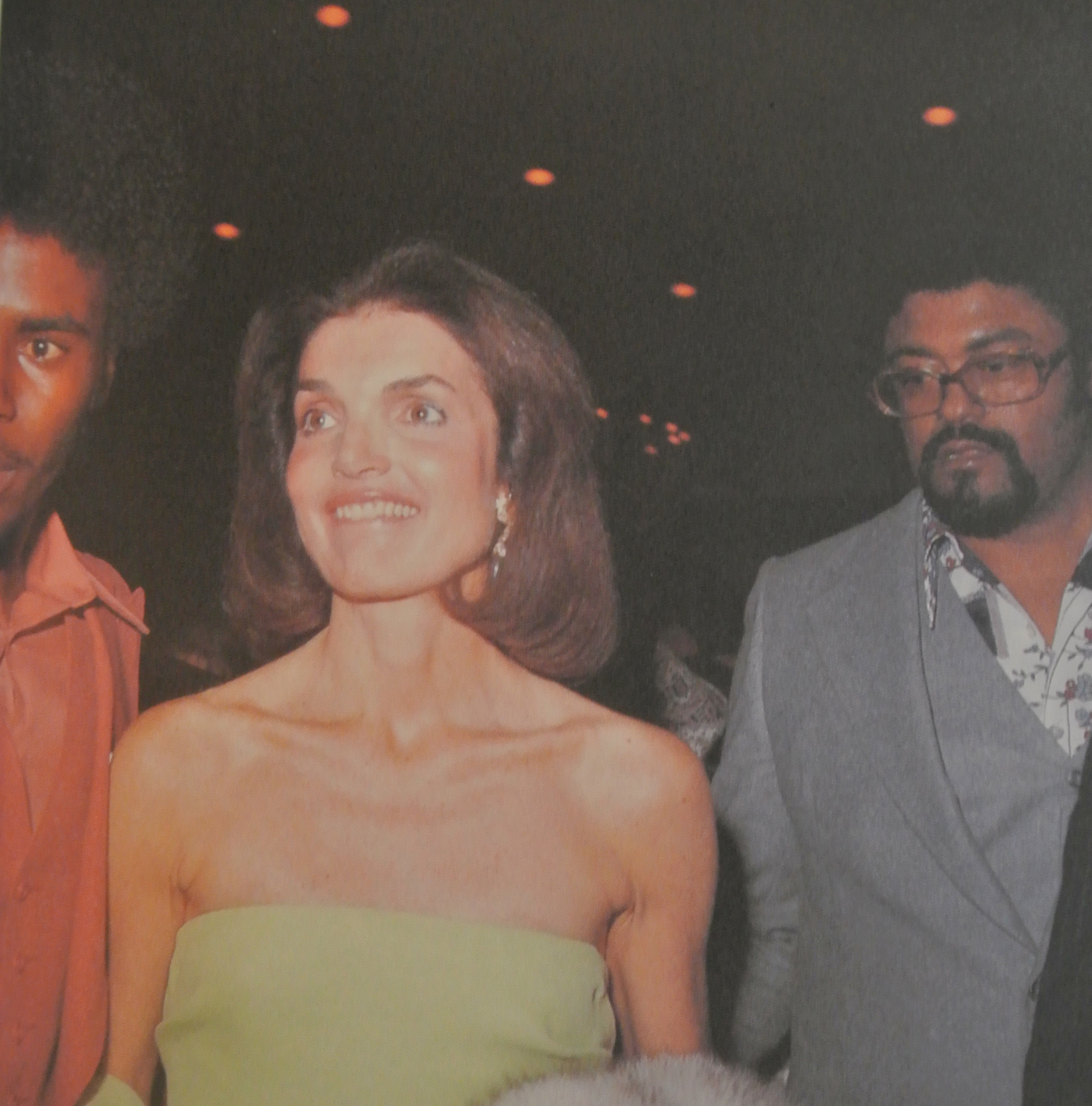
Jacqueline Kennedy Onassis at benefit, New York, 1976. Photo: Globe Photos. Found in Halston.

Halston’s rise to fame and precipitous decline ended with his death in 1990. His talent for creating accessories and clothing that accentuated a woman’s face and form is well documented in photos and through the words of his admirers. Diane Vreeland once said:  “He was probably the greatest hatmaker in the world. I’d say to him, ‘H., I had a dream about a hat last night’; and I’d go about describing it, and then, by God, he’d give it to me line by line.”

The New York Times, June 29, 1966. Found in Halston.

Source: Mears, Patricia and Steven Bluttal, ed. Halston. London: Phaidon, 2001.
Posted in Mystery Mondays | Tagged , , , , , | Leave a comment

Mystery Monday

While watching the fall foliage change from greens to bright yellows and mottled reds, we’ve also sighted a fair amount of New Yorkers in colorful and patterned jackets, scarves and hats. It’s these fashionable accessories that have inspired our latest mystery:

Who designed this chic hat?

Think you know? Submit your guesses below; we’ll tell you all about this designer on Thursday.

Posted in Mystery Mondays | Tagged | 5 Comments

Fashionista Friday: Anna Maria Garthwaite

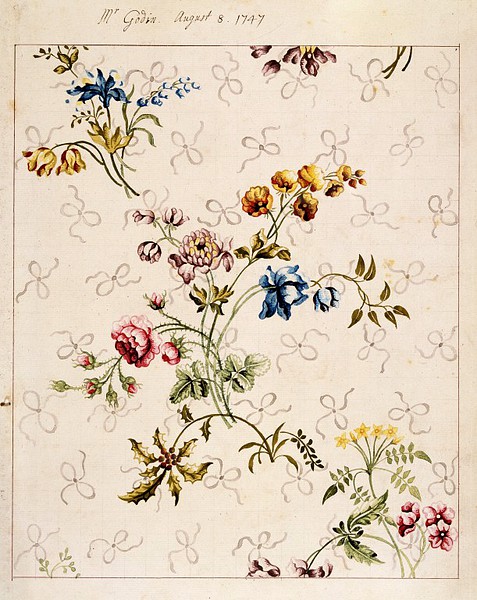
Garthwaite, Anna Maria. Design for silk weaving. Watercolor on paper. 1747. Victoria and Albert Museum.

Save for a few biographical tidbits, very little is known about the life of Anna Maria Garthwaite (1690-1763), the daughter of a clergyman who left home in 1726 to live with her widowed sister.  In 1728 the pair moved to the Spitalfields district in London, where Anna Maria would work as a freelance artist, creating over 1,000 watercolors throughout the course of her career, which she sold directly to the local master silkweavers.  Many of those designs have been preserved at the Victoria and Albert Museum, and some even include technical instructions, date, and to whom the design was sold.

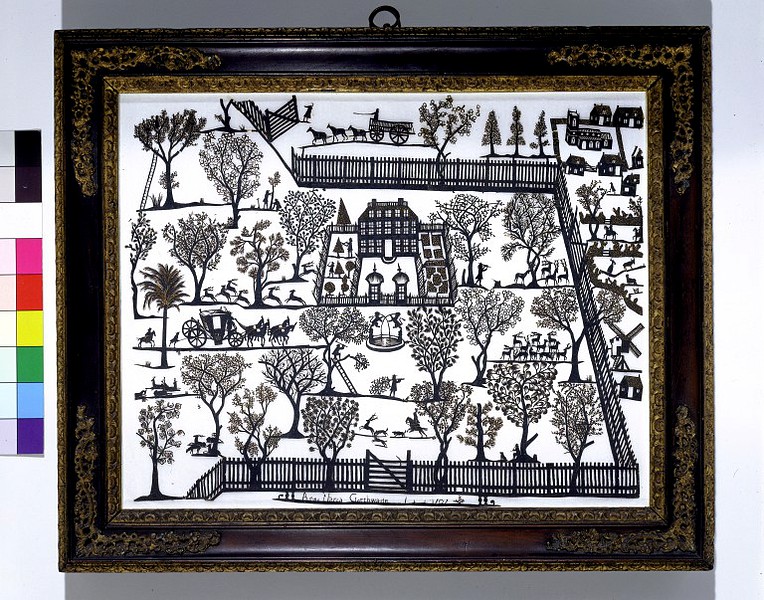
It is not known how Anna Maria developed her artistic skills, although there is early evidence of her abilities in a papercut that can be found at the V&A.

Garthwaite, Anna Maria. Papercut. 1707. Victoria and Albert Museum.

However, there is a great disconnect between a papercut done by a teenager and a sophisticated understanding of how silk weaving could translate a design on paper.  It is nothing short of intriguing that a spinster with no formal artistic education could not only penetrate England’s silk weaving industry, but be a major influence on textile production.

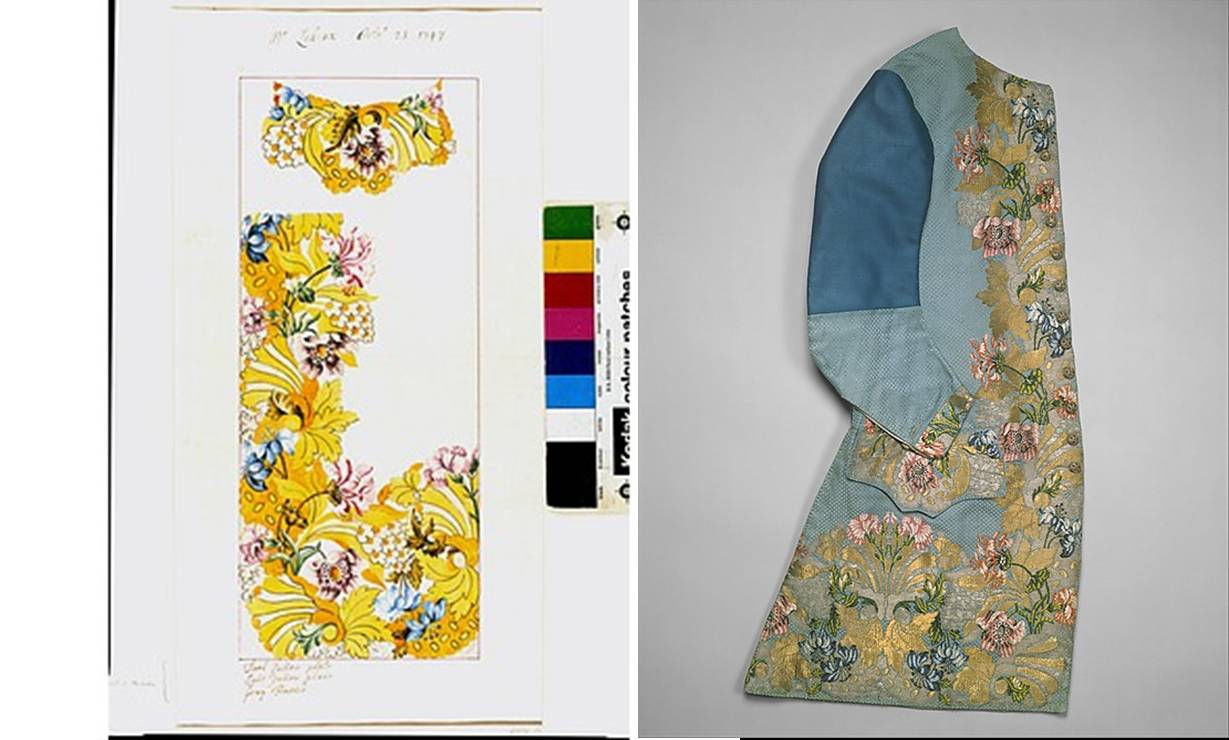
Anna Maria created watercolors, which were sold to the weavers, who would transfer the designs to the loom.  While the V&A houses over 800 of Anna Maria’s watercolors, there are a handful of surviving garments and textiles that can be matched to her designs.

Anna Maria’s design for a man’s waistcoat, which was sold to master weaver Peter Lekeux, and the resulting garment. Left: Garthwaite, Anna Maria. Design for silk weaving. Watercolor on paper. 1747. Victoria and Albert Museum. Right: Man’s Waistcoat. Textile by Peter Lekeux, design by Anna Maria Garthwaite. Silk, wool, metallic. 1747. Metropolitan Museum of Art.

Anna Maria’s design, dated April 22, 1744, was sold to Mr. Gregory, who wove the silk. As with many gowns of fine materials, those made of Anna Maria’s designs were often cut and altered for new wearers or to reflect changes in style. Left: Garthwaite, Anna Maria. Design for silk weaving. Watercolor on paper. 1744. Victoria and Albert Museum. Right: Woman’s gown. Textile design by Anna Maria Garthwaite. Brocaded silk. Made 1744, altered 1780s. Victoria and Albert Museum.

Fabrics made from Anna Maria’s designs were so prized they were cut and altered into more fashionable silhouettes as much as a full century after they were woven. Left: Garthwaite, Anna Maria. Design for silk weaving. Watercolor on paper. 1742. Victoria and Albert Museum. Right: Woman’s gown. Textile design by Anna Maria Garthwaite. Brocaded silk. Made 1742-43, altered c. 1840. Albany Institute of History and Art.

We at FIT are lucky to have a dress made from textile of Anna Maria’s design right here in the Museum’s collection:

Robe a l’anglaise. Silk damask. Ca. 1775, textile 1751. Museum at FIT.

These garments and fragments of textiles are testaments to Anna Maria’s role in the evolution of the British silk textile industry, and the hundreds of watercolors she produced, including technical notes, are testaments to her savvy business acumen.  At a time when French silks were in vogue, but Parliament prohibited their use in England, Anna Maria riffed off of French designs and followed the Rococo aesthetic with an added English flair.  When Parliament prohibited anything other than British textiles to the Colonies, Anna Maria’s designs became highly sought after, as fashionable American women demanded only the latest in design.  The fact that garments made from her fabrics were cut and altered to fit new bodies and reflect new silhouettes in fashion reflect the value placed on the figured silks attributed to her design.

English Heritage plaque at 2 Princelet Street, London.

Resources
Lazaro, David E.  “Fashion and Frugality: English Patterned Silks in Connecticut River Valley Women’s Dress, 1660-1800.”  Dress Vol. 33.,  2006.
Rothstein, Natalie.  Silk Designs of the Eighteenth Century in the Collection of the Victoria and Albert Museum.  London: Thames and Hudson, 1990.
Posted in Fashionista Friday | Tagged , , , | 3 Comments

Mystery Monday: The Squash Blossom as a Symbol of Fertility

Peabody, Henry. Hopi Woman Dressing Hair of Unmarried Girl, 1900. At the University of California, San Diego.

Yes, this hairstyle is called the squash blossom whorl, and it is the traditional hairstyle for unmarried girls in the Hopi tribe.

The Hopi are a Pueblo Native American tribe who have farmed land in what is now the state Arizona for many hundreds of years. The Hopi year is divided by two major events, the winter solstice and the summer solstice, and a complex series of minor events, including ceremonies and traditions with agricultural themes developed to promote healthy crops, fertile ground, and the most favorable growing conditions. Using their surroundings as inspiration, the Hopi people have creatively interpreted their need for rain, corn, and crops by imitating natural forms and cycles in dance, jewelry, pottery, and yes, hairstyles. The most complex element of these ceremonies and traditions is the role of the kachinas, which can most simply be defined as the guardians of the land and of the people.

During the Soya’la, a ceremony celebrated at the time of the winter solstice, squash blossoms are used as a decoration:

“An individual drama is enacted by the Hawk Youth, Ki’ sha Ti’ yo, and his companion, the Hawk maiden, Ki’ sha Ma’ na. This is performed, in part, in the open, The youth is costumed with a brightly colored, feather headdress. His chin is blackened, and so are his feet. The maiden carries a framework of crossed rods which are arranged to represent clouds. This is decorated with a squash blossom at each intersection. …The blossoms are beautifully contrived by a means which only the makers know how to produce and are handsomely dyed. After a long ritual, the youth and the maiden dance together. In the course of the dance, the maiden shakes the frame which she carries and dislodges the squash blossoms. The dance and other details of the drama symbolize the rebirth of all plants and all creatures — the new life that is now to begin.” (2)

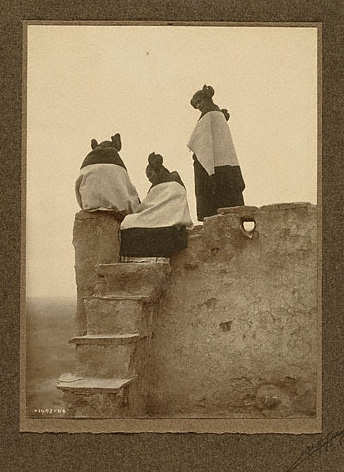
Curtis, Edward Sheriff. Hopi, Watching the Dancers, 1906. Gelatin silver print, 7 3/4 x 5 13/16 in. From The J. Paul Getty Trust. Found online.

Additional images of the process of constructing the squash blossom whorl can be found at the Mathers Museum of World Cultures in Bloomington, Indiana. Please use the link provided to view a set of images from 1913.

This week, we have remarked on some fantastic hairstyles inspired by the Hopi Squash Blossom. Bjork’s hairstyle on the cover of her album, Homogenic, and Princess Leia’s famous space age side buns. Hairstyles with cultural significance often find a renaissance in another culture. Traditional hair fashions with a special significance can inspire new interpretations totally devoid of meaning, or reinterpretations within new, different context. We think immediately of the mohawk, a modern symbol of rebellion which was borrowed from the Iroquois, who removed most of their hair in a rebellious gesture toward the scalping of their people.

Other Native American hairstyles continue to inspire us: beautiful braids, the elegant topknot, the chongo, and crescent-shaped hair of the Seminole tribe. Like clothing and jewelry, tradition hairstyles were once a sign, an indicator of status or participation, and modern fashion continues to renew and recreate the meaning of these powerful symbols.

Notes:
1. Mora, Joseph. The Year of the Hopi: Painting and Photographs by Joseph Mora, 1904-06. New York: Rizzoli, 1982, c1979.
2. O’Kane, Walter. The Hopis: Portrait of a Desert People. Norman, University of Oklahoma Press, 1953. (Quote from page 151.)
Posted in Mystery Mondays | Tagged , | 9 Comments

Mystery Monday

Interested in hair styling? This mystery is for you:

What is the name of this elaborate updo? What does it signify?

Add your guesses below. We’ll provide the answer on Thursday!

Posted in Mystery Mondays | Tagged | 5 Comments