Tomorrow: Fashion & Music Symposium at FIT

Join us tomorrow!

Here are the abstracts for some of the papers that will be presented tomorrow:

The Art of Exaggeration: The Fashion & Costume of Gaby Deslys

A New Mode: Fashionable Women of the Theremin

Callas Behavior: Fashion and the Making of a Diva

Kind of Blue: The Changing Music and Personal Style of Miles Davis

Wranglers and Rhinestones: Menswear in Country Music

Posted in Symposium | Leave a comment

Fashion & Music Symposium- Wranglers and Rhinestones: Men’s Western Wear in Country Music

Wranglers and Rhinestones: Men’s Western Wear in Country Music

By Jessica Pushor

The western wear introduced by the singing cowboys in the 1930’s has changed not only the clothing of country music performers and listeners but also the very identity of American country music.

Cowboy hats and boots are a common sight at today’s country music concerts and festivals. The two seem to go hand in hand and it is hard to imagine country singers without their signature cowboy hats and regalia. But this was not always so, the singing cowboy image came about in the 1930’s, before country music stars either wore their Sunday bests to perform in or costumes that played up their “hillbilly” rural image.  The influence of Hollywood and the popularity of westerns on country music in the 1930’s and 1940’s have also had a profound effect on fashions of country stars. Singer/actors such as Gene Autry and Roy Rogers established the image of the singing cowboy and began the trend of country music performers wearing cowboy costumes. Designers such as Rodeo Ben, Nathan Turk, and Nudie Cohen created the cowboy look associated with the top stars of country music thru the 1970s. As times and music tastes changed western wear also evolved with influences from rock and pop music as well as from and TV shows and films. I will also look at the individual country music performers that were also influential on the development  of western wear such as; Gene Autry, Roy Rogers, Hank Williams, Dwight Yoakam and Garth Brooks.  The establishment and evolution of western wear from rhinestone cowboy, to redneck chic, to an esthetic used by fashion designers and finally as a country music uniform is truly an American men’s fashion revolution as well as a cultural phenomenon.

Join for Two-Part Harmony: Fashion & Music Symposium

Posted in Symposium | 2 Comments

Fashion & Music Symposium- A New Mode: Fashion, Women, and the Theremin

A New Mode: Fashion, Women, and the Theremin

Patrice George

When the theremin, the world’s first electronic musical instrument, was introduced to New York audiences in1928, some though it was just an amusing experiment. Its creator, Russian science professor Leon Theremin, demonstrated that music could be created by the movement of hands in air, without touching the instrument itself.  He dreamt that his instrument would be adopted by the finest musicians of the 20th century for performance of classical, and modern, compositions.

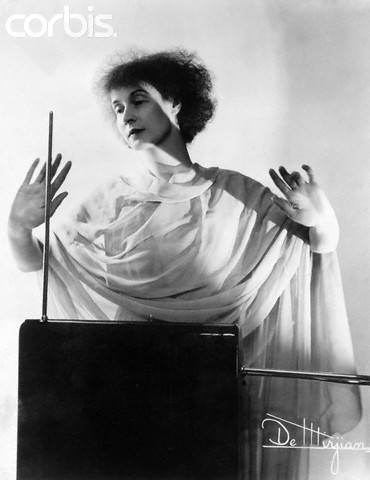
Lucie Bigelow Rosen and Clara Rockmore, two musically gifted and fashionable women, shared Theremin’s belief in the future of his electronic music.   They worked closely with Theremin to develop techniques that expanded the potential sound and repertoire of the instrument.  Both Rosen and Rockmore were also exceptionally beautiful women who confidently combined contemporary and historical styles in the garments they wore for performances and publicity images.  They used their own sense of style on stage to define an instrument that had no image of its own. Rosen’s Fortuny gowns, or “Greek Oracle” style, and Rockmore’s dramatic gowns with surrealist details, influenced other musicians, and artists who produced theremin-related work.

This paper will examine how Theremin, Rosen, and Rockmore, established the theremin’s place in modern music, Hollywood science fiction films, and the Beach Boy’s surfer sound. Rosen and Rockmore are honored today as pioneers in electronic music performance; as well as for the way the distinctive performance images they created to enhance the Theremin’s unique sound.

Lucie Bigelow Rosen playing the Theremin. Pitch is controlled by hand movements.ca. 1920s. Image by © Bettmann/CORBIS

Join us for Two-Part Harmony: Fashion & Music Symposium 

Posted in Symposium | Tagged , , , , | 1 Comment

Then & Now

(left) Mary Jane Russell photographed at Le Pavillon by Lillian Bassman.  Harper’s Bazaar, 1950. image source: fiercer than you (right) Lost in Lace, photography and styling by Damian Foxe, crochet recycled cotton and synthetic fabric rug by Hooked Designs, embroidered cotton voile top and skirt by Emilio Pucci. Scanned from Financial Times Suprior Interiors, April 21, 2012. 

Posted in Then&Now | Tagged , , , , , , , , , | 2 Comments

Fashion & Music Symposium- The Art of Exaggeration: the Fashion & Costume of Gaby Deslys

The Art of Exaggeration: the Fashion & Costume of Gaby Deslys

By Cassidy Zachary

In her day, music-hall performer Gaby Deslys (literally “of the Lilies”) was one of the most internationally celebrated stars of the WWI era, and one of the most fashionable. Her phenomenal success was inextricably linked to her appearance–her irresistible charm coupled with lavish and extravagant costumes kept audiences coming back for more.

Gaby came from a long tradition of daring, provocative performers. Her propensity for sumptuous ornamentation was expressed in towering headdresses, scandalously low décolletage, and exotic fabrics and silhouettes. She was as controversial as she was celebrated, but as Cecil Beaton noted: “the more luxurious and scandalous her life, the more people loved her.”[1] Men were infatuated with her and women wanted to be her.

As a performer, Gaby enjoyed financial independence that afforded her freedom and power and often put her at odds with prevailing gender standards which relegated women’s roles to wives and mothers. Unapologetically self-sufficient, her adoption of avant-garde styles, on and off the stage, exemplified her modernity. Her collaborations with leading fashion authorities, such as the couturiers Lucile and Paquin, as well as the fashion illustrators Étienne Drian and Erté, solidified her status as a fashion leader, while she herself was responsible for setting many mainstream trends.

Today, many popular musicians, such as Lady Gaga or Bjork, are synonymous with their spectacular display of clothing–their identities as performance artists inseparable from their adoption of ostentatious, eccentric styles. Going back over one hundred years, this paper provides a refreshing look at one of the early originators of the art of exaggeration, the irreplaceable Gaby Deslys.

Join us for Two-Part Harmony: Fashion & Music Symposium


[1] Cecil Beaton, Glass of Fashion, (New York: Country Life Press, 1954), 61.

Posted in Symposium | Tagged , , | 4 Comments

Fashion & Music Symposium- Callas Behavior: Fashion and the Making of a Diva

Callas Behavior: Fashion and the Making of a Diva

By Tracy Jenkins

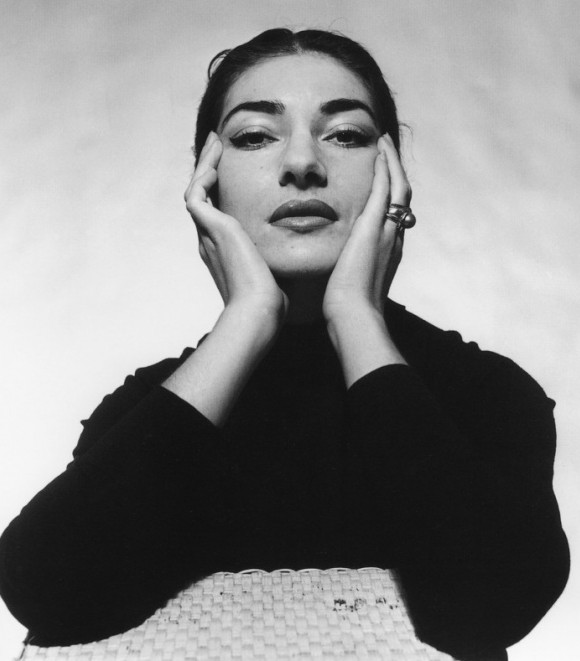
Christened “La Divina” by critics for her remarkable voice, Maria Callas personified what is still thought of today as The Diva. She remains, even after her death, one of the most famous opera singers in history. From an unlikely beginning as a plump, myopic girl with a gifted but untrained voice, Maria transformed herself into a svelte, commanding star whose professional triumphs are attested to by critically-acclaimed performances at the most renowned opera houses in the world. She captured the attention of fans and critics with her remarkable voice, acting ability, and appearance, and in the latter half of her career, highly-publicized–and largely manufactured–scandals. She was continually in the news, and the photographs accompanying these stories brought her image to a wider public and contributed to her reputation as a tempestuous and glamorous woman of enormous talent with a temper to match.

Fashion helped to define Callas as a Diva. After a dramatic weight loss in 1953, her confidence and her career skyrocketed. She wore camera-ready clothing in keeping with a star’s persona: exquisitely tailored dresses and suits, evening gowns, sumptuous furs, and sparkling jewelry. With her fashionably small waist and well-defined facial features, she embodied the ideals of 1950s glamour. Yves Saint Laurent called her the “diva of divas, empress, queen, goddess, sorceress, hard-working magician, in short, divine.”[1] Today, fashion keeps her image alive through recordings played on the runway, homages in collections by Galliano and Dolce and Gabbana, and our very ideas about what defines a Diva.

Maria Callas, 1957

Join us for Two-Part Harmony: Fashion & Music Symposium


[1] David A. Lowe (ed.), Callas: As They Saw Her (New York: The Ungar Publishing Company, 1986),
p. 183.

Posted in Symposium | Tagged , , , | 3 Comments

Fashioning DIY & Craft Revivalism- Panel Discussion

Tuesday, May 1st from 2:30 pm to 5:00 pm
Theresa Lang Student Center
55 W 13th Street, 2nd Floor New York NY 10011

This afternoon panel will discuss the role of DIY and craft movements in international contexts, focusing on theories of aesthetic embodiment and the materializing practices of cultural producers and consumers within the ever changing global economy. The featured speakers offer insights into the histories and practices of DIY from Punk culture in NYC to developments within the creative industries and youth cultural entrepreneurship in Indonesia, as well as linking connections between the 19th century American Arts and Crafts Movement, and its current appreciation, to the revival of craft and slow fashion practices in contemporary Russia.

Speakers and presentations include:

Liudmila Aliabieva, Editor-in-Chief of Fashion Theory Russia and Lecturer in Critical and Cultural Studies at the British Higher School of Art & Design, Moscow
Hand-made Revival in Contemporary Russia

Brent Luvaas, Assistant Professor of Anthropology, Drexel University
Silkscreen Revolution: Indonesian DIY Culture and the Ethos of a Creative Economy

Fran Mascia-Lees, Professor of Anthropology and Dean of Social and Behavioral Sciences, Rutgers University
The Ethnography of an Aesthetic: The Arts and Crafts Revival in the United States

Marvin Taylor, Director, Fales Library and Special Collections at New York University
Dress Code: Downtown Fashion Research in the Fales Library

The event is free and open to the public, seating is limited.

The panel is organized by Heike Jenss, Director MA Fashion Studies and Todd Nicewonger, Post-Doctoral Fellow in Fashion Studies, School of Art and Design History and Theory, Parsons The New School for Design.

The event is part of the Fashion Cultures Lecture, a shared course bringing together students in the MA Fashion Studies/ADHT and MFA Fashion Design and Society Students/SOF programs, co-taught by Francesca Granata, Assistant Professor of Fashion Studies and Todd Nicewonger, Post-Doctoral Fellow in Fashion Studies, ADHT.

http://adht.parsons.edu/events/2012/04/fashioning-diy-and-craft-revivalism/

Posted in Conference | Leave a comment

On This Fashion Day…

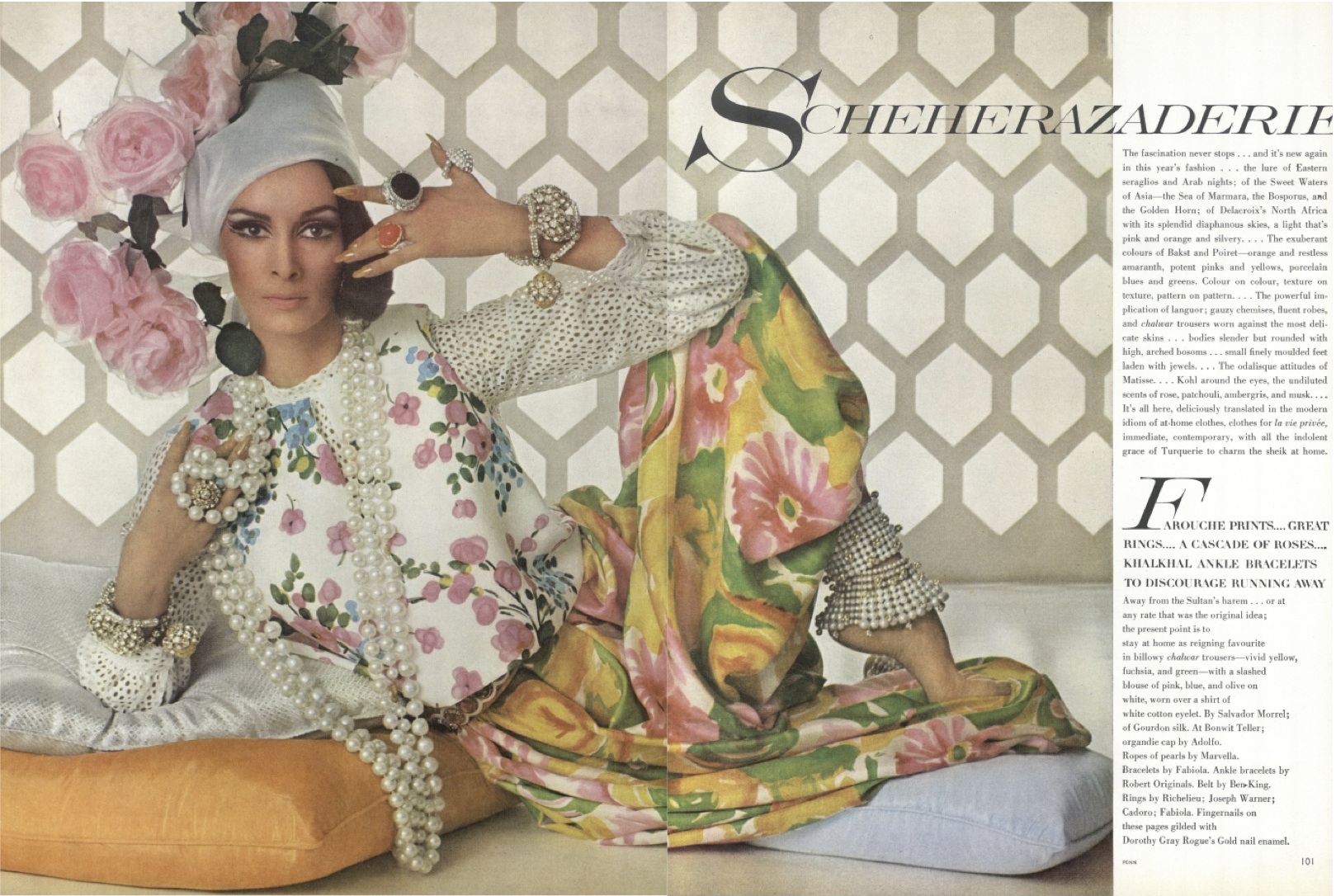
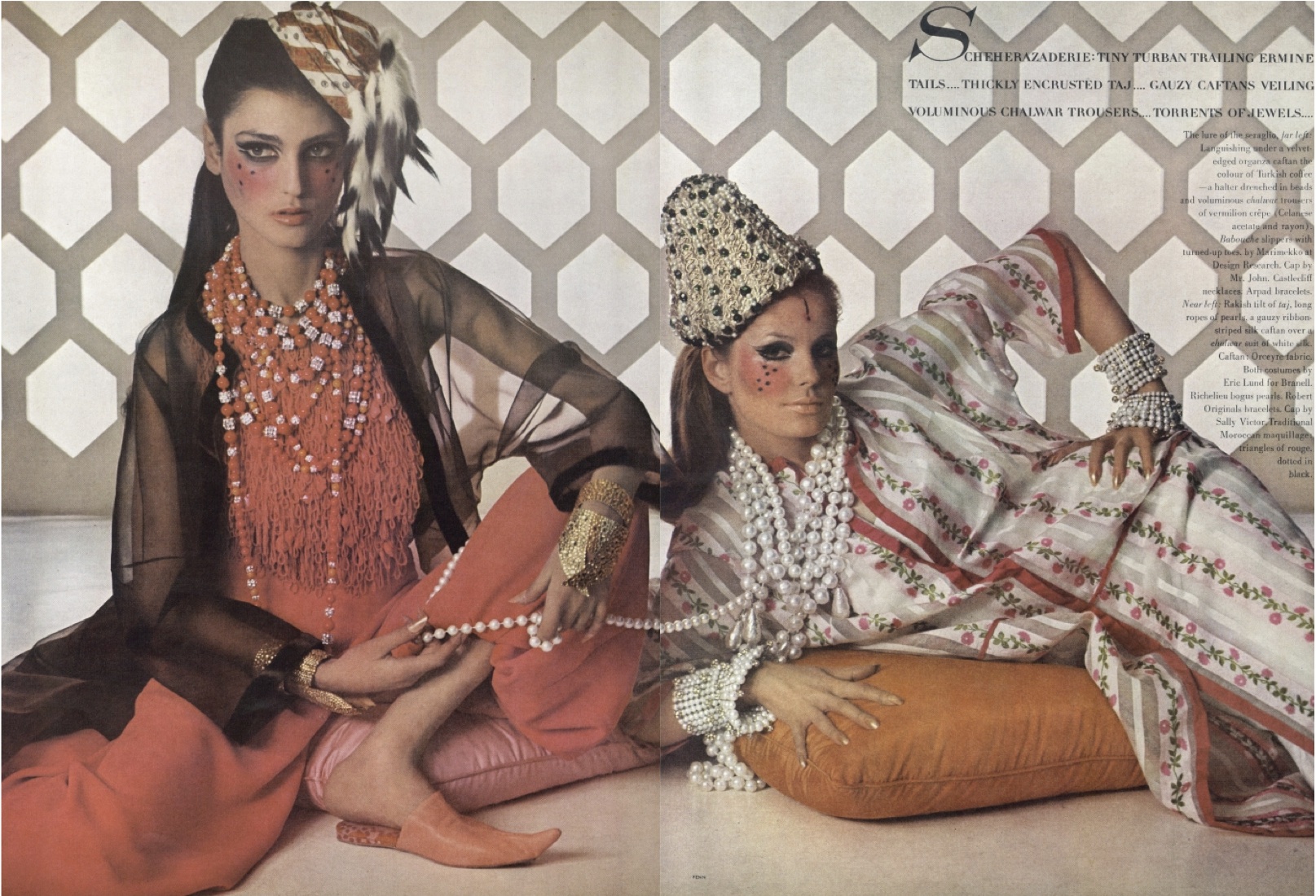
Do you ever wake up and wonder what was happening in fashion on that exact day 30, 40, or 100 years ago? Well I do, which is why I’ve started “On This Fashion Day”! Today’s entry is actually “On This Fashion Month” since it’s from April 15, 1965. The editorial focuses on fashion’s continued fascination with “the lure of Eastern seraglios and Arab nights…of Delacroix’s North Africa with its splendid diaphanous skies…The exuberant colors of Bakst and Poiret…The odalisque attitudes of Matisse…It’s all here, deliciously translated in the modern idiom of at home clothes, clothes for la vie privee, immediate, contemporary, with all the indolent grace of Turquerie to charm the sheik at home.”  “Scheherazaderie,” Vogue, April 15, 1965.

"Clothing by Salvador Morrell, hat by Adolfo, ropes of pearls by Marvella, ankle bracelets by Robert Originals, rings by Richelieu, Joseph Warner, Cadoro, and Fabiola

All clothing by Eric Lund for Branell. Left: slippers by Marimekko, hat by Mr. John, bracelets by Arpad. Right: hat by Sally Victor, "bogus" pearls by Richelieu, bracelets by Robert Originals.

Left: silk pyjamas by Lucie Ann of Onandaga Silk, turban by Mr. John. Right: caftan by Perfect Caftan, turban by Sally Victor, earrings by Napier, rings by Castlecliff, Joseph Warner, and Richelieu. Makeup an "impression of a Moroccan bride's maquillage."

Posted in Uncategorized | 1 Comment

Then & Now

(left) Wool and silk dress, Geoffrey Beene, Spring/Summer 1992.The Metropolitan Museum of Art, Gift of Geoffrey Beene, 2001. 2001.393.108 (right) Dress,  Common Raven, designed by Rachel Cohen. Spring/Summer 2012.

Posted in Then&Now | Tagged , , , | 1 Comment

Fashion & Music Symposium- Kind of Blue: The Changing Music and Personal Style of Miles Davis

Kind of Blue: The Changing Music and Personal Style of Miles Davis

By Alex Joseph

Miles Davis (1926-1991), one of the most influential jazz artists of all time, had a long, extremely productive career, featuring 67 studio albums.  For the purposes of a fashion presentation, it may be worth noting that he was known for constantly changing his style of music.  His New York Times obituary reads, “Each [change] brought denunciations from critics; each, except for the most recent one, has set off repercussions throughout modern jazz. ‘I have to change,’ he once said. ‘It’s like a curse.’”  Over time, Davis’s personal style changed too.  In photographs of his early performances, which date from the late ’40s, Davis appears very much of his time, in a starched white shirt, necktie, and jacket.  By the ’60s, the look was more casual and fashionable.  Later, his style became increasingly eccentric, with elaborate costumes.  This presentation will review filmed images and photographs of Davis and examine them in light of current fashion, social and cultural changes, and Davis’s own biography and particular sensibility.  These changes will be noted to some extent within the context of the music that Davis was playing at the time.  Background on Davis will be provided by Ian Carr’s Miles Davis: the Definitive Biography, and Davis’s autobiography.  Published photographs and written profiles from newspapers and magazines, unpublished photographs and art, album covers, and film excerpts will be treated as primary sources. The effect of social changes such as the civil rights movement will be discussed.  Finally, Davis’s own attitude toward personal style will be considered.  Was he exacting, oblivious, or something in between?

Miles Davis, Hackensack, NJ, 1954
© FRANCIS WOLFF, 1954

Join us for Two-Part Harmony: Fashion & Music Symposium

Posted in Symposium | Tagged , , | 4 Comments