If fashion is a religion, then Chanel was its prophet. Fashion lore attributes certain modes and manners to this designer, as though she channeled the fashion gods. Simple was chic. A suntan was glamorous. Pants could be charming. Every woman needed a little black dress. Her sole invention of the petite robe noir has had the strength to persist as a truth among the myths. The first appearance of this divine inspiration has even been dated in the pages of Vogue.
On October 1, 1926, a little black dress by Chanel was called a “Ford,” like the ubiquitous model T, a new kind of dress that every woman should own. For several years prior to this endorsement, however, similar styles had been offered by Chanel and her contemporaries. The House of Premet had unveiled its widely-copied version of a little black dress with white collar and cuffs, named after the best-selling novel LaGarçonne, as early as 1922. The arrival of the little black dress was further complicated by the uniforms of school girls, the dress habits of both debutantes and bohemians, the attire of couture house vendeuses, and even by lesser-known designs from Chanel’s supposed opposite, Paul Poiret. Some fashion historians have accurately described Chanel’s role as the strongest voice in this choir, rather than as a soloist. Even so, the myth that Chanel created the look has been allowed to continue. Who benefits from this oversimplification, and how has the myth been perpetuated? Can scholarship promote a clearer understanding of the development of this staple of the modern female wardrobe through connoisseurship? Without downplaying Chanel’s enormous contributions, how can historians separate the facts from the fiction?
Who is responsible for that little black dress?
Undressing the Fashionable Myth Symposium. Saturday May 7th, Robert Lagary Board Room, Marvin Feldman Center 9th Floor, Seventh Ave at 27th street.
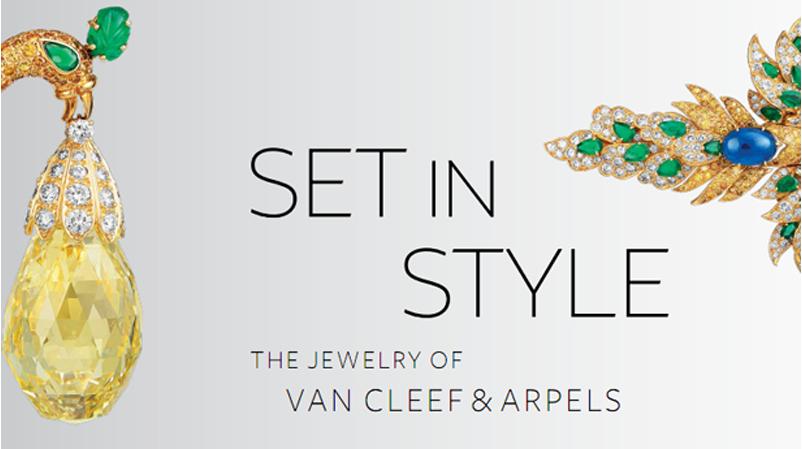
The exhibition Set in Style: The Jewelry of Van Cleef & Arpels, includes 350 pieces from the firm’s collection and international private collections as well as related objects from the museum’s collection through which the curators hope to illustrates “the firm’s celebrated history” and place “its contribution to design in a broader context.” The introductory text suggests that the design philosophy of the firm provides an “opportunity to study the evolution of twentieth-century jewelry in the context of the decorative art and other design disciplines.” Although from the objects on view very few are drawn from the museum’s collection, the premise of the exhibition works with Cooper- Hewitt’s mission “to advance the public understanding of design across the twenty-four centuries of human creativity represented by the Museum’s collection.”
The exhibition is held on the ground floor of the Copper-Hewitt Museum. It is divided into six themes; each is displayed in a separate space with distinctive design features. The exhibition includes 350 objects such as jewelry pieces, watches, casings and boxes, original drawing documenting the elaborate design process, special order books, catalogues and images of famous personalities who wore some of the objects on display.
The themes of the exhibition are Innovation, Transformations, nature as Inspiration, Exoticism, Fashion and Personalities. Each is displayed in a separate space (except for Exoticism and Fashion which share one space) with distinctive design features that echo both the design motifs of the objects and the unique features of each room in the mention.
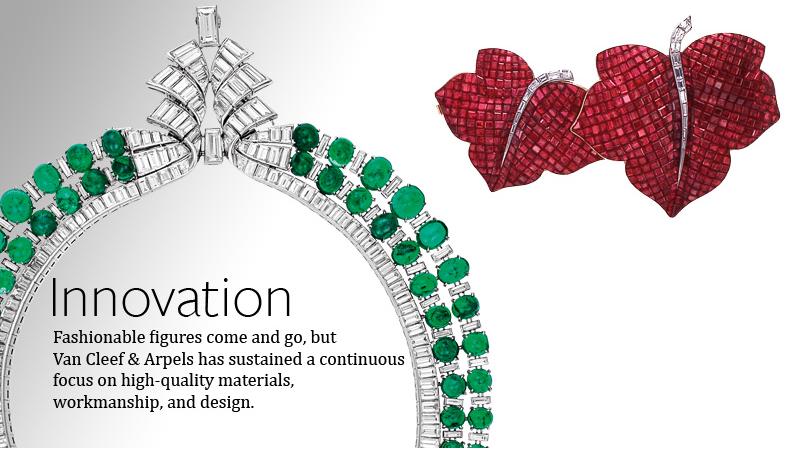
In this first room the visitor will find the introductory text and the room’s thematic wall text. The theme of the room is Innovation, both stylistically and technically. The main focus is on the Mystery Setting, a technique invented and perfected by the firm in which “matched gem stones are grooved and set in channels so the setting is invisible.” A monitor presents a video that captures the making of this complicated process. Only after seeing the video was I able to truly appreciate the complexity of the process and therefore the value of the pieces. Also displayed are examples of motifs similar to the Art Deco style which were used five years prior to the official initiation of the style in 1925, establishing Van Cleef & Arpels as a taste maker and leader in the world of design.
A large elongated table is set in the center of the room, on which approximately eighty objects are housed inside one large oval case. Above the case silvery leaf shapes are dangling, enhancing and reflecting the light. Each object, or a small grouping of objects, is placed on small beige stand angled to allow better view- similar to display in jewelry store. Next to the objects are numbers that correlates to the numbers in a brochure, given to each visitor upon admission, to which the visitor should refer if he or she is interested to learn more. Therefore, there are no individual labels throughout the exhibition. It seems that the amount of objects on display, although providing a broad picture of the history and evolution of the firm, does not leave much space for the labels. It is clear that the designers have made a conscious decision to create a display similar to what we might find upon visiting Van Cleef & Arpels store on Fifth Avenue, rather than in a museum setting. In an interview found on the museum website the designer Patrick Jouin, from the French studio Jouin Manku, explains that he wanted the visitors to lean forward to look at the objects, they will then see their own reflection on the glass and on top of the objects, as if they themselves are wearing the jewelry. It makes sense then that the designers preferred to eliminate design features associated with a museum display- the labels- to achieve their vision. The visual effect is without doubt striking; the presentation of the objects is beautiful and provides a clean looking background for their display. Personally I found referring to the brochure a tedious task, and a solution that do not serve best the objects or the exhibition as a whole.
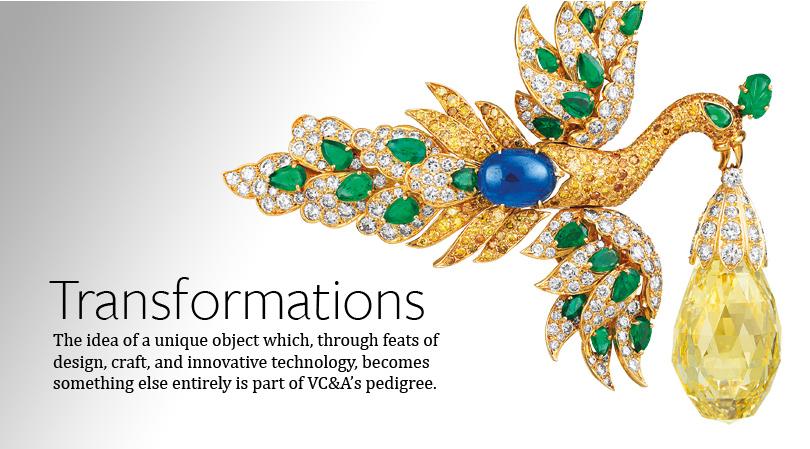
The second room is themed Transformations. Once again a large table is placed at the center of the room; however, the atmosphere in the room is very different, the objects on the table are set inside bubble-shaped individual cases, as if they were served for dinner in the mansion’s dining room. In each case 2-5 objects with a similar design theme are grouped together. Here too the theme is studied from two aspects, the first includes objects that literally transform into other objects (such as the Zip necklace, necklace’s pendant that can be worn as a brooch and a necklace that converts into bracelet), and the second objects that illustrates the stylistic transformation of the firm as a result of its move from Paris to New York during World War II. A monitor presents a short video that illustrates how the Zip necklace zips to become a bracelet. Unlike the film in the first room this one looks like a television commercial, and not necessarily a good one. Across the room on the south wall are two additional cases with retail cards, boutique catalog and special order book which quite nicely enhance the theme of the room as shown through the objects.
According to the wall text, the objects in the third room titled Nature as Inspiration represents Van Cleef & Arpels’ emphasis on “evoking the sprit, rather than slavishly copying the [natural] form.” They give as an example their famous snowflakes, made of gold and studded with diamonds, and the use of multiple colored gemstones together as an echo for a bouquet of flowers. The most striking feature in the room is found on the four tables in the corners, surrounding the main table. It seems as if one object is standing on each, uncovered and unprotected. When the visitor approaches, he or she, discovers that in fact it is only a hologram, the real object is embedded in the table under a glass. The effect is beautiful and exciting; I felt at once encouraged to break the museum’s rules – to touch the object- and teased at for thinking this precious jewelry is within my reach, both physically and financially. It is demonstrated again in this room, that when the designers decided to show so many objects together (the main case contains over fifty objects) it is hard for the viewer to grasp the beauty and uniqueness of each piece. In my opinion when the pieces are displayed alone or in small groupings they better convey the themes of the exhibition.
In the corridor that leads from the room to the sitting area one piece of jewelry, a Mystery –Set peony, is displayed inside a large glass bubble that stands on one leg. It is shown through a magnifying glass, which allows the visitor to admire the smallest details. As I walked past I realized the back is also visible, though not magnified, and allows admiring the complexity and sophistication of the Mystery- Setting. It is the only piece in the exhibition visible from the back. It seems that the use of technology in this context was to the benefit of the objects and the themes of the exhibition. It further illustrates my point that the designers did a better job when displaying single objects.
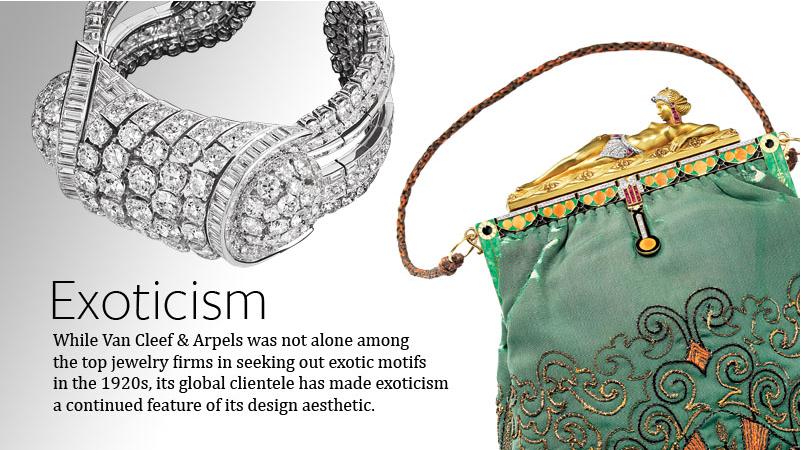
The fourth room is divided into two spaces and two themes: Exoticism and Fashion. The room is bright, with strong white light, white curved tables and cream fringed curtain that divides the room to one large and one smaller space. On both tables the objects are displayed inside cases in organic round shapes. While the south table, dedicated to Exoticism, has labels clearly indicating the region or culture that influenced the design, the theme of Fashion as displayed on the north table is not very clear.
Although the text regarding the Fashion theme states that “fashion and jewelry are forever intertwined, reflecting the ethos of changing times,” the objects on display did not support that statement. I was not convinced that Van Cleef & Arples “understood the link between fashion and jewelry as a powerful emotional sensibility that greatly influences contemporary design.” I would have loved to see actual garments combined with the jewelry, and how their design and motifs are reflected in one another. Although jewelry and fashion are strongly linked the fashion aspect received the smallest portion of the exhibition and the least attention.
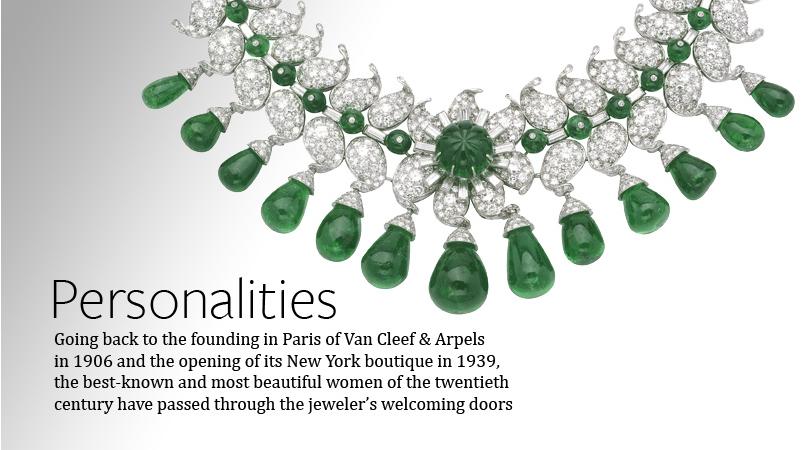
The last space is set in a long corridor and dedicated to personalities who wore the jewelry. The objects are displayed in two cases on the wall, on top of several layers of organic wave like shapes in shades of gray, punctured by small little holes from which a bluish light is showing. Next to each object a label indicating who was the women who wore it. Across the room on the wall are actual picture of those famous women. In my opinion it is the best room in the exhibition, as it truly illustrates the power of the pieces- when combined with clothes, body and personality.
I would recommend this exhibition both to my peers and my friends. I believe the visual appeal of the exhibition is broad and the objects are beautiful. Although the design of the exhibition is without any doubt arresting, I believe it takes over other equally important aspects. I left the exhibition feeling I have watched a promotional exhibition rather than a retrospective of the firm. After watching the videos and carefully observing the objects, I have better understanding of the quality of design and craft of the firm and its history, but it took two visits of nearly two hours each time. I think the ordinary visitor will be overwhelmed by the amount of objects, and will not benefit from the label-free display.
Set in Style: The Jewelry of Van Cleef & Arpels
On View through June 5th. Cooper-Hewitt, National Design Museum corner of 91st Street and Fifth Avenue, New York City.
I encourage you to check out this fascinating post on Worn Through. It’s an interview with wigs designer Sophia Gan, and also includes a great video of Julien d’Y showing the making of heads and wigs for The Model as Muse exhibition at the MET.
Hemlines rise when the economy is good and fall when times are tough—so says the theory of the “hemline index.” This supposed correlation between skirt length and the economy has been cited in everything from books on investing, to academic studies, to newspaper articles hoping to spice up the latest stock market numbers. The theory has been credited to multiple figures, including an economist in the 1920s and a stock analyst in the 1960s, but citations to original texts are not easy to find. This paper is an investigation of the history of the theory, the various ways it has been referenced, and the reasons that have been given for the connection between rising hemlines and economic boom. While some have dismissed the theory as frivolous, others have given it weight and believe it to be logical and provable. This paper is also a re-examination of the evidence for the theory through the study of key moments in the twentieth century where either fashion or the economy shifted significantly. Whether true or false, the continuing resonance of the hemline index goes to the heart of how our culture understands fashion. Is it something that reacts and follows trends started elsewhere, or is it so pure an expression of the spirit of the times that it can predict shifts in other parts of society?
prosperity or depression? The long hemline of the 1930s. Max M. Autrey, Myrna Loy, 1930.
***Scanned from the book “Decades of Fashion” by Gatochy
Undressing the Fashionable Myth Symposium. Saturday May 7th, Robert Lagary Board Room, Marvin Feldman Center 9th Floor, Seventh Ave at 27th street.
You probably guessed by now that we, at On Pins and Needles, are big fans of Special Collections and FIT Archives. What is housed on the shelves of this department is a dream come true for every fashion scholar and researcher. That’s why I felt super lucky when, as an intern, I was given the opportunity to work on one of the gems of the collection. It is nicknamed ‘the oldest book’, because a) it IS the oldest book in the collection (dated 1680) and b) it’s real name is not very easy to pronounce (Vestitus Sacerdotum Hebraeorum). And if you were wondering why I was the one given this opportunity, well that’s part of the story.
So let’s back up a little bit, Vestitus Sacerdotum Hebraeorum aka the oldest book, was written at 1680 in Amsterdam by Johanne Braunio (1638-1708). As its Latin name might suggest, the book centers on the vestments of Jewish priests, and is written mostly in Latin. It has been in the possession of FIT for at least two decades, though if you search the catalog you’ll find very little information on the content of the book. And this is where I come in. Along with Latin, the book also has many references in Hebrew, which I speak, read and write pretty well. I must say it’s the first time this knowledge has come to good use… The Hebrew text in the book allowed me to make better sense of what it really contains. That and some good old online research.
So what’s this old book really about? Turns out it is the most comprehensive historical research ever to be made on vestments of Jewish priests who served at the Jewish Temple in Jerusalem. The book is composed of two volumes (bound together), and contains seventeen beautiful engravings attributed to Bastiaan Stoopendaal.
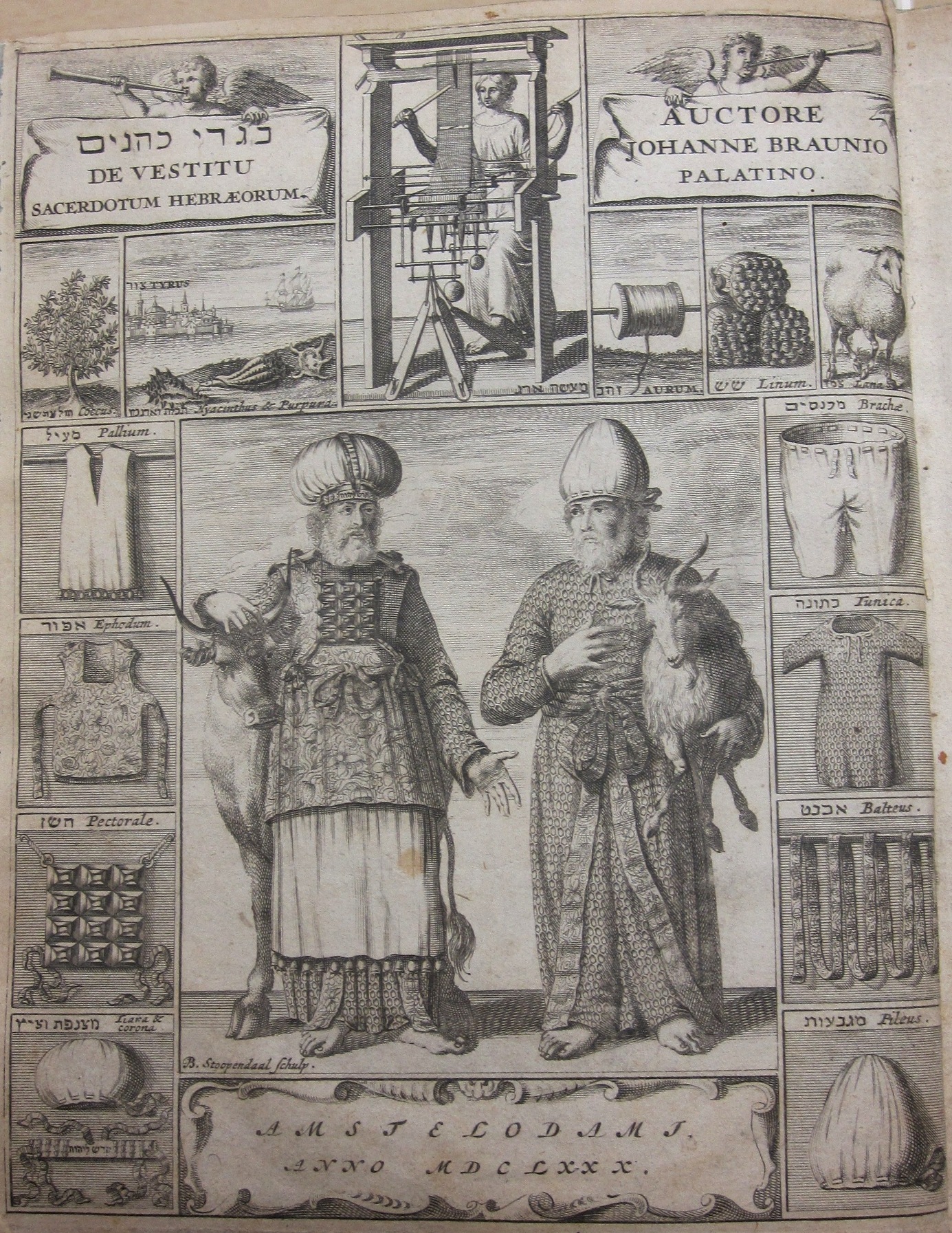
The book, on all its 800 plus pages, is a detailed research of not only the different types of garments, but also of the materials from which they were made, and their origin. The author cites biblical sources and explains the process of making each material and each garment. The book opens with the below illustration, which is also a table of content of sort.
Table of content, from top left clockwise: Scarlet silk (Tolaat Shani ), Blue and Purple (Techelet, Argaman), Weaving, woven fabric (Maase'e Ereg), Gold thread (Zahav), Linen (Shesh), Wool (Tzemer), linen breeches or undergarments (Michnasayim), Tunic (Ketonet), sash (Avnet), cone-shaped turban (Megbaot), headdress and golden crown (Mitznefet and Tzitz), breastplate (Hoshen), Vest (Efod), Robe (Me'il). at the center: Priest (Kohen Hediot) and High Priest (Kohen Gadol)
The first volume centers on the materials and the process of making the colors and fabrics, by who they were used, how and when. While the second volume centers on each garment, how it was made and when and how it was worn.
Below are some examples of the illustrations and short explanation of their content
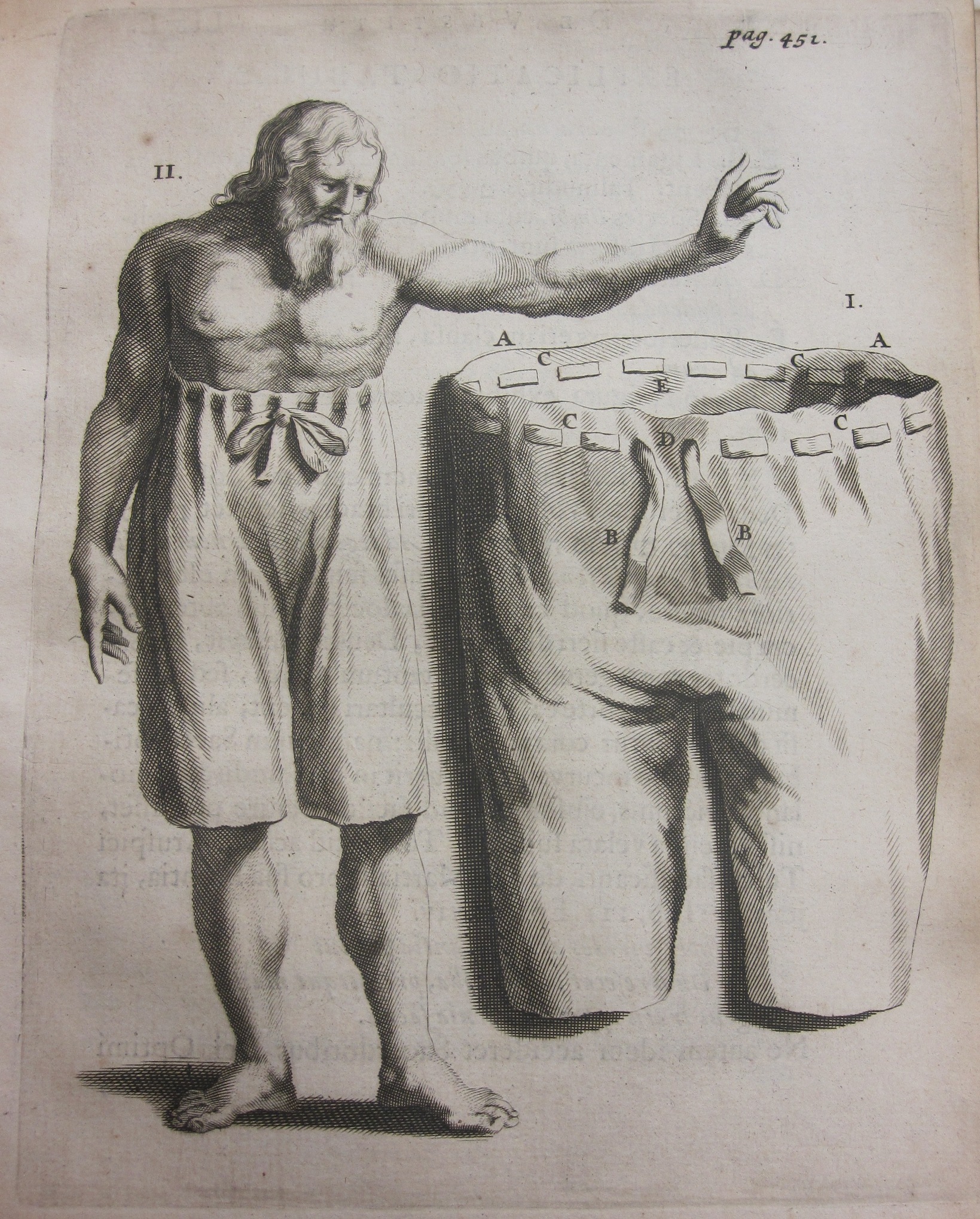
Volume 2, page 451. Illustration of breeches (Michnasayim). The breeches were made of pure linen and used as an undergarment to cover the body from waist to knees.
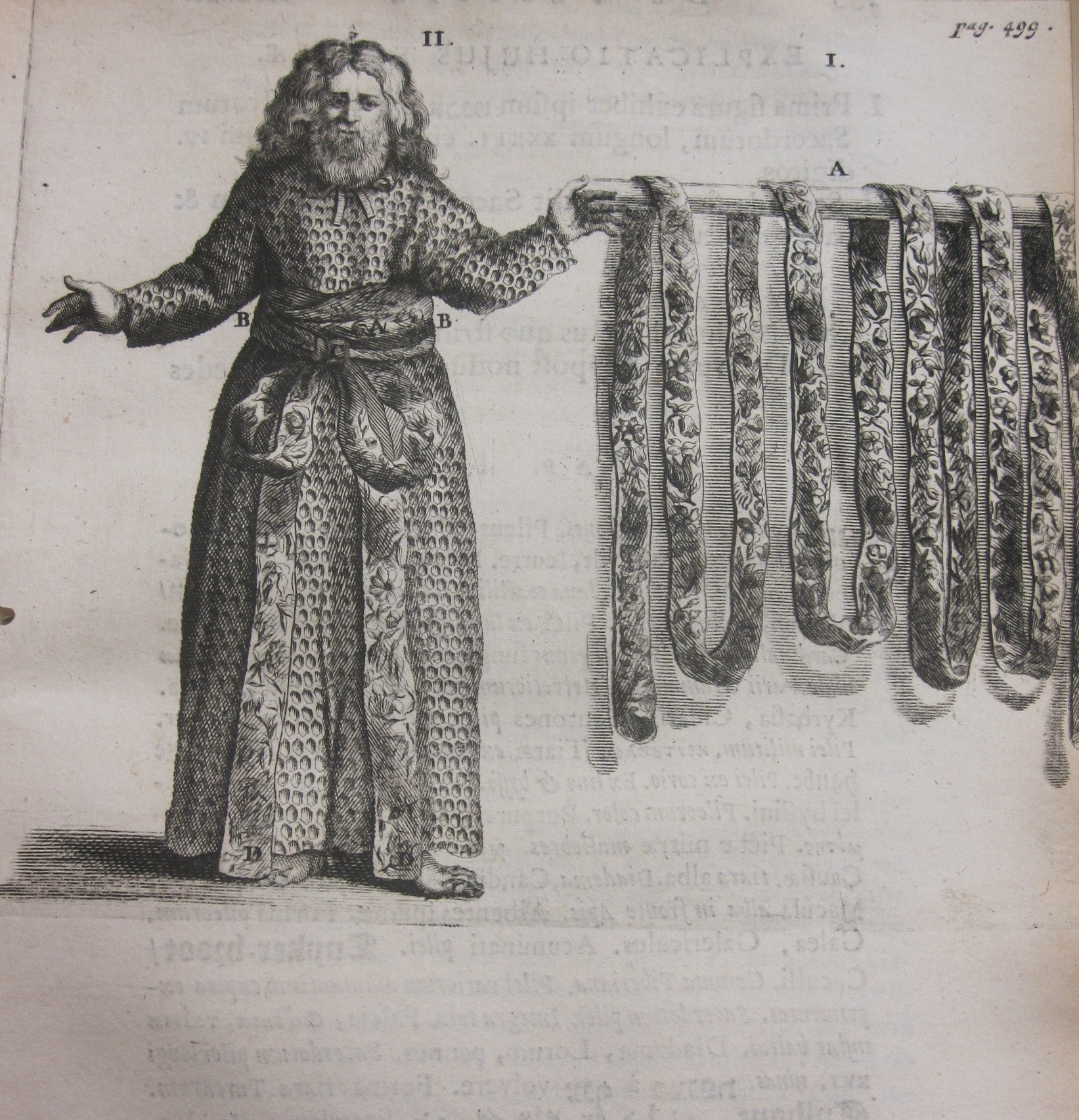
Volume 2, page 499. Sash (Avnet), this illustration depicts a priest dressed in tunic with a sash wrapped around his waist, as well as a separate depiction of the sash as it hangs loose, open and unwrapped, to illustrate its length. The sash is made of fine linen, and the one depicted here was probably worn by the high priest as it seems to be embroidered, a priest's sash would have been plain. The sash was worn over the tunic, which in turn was worn over the breeches, reaching from neck to feet, and made of two pieces of fabric. According to biblical sources, the tunic of the high priest was embroidered and the that of the priests was plain.
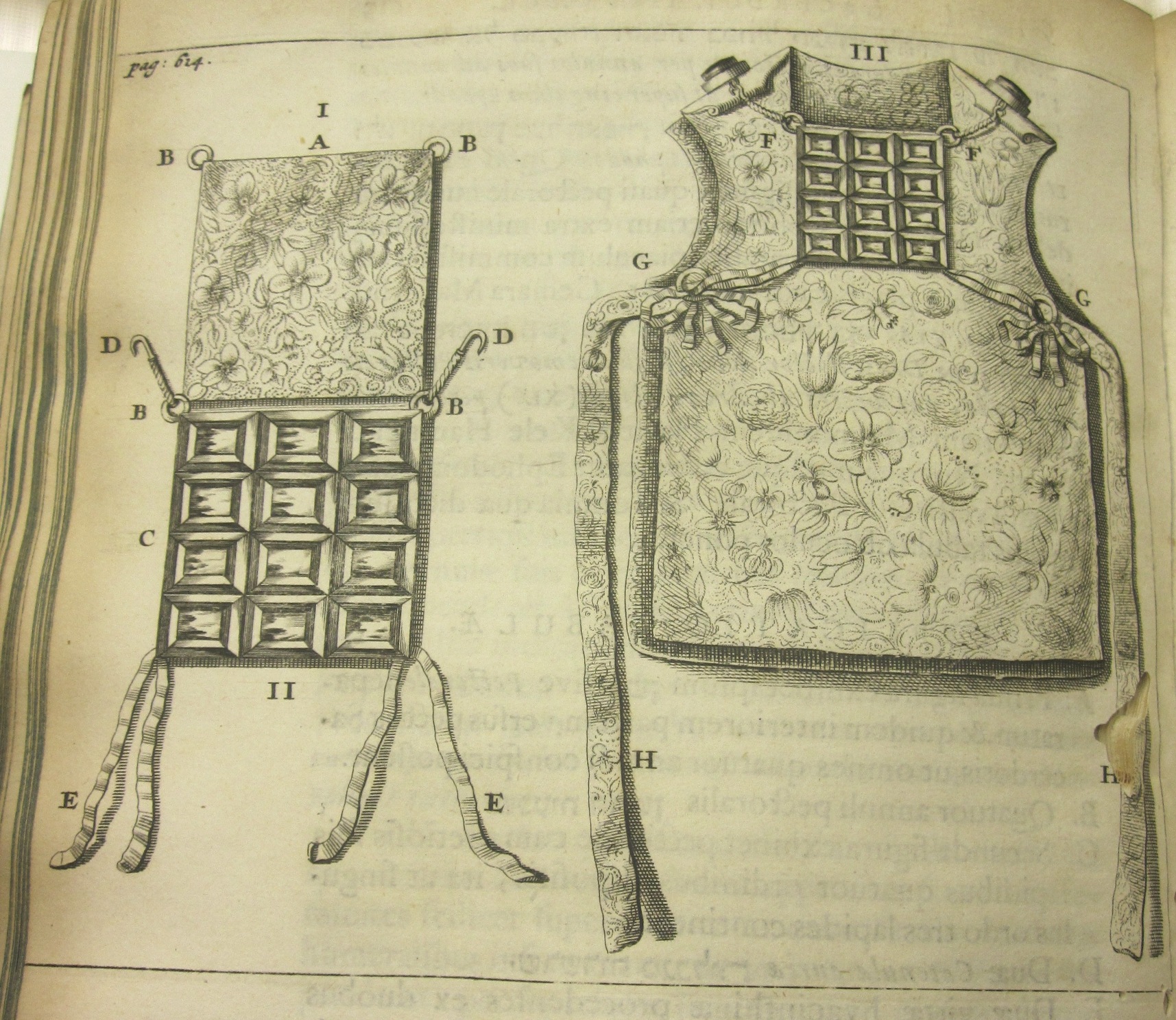
Volume 2, page 614.Vest (Ephod) and breastplate (Hoshen). The breastplate, set with precious stones,was worn by the high priest over the vest, the illustration depicts how it was tied and attached to the vest. The vest was made of two pieces of fine linen embroidered with gold, scarlet, blue and purple threads. In the book the author explains the name and meaning of each gem stone, as well as the specifics of its placement on the breastplate and its origin.
Towards the end of the book, after attending to each garment separately, the author shows the priest and high priest fully dressed.
Volume 2, page 822. Fully clothed high priest, the illustration shows how the different vestments were worn together to form a complete outfit. The vestments (in the order in which they were worn): linen breeches (Michnasayim), tunic (Ketonet), sash (Avnet), robe (Me'il),vest (Efod), breastplate (Hoshen) and headdress and golden crown (Mitznefet and Tzitz).
Although the Hebrew in the book is not exactly contemporary, and biblical terms are not my forte, and although making sense of the very little text I could read was not easy, I truly enjoyed this project. I felt privileged to hold a book that survived centuries and owners. The fact that the book not only contains meaningful historical research, but also has an history of its own is what made this project so exciting. If only books could talk!
Often called the “inventor of the mini skirt,” Mary Quant has also, by herself and others, been named the creator of a number of other fashion innovations. Supposedly responsible for fashion tights, make-up, hot pants, PVC clothing and even the duvet, Quant has always been seen to be on the forefront of modern design in the 1960s. The myths surrounding the miniskirts evolution are numerous, and have left the history of 60s fashion in confusion. Seeking to solve the question of the miniskirts’ creation, this paper will look at her work in the context of streetstyle of the era as well as the designs of her competitors for the inventor’s title, John Bates and André Courrèges. Similarly, an in depth analysis will be given to many of the claims made about her career, documenting for the first time the true nature of her contributions. While obviously a talented designer who clearly understood how to tap into the mood of the moment, how many innovations was she truly responsible for? Did she create new styles or merely popularize them?
Who invented the miniskirt?
Undressing the Fashionable Myth SymposiumSaturday May 7th,Robert Lagary Board Room, Marvin Feldman Center 9th Floor, Seventh Ave at 27th street.
Undressing the Fashionable Myth Symposium, organized by FIT’s MA program Fashion and Textile Studies: History, Theory, Museum Practice , will present nine papers by students that will try to explore the myths and misconception of the fashion world.
In the next few weeks we will post several abstracts of their papers, we hope you can join us!
Undressing the Fashionable Myth Symposium. Saturday May 7th,Robert Lagary Board Room, Marvin Feldman Center 9th Floor. Seventh Ave at 27th street. This event is free and open to the public. To register please call 212-217-4319 or email gradrsvp@fitnyc.edu
This is a guest post by blogger and fashion designer Ya’ara Keydar.
Ya’ara is a talented designer who graduated from Shenkar College for Engineering and Design in 2006. After graduation she worked for a leading Israeli brand, and in recent years she designs beautiful and unique wedding gowns under her own name. Her blog, in the Hebrew language, is one of my favorites. It is called Nekudot, which literally means dots (as in polka dots), and is all about connecting the dots…. in each post she starts with an idea or concept (say pillows, or post-its) and explores how it visually translate in fashion and design through images from magazines, websites and films . The blog is truly inspiring, it’s the kind of thing when you read it you think to yourself: “this is so great, how come I didn’t think about it first???”
In this post Ya’ara tells about the research and inspiration for her senior year collection:
It was 2006, I was then in my senior year at Shenkar College, with absolutely no inspiration and no clue as to where my senior year collection was going. After seeking inspiration in any place possible, panic took over so I decided to spend a day at the periodicals floor at the college’s library.
The goal: Not to leave my seat before I find my inspiration topic, or to be dragged out of the library kicking and screaming- whichever come first. The means: to flip ‘till I drop, with the hope that something will jump at me out of the pages.
After many long hours, the miracle happened.
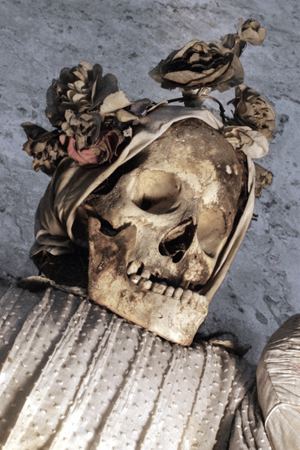
Four pictures taken by photographer Paolo Ventura, titled Dressed for Eternity, took my breath away.
Photos by Paolo Ventura
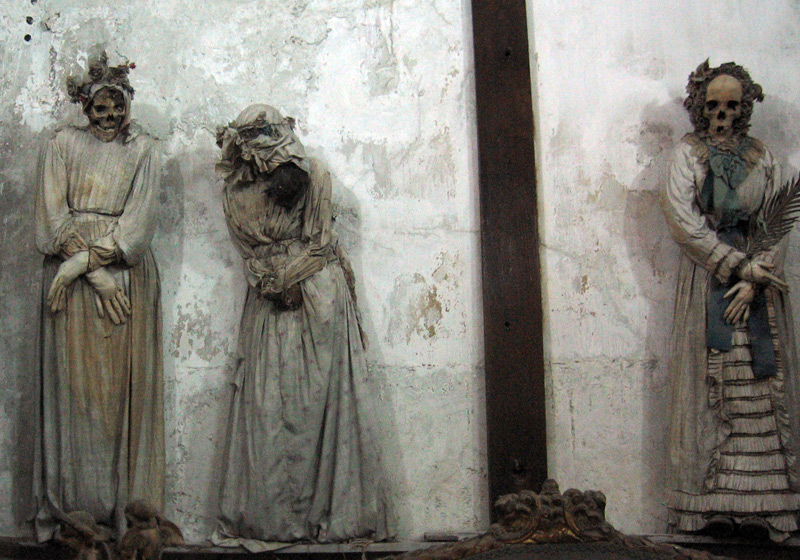
After overcoming the first shock and creepy feeling that took over me, I started to read more about the project that was taken in burial catacombs in Sicily, called The Capuchin Catacombs. I didn’t find too many pictures of the place online, but there was quite a lot of written material, from which I gathered that in this bizarre catacombs are about 8,000 mummified bodies, fully dressed with their everyday clothes- a surreal madness that is both revolting and astonishing in its beauty and power.
The burial catacombs were operated in the 16th century by monks who realized the cave provided a unique environment in which bodies were naturally preserved. Soon after the first monk was placed in the catacombs, it replaced the traditional burial or cremation and became a status symbol for the people of the region. Between the 17th and 18th century (and even up to the early 1920s) 8,000 mummies were placed in the catacombs, of mostly men, women and children of high society, as it was quite expensive to maintain the bodies. All 8,000 mummies are attached to the walls side by side, dressed in their best garb, following the fashionable trends of their times.
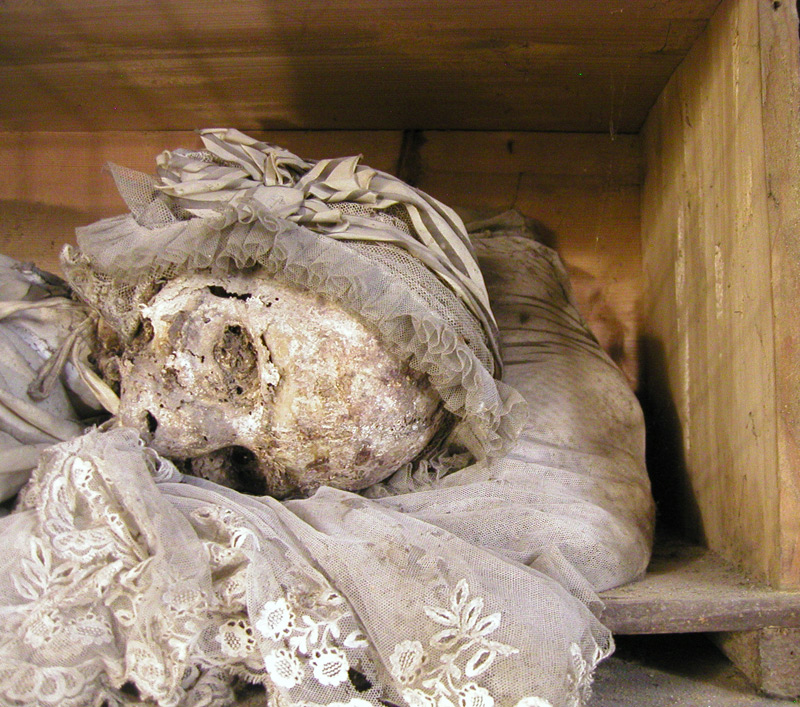
Capuchin Catacombs, photo by Paolo Ventura
The bodies, some are now merely skeletons and some fully preserved, are dressed in beautiful clothes, most are effected by time but the details are still visible. The clothes, covered in dust, turned yellow and are disintegrating. But they still stand as a vivid reminder to the period in which they were worn.
Capuchin Catacombs, photo by Paolo Ventura
Capuchin Catacombs, photo by Paolo Ventura
Below are representative examples of women’s dress from the 18th and 19th century, through which I studied the materials and silhouettes that were fashionable at the time mummies were put in the catacombs.
And then…..
During my days as a fashion student I had limited contact with the outside world; from time to time my dad would come and grab me away from the sewing machine to chat over coffee. That day, when I walked out of the library, realizing I have found a topic for my collection, he rang me up and we met. I showed him the pictures, and he, astound by this revelation, announced right there and then that we are to fly there together asap. And we did.
A week later I found myself in Palermo, Sicily, walking in the freezing hallways of the catacombs.
The author in the Capuchin Catacombs, photo by the author's father
I guess you can tell from the pictures I was slightly shocked. As a child my biggest nightmare was Michael Jackson’s music video Thriller, and regardless- visiting the Capuchin Catacombs is really quite a crazy experience. Even if you do not mean it, as you walk by the mummies and skeletons, many questions arise; complicated questions about life and death, the desire to live forever, and many thoughts about my beloved grandpa Dov, to whom we said goodbye in 2005, a year before these pictures were taken.
Despite all creepiness the clothes, skeletons and the catacombs themselves are visually striking. With my camera I was able to capture details that later became a direct influence on my collection.
Photograph by author
Photograph by author
photograph by author
And here are some pictures from my obsessively-kept sketch book:
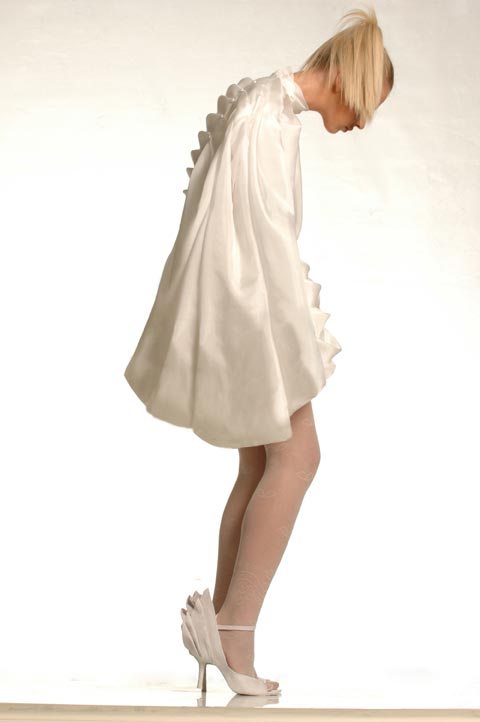
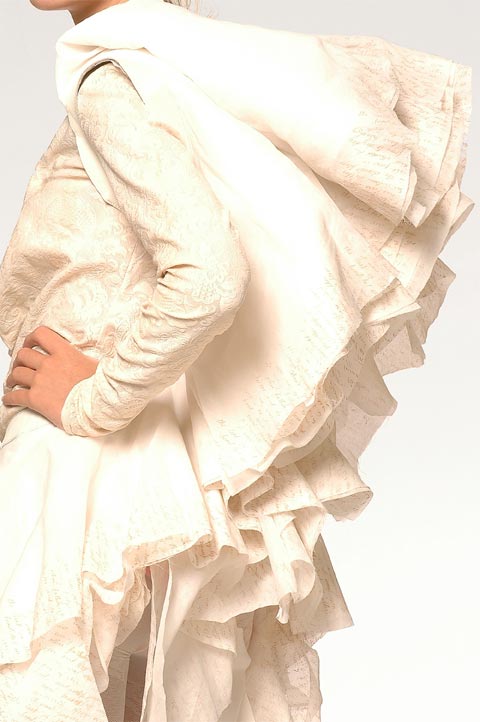
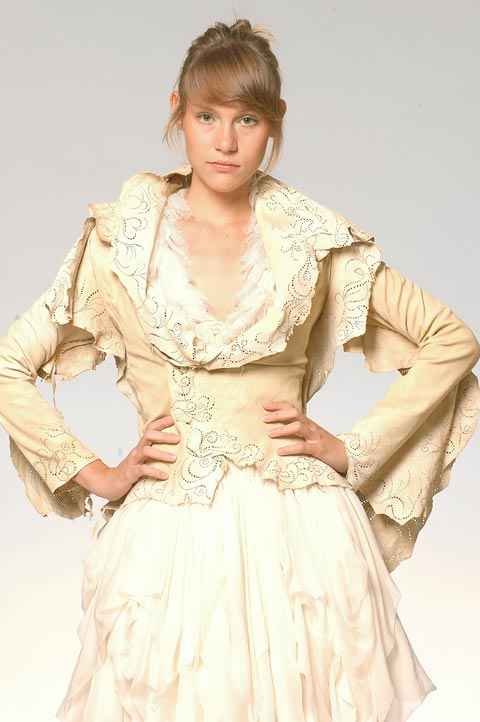
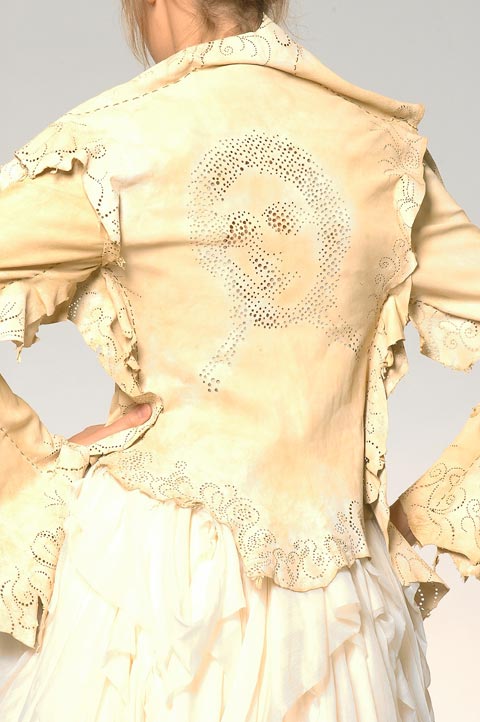
My collection, titled Requiem For Eternity. sprang from the realization that while the Capuchin people were not buried, the clothes they wear are in fact their tomb. The contrast between the spirit who’s time has come to leave the body, with that of the body who wants to stay on earth forever was at the center of my collection.
The project encapsulated the long path I’ve taken, that of raising and exploring questions, especially about the human desire to live forever and to leave our mark on this world. Is there an end to the body? to the soul? and what will be left of our clothes once we leave them?
I chose to clean the color palette to recreate a feeling I experienced in the catacombs, that of the loss of vitality, as a hint to the people who existed before me; as if time has passed through my designs, fading the colors away, leaving behind only vague memories of past life and the marks of time.
Here is the illustrated collection:
Requiem For Eternity, senior year collection, Shenkar College. Illustration by author
And here are some of the outfits from the collection:
And this is the song that served as soundtrack to the fashion show, by Pulp vs The Swingle Sisters:
My body may die but my heart will keep loving you baby Oh, our love will survive the passing of time Believe me, believe me















 ON PINS AND NEEDLES