On Costumes and Credits

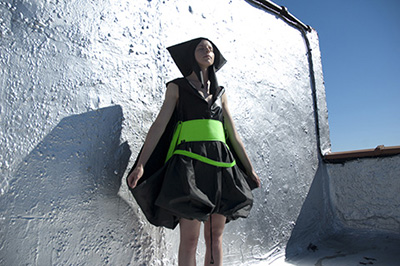
Check out this interesting interview with Black Swan costume designer Amy Westcott, surrounding the controversy over Rodarte’s contribution to the film’s costumes. The interview raises the question of who should be credited (and how) when a well- known fashion designer collaborates with a lesser-known costume designer. Not to say that this is the case, but it does bring to mind Edith Head‘s Academy Award for Costume Design for the 1954 film Sabrina, despite the fact that Audrey Hepburn‘s wardrobe was in fact designed by Hubert de Givenchy.  the question of who should get the credit- the one conceptualizing the over look of the film and its atmosphere through costume design, or the one who created a few key costumes (be them iconic or not) for the leading character- is an interesting one and it is worth further exploring.

Laura Mulleavy and Natalie Portman in a fitting for the film Black Swan . Photo by Autumn de Wilde

Original sketch by costume designer Amy Westcott for the film Black Swan

Posted in interviews | Tagged , , , , , , , | Leave a comment

Then&Now will be back soon

Then&Now is on a forced vacation due to technical difficulties (i.e. my main computer has died in good age), I have some great images in store and will post them as soon as my new computer is installed. Don’t hold your breath, it might take a few weeks.

Posted in Uncategorized | Leave a comment

Cross Pollination at Ecouterre

Check out this post on our cross pollination project at Ecouterre, a website devoted to the future of sustainable fashion design. You can also upload the PDF of the publication which, if printed, is also a shirt pattern.

Posted in Uncategorized | Tagged | 1 Comment

Cross Pollination: Eco-Fashion

Over the summer some of us took part in the Cross Pollination: Eco- fashion workshop, which resulted in a wearable publication. Check it out here.


Posted in Uncategorized | Tagged | Leave a comment

Pants make the man?

Here and here you can find two interesting pieces about two very different men and how they are defined by the pants they wear.

Posted in Uncategorized | Tagged , , , , | Leave a comment

My Experience At Special Collections- Part III

This three part post documents the experiences of three students in their first internship at Special Collections and FIT archives.  The mission statement of the Special Collections is to acquire, preserve and provide access to wide range of primary materials in their original formats, including archives, scrapbooks, oral histories, fashion sketches, illustrations, books, journals and other items.

Dreams come true in the storage room

By Christian Hernandez

Over the course of the past five years, it has become blatantly clear that working with historic dress, textile and related artifact collections is not only an interest but a passion of mine. Applying and being accepted into this program was a dream come true and yet, every day only gets better. Within the first few days of starting this program I was introduced to Karen Cannell and the Special Collections and Archives at FIT.

With a specific interest in paper storage and conservation as it relates to dress and textiles collections (the “related artifacts” in my interest/passion) I am in heaven whenever I step into the storage room at Special Collections, which I am now an intern at. Among the many other things that I am in awe of, Special Collections has original sketches from the in-house Bergdorf Goodman designer, unpublished Versace runway shots, etiquette books from the turn of the century and magazines, and the first ever issue of Harpers Bazar, something not even the Harpers Archive has.  I also have a personal interest in paper conservation, restoration, storage and handling as it relates to dress and textile collections, which means that not only do I get to look through centuries old magazines, but I can help make sure they last for years to come.

Although my time there has just begun, I have already learnt so much and will relish any other knowledge that I can absorb. My fellow interns, the staff at the Special Collections, Karen herself and the people who utilize the archives for their research have taught me so much. I look forward to what the future has to come because these few shifts so far have been a dream come true.

Fashion Plate. “Gentleman’s Magazine”, December 1869.

Posted in Uncategorized | Tagged , , , , | 1 Comment

My Experience at Special Collections- Part II

This three part post documents the experiences of three students in their first internship at Special Collections and FIT archives.  The mission statement of the Special Collections is to acquire, preserve and provide access to wide range of primary materials in their original formats, including archives, scrapbooks, oral histories, fashion sketches, illustrations, books, journals and other items.

Solving Fashion Mysteries

By Cassidy Zachary

What does Godey’s Ladies Book, La Belle Assemblée, Der Bazar, and L’Illustrateur des Dames all have in common? Besides all being 19th century women’s fashion magazines, they also make up part of the vast and amazing collection that is the Special Collections department at F.I.T.  Currently, I have the pleasure of organizing a “miscellaneous” collection for the department, seeking to bring an identity to the unidentified costume and fashion plates.  So far, I have identified rare hand-painted plates by Emilie Callois, costume plates from the 19th century publication of Braun and Shneider’s Zur Geschichte der Kostume or The History of Costume, and some beautiful hand-painted fashion plates from the magazine Les Nouvelles Idees, published in the 1920s.  The collection is incredible and my experience as an intern is a continuous delight.  Everyday, I delve into the past and learn something new about the inspirations and cultivations of fashion, my passion. Under the tutelage of Karen Cannell, this internship is exposing me to the research possibilities in my field as well as to the availability of primary source material.  I look forward to another semester here!
Posted in Uncategorized | Tagged , , , , | Leave a comment

My Experience at Special Collections- part I

This three part post documents the experiences of three students in their first internship at Special Collections and FIT archives.  The mission statement of the Special Collections is to acquire, preserve and provide access to wide range of primary materials in their original formats, including archives, scrapbooks, oral histories, fashion sketches, illustrations, books, journals and other items.

The Work and Life of Fashion Photographer Rose Hartman

By Anna Yanofsky

You know that picture of Bianca Jagger on a white horse trotting into Studio 54 for her little 70s birthday soiree? Today I spent the better part of the afternoon talking to its creator, New York nightlife and fashion photographer Rose Hartman, all about it. Rose is gifting her entire archives to Special Collections, and as part of my internship with SPARC I’ve been entrusted to make sure that this phenomenal woman’s life’s work is preserved and available for research. I also get the amazing opportunity to create an oral history with Rose. Over the next few months I’ll be going through photos with her while a tape recorder grabs her every word about what it was like to be backstage at Halston, on the dance floor feet from Andy Warhol, and in the atelier with Betsy Johnson. The oral history and Rose’s photographs will be part of an exhibition on the FIT campus that I will also be involved in planning. I’m thrilled to be entrusted with such a dynamic project as such a novice. It’s an incredible opportunity for learning a myriad of collections management, organization, and exhibit skills. On a side (but significant) note, Rose’s photo was a background on my phone the day I sat down to interview with Karen and my dad used to run drinks at Studio 54–I think this project was mine even before it existed!
Bianca Jagger celebrating her birthday at Studio 54 in 1977 (Photo by Rose Hartman)


Posted in Uncategorized | Tagged , , , , , , | 3 Comments

Job Opp: Collections Assistant, Antonio Ratti Center

The Metropolitan Museum of Art, one of the world’s finest museums, is seeking a Collections Assistant in the Antoino Ratti Textile Center Department. Working under the direction of the Ratti Center’s Collections Manager, the Collections Assistant will provide collections care support, as well as, prepare objects for viewing.

Additional responsibilities include, creating storage support for textile objects, monitoring and maintaining storeroom environment, as well as, monitoring the conditions of the textile objects.

Successful candidates will have at least 1-3 years museum experience. Art handling experience preferred. Knowledge of textile history or study, collections management and database systems is required. BA. in Art History or Textile Studies required. Strong computer skills and familiarity with The Museum System database preferred. Basic knowledge of the use of microscopes (stereo and video) preferred. Good organization and communications skills are required.

How to apply:

Please send cover letter, resume, and salary history as a Word attachment with the position title in the subject line to employoppty@metmuseum.org.

Click here for more information.

Posted in Uncategorized | Leave a comment

Then&Now- special edition

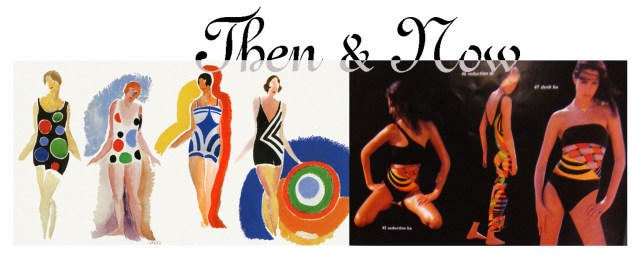
Sonia Delaunay, swimsuits, 1928                                                    Lea Gottlieb for Gottex, inspired by Sonia Delaunay, 1998

I mentioned here before a paper I wrote as an under-grad student on the Swimwear house Gottex. This fall semester, I am studying yet again the work of the founder and designer Lea Gottlieb. For my research I am going back to some of the people I interviewed, some of the source I reviewed, and yes, strangely enough to reading my own paper- which was written in collaboration with my peer Eli Korman. In our paper we focused on the influence of artists and art movements on Gottlieb’s designs, while my new paper will center more on the branding of the company, contrasting and comparing the marketing strategies in Israel, Europe and the US. In addition I will dedicate part of my paper to the textiles and how it was developed and sourced.

Gottlieb was inspired by many things, but some of the strongest influences come from the art world. Sissi Rosenbaum, which oversaw all Gottex collections from 1984 to 1997, told me Gottlieb traveled the world seeking for inspiration, stopping at cities to visit interesting museum exhibitions and art-books stores. One artist which particularly influenced her was Sonia Delaunay.  It is interesting that the two women have very much in common, not only in their visual language and artistic style but also in their personal life. They share passions and were driven, it seems, by similar desires and ideas. While  Gottlieb- the designer- ‘played’ with art, deconstructing famous artworks to fit her needs as a designer,  Delaunay- the artist- ‘played’ with fashion design, using her artistic background and extensive color study to create strikingly beautiful and unique designs.   Even biographically there are similarities, they are both of Jewish Eastern- European background (Delaunay was born Sarah Stern, to a Jewish family in the Ukraine, Gottlieb was born in Hungary), both were adopted by their relatives as young girls, and both married to strong men which were their partners in life and work, yet they were successful by their own rights.

I bring here an edited excerpt from the chapter Eli and I wrote on these two creative and passionate women.

“Gottlieb designed numerous pieces that were directly inspired by Delaunay; however, the similarity in their creative styles is reflected in Gottlieb’s designs as a whole.

Delaunay was influenced by the Cubist movement, which maybe one of the reasons she was encouraged to experiment with the collage technique. At the turn of the century this technique mirrored the modern diversity;  for Delaunay it gave the opportunity to combine separate elements into one cohesive language, it was a tool she used to express the diversity of the sources which influenced her art and design- from her childhood in Russia and the Ukraine, her years in Paris, Portugal and Spain, the artists she admired (among them Van Gogh, Mattise and Gaugain) and the visual study of color and form she develop with her husband, the artist Robert Delaunay.

In her designs, Delaunay combined solid and printed fabrics, symmetrical and asymmetrical forms, colors reflected in urban landscapes and those reflected in rural life, and she pieced together letters and words. In 1911 she made a patchwork quilt for her son Charles (now at the Musée National d’Art Moderne in Paris), it was made of small pieces of fabric which together created an abstract surface of color and form.  Her friends interpreted it as a cubist piece of art, but for Delaunay herself it was continuation of the tradition of Russian peasants she witnessed as a young girl. The abstract forms and bold colors of the quilt marked a turning point in her approach to art and design, an approach she later developed into a distinctive and individual visual language.

Gottlieb may not cut and piece together actual pieces of fabrics to create a surface (although she sometimes does), but the principles of collage are at the center of her work.  When Gottlieb uses a famous piece of art to create a print for a swimsuit she always gives it a personal interpretation. At first glance the print may seem an exact replication of the original, Montes’ or Mattise’s painting for example, but a closer look unravels Gottlieb’s unique touch and ability to deconstruct and reconstruct almost every inspiration she uses.

Delaunay aspired to create garments which harmonizes with the feminine figure, in letters from 1968 to the French publisher Jacques Damase (published in April 1980 in Le Jardin des Modes), she attacks a “certain designer” who copied a famous work of art and pasted it onto a dress without researching and understanding the meaning of that work, and only in order to shock and provoke (referring to Yves Saint Laurent and his Mondrian dress).  But Gottlieb is not guilty of that crime, as any work of art she references is filtered and reinterpreted. She takes each work of art apart, reorganizing elements of it in perfect harmony and with careful attention to the fit and the wearer’s body. The end result always reflects the artist’s world as well as her own.

Both Delaunay and Gottlieb do not separate their life from their art. Each in her own way, they fuse everyday life with art and design. Delaunay believed that art should not be confined to the studio or gallery space, but be part of each and every aspect of life. She dedicated herself to making the world beautiful- by painting and by designing everything from cloths to fabrics, theater costumes, rugs, cars, game cards and furniture. In her eyes fashion and design are a continuation of abstract art. Her liberated use of color and form paved the way to new type of dress, which like Chanel offered a more relaxed and practical fit, only with added drama of strong colors. Delaunay found a way to merge Fine Art with Applied Art- without constrains of surface and limits of color she brought Fine Art into her fashion design and made life and art inseparable.  After World War I, Delaunay experienced a burst of creativity in many different aspects, but most importantly she started to view dress differently. She had the urge to change what she perceived as dreary and dull clothes by continuing her color study on wearable textiles. She was the first to wear her own dresses which corresponded with her paintings[1]. The waist-less, straight and simple silhouette of the 1920s was a perfect surface to showcase her approach to color and form- the short dresses allowed freedom of movement and became almost walking versions of her paintings.

If Delaunay brings art to every aspect of life, then Gottlieb does exactly the opposite, she brings all aspects of life to create her personal artwork. By meticulously collecting ideas and inspiration from different cultures and countries she pieces together a rich visual world of beauty. In her travels around the world she endlessly absorbs the landscapes and local folklore; she finds inspiration not only in art  but also in music, dance, nature and color. The new world she creates by bringing all these components together is expressed with the tools of the fashion designer- textiles, color, cut and fit. Much like Delaunay Gottlieb turns her designs into ‘living paintings’. By walking a fine line between the original recognized artwork and the new creation she constructs an object that stands independently- related to the original yet completely new and unique.”

For both Gottlieb and Delaunay design, art and creativity were inseparable part of life. For each of them work was essential as breathing air and they constantly thrived to challenge the boundaries that separate art and design.


[1] Sischy Ingrid, Art\Fashion 1997 p.57

Posted in Then&Now | Tagged , , , , , | 6 Comments