Fashions and Textiles of the Wiener Werkstätte

My brief study of the textiles of the Wiener Werkstätte last week left me wishing I knew more, so I spent the last week mining some additional information and images to share with you. Here are some equally intriguing tidbits about the textile and fashion departments:

Wiener Werkstätte. Dress, 1924. Slik, print probably by Josef Hoffmann. Accession number 1982.52 at The Metropolitan Museum of Art.

Wiener Werkstätte. Dress, 1924. Slik, print probably by Josef Hoffmann. Accession number 1982.52 at The Metropolitan Museum of Art.

Mixed prints? Tassel jewelry? Feather accessories? Bold black and white? I could be describing recent trends, or I could be describing the fashions and fabrics of the Wiener Werkstätte.

Active since the Workshop’s conception in 1903, the textile department of the Wiener Werkstätte was not formally organized until 1910. As I mentioned last week, Josef Hoffmann is credited with many of 1,800 designs the department produced, but he was only one of approximately 80 members who designed printed textiles for fashion and furnishings as well as custom textiles for more expensive interiors. As head of the department, Hoffmann oversaw the work of designers such as Dagobert Peche, Maria Likarz, Maria Vera Brunner, Jacqueline Groag, Carl Otto Czeschka, Max Snischek, Leopold Blonder, and Lotte Frömel-Fochler.

The fashion department of Wiener Werkstätte was also founded around 1910. Led by Eduard Wimmer-Wisgrill, the department saw significant growth in its first four years; this growth resulted in a restructuring around 1914 with the creation of new segments, including a special section dedicated to blouse design and construction. According to the Victoria and Albert Museum, it was in this same year that the Workshop first used patterned textiles as fashion fabrics.

Wimmer, Eduard and Ugo Zovetti. Blouse, ca. 1914. Silk satin lined with cotton and trimmed with net. Accession number T.47-2004 at The Victoria and Albert Museum.

Wimmer, Eduard and Ugo Zovetti. Blouse, ca. 1914. Silk satin lined with cotton and trimmed with net. Accession number T.47-2004 at the Victoria and Albert Museum.

The printed fabrics of the Wiener Werkstätte feature geometric compositions as well as colors and shapes inspired by the more temporal aspects of natural world. In many of the surviving samples, order and chaos coexist in floral designs reduced to the simplest representational shapes, while forests of repeated forms swarm over the surface of silk swatches. The designs of the Workshop refused to sit quietly on a couch cushion or a blouse; instead, they matched or exceeded the abrupt modernity of the interior or outfit of which they played a pivotal role.

Inspiration for these designs came from various sources, including regional folk art and modern art. As styles changed, so did the textiles, and when observed chronologically in Textiles of the Wiener Werkstatte, 1910-1932, the shift from Art Nouveau to Art Deco is easily visible.

Hoffmann, Josef. Eggs, ca. 1907/8–14. Color lithograph, 13.3 x 8.3 cm. Accession number WW.5.

Hoffmann, Josef. Eggs,
ca. 1907/8–14. Color lithograph, 13.3 x 8.3 cm. Accession number WW.5 at The Metropolitan Museum of Art.

Koehler, Mela. Mode mit Maske, ca. 1907/8–14. Color lithograph, 14.1 x 8.9 cm. Accession Number WW.270 at The Metropolitan Museum of Art.

Koehler, Mela. Mode mit Maske, ca. 1907/8–14. Color lithograph, 14.1 x 8.9 cm. Accession Number WW.270 at The Metropolitan Museum of Art.

Likarz, Maria. Fashion (Mode), ca. 1907/8–14. Color lithograph, 14 x 9 cm. Accession number WW.781 at the Metropolitan Museum of Art.

Likarz, Maria. Fashion (Mode), ca. 1907/8–14. Color lithograph, 14 x 9 cm. Accession number WW.781 at The Metropolitan Museum of Art.

Zülow, Franz von. Narcissus, 1910. Accession number 1984.537.120a-h at The Metropolitan Museum of Art.

Zülow, Franz von. Narcissus, 1910. Accession number 1984.537.120a-h at The Metropolitan Museum of Art.

Unknown designer of the Wiener Werkstätte. Textile sample, 1910–28. Silk, 26.7 x 17.1 cm. Accession number 1994.549.20 at The Metropolitan Museum of Art.

Unknown designer of the Wiener Werkstätte. Textile sample, 1910–28. Silk, 26.7 x 17.1 cm. Accession number 1994.549.20 at The Metropolitan Museum of Art.

Unknown designer at the Wiener Werkstätte. Textile sample, 1910–28. Silk, 19.7 x 27.9 cm. Accession number 1994.549.14 at The Metropolitan Museum of Art.

Unknown designer at the Wiener Werkstätte. Textile sample, 1910–28. Silk, 19.7 x 27.9 cm. Accession number 1994.549.14 at The Metropolitan Museum of Art.

Likarz, Maria. Fashion (Mode), ca. 1907/8–14. Color lithograph, 9 x 14 cm). Accession number WW.559 at The Metropolitan Museum of Art.

Likarz, Maria. Fashion (Mode), ca. 1907/8–14. Color lithograph, 9 x 14 cm). Accession number WW.559 at The Metropolitan Museum of Art.

Unknown designer of the Wiener Werkstätte. Textile sample, ca. 1920. Accession number 1984.537.118 at The Metropolitan Museum of Art.

Unknown designer of the Wiener Werkstätte. Textile sample, ca. 1920. Accession number 1984.537.118 at The Metropolitan Museum of Art.

Klimt, Gustav. Textile sample, ca. 1920. Accession number 1984.537.36a-f at The Metropolitan Museum of Art.

Klimt, Gustav. Textile sample, ca. 1920. Accession number 1984.537.36a-f at The Metropolitan Museum of Art.

Unknown designer at the Wiener Werkstätte. China silk textile sample, ca. 1920. Accession number 1984.537.108 at The Metropolitan Museum of Art.

Unknown designer at the Wiener Werkstätte. China silk textile sample, ca. 1920. Accession number 1984.537.108 at The Metropolitan Museum of Art.

Peche, Dagobert. Wrong Way, 1922. Gouache on paper. Accession number 1984.537.23.

Peche, Dagobert. Wrong Way, 1922. Gouache on paper. Accession number 1984.537.23.

Likarz, Maria. Romulus, 1928. Silk, 27.9 x 18.4 cm. Accession number 1994.549.42.

Likarz, Maria. Romulus, 1928. Silk, 27.9 x 18.4 cm. Accession number 1994.549.42.

In time, additional expansions of the fashion department led to segments focused on the design and production of hats, handbags, shoes, and other accessories, as well as trimmings such as lace. For a detailed timeline of the history of Wiener Werkstatte and its various departments, please visit this website.

Additional Resources:
1. Noever, Peter, ed. Dagobert Peche and the Wiener Werkstätte. New Haven, Connecticut: Yale University Press in association with the Neue Galerie New York, c2002.
2. Rayner, Geoffrey. Jacqueline Groag. Textile & Pattern Design: Wiener Werkstätte to American Modern. Woodbridge, England: Antique Collectors’ Club, c2009.
3. Völker, Angela. Moda, Wiener Werkstätte. Firenze: Cantini, c1990.
4. Völker, Angela and Ruperta Pichler, collaborator. Textiles of the Wiener Werkstätte, 1910-1932. New York: Thames and Hudson, 2004.
Posted in Mystery Mondays | Tagged , , , , | Leave a comment

Mystery Monday: Mela Koehler

Yes, this lithograph is by Mela Koehler (1865 – 1960), a close collaborator with the Wiener Werkstätte.

Koehler, Mela. Happy Easter! (Frohe Ostern!), ca. 1907/8–14. Color lithograph, 5 1/2 x 3 9/16 in. (14 x 9 cm). Accession Number WW.553 at The Metropolitan Museum of Art.

Koehler, Mela. Happy Easter! (Frohe Ostern!), ca. 1907/8–14. Color lithograph, 5 1/2 x 3 9/16 in. (14 x 9 cm). Accession Number WW.553 at The Metropolitan Museum of Art.

Founded in 1903 by Josef Hoffmann and Koloman Moser, the Wiener Werkstätte, or Vienna Workshop, remained active for only 29 years, but its influence perseveres. At its conception and long past its dissolution, the Wiener Werkstätte serves as an unforgettable reminder that progress cannot always be measured in the charts and figures so often employed by proponents of mass production.

Members of the Wiener Werkstätte included artists and architects interested in elevating the ordinary and mundane, who believed strongly in the ability to improve the most utilitarian objects and the most menial tasks with thoughtful design. The movement was both socially and aesthetically progressive, embracing new fashions as part of a Gesamtkunstwerk, a unified work of art that addresses all facets of design, including the architecture and interiors of the home and workplace. Of course, the Workshop owed much to William Morris and the Arts and Crafts movement.

So, what was Mela Koehler’s role? Born in Vienna, she studied at the School of Applied Arts with Koloman Moser. She was a member of the Österreichischer Werkbund, an organization that held similar values to the Wiener Werkstätte. Koehler was also a member of the Vereinigung bildender Künstlerinnnen und Kunsthandwerkerinnen Wiener Frauenkunst, or Association of Female Artists and Craftswomen, which was commonly abbreviated to Wiener Frauenkunst. She was a supporter of women’s rights and women’s suffrage, so it is fitting that her clever fashion illustrations for the Wiener Werkstätte often feature women who are direct and confident.

Koehler worked closely with members of the Wiener Werkstätte from the late 1900s to its closure. As an illustrator, she participated in the design of more than 900 postcards featuring whimsical holiday themes and fashion illustrations.

Koehler, Mela. Happy Easter! (Frohe Ostern!). From Mail Art Anno Klimt, found online.

Koehler, Mela. Happy Easter! (Frohe Ostern!). From Mail Art Anno Klimt, found online.

Koehler, Mela. Bright yellow egg dress with two bunnies, from the series Easter greetings, about 1912. Color lithograph on card stock, 14 x 8.9 cm. Accession number PG.2010.194.1 at the Museum of Fine Arts, Boston.

Koehler, Mela. Bright yellow egg dress with two bunnies, from the series Easter greetings, about 1912. Color lithograph on card stock, 14 x 8.9 cm. Accession number PG.2010.194.1 at the Museum of Fine Arts, Boston.

Koehler, Mela. Wiener Werkstatte Dress, 1911. From the University of California, San Diego. Found on ARTstor.

Koehler, Mela. Wiener Werkstatte Dress, 1911. From the University of California, San Diego. Found on ARTstor.

Koehler, Mela. Fur trim black hat, from the series Portraits of women with hats. Color lithograph on card stock, 14 x 8.9 cm. Accession Number PG.2010.182.1 at the Museum of Fine Arts, Boston.

Koehler, Mela. Fur trim black hat, from the series Portraits of women with hats. Color lithograph on card stock, 14 x 8.9 cm. Accession Number PG.2010.182.1 at the Museum of Fine Arts, Boston.

Like other products of the Workshop, these postcards carried a strong message: that great design can impact and improve every part of life. The Workshop created these postcards during a period when mail delivery occurred multiple times a day, and these holiday cards amused recipients while the fashion illustrations informed women on the popular patterns and styles of reform dress.

Though the holiday postcards often featured period dress, the aesthetic of the Wiener Werkstätte is visible in Koehler’s fashion illustrations, which shared the exaggerated drama of the frenetic, abstract patterns of the fashion fabrics designed by Josef Hoffmann. For example, here is a dress the recipient of Monday’s mystery postcard may have worn:

Wiener Werkstätte. Afternoon Dress, 1913–16. Silk textile designed by Dagobert Peche, dress designed by Joseph Wimmer-Wisgrill. Accession Number C.I.64.69.1 at The Metropolitan Museum of Art.

Wiener Werkstätte. Afternoon Dress, 1913–16. Silk textile designed by Dagobert Peche, dress designed by Joseph Wimmer-Wisgrill. Accession Number C.I.64.69.1 at The Metropolitan Museum of Art.

Of course, the modern Austrian woman of the 1910s would have paired this dress with the perfect accessories. Perhaps she would have worn shoes with a similar pattern, or an equally colorful and modern purse. And can you imagine? Only several years later, in 1918, an Austrian woman could have worn this ensemble to the polls! Progress, indeed.

Wiener Werkstätte. Purse, around 1915. Leather, 3 1/2 in L. Accession number 1994.470 at The Metropolitan Museum of Art.

Wiener Werkstätte. Purse, around 1915. Leather, 3 1/2 in L. Accession number 1994.470 at The Metropolitan Museum of Art.

Interested in learning more about Mela Koehler or the Wiener Werkstätte? Visit next week for a post about textile design with additional illustrations and images.

Posted in Mystery Mondays | Tagged , , , | 1 Comment

Mystery Monday: Easter Edition

Spring break has arrived and Easter is on its way!

To celebrate the arrival of a favorite holiday and holy day, here’s the latest mystery:

EasterMM

What artist took a break from fashion illustration to draw this whimsical scene?

Think you know? Submit your guess below; we’ll tell you all about this talented artist on Thursday!

Posted in Uncategorized | 1 Comment

Mystery Monday: The Countess da Castiglione

Yes, this is a photo of the Countess da Castiglione.

Pierson, Pierre-Louis. Scherzo di Follia, 1863-66, printed 1940s. ID number 21041 at The Metropolitan Museum of Art.

Pierson, Pierre-Louis. Scherzo di Follia, 1863-66, printed 1940s. Identification number 21041 at The Metropolitan Museum of Art.

When the Countess met Pierre-Louis Pierson in 1856, ego met opportunity and a lifetime partnership began. For many years, Pierson photographed the great beauty as  she portrayed mythical and historical figures in a series of portraits that complemented her figure and fueled her narcissism.  Fully aware of her physical charms, the Countess employed her wit and invested her assets in a series of dalliances with influential and affluent men that funded her extravagant tastes and secured her reputation as a femme fatale.

In the portrait above, the Countess looks cold and wary; she is purposefully distant, and the framed eye and the draping of her gown hint of deception. The Countess is creating an illusion; she is inviting the viewer to see only what she chooses to reveal. Her pose in this photograph is comparable to the scripted lines of today’s reality television shows, in which producers and directors stage scenes and direct participants to create fantasies that sometimes show a mere glimpse of actuality. In her photographs, the Countess is creating a cleverly constructed fantasy for admirers and for herself.

Pierson, Pierre-Louis. La Reine d'Étrurie, 1863-67. Albumen silver print from glass negative, 11.3 x 9.4 cm. Accession number 2005.100.421 at The Metropolitan Museum of Art.

Pierson, Pierre-Louis. La Reine d’Étrurie, 1863-67. Albumen silver print from glass negative, 11.3 x 9.4 cm. Accession number 2005.100.421 at The Metropolitan Museum of Art.

When viewing these beautiful and fanciful photographs of the Countess, many viewers assume that Pierre-Louis Pierson directed the camera angle, the poses, and perhaps made suggestions about clothing and costume. Pierson did photograph the Countess, but it was the egotistical beauty who decided the theme, composition and subject matter.

Pierson, Pierre-Louis. Countess de Castiglione as Elvira at the Cheval Glass, 1861-67. Salted paper print from glass negative, 14.5 x 15.4 cm. Accession number 2005.100.392 at The Metropolitan Museum of Art.

Pierson, Pierre-Louis. Countess de Castiglione as Elvira at the Cheval Glass, 1861-67. Salted paper print from glass negative, 14.5 x 15.4 cm. Accession number 2005.100.392 at The Metropolitan Museum of Art.

The Countess’ love of fashion is evident in the many photographs she composed with gowns and accessories. Whether she was feigning to be Elvira at the Cheval Glass, Anne Boleyn, or personifying a darker, unnamed emotion, the Countess could not completely divorce her characters from contemporary culture. What gowns! Such hair! What striking hats and fans! The element of fantasy is always grounded with a grain of reality as the Countess poses while wearing fashions of the mid to late 1800s.

Pierson, Pierre-Louis. La Comtesse Reclining in Dark Dress with Chain Around Neck, 1861-65. Albumen silver print from glass negative, 10.2 x 12.0 cm. Accession number 1975.548.257 at The Metropolitan Museum of Art.

Pierson, Pierre-Louis. La Comtesse Reclining in Dark Dress with Chain Around Neck, 1861-65. Albumen silver print from glass negative, 10.2 x 12.0 cm. Accession number 1975.548.257 at The Metropolitan Museum of Art.

Over 400 portraits of the Countess exist, and while some reveal a different facet of the Countess, they primarily document a fanciful element of three periods of her life – her entrance into Parisian society, her return to Paris after a brief exile, and her later years.

Pierson, Pierre-Louis. Rachel, September 1, 1893. Albumen silver print from glass negative, 14.6 x 9.8 cm. Accession Number 2005.100.390 at The Metropolitan Museum of Art.

Pierson, Pierre-Louis. Rachel, September 1, 1893. Albumen silver print from glass negative, 14.6 x 9.8 cm. Accession Number 2005.100.390 at The Metropolitan Museum of Art.

The Metropolitan Museum of Art has a series of thematic essays on a variety of subjects, including an essay written by Malcolm Daniel about the Countess. Please see this website for a detailed biography and further resources.

Posted in Uncategorized | 3 Comments

Mystery Monday

Beauty is in the eye of the beholder.

We look at this woman and observe her detailed gown and her striking crown of gray hair. We notice how her elegant, long fingers gracefully hold a frame to a haughty eye.
What does she see? What is her appraisal of her viewer?

MMWho is the brazen fashionista in this photograph?

Think you know? Add your guess below; we’ll tell you all about her on Thursday!

Posted in Mystery Mondays | Tagged | 2 Comments

Exhibition Review: Impressionism, Fashion and Modernity

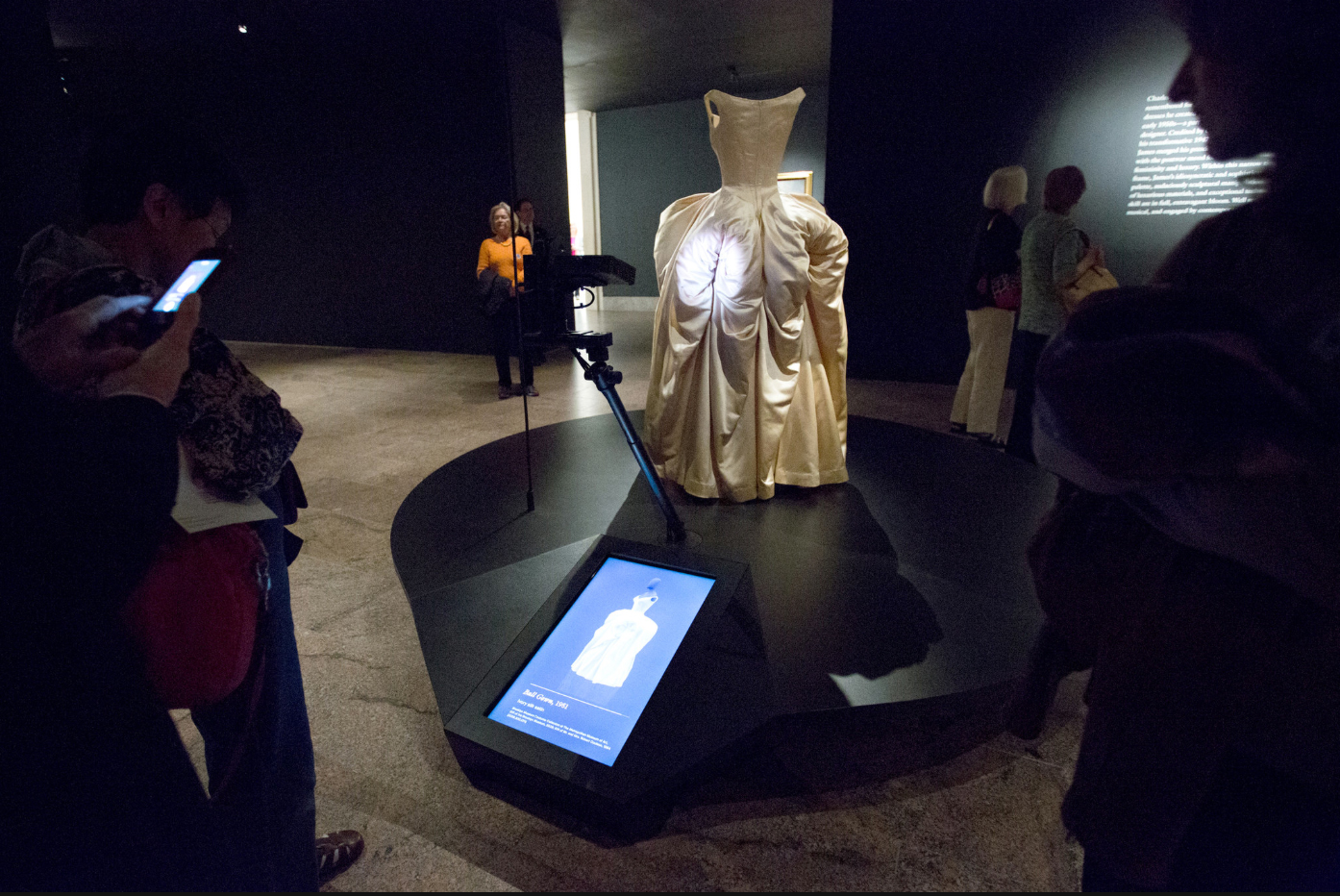
This weekend, while visiting the newest exhibit at The Metropolitan Museum Art,  I watched as ruffles became brush strokes and bright buttons became dots of paint on a canvas.

At Impressionism, Fashion and Modernity, gowns, suits, parasols, hats, and fans from the period are available for your study, as they appear alongside paintings containing similar and sometimes the same objects. Each object reveals details the Impressionist painters left to our imagination, but being removed from this period, it is difficult to imagine and infer the beautiful detail of the bustle or the expertly sewn soutache trim without seeing the garment or accessory firsthand.

This exhibit teaches how to see these paintings more accurately. It gives us a hint of the reality Monet, Courbet, Tissot, and others transformed into statements of style and feeling. The artists captured distinct moments in a previous time, one that was vastly different from our own.

Credit Suzanne De Chillo of the New York Times.

Credit: Suzanne De Chillo/New York Times

In the paintings displayed at Impressionism, Fashion and Modernity, bold fashions are as prominent as the subject, sometimes overwhelming a portrait with a striped dress or a red bolero. The striking gowns and accessories in these works demand an audience; the color, setting, and subject matter reflect on a new era in fashionable clothing and conduct for the epitome of urbanity – the Parisian.

The women wearing peignoirs, day dresses, and evening gowns captured by the Impressionist painters convey an intimacy and immediacy of the moment and of the era. The quick brush stokes share an expediency with the industrial age, as ready to wear and patterns made fashionable dress available to most social classes. The large, loose application of color exploits the frivolity of fashionable lace and trim, building volume where none existed. And the variety of colors upon the canvas explores the novelty of alkaline dyes on women posed near treasured antiques.

The Impressionists were capturing a change in lifestyle, a nod to the new consumerism, an acceptance of relaxed morals (at least for those among the artistic community), and the increasing disparity between men’s and women’s fashion.

The first half of the exhibit features dresses from the 1860s and their triangular silhouette, with a fitted bodice and a full skirt with additional gathering at the back. With the crinoline, the volume of the skirt becomes a dramatic feature of many of the Impressionist paintings, especially when artists borrowed poses from the popular fashion plates, also on exhibit. These skillfully rendered illustrations, created as steel and wood engravings, display intricate dress details overlaid by bright paints carefully applied by hand.

Monet, Claude. Luncheon on the Grass (left panel and center panel), 1865-66.  Oil on canvas, 164 5/8 x 59 (left panel) and 97 7/8 x 85 7/8 in. (right panel). From the collection at the Musée d'Orsay. Found online.

Monet, Claude. Luncheon on the Grass (left panel and center panel), 1865-66. Oil on canvas, 164 5/8 x 59 (left panel) and 97 7/8 x 85 7/8 in. (right panel). From the collection at the Musée d’Orsay. Found online.

A moment, a glance, and a well-placed prop – much of Impressionism is just that.  They are works that quietly share their stories through quick, bold brushstrokes documenting both dress fabric and model. Dollops of lace or tarlatan share the canvas with the subject strolling languidly en plein air or relaxing in a lavish interior space. A fashionable cashmere shawl draped dramatically over a woman’s arm and back is forever captured, and a glove drops to the floor remaining there as posed as the model wearing its mate. A coquettish turn of the head replaces the structured pose of a formal portrait, and the yardage of unstructured intimate apparel reveals much about a relationship.

In some these portraits, fashion gives an impression of impropriety. Illicit affairs are subtly implied by the presence of men’s accessories – a monocle or a top hat. Jeanne Duval, Baudelaire’s mistress, received a cavalier portrayal in Manet’s work of 1862, as she lays crippled and blind from syphilis. She is of course, dressed in white, but as Emile Zola said, she is in one of the many tones of white used during the period. Could this white be an accusatory tone, or simply an accurate one? Her portrait does certainly not pay her any compliments.

Zola has a quite a presence at the exhibit. His words appear on walls adjacent to Impressionist masterpieces, and his flattering description often describes his appreciation for the artists and their subjects. As a contemporary, Zola and other quoted critics provide a valuable perspective to the artwork surrounding them.

lala

Credit: Suzanne De Chillo/New York Times

In the 1880s, the triangular silhouette evolved into the shortened princess style, its bustle and elegant swept tiers hinting at movement and providing a new canvas for jet beading, fringe, and other popular trims. Men’s fashion had also developed a more streamlined shape. According to a contemporary critic, a suit had become two pipes feeding into a larger pipe, and topped “by a gutter pipe” – a hat! The urban male had become stylishly serious, requiring only two types of clothes, both day and evening. In the 1880s, a woman’s wardrobe was still confined by the corset and fashions that mandated many changes of dress based on time of day and activity.

Fantin-Latour, Henri. Édouard Manet, 1867. Oil on canvas; 46 5/16 x 35 7/16 in. Part of the collection at The Art Institute of Chicago. Found online.

Fantin-Latour, Henri. Édouard Manet, 1867. Oil on canvas, 46 5/16 x 35 7/16 in. Part of the collection at The Art Institute of Chicago. Found online.

Of course, Worth has a presence at this exhibit in both fabric and pictorial scenes of parties and festivities. His detailed gowns, with their well-placed pleats and trims, were widely copied both in Europe and in the United States. When describing a particularly gossamer Worth creation, a plaque in the exhibit mentions that the rose and leaves stitched to the gown would have “trembled with every movement of the wearer”. A man’s top hat, both stately and serious, was the perfect foil for a woman’s flower-covered bonnet.

The enduring appeal of the Impressionists is this: these omitted details that place garments to a certain period or year are replaced by an emotional expression – an expression of joy, of lust, of friendship. It is this emotional expression that allows these interpretations of period fashion to remain relevant.  It also best serves the fashions and designers of the day. For what is fashion removed from feeling and a designer removed from his zeitgeist? Clothing without context is just a shell of a story. Alongside a painting, a dress or a suit becomes part of a visual essay on context and culture.

For a multitude of images of the exhibit, please visit this site. Impressionism, Fashion, and Modernity is on view at the Metropolitan Museum of Art until May 27, 2013.

The Metropolitan Museum of Art
1000 Fifth Avenue
New York, New York 10028-0198
Phone: 212-535-7710

Hours:
Tuesday–Thursday: 9:30 a.m.–5:30 p.m.
Friday and Saturday: 9:30 a.m.–9:00 p.m.
Sunday: 9:30 a.m.–5:30 p.m.

Posted in Uncategorized | Leave a comment

Exhibition Review: Fortuny y Madrazo: An Artistic Legacy

Red, aqua and gold surround visitors at the Queen Sofia Spanish Institute, punctuated with swirls of silk turbans and gowns of apricot and cornflower blue. All is framed by Fortuny fabric, paintings, photographs and Fortuny lamps.

A Delphos dress greets visitors; it is Fortuny’s most familiar design, which he based on the chiton, a linen garment worn in Classical Greece. With its pleats and soft, columnar shape, Fortuny used the Delphos dress as a caryatid to visually support the patterns on his more substantial robes and scarves. These dramatic patterns, like the timeless silhouette of Delphos gown, recalled the past but were both a product of Fortuny’s innovative textile design methods; the complex technique Fortuny used to create the pleats is still not fully understood.

Fortuny, Mariano. Delphos dress, c1930. Peach pleated silk gown with Venetian clear glass beads. From the Collection Brooklyn Museum Costume Collection at the Metropolitan Museum of Art, Gift of the Brooklyn Museum, 2009.

Fortuny y Madrazo, Mariano. Delphos dress, circa 1930. Peach pleated silk gown with Venetian clear glass beads. From the Brooklyn Museum Costume Collection at the Metropolitan Museum of Art.

Mariano Fortuny y Madrazo (1871 – 1949) was an artist, an innovator, and a collector. His hand-printed textiles and iconic Delphos dress are steeped in the patterns and designs of the past, recreated with a romantic and initially shockingly feminine shape.  Fortuny y Madrazo: An Artistic Legacy links his work in fashion to the past while sharing Fortuny’s contributions to modern fashion design.

Hailed as an artist who painted fabrics, Fortuny’s artistic heritage shares much of the exhibition space. Etchings, photographs, and paintings represent an artistic legacy that began with Fortuny’s great grandfather, José de Madrazo, whose portrait of Ingres hangs beside the work of his son, Federico de Madrazo, a central figure in Spanish Romanticism. Fortuny’s photographs of his time in Morocco, in Greece, and in Egypt pair well with his designs, and evoke a similar turquerie style and mood to his fashion photographs on display in the second gallery.  In these photographs, a woman poses artistically to record Fortuny’s Delphos design.

Oh, the many variations of Delphos gown! Fortuny disregarded fashion trends, instead created gowns of a similar style for over twenty years for clients like the Marchesa Casati, Isadora Duncan, Gloria Vanderbilt, and others. He designed the gowns in a multitude of colors, including soft pastels and the deepest jewel tones. Most striking are the small finishing details of each dress, like the delicate Murano glass beadwork that follows the edge of a neckline or a side slit. These details complete the first layer of Fortuny’s signature look, which was only complete with the addition of a colorful patterned scarf or robe.

The patterns of the scarves and aljubas used as Fortuny’s canvases recall Sassanian motifs and designs from the Islamic and Coptic worlds. The kimono sleeves, the silk velvet, and the deliberately faded garments are both opulent and dramatic; one can imagine their fluid lines taking the shape of the women who wore them as they walked, talked and danced through elegant soirees, as gathered robes billowed at the smallest step, sleeves moved at the slightest wave of  a hand, and metallic patterns shimmered with every turn. Fortuny’s recreated designs reveal our own fascination with the past, they reveal the glamour we place on the ephemeral.

Fortuny y Madrazo: An Artistic Legacy will be at the Queen Sofia Institute until March 30, 2013.

Queen Sofía Spanish Institute
684 Park Avenue
New York, New York 10065
T 212-628-0420

Gallery hours:
Monday–Thursday 10am–6pm
Friday 10am–8pm
Saturday 10am–5pm

Posted in Exhibition | Leave a comment