Fashionista Friday: Marquise de Miramon

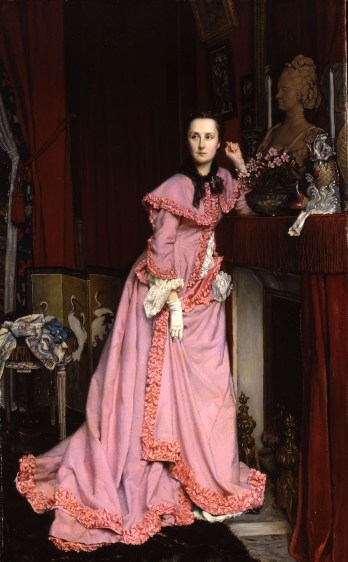
Jacques Joseph Tissot. Portrait of the Marquise de Miramon, née, Thérèse Feuillant. 1866. Oil on canvas. J. Paul Getty Museum, Los Angeles.

At the Getty Center in Los Angeles hangs this painting by Jacques Tissot.  The subject, Thérèse-Stephanie-Sophie Feuillant, the Marquise de Miramon (1836-1912) is painted in a pink velvet ruffled dressing gown.  The Getty’s records for this painting are remarkably complete, including two letters from Tissot himself to the Miramon family, asking for permission to display the painting at the Paris Salon of 1867, as well as swatches of the dressing gown’s pink velvet.

Dressing gown, peignoir, robe de chambre, wrapper and hostess gown can all be categorized under the umbrella term “at-home gown.”  It was not inappropriate to be seen in a dressing gown during the morning’s leisure hours, as reflected by the Marquise’s unapologetic attitude in being recorded in this state of dress.  Despite this, dressing gowns played a small role in scandals that rocked the art world at the Paris Salon of 1868.

In the Salon of 1868, Edouard Manet displayed Young Lady in 1866, in which the subject is also wearing a pink peignoir, like the Marquise de Miramon, and is pictured with her pet parrot.  Manet’s Young Lady is also seen wearing a cameo on a black ribbon, a popular accessory of the 1860s but usually depicted on women in street clothes—suggesting that the subject is caught at a point of transition in her state of dress.  Whether she is moving toward or away from nudity is the viewer’s choice (although the man’s monocle in her left hand might suggest the former).
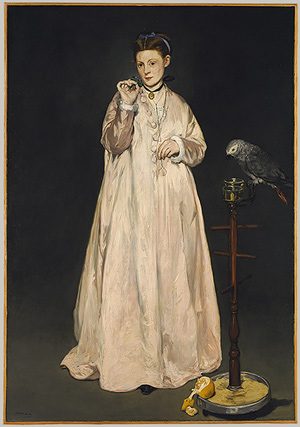
Edouard Manet. Young Lady in 1866. 1866. Oil on canvas. Metropolitan Museum of Art.
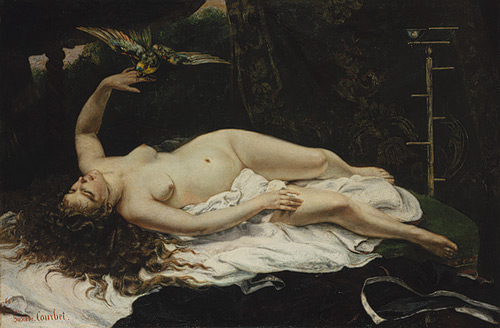
Gustave Courbet. Woman with a Parrot. 1864. Oil on canvas. Metropolitan Museum of Art.

However, critics blasted Manet’s work for its similarities to his friend Gustave Courbet’s Woman with a Parrot, a nude that had been rejected in 1864 by the Salon for indecency, but was granted a place in the show in 1866.  One critic wrote of Manet, “he has borrowed the parrot from his friend Courbet and placed it on a perch next to a young woman in a pink peignoir. These realists are capable of anything!”  The innocuous pink peignoir, a simple at-home garment, became representative of a divide between a scandalous nude and a slightly more tolerable portrait, the disconnect between Realists and Impressionists, and the growing moral distance between traditional and mid-century Victorians.

Regardless of the dressing gown’s relation to a scandalous nude portrait, it was very much a part of fashion in the 1860s, even appearing in Harper’s August 1860 and August 1861 issues.
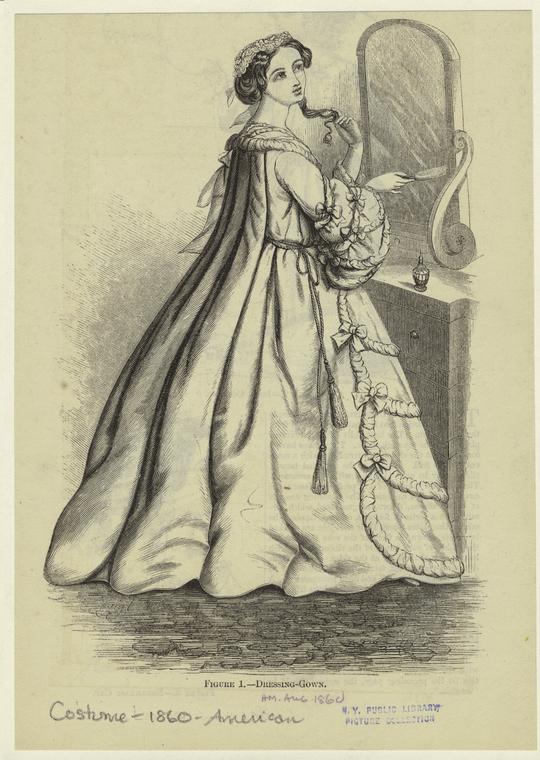
Harper’s Magazine, August 1860.
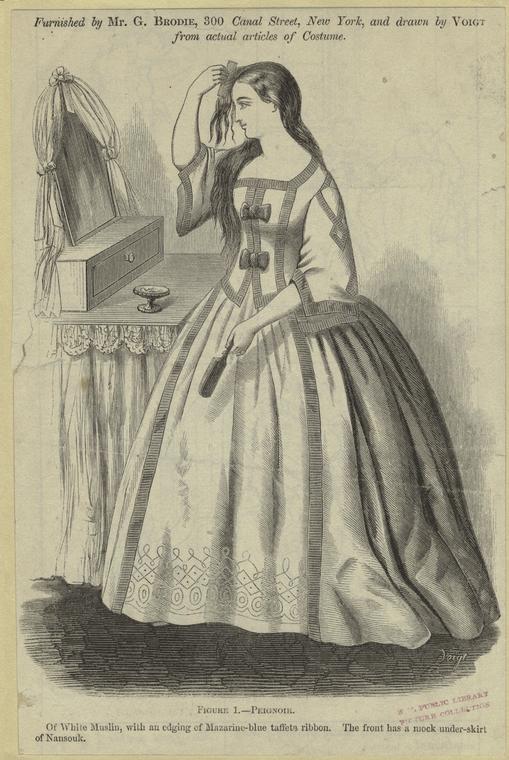
Harper’s Magazine, August 1861.

Several extant dressing gowns of the 1860s still exist, showcasing luxury and ornamentation perfectly suitable for women of the aristocracy such as the Marquise de Miramon.
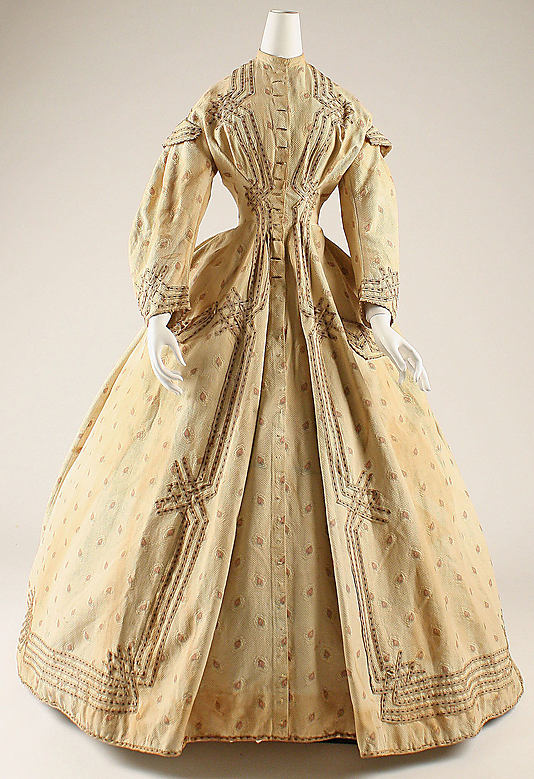
Fashionable, even at home. The fabric and trim of this dressing gown are so fine it appears to be more than just leisure wear. Dressing gown, ca. 1860. Metropolitan Museum of Art.
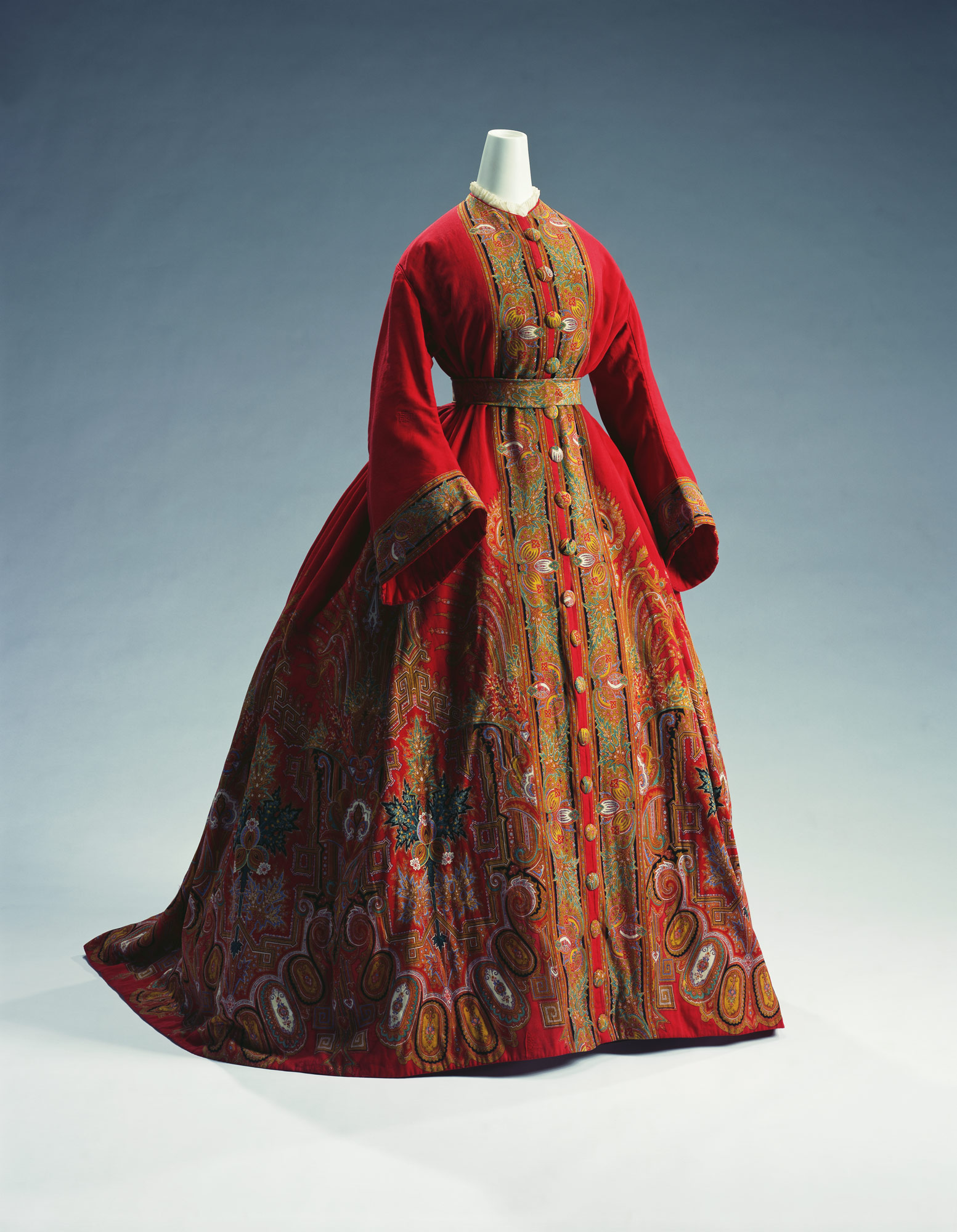
The print on this dressing gown reflects the craze at the time for cashmere shawls. Dressing gown, ca. 1866. Kyoto Costume Institute.

The Getty describes the Marquise de Miramon as “costumed in the latest style and surrounded by fashionable decorative objects” (Getty 2009)—clearly, leisure fashion in the 1860s certainly followed as much rule and regulation as other modes of Victorian dress, and provided just as much opportunity for expression.

Resources
“Édouard Manet: Young Lady in 1866 (89.21.3)”. In Heilbrunn Timeline of Art History. New York: The Metropolitan Museum of Art, 2000–. http://www.metmuseum.org/toah/works-of-art/89.21.3 (December 2008)
Ewing, Elizabeth.  Dress and Undress: A History of Women’s Underwear.  New York: Drama Book Specialists, 1978.
“Gustave Courbet: Woman with a Parrot (29.100.57)”. In Heilbrunn Timeline of Art History. New York: The Metropolitan Museum of Art, 2000–. http://www.metmuseum.org/toah/works-of-art/29.100.57 (December 2008)
Hadler, Mona.  “Manet’s Woman with a Parrot of 1866.”  Metropolitan Museum Journal, Vol. 7 (1973).
J. Paul Getty Museum.  “Portrait of the Marquise de Miramon, née, Thérèse Feuillant.”  Historical Witness, Social Messaging: Information and Questions for Teaching.  J. Paul Getty Trust, 2009.  http://www.getty.edu/education/for_teachers/curricula/historical_witness/downloads/tissot_marquise.pdf.
 

Posted in Fashionista Friday | Tagged , , , , | 3 Comments

Mystery Monday: H. R. Mallinson’s “American National Parks” Series

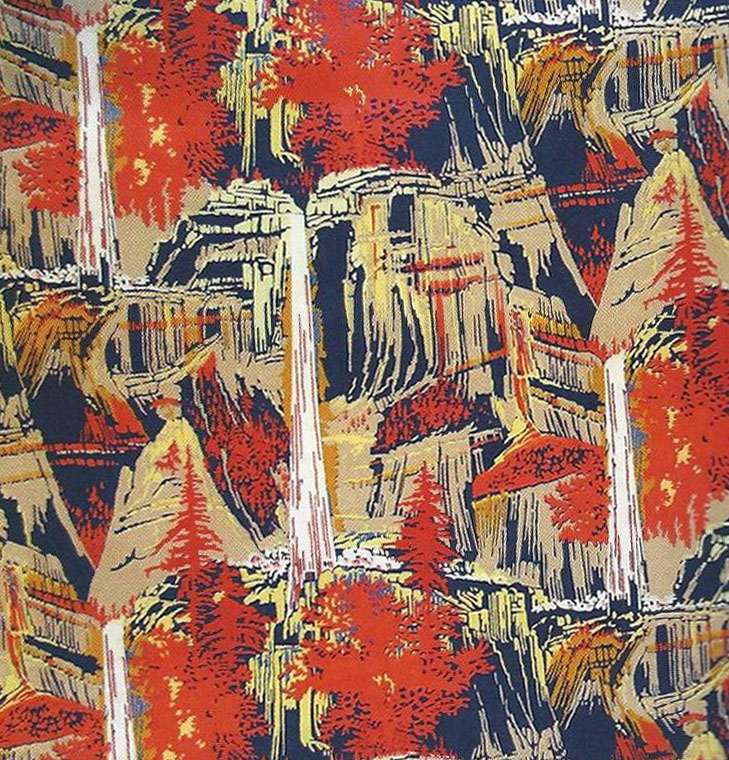
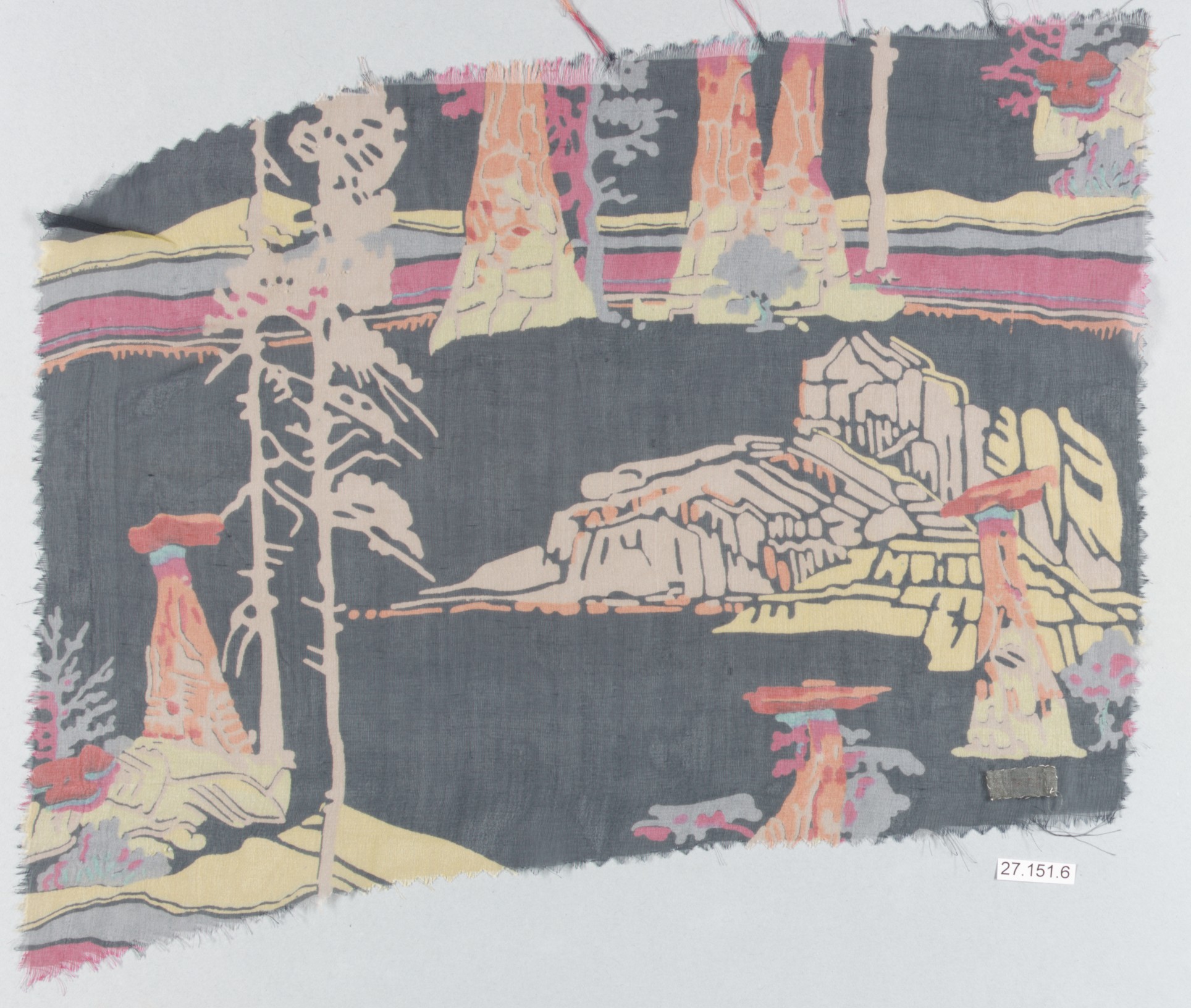
H. R. Mallinson. “Garden of the Gods”, 1930. Silk, 29.8 x 23.2 cm. Copyright 2012 the Metropolitan Museum of Art.

If you guessed H.R. Mallinson’s “American National Parks” series, you are correct!

H. R. Mallinson. “Garden of the Gods”, 1930. Silk, 29.8 x 23.2 cm. Copyright 2012 the Metropolitan Museum of Art.

“To see a little further into Fashion’s future; to dig a little deeper for quality production; to know no mean between right silks and wrong silks; to be satisfied never with good enough but always to supply even better than the customer expects.” – M. C. Migel & Company’s “Silk Creed” (175)

Founded in 1895, M. C. Migel & Company hired its greatest asset only two years later, talented salesman Hiram Royal Mallinson. In 1915, when Migel left the company after making a comfortable profit, the M. C. Migel & Company became H. R. Mallinson & Company with a subtitle of “Qualité Silk Originators.” Under Mallinson’s leadership, the company experienced its greatest commercial success.

What made H. R. Mallinson a great salesman and leader? His dedication to quality and originality. His goal to produce and market American silks that rivaled the silks produced in Europe was supported by his supreme salesmanship and his focus on reaching the individual consumer. American Silks, 1830 – 1930 devotes a whole chapter to Mallinson’s advertisements and marketing campaigns and the impact these campaigns had on the fashion and textile industry.

H. R. Mallinson & Company novel large-scale high fashion print Paradise Valley, Mount Rainier; landscape design from the 1927 “American National Parks” series. From The Collection of the Newark Museum. Museum Purchase 1927. J. Ackerman Cotes Collection (Detail). Found in American Silk, 1830 – 1930.


The “American National Parks” design series was a reaction to a successful line of prints by Stehli Silk Company in 1925. The Stehli Silk company had produced a series of prints designed by American artists and illustrators, and the success of this line had “challenged Mallinson’s design leadership” (215). In the spring of 1927, Mallinson began marketing designs featuring majestic icons of the American landscape.  “The twelve landscape designs, each available in from eight to twelve colorways on three different ground cloths, surpassed in sales and critical response anything Mallinson had done before” (216). The prints were a success!

H. R. Mallinson & Company novel large-scale high fashion print, Bridal Veil Falls, Yosemite; landscape design from the 1927″ American National Parks” series. From The Collection of the Newark Museum. Museum Purchase 1927. J. Ackerman Cotes Collection (Detail). Found in American Silk, 1830 – 1930.

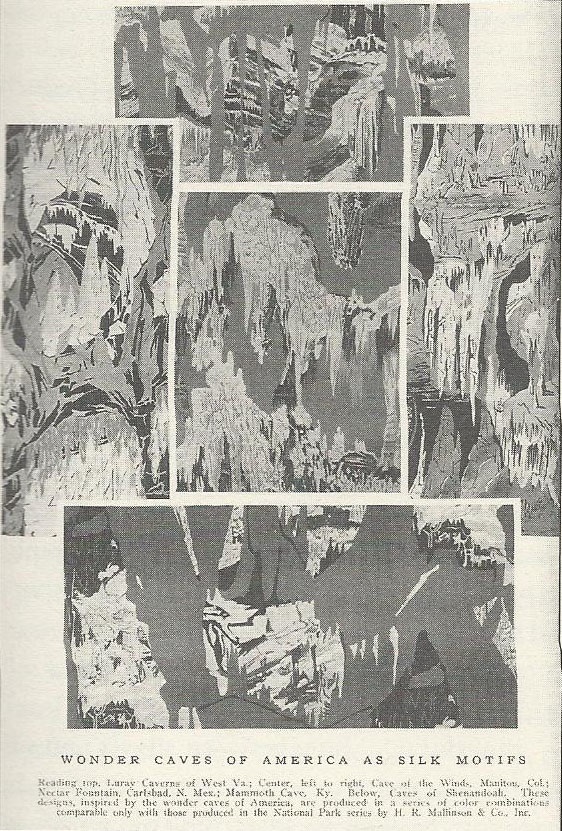
Later that fall, Mallinson & Company released a second series of prints, “Wonder Caves of America”. This also sold well, and in the spring of 1928, Mallinson & Company released the “American Indian” series, a series of fifteen designs inspired by fifteen Native American tribes.

Examples of both the “American National Parks” series and the “American Indian” series can be found online at the Museum of Fine Arts, Boston. These slideshows include hand drawn sketches and samples of these two designs series. To view these two collection tours, please use the following links: National Parks Collection Tour and American Indian Collection Tour.

Following these successful designs, Mallinson & Company marketed its final National design series in 1929, the “Early American” series.

“Early American was styled to offer something to everyone: traditional florals in the Life of Lincoln and Showboat on the Mississippi, Jazz Age designs with ray effects, jutting angles, and jagged lines in Betsy Ross/Liberty Bell, and Franklin’s Key to Electricity, a horizontal stripe in Covered Wagons/Oregon Trail, and a regular geometric in Old Sampler/Paul Revere” (216).

Feature page with the designs for Wonder Caves of America, a follow-up to the National Park print series. From the American Silk Journal. Found in American Silk, 1830 – 1930.

H. R. Mallinson & Company had its most successful year in 1927.

“At this point, Mallinson’s ran a ten-thousand spindle throwing mill in Paterson and one of twenty-thousand spindles in Trenton to provide silk yarns for its own weaving mills. The flagship Long Island City (Astoria, New York) mill operated 200 jacquard and 500 box looms. Erie’s equipment included 50 jacquard, 100 velvet, and 500 plain and box looms. The Union City (formerly West Hoboken, New Jersey) mill ran 100 velvet looms, and the Allentown, Pennsylvania, ran 25 jacquard and 250 box looms.”

It was during this year that its net profit was over a million dollars, which would be the equivalent of about 13 million dollars today.

So, what caused H.R. Mallinson’s decline? In 1928, as ready to wear clothing became more popular, silk piece goods lost some of their appeal.  Along with the difficulties caused by the Great Depression, Mallinson & Company found new competition with the garment industry. Mallinson continued to seek new ways to market silk goods, and in 1930, opened an office at 512 Seventh Avenue in the garment district (193). Despite Mallinson’s efforts to compete with emerging markets, his efforts to open new sales offices failed to realized a profit. H. R. Mallinson died suddenly in May 1931, and within five years, the company had sold some of its mills and had filed for bankruptcy. After several name changes and efforts at revitalization, the company was absorbed into Burlington Industries in 1952 (250).

For the past few years, the runways have displayed wonderful collections of bold and bright prints. Like the vibrant prints Mallinson & Company created in the 1920s, the witty subject matter and the dynamic colors in today’s prints appeal to consumers. After 1928, the demand for bold prints like those in the National Parks series waned as smaller prints became fashionable. And the cycle repeats and repeats and repeats.

Visit us next Monday for next week’s mystery!

Notes:
Field, Jacqueline, Marjorie Senechal, and Madelyn Shaw. American Silk 1830 – 1930: Entrepreneurs and Artifacts. Lubbock, Texas: Texas Tech University Press, 2007.
Posted in Mystery Mondays | Tagged , | 4 Comments

Mystery Monday

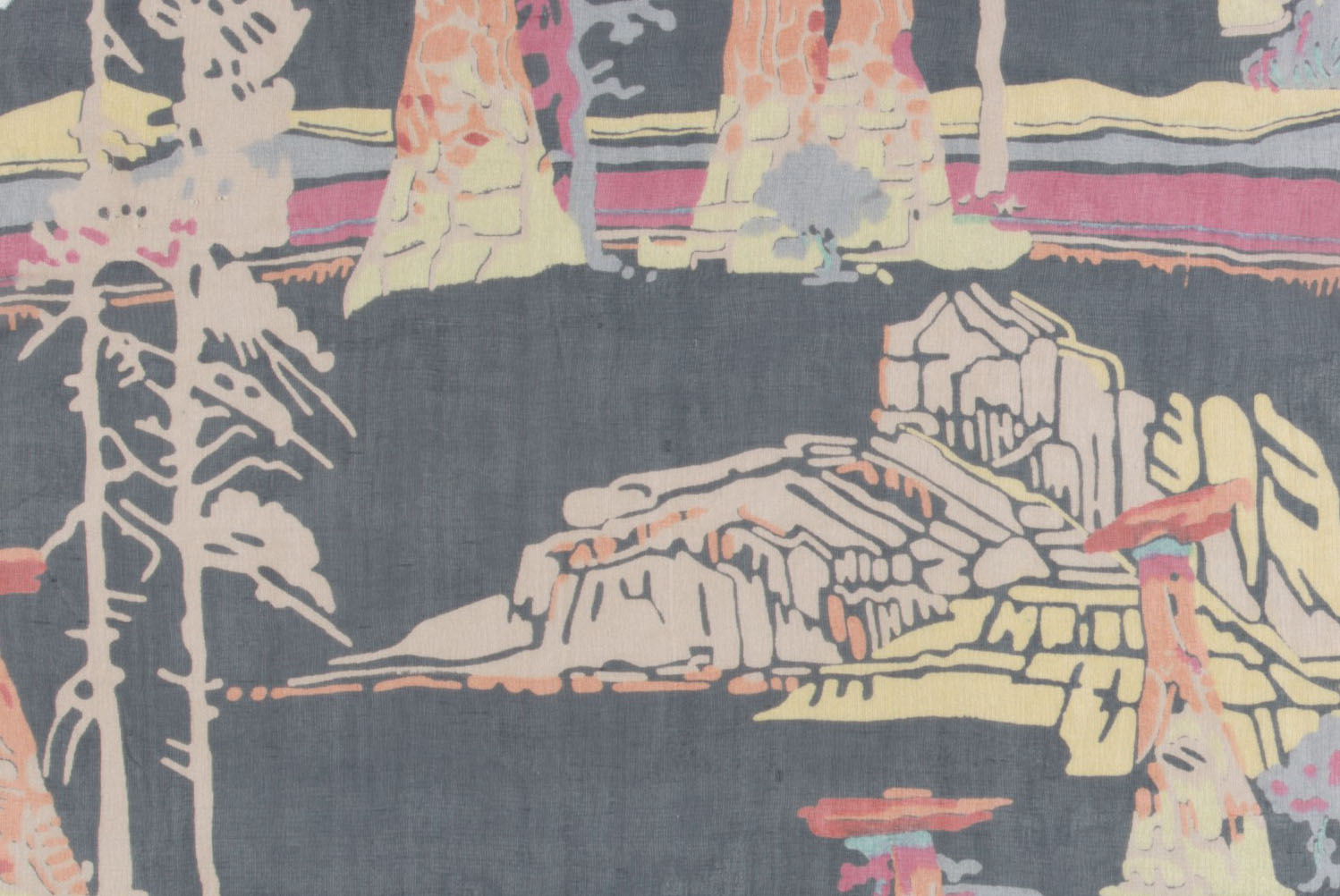
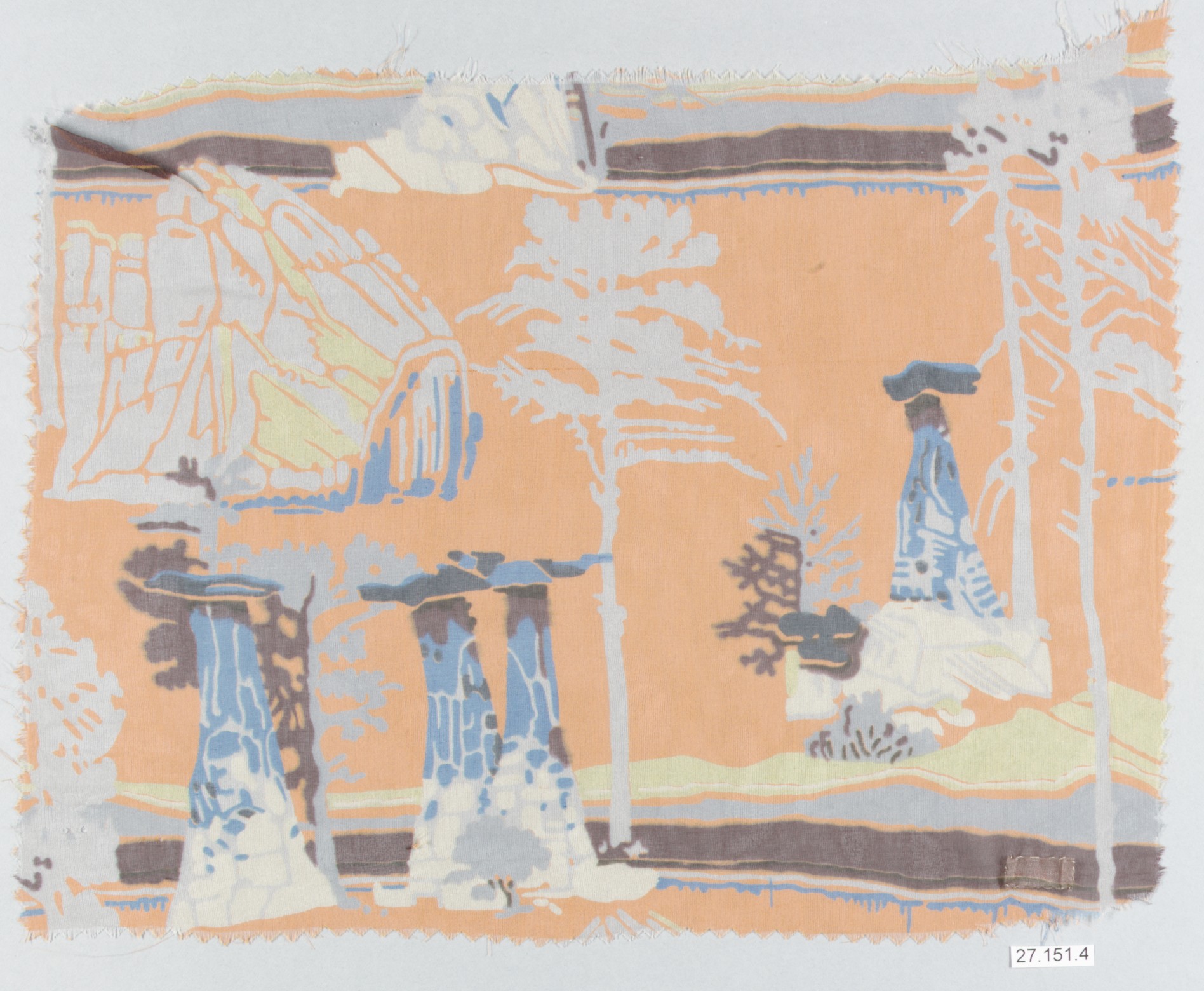
Prints and patterns – the bolder the better! Here’s our new mystery:

What company produced this textile? From what design series is this textile?

Think you know? Post your guesses below; we’ll tell you on Thursday if your guess is correct!

Posted in Mystery Mondays | Tagged | 1 Comment

Fashionista Friday: Shirley Temple

Shirley Temple (b. 1928)

Shirley Temple in Baby Take a Bow. Fox Films, 1934.

Without a doubt, Shirley Temple was the most famous child of the 1930s.  Precocious, bubbly, and an embodiment of “cuteness,” Shirley began her film career at the tender age of three, but by puberty she was removed from Hollywood and sent to a real school for the first time in her life.  She would later attempt a return to her former career as an adolescent but would leave acting for good by age twenty-one.

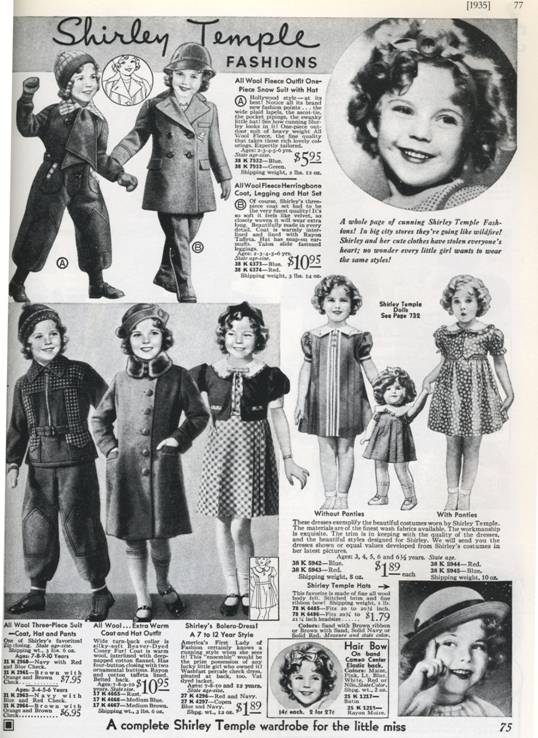
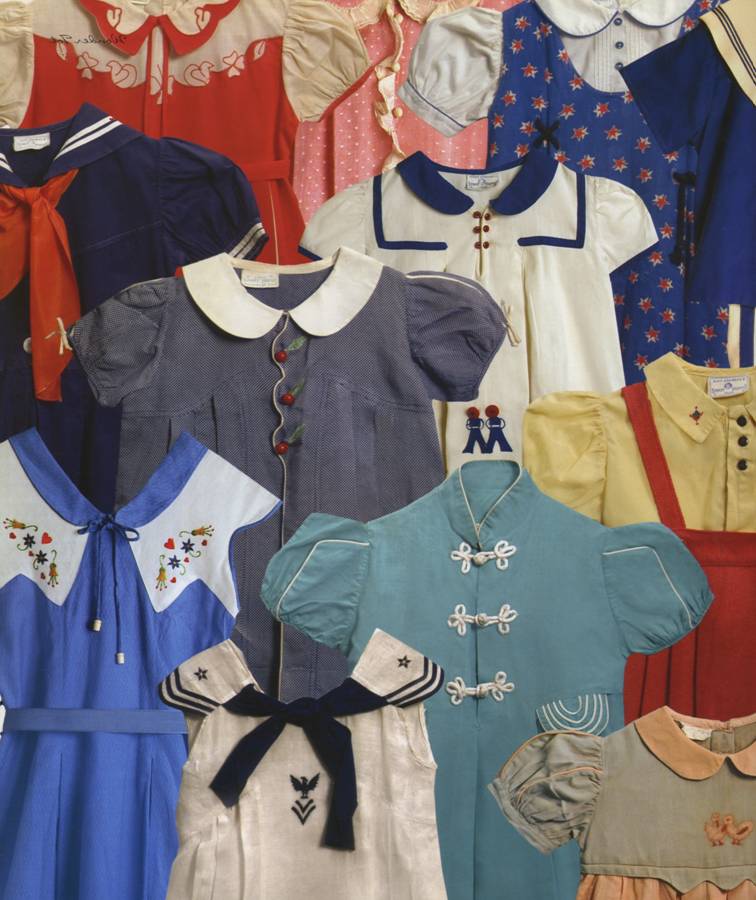
At the time of her retirement from film, she had amassed a tidy fortune between $3 million and $4 million.  Shirley had not just earned a paycheck from acting in films—she had lent her name and face to numerous licensing agreements, including lines of garments that emulated her on-screen style.  Several companies were contracted to produce dresses, gloves, coats, hats, swimsuits, etc. under the Shirley Temple Brand.  The most successful partnership was with the Rosenau Brothers of Philadelphia, who created the Shirley Temple Cinderella Frock line.  Cinderella dresses were designed to align with Shirley’s latest film, and bore a hangtag that proudly announced the dress to be “Just Like Mine.”

Cinderella Frock design based on The Little Colonel, 1935.

Cinderella Frock design based on Dimples (also advertised as The Bowery Princess), 1936.

At Sears, Shirley Temple dresses were twice the price of other girls’ dresses; they were of “highest quality” and their workmanship “exquisite.” Sears catalog, 1935 (Blum 77).

A collection of Cinderella Frock dresses (Dubas 137).

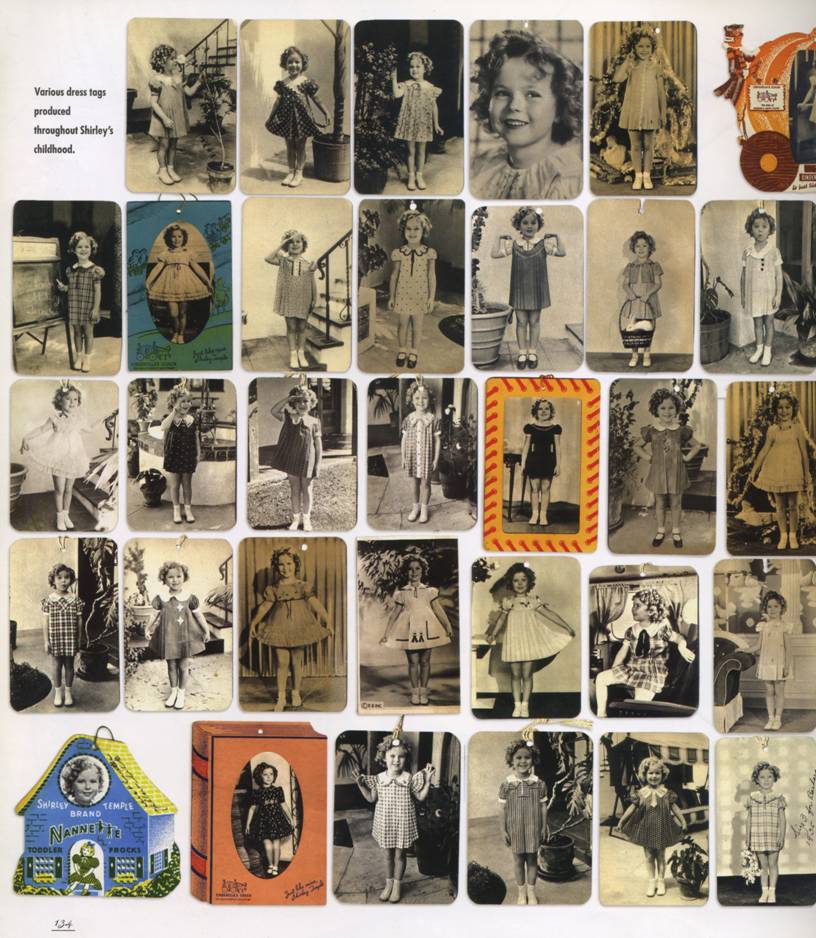
Shirley was kept perpetually infantilized in her films and promotional appearances, wearing costumes that never quite grew up with her. Between the ages of seven and ten (although movie studios had preferred you to believe six and nine) Shirley was still dressed like a toddler.  Her dresses had either a high waistline or none at all, emphasizing a round tummy like a toddler’s, as well as a full, short skirt, showing off baby fat-ridden thighs and occasionally panties.

Shirley Temple wore roughly the same silhouette long into middle childhood. A collection of promotional tags produced by Cinderella Frocks (Dubas 134).

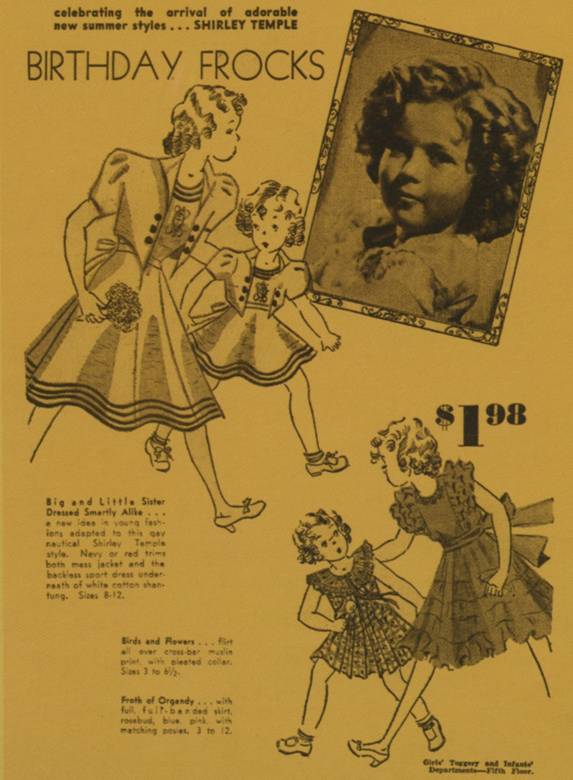
While Shirley Temple remained in perpetual toddlerhood through the 1930s, the average American girl was permitted to age properly.  Fashionable dresses for older girls had a waistline that sat at the natural waist and a slightly longer skirt that reached to the knees. Cinderella Frocks capitalized on that idea and introduced Big and Little Sister designs.

An advertisement for Big and Little Sister dresses by Cinderella Frocks (Dubas 140).

Shirley’s sartorial influence had a deep impact on American perception of child rearing and the acceptance of a toddler as a thinking, feeling, individual.  In his book The Commodification of Childhood: The Children’s Clothing Industry and the Rise of the Child Consumer, Daniel Cook examines the rise of consumer marketing to children, who had previously been seen as asexual, dependent creatures, and any choices regarding children’s needs had been directed toward their mother.  In the 1930s, marketing was beginning to be aimed toward children, appealing to their tastes and desires.  With Shirley’s unending toddlerhood, the acceptance that small children have wants and needs was enforced.  Toddler boys ceased to be dressed like toddler girls.  Juvenile marketing continued with the licensing of other Hollywood stars’ names and Disney character merchandise.  Marketers began to see the world through a child’s perspective, and, judging by the value of the global children’s wear market, projected to be $176.1 billion in 2015 (WeConnectFashion 9), they still do today.

Resources
Blum, Stella, ed.  Everyday Fashions of the Thirties as Pictured in Sears Catalogs.  New York: Dover Publications, 1986.
Children’s Wear.  New York: WeConnectFashion, 2012.  http://libproxy.fitsuny.edu:2052/library/restricted/PDF/SAB2011/ChildrenSTRTBIZ12.pdf (accessed September 26, 2012).
Cook, Daniel Thomas.  The Commodification of Childhood: The Children’s Clothing Industry and the Rise of the Child Consumer.  Durham: Duke University Press, 2004.
Dubas, Rita.  Shirley Temple: A Pictorial History of the World’s Greatest Child Star.  New York: Applause Theatre Books, 2006.
Shirley Temple Official Website. http://www.shirleytemple.com (accessed September 26, 2012).
Windeler, Robert.  The Films of Shirley Temple.  Secaucus, NJ: Citadel Press, 1978.
Posted in Fashionista Friday | Tagged , , , | 2 Comments

October Treasure of the Month: Monte Santo & Pruzan

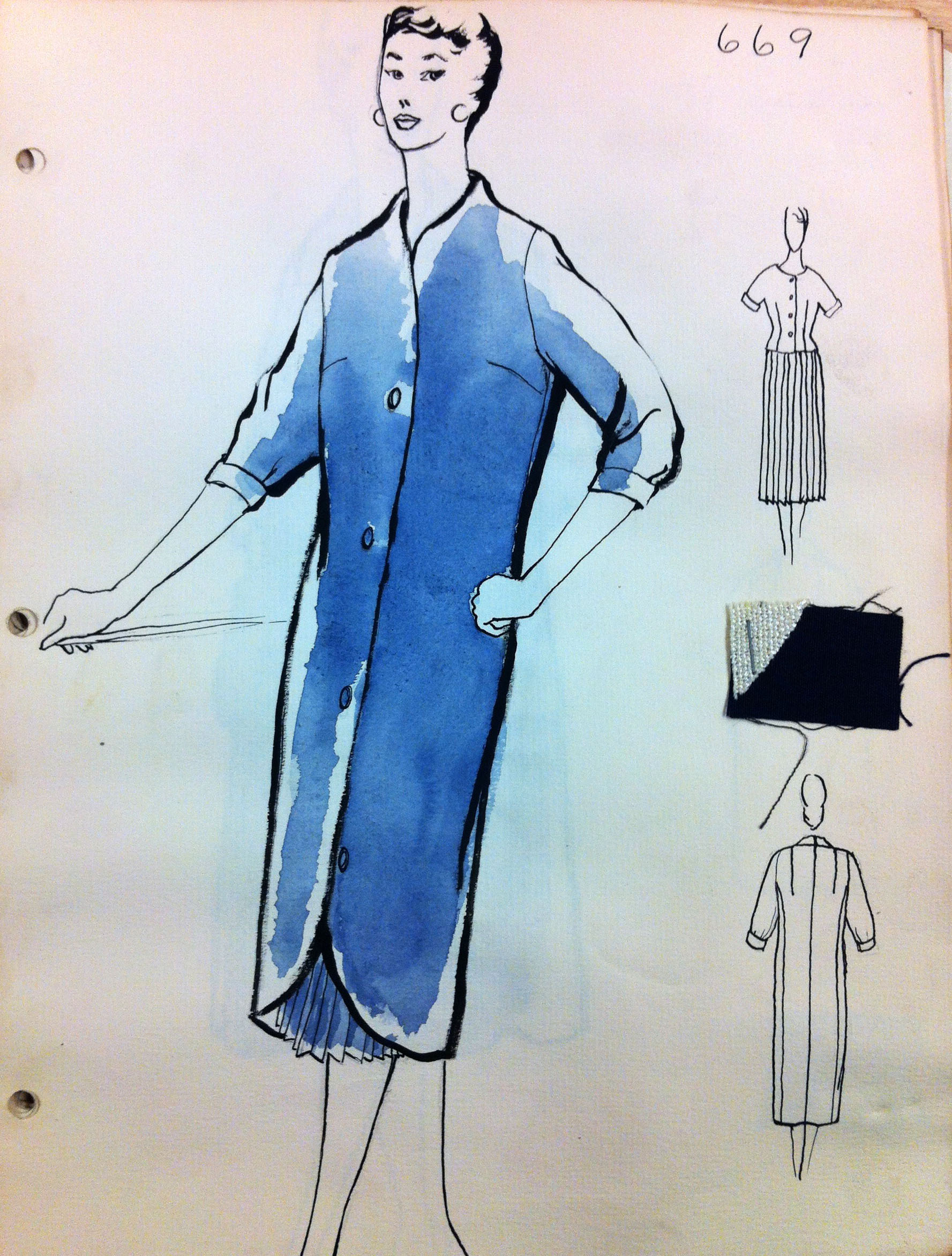
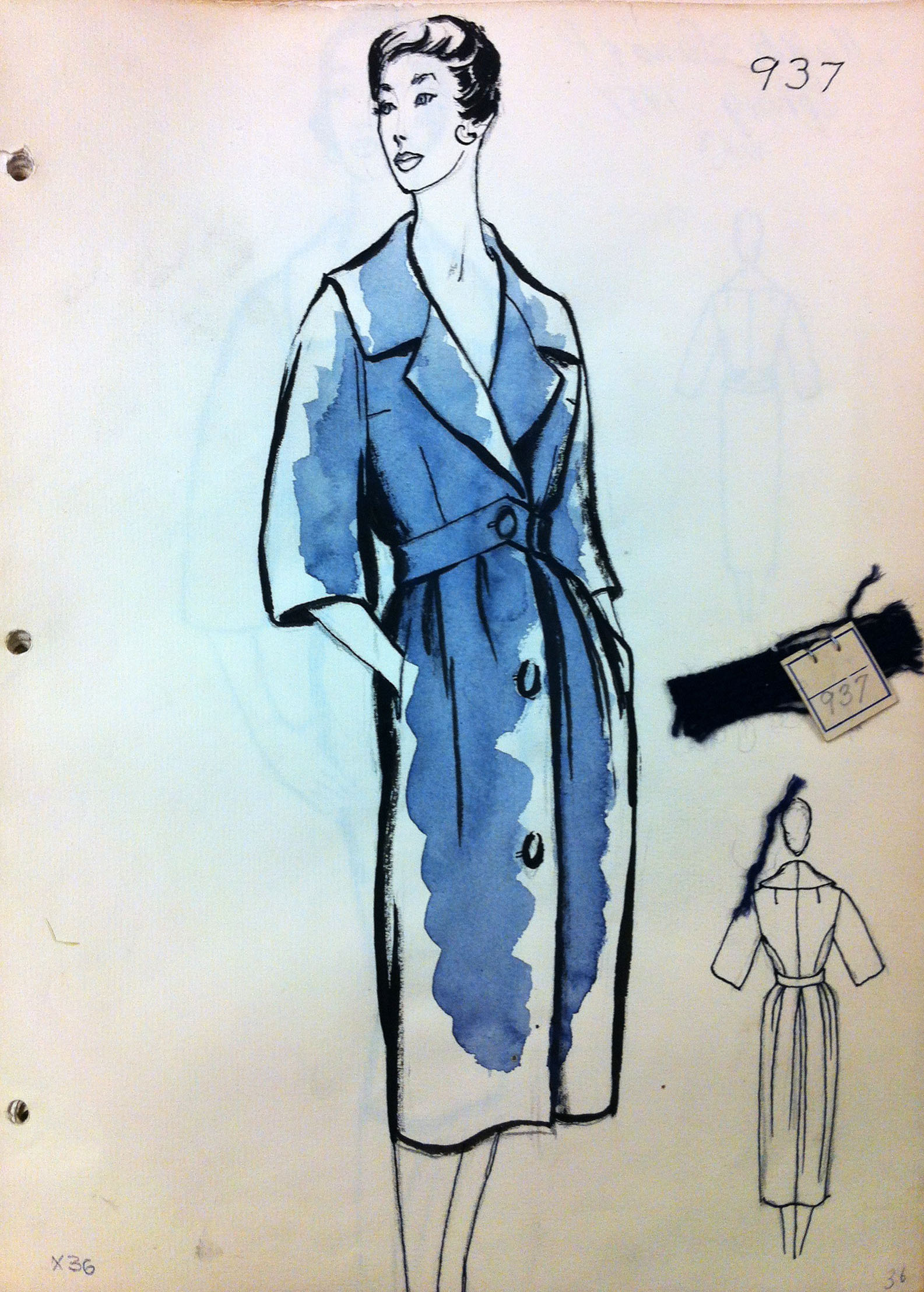
This month’s treasure comes from Special Collections and FIT Archives. It features the wonderful sketches and swatches collection of the coats and suits manufacturer Monte Santo & Pruzan.

Monte Santo & Pruzan coat, 1957.
Special Collections and FIT Archives.

Vincent Monte Santo was the man who started it all. In 1915 he opened a costume tailoring house that specialized in woolen outerwear and suits for women. With the onset of World War II the ready-to-wear American market thrived, Seventh Aveneu replaced Paris as the supplier of chic and American women flocked to department stores. This may have been the impetus behind Monte Santo decision to abandon his private clientele and to become a wholesaler for department stores such as Lord & Taylor, Saks Fifth Avenue, and Bergdorf Goodman.

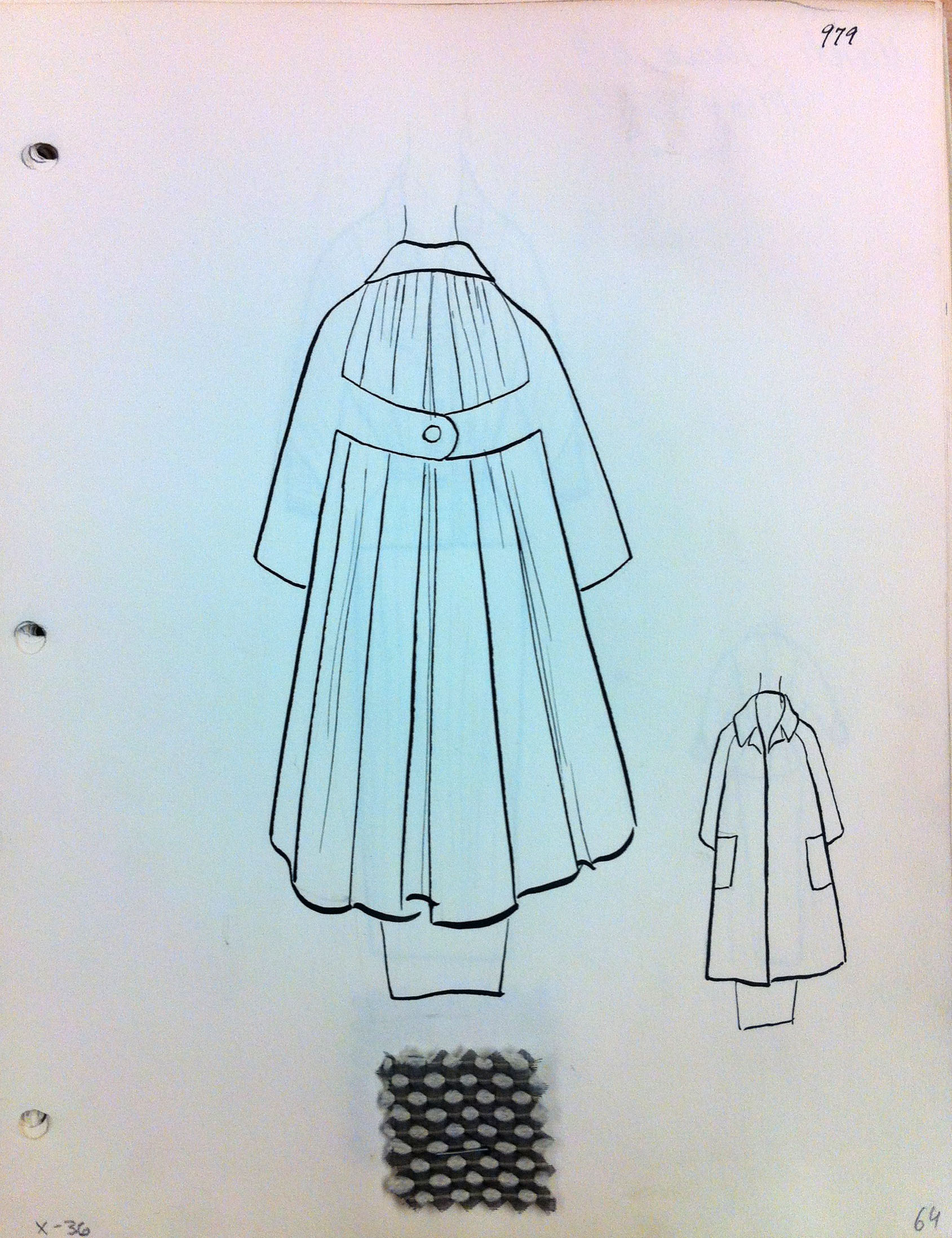
During the 1950s Monte Santo was joined by Max Pruzan, and the company changed its name to Monte Santo & Pruzan. Their coats relied on the company’s long standing tradition of fine tailoring and retailed at high prices that equaled, if not surpassed, line-for-line certified copies of leading couture designers such as Dior and Balenciaga. This coat for example sold at Lord & Taylor for a price that would have cost in today’s value almost $2,000.

Monte Santo & Pruzan pleated-back coat, 1954. Special Collections and FIT Archives

The same coat as it appeared in a Lord & Taylor advertisement in Harper’s Bazaar, 1954. Lord & Taylor scrapbook collection, Special Collections and FIT Archives.

The perfect fit and beautiful wool fabrics were matched with stylish cuts and silhouettes. The influence of Balenciaga is evident in the sloping shoulders, the structured fit, and the simple yet sophisticated design details. For the better part of the 1950s the company employed French-born designer Jacques Tiffeau. The colorful Tiffeau, who was once Christian Dior’s lover, may have been the designer of these coats.

Monte Santo & Pruzan coat and dress, 1956. Special Collections and FIT Archives.

Pruzan retired in 1966, and the company dissolved in 1969. Tiffeau, who was awarded two Cotty awards and was a close friend of anyone who mattered in the world of fashion and magazine publication , is unfortunately not remembered today as the great designer he once was, but this is a topic for a totally different post.

Monte Santo & Pruzan coat, 1956. Special Collections and FIT Archives.

Special Thanks to Ariele Elia for her helping in researching and scanning the materials.

The Department of Special Collections and FIT Archives’ mission is two-fold. Regarding Special Collections, it acquires, preserves, and provides access to a wide range of primary research materials in original formats and across many languages and geographical spectra. All acquisitions support one or more curricula offered at FIT. Regarding the College Archives, the Department acquires, preserves, and provides access to College records permanently-scheduled or of enduring value created in the course of College business by administrators, staff, faculty, and students. These efforts support myriad goals in and across FIT units as well as research from those outside the FIT community.

In order to view these original works or other Special Collections materials please email: fitlibrary.sparc@gmail.com or call 212.217.4385 for an appointment.

Posted in Treasure of the Month | Tagged , , , , , , | 2 Comments

Mystery Monday: Marchesa Luisa Casati

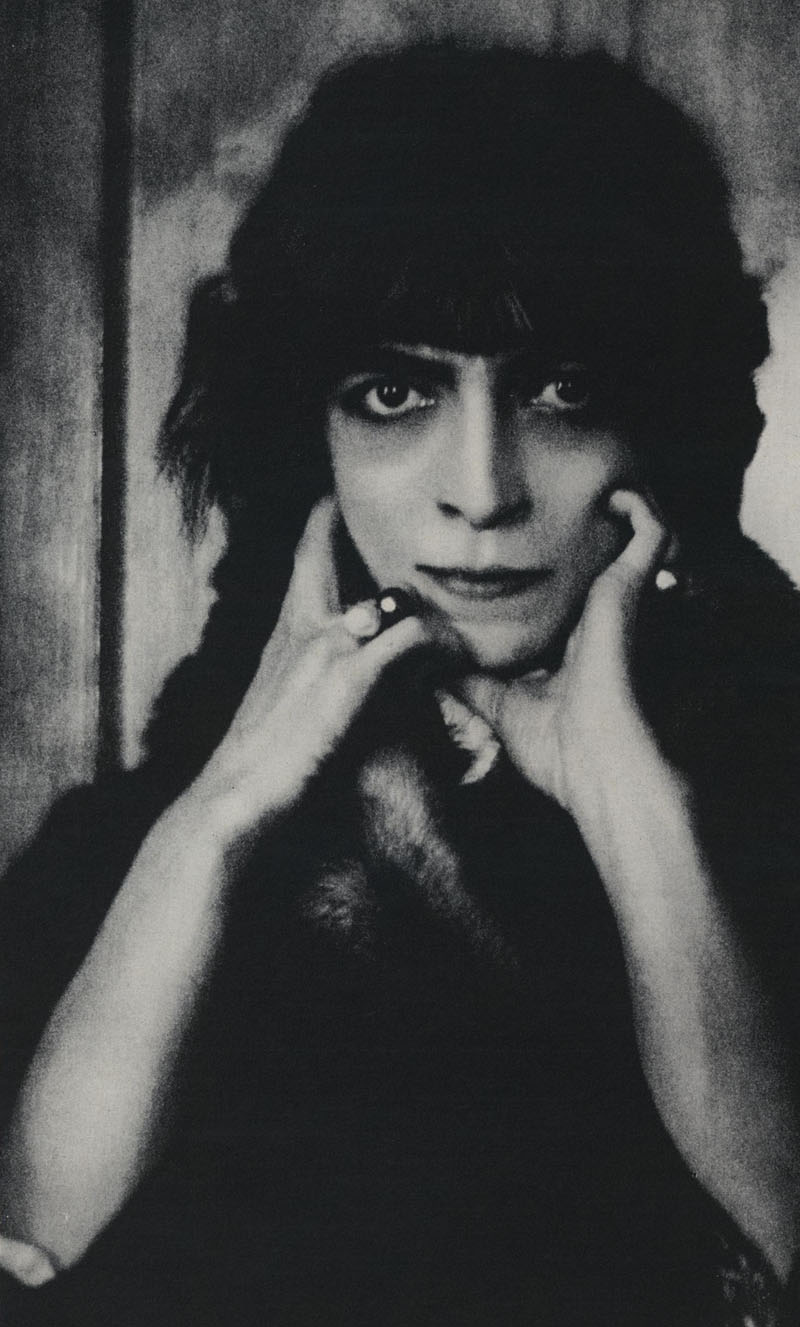
One of Baron de Meyer’s photographs of Luisa Casati, 1912. Found in Vogue. © 2012 Conde Nast.

“The door to the room where we sat chatting suddenly opened. A dead woman entered. Her superb body was modelling a dress of white satin that was wrapped around her like a shroud and dragged behind her. A bouquet of orchids hid her breast. Her hair was red and her complexion livid like alabaster. Her face was devoured by two enormous eyes, whose black pupils almost overwhelmed her mouth painted a red so vivid that it seemed like a strip of coagulated blood. In her arms, she carried a baby leopard. It was the Marchesa Casati. ”  – Gabriel-Louis Pringué (7)

If you guessed Marchesa Casati, you are correct! So, who was she?

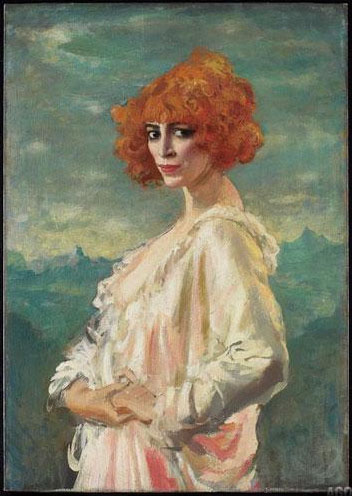
“Who is Luisa? … The one woman who ever astonished D’Annunzio, the one woman who was painted by Boldini, Van Dongen, Augustus John, and dozens of others…Luisa, who wore necklaces of snakes and rested on pillows of leopards—all of them alive, of course. Luisa, who had a palace in Milan and another in Venice, who owned the most beautiful of emeralds, who wore chinchilla on the Lido and lamé in St. Moritz … Luisa, who ordered the likeness of her lovers modeled in waxen figurines. Luisa, who once had everything and who now has nothing, apart from the few friends she continues to astonish. In a word—Luisa Casati.”  – Tony de Gandarillas, 1950 (3)

John, Augustus Edwin. The Marchesa Casati, 1919. Oil on canvas, 96.5 x 68.6cm. On view at the Art Gallery of Ontario. © 2009 Art Gallery of Ontario

Boldini, Giovanni. Casati, 1911-1913. Oil on Canvas, 130 x 176 cm. Found in Vogue. © 2012 Conde Nast. On view at The Galleria nazionale d’arte moderna e contemporane.

What did she wear? These quotes, from the Vogue article, “People are Talking about: Extravagant Casati”, describe four of her extreme outfits:

“She herself arrived last, a kind of Tiepolo goddess, wearing a crown of ostrich feathers, a hoop-skirted gown of gold cloth, her train borne by small blacks [sic] bedecked with plumes, her cheetahs at her heels and held in leash by ropes of turquoise.”

“…The Marchesa appeared in the piazza San Marco in Venice in a cloak of antique red brocade, a gold chain around her neck, a fur cap on her head, accompanied by two Afghans with collars of turquoise and follow by a turbaned Moor.”

“In Paris, she appeared in her box at Opera with the tail of a white peacock unfurled around her head. She was Andarte, Salambô; and she was Lady Macbeth the night she made her entrance after having had the neck of a chicken slit above her right hand.”

Casati continues to inspire us today. According to http://www.marchesacasati.com, more than a few recent collections have been inspired by Casati’s life and legend. Here are a few examples:

Alexander Mcqueen S/S 2007 RTW. From Style.com

Chanel Resort 2010 Collection. From Style.com

NARS Cosmetics for Zac Posen Pre-Fall 2011. From Style.com

A strong voice can be found among the multitude of interesting quotes  and descriptions of the Marchesa. It is her own! The letters she left behind, with their esoteric language and romantic imagery, add to her mystique. After beginning her affair with Gabriele D’Annunzio, an Italian poet, Casati’s extreme behavior and costume evolved, incorporating the fur, feathers, and jeweled elements for which Casati become so famous. D’Annunzio gave Casati the nickname Kore, in memory of the Parthenon’s archaic statue, and it is as Kore that she appears as in his poetry (3). In the text of the following telegrams, found in the Vogue article, “People are Talking about: Extravagant Casati”, we see Casati’s own clever use of poetic language:

“I have a ferocious turtledove.”

“Kore is dead because she wished to draw near the gods, her heart is asleep forever.”

“The waxen figure is in the house of crystal and come see the lagoon through the windows of gold.”

And finally and most famously, here is Casati’s wish:

“I want to be a living work of art!”

Looking for more information on your favorite Fashionistas? Be sure to visit our site on Fashionista Fridays!

For more information, please see the following sources:
1. The Art Gallery of Ontario website: http://artmatters.ca
2. “Features: The Marchesa Casati Gives A Fete of Ancient Splendour.” Vogue, Oct 01, 1927.
3. Jullian, Phillipe. “People are Talking about: Extravagant Casati.” Vogue, Sept 01, 1970.
4. The Official Marchesa Casati website: http://www.marchesacasati.com
5. Ryersson, Scot D., Michael Orlando Yaccarino and Quentin Crisp. Infinite Variety: The Life and Legend of the Marchesa Casati. Minneapolis: University of Minnesota Press, 2004.
6. Ryersson, Scot D., Michael Orlando Yaccarino. Marchesa Casati: Portraits of a Muse. New York: Abrams, 2009.
Posted in Mystery Mondays | Tagged | Leave a comment

Mystery Monday

In celebration our new column, Fashionista Friday, this week’s mystery tests your knowledge of famous fashionistas throughout history:

Who is this lady with the wild hair and expressive brows?

Submit your guesses below! We’ll tell you all about her on Thursday.

Posted in Mystery Mondays | 2 Comments

Fashionista Friday: Eleonora di Toledo

Agnolo Bronzino, Eleonora di Toledo with her son Giovanni, c. 1545. Florence, Galleria degli Uffizi.

Undoubtedly, when a state portrait is painted, a little propaganda sneaks its way into the work of art.  In this portrait by Agnolo Bronzino, c. 1545, Eleonora of Toledo wears a dress of striking brocaded velvet.  Although the sumptuousness of the fabric, which is woven with silver threads on the ground, a pattern of black velvet and silver and gold brocaded effect, is indicative of her rank in society, the cut and construction of her garments are conventional for the time and place; in 16th century Italy, the distinctions in dress between classes was not defined by different types of garments, but by quality of materials and tailoring. 

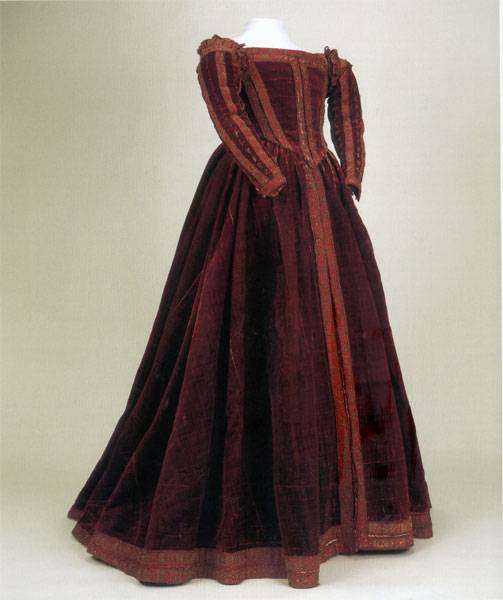
Much about the construction of this garment can be gleaned from the study of her burial clothing, which underwent an extensive restoration and is kept at the Galleria del Costume in Florence; the general shape and construction of Florentine clothing varied very little in the approximately twenty years between the date of this portrait and Eleonora’s burial in 1562.


Funeral dress of Eleonora di Toledo. 1562. Florence, Galleria del Costume.

Another extant garment of the 1560s, a red silk velvet gown on display at the Museo di Palazzo Reale in Pisa, has applied trim in an identical placement to Eleonora’s burial clothing.  It is similar in construction, and its sleeves have a comparable silhouette to the ones in the Bronzino portrait, although they do not appear to be cut in panels.  This gown may have very well belonged to Eleonora as well, or at least to one of her ladies-in-waiting.


Red silk velvet gown, c. 1560. Museo di Palazzo Reale, Pisa.

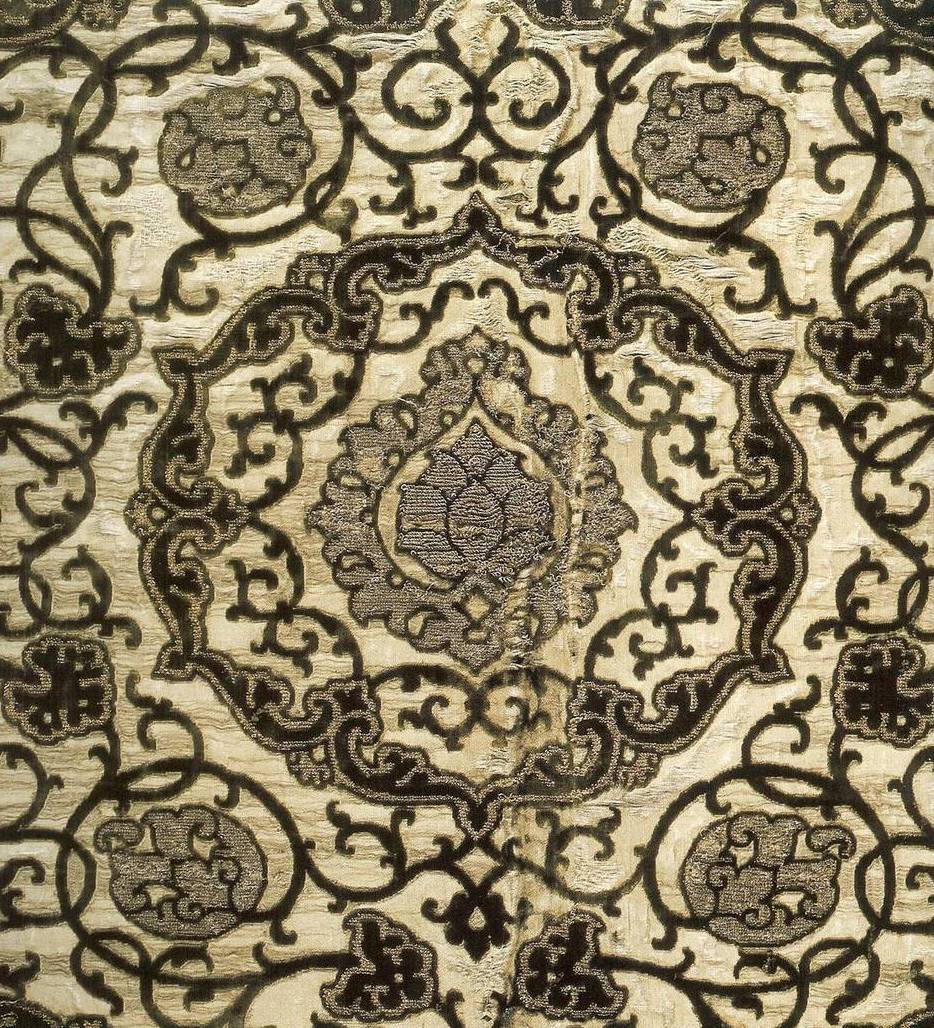
Perhaps the most discerning aspect of the gown from the Bronzino portrait is its magnificent silk fabric.  Renaissance Italy was renowned for its silk mills, and what better way to distinguish the Duchess’ rank by enrobing her in the most decadent example of rich weaving available?  An existing textile from the Museo del Bargello is identical to the one depicted in the portrait. 

Patterned velvet on silver ground with silver and gold brocade effect, 16th century, Florence, Museo del Bargello.

In some ways, this garment almost appears too good to have existed.  There is speculation among scholars that Bronzino may have painted Eleonora in a gown of conventional fashion, and was given a textile to copy.  Eleonora’s wardrobe had been recorded, albeit incompletely, and this gown does not appear in the records. 

But a gown of such splendor surely couldn’t have been dismissed from wardrobe accounts, could it?

Regardless of whether or not this particular dress actually existed or was an imagined conglomerate of typical Florentine dress and an extraordinary example of Italian silk weaving, the dynastic portrait of Eleonora of Toledo reflects a fashion that was entirely appropriate to her wealth and status in mid-16th century Florence.  

And for those who believe that all fashion comes around again, or if you fancy dressing in a contemporary interpretation of the fashion of the Duchess of Medici,  it looks like you’re in luck this season!

J. Crew catalog, September 2012.

Nanette Lepore Society Sheath, http://www.nanettelepore.com (accessed September 26, 2012)


Selected Bibliography  
Arnold, Janet.  “Investigation into the Medici Graves Clothes.” Costume nell’età delRinascimento.  Dora Liscia Bemporad, ed. Firenze: EDIFIR, 1988.
Bulgarella, Mary Westerman.  “The Burial Attire of Eleonora di Toledo.” The Cultural World of Eleanora Di Toledo, Duchess of Florence and Siena.  Konrad Eisenbichler, ed. Hants, England and Burlington, VT.: Ashgate Publishing, 2004.
Harris, Jennifer, ed. 5,000 Years of Textiles.  Washington: Smithsonian Books, 1993.
Orsi Landini, Roberta & Bruna Niccoli.  Moda a Firenze, 1540-1580: Lo Stile di Eleonora di Toledo e la Sua Influenza.  Firenze: Pagliai Polistampa, 2005.
Posted in Fashionista Friday | Tagged | 6 Comments

Mystery Monday: A Tailor and a Seamstress

Schoen, Erhard. Tailor and Seamstress, not before 1491 – 1542. Woodcut print, 279 x 180 mm. From The Illustrated Bartsch, volume 13, commentary, German Masters of the Sixteenth Century: Erhard Schoen and Niklas Stoer.

Yes, this print depicts a tailor and a seamstress.

The Tailor:

Hail to you, beautiful seamstress, come along with me to Norway. There to dress the lansquenets well; and want to earn a good deal of money, while you prepare the shirts of silk, embroidered with gold; you’ll make more money in a month than as a seamstress in a year.

The Seamstress:

If you would be a good fellow, I’d dare to be liked by you. I would not have my friends stop me. I hope that we will both prosper. You will make garments according to the lansquenets custom; divided, split and cut apart; of silk, damask, and velvet; from this we will gain honor and wealth.

These verses reflect the historic relationship of the tailor and the seamstress, where the tailor would design clothing for both sexes, and the seamstress would be responsible for garment construction and finishing. So, what changed in Paris in 1675?

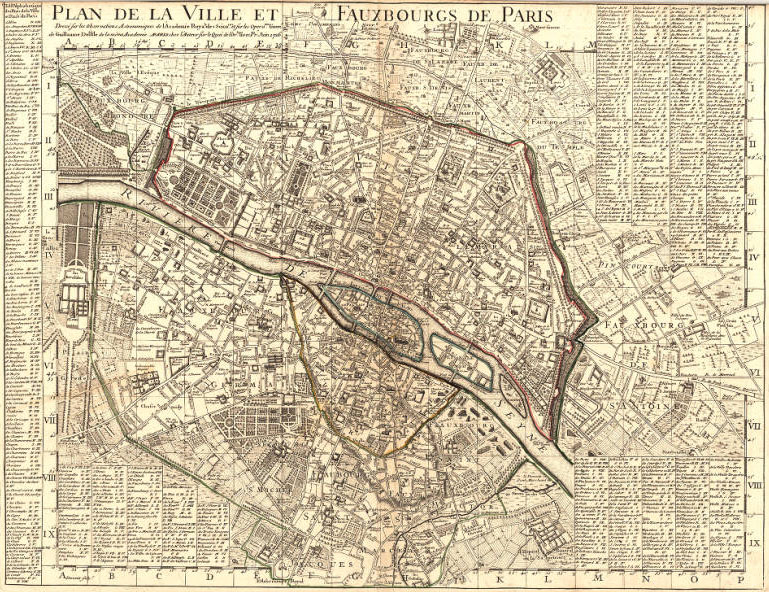
Plan De La Ville Et Fauxbourgs De Paris Dressé sur les Observations AStronomiques de l’Academie Royale des Sciences et sur les Operationes Geom. De Guillaume Del Isle de la meme Academie, 1716.  Copper engraving handcolored with watercolor, 49 x 63 cm. From the University of Washington Libraries. Special Collections Division. Found online.

According to Ann Hollander, in Sex and Suits, in the 1660s:

In the modest bourgeois vein, women’s dress was sober and self-contained while men’s was assertive and dashing, even in dim colors.

Such differences went along with a profound split that occurred in the craft of tailoring during the reign of Louis XIV, a split that had very lengthy effects. In 1675 a group of French seamstresses successfully applied for royal permission to form a guild of female tailors for the making of women’s clothes–to become the first professional dressmakers. Louis approved, believing that the dignity of French women would be well served by such a development, which permitted scope for their talent, respect for their modesty, and independence for their taste. Increasingly thereafter, as all of Europe copied French fashion and fashion methods, women dress women and men dressed men.

So what happened when women started to dress women?

After the foundation of the dressmakers’ guild, and the spread of the idea that female dressmakers were appropriate for the making of women’s clothes, male tailoring proceeded as before according to craft tradition, but only for men, while dressmaking provided larger ornamental possibilities for women. A difference in the way clothes were conceived and made for the two sexes came into existence for the first time, a separation that profoundly affected both the character and the reputation of fashion for the next two centuries, and that still survives.

Without the skills and the knowledge of the male tailors, the dressmakers continued to rely on the tailors to create foundation garments for women. The dressmakers used skilled handwork and excellent draping skills to create extreme fashions, adding volume and accessories without making major alterations to the basic shape of the dress.  At the same time, the tailors continued to refine the cut and shape of men’s clothing, and as a possible reaction to the excess of lace and trim in women’s fashion, chose to use more neutral colored fabrics and to create simplified silhouettes.

The result? A complete distinction between menswear and women’s wear.

For more information, please see the following sources:

Crowston, Clare Haru. Fabricating Women: The Seamstresses of Old Regime France, 1675–1791. Durham, N.C.: Duke University Press. 2001.

Hollander, Anne. Sex and Suits. New York: Kodansha International, 1994, pages 65 – 67.

Posted in Mystery Mondays | Tagged , , , , | 8 Comments

2 Years Giveaway- winner announced

Thanks to everyone who participated and liked us on FB. Please go to our page to find out who is the new owner of two vintage covers of Vogue and Harper’s Bazaar!

On another note, you must have noticed that I did not post much in the last couple of months. Sometimes life gets in the way! Being a working mom, part-time student and a blogger -so it turns out- is quite a handful. In addition, I have recently started working on a very exciting project which I can’t wait to tell you all about. At the moment I can only reveal that it is very dear to my heart and should have been a long time coming!

Although I will probably won’t be able to post as frequently as I used to, I continue to oversee the content posted here. I am very pleased to have two new authors, first year students Laura Peluso and Leia Lima who will contribute their thoughts and research on everything related to the our field. I hope you’ll enjoy reading their posts as much as I do!


Posted in Uncategorized | Leave a comment