Uniformed Individuality: Military-Inspired Fashion of the 1980s (Part I)

Elle Magazine, mid-1980s (exact year unknown). Scanned from the book Elle Style: the 1980s [Filipacchi Publishing, c.2003]

When flipping through fashion magazines from the 1980s it is clear that fashion designers of the time were fascinated with the past. But, it is not just one period in the past, but rather a wild mix of influences that makes the 1980s aesthetic so identifiable. Ancient Greece and Rome, the Middle Ages, the eighteenth and nineteenth centuries, and almost all of the preceding decades of the twentieth century were used as sources of inspiration for the fashion designers of the 1980s.

However, I found that in particular many fashion designers of the period looked back to the 1940s. Of course the most obvious similarity is the strong shouldered silhouette, although another theme that resurfaces in both decades is the reinterpretation of uniforms and incorporation of design elements from the military. Whereas these elements in women’s fashion in the 1940s can be linked to the influence of war time, I wanted to understand how they made their way into the often glamorous, always extravagant, fashion of the 1980s.

While the early 1940s were ascetic, the 1980s were money-driven and emphasized luxury- it seems these two decades could not be more different. One wonders then, what drove the fascination of leading designers with so somber a time in human history as the 1940s? How did fashion that was subjected to rationing, constriction and shortage of materials reemerge in a decade that was all about extravagance, luxury, and material status?This post will try to offer some insights on the topic.

In 1971 Yves Saint Laurent introduced his Liberation couture collection, in which he appropriated the prevailing broad shouldered silhouette of the 1940s. This collection was a nostalgic reminiscence of his childhood memories of Oran, Algeria, where he grew up safeguarded by his mother, his sisters, and his aunts- unaffected by World War II. But for his French clients the Nazi occupation was a relatively fresh memory and the collection was not received well. While Saint Laurent’s romanticizing of this dark period seemed tasteless in the early 1970s, by the end of the decade the exaggerated 1940s silhouette was extremely fashionable, so much so that today it is the most recognizable feature of the 1980s fashion.

Outfits by Yves Saint Laurent, scanned from Vogue Italia, September 1981.

The New York Times review of this collection suggested that the designer’s drive to revive a period that aroused mostly bad memories, was in part due to his relation to the growing youth movement. The reporter, Bernadine Morris, noted that Paloma Picasso showed up wearing “her mother’s black crepe nineteenth-forties dress to the Saint Laurent opening.” The new youth culture that emerged in the late 1960s traded fashion in general, and couture in particular, for vintage personal style. Young people all over the world rejected fashion from “above,” the days of fashion dictated by French couture houses, it seemed, were over. Instead, they rummaged flea markets, or better yet, their mothers’ closets- and what they found there were garments from the 1930s and ’40s.

In her book Uniforms Exposed: From Conformity to Transgression, Jennifer Craik points out that uniform and military motifs were easily transformed into the anti-establishment, rebellious, and revolutionary imagery of the 1960s youth culture. Young people, who did not want to shop the stores their parents did, bought army surplus, which was left in abundance after World War II all over Europe and the United States. Army uniforms were not only unconventional dress for everyday life, but they also symbolized the youth’s new radical point of view and their rejection of the old and established.

Craik suggests that soon enough, what started as a radical statement, found itself in the heart of normalized mainstream fashion. By the mid-1970s, the radical ideas of the late 1960s were widely accepted by both young and old, resulting in a visual expression that related to going back to nature and embracing non-western cultures and ideas. In contrast, the rise of political leaders such Margaret Thatcher in the UK, and Ronald Regan in the US during the 1980s, signaled a transition into a much more conservative period, money was no longer a bad word- quite the opposite.

Ad, scanned from Vogue Italia September 1981.

Ad (detail), scanned from Vogue Italia September 1981.

In July 1976, Saint Laurent introduced his Opera-Ballet Russes couture collection which was featured on the front page of the New York Times. Saint Laurent’s collection is credited for reviving the dormant haute couture, but it also precedes the post-modernism of the 1980s with its mix of influences and stylisitc references.

Fashion magazines from the 1980s reveal the transition in taste from the romantic and free-spirited attitude of the 1970s to the cynical, money and brand-driven attitude of the 1980s. In early years of the decade, many featured designs are inspired by Russian peasants’ dress and traditional Moroccan costume, the prevailing silhouette, although already exaggerated at the shoulders, is much softer and the hemline is generally longer.  As the years progress the look becomes more rigid and the shoulders become wider and wider. Many designers offer leather jackets and masculine suits, but they also emphasize unapologetic sexuality.

An ad for Sports Max, showing influence of Russian dress. Scanned from Vogue Italia, September 1981.

The scholar Anne Hollander notes that “it has always been fashionable to copy certain elements of dress that have public timeliness, such as military motifs in war time or foreign motifs while public attention is focused on the foreigners in question.” Indeed, many fashion designs and editorials in fashion magazines reveal strong Russian influences; at the beginning of the decade in Russian peasant-like dresses and floral embroideries, and later in Soviet icons and Red Army military elements. Saint Laurent’s Opera-Ballet Russes certainly started the trend, but it was also Mikhail Gorbachev’s Perestroika and Glasnost, and his new openness to the west that might have inspired so many designers to use Soviet iconography and specifically military elements.

Scanned from Vogue Italia, September 1982.

Scanned from Vogue Italia, September 1982.

Next week’s post will focus on how military elements were interpreted by fashion designers of the 1980s, as well as how fashion magazines adopted imagery relating to World War II as a backdrop for 1940s retro fashion. I hope you will come back next week for another taste of military-inspired 1980s fashion.

Selected bibliography
Craik, Jennifer. Uniforms Exposed : From Conformity to Transgrression. Oxford; NewYork: Breg, 2005
Bonami, Francesco, Frisa, Maria Luisa, Tonchi, Stefano, eds. Uniform: Order and Disorder, Milano: Charta, c.2000.
Font, Lourdes. “Saint Laurent, Yves.” in Grove Art Online.
Hollander, Anne. Seeing Through Clothes, New York: Viking, 1978.
Morris, Bernadine. “Now Why They Are Throwing Brickbats at Saint Laurent?” New York Times, February 2, 1971.
Posted in Research | Tagged , , , , , , , , , , | 5 Comments

Guest Post: Schiaparelli’s Shock Tactics (Part I)

By Victoria Pass

Today’s post is by Victoria Pass, she received her PhD from the University of Rochester in May 2011 and she is currently teaching at the Maryland Institute College of Art. Her dissertation, Strange Glamour, examines fashion and art in the 1920s and 1930s. Her research examines fashion in the context of art, politics, gender, and race and she is currently working on a projects on African influences on modern fashion- a paper she recently presented at the Women in Magazines conference at Kingston Universality (UK).
 

Elsa Schiaparelli seems like an unlikely candidate for the godmother of punk style.  An Italian aristocrat, Schiaparelli took up designing to support her daughter after she was abandoned by her husband.  She launched her first collection in Paris in 1927, and by the mid 1930s she was a household name in both Europe and the US, dressing the likes of Joan Crawford, Tallulah Bankhead, and Mrs. Wallis Simpson, the future Duchess of Windsor.    She would seem to be a far cry from women like Vivienne Westwood or Siouxsie Sioux, and yet her aesthetic and ethos reflects the same impulse to shock and to question gender norms as punk style.

John Phillips, Elsa Schiaparelli wearing a jacket of her new magenta color known as, “Shocking,” for Life, 1937

Vivienne Westwood wearing a “Destroy” muslin T-shirt Designed by Malcolm McLaren and Westwood, 1977 Source: V & A: http://www.vam.ac.uk/vastatic/microsites/1231_vivienne_westwood/changing_styles_3.html

There are many affinities between Schiaparelli’s work and the aesthetic of punk.  In collaboration with Surrealist Salvador Dali, Schiaparelli created a garment that appears to be torn, presaging the torn clothing and distressed looks of the punks.

Elsa Schiaparelli and Salvador Dali, Tear Illusion Dress, February 1938 (London: V &A, T.393&A,D to F-1974) http://collections.vam.ac.uk/item/O84418/the-tears-dress-the-circus-evening-ensemble-dress-schiaparelli-elsa/

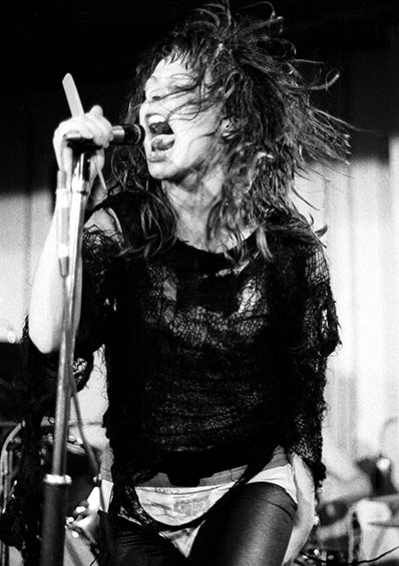
Ian Dickson, Ari Up, front-woman for the Slits, 1977

Schiaparelli also adopted the collage technique of the cubists, creating a fabric print from newspaper clippings about her.  This print’s cut and paste look mirrors the look of Xeroxed punk fan-zines and posters.

Cecil Beaton, Schiaparelli accessories in Vogue, April 1935

Malcolm McLaren and Vivienne Westwood , Punk ensemble, c. 1977 (New York: Metropolitan Museum of Art, 2006.13) http://www.metmuseum.org/Collections/search-the-collections/80063096

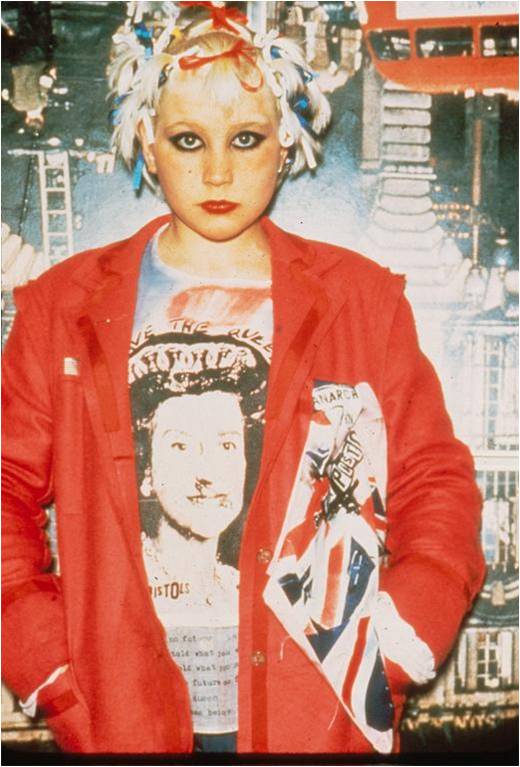
Fred Scrutin, Punk girl in front of the Seditionaries Shop, London, c. 1978-80

There is a much deeper connection between Schiaparelli’s designs and punk style. In the 1982 film, Ladies and Gentleman, The Fabulous Stains the bravado of Corrine, played by Diane Lane, as the front woman for the titular band, seems to me to be emblematic of the style of punk women.  Throwing off her brown overcoat during the band’s first performance and pulling off her red beret, Corrine reveals what will become her signature style, fishnets, black briefs, a transparent red blouse, matching her aggressive red eye makeup, and an incredible punk coiffeur with bleached stripes on the sides.

video

The style is aggressive and revealing, Corrinne shouts at the audience:  “I’m perfect, but nobody in this shithole gets me because I don’t put out.”  Corrine’s combination of provocative and sexually explicit clothing with aggressively harsh and ugly eye makeup and hairstyle, as well as her “I don’t put out” motto undermines gendered ideas about fashion’s relationship to sexuality and women’s promiscuity.  Here style both attracts and repels viewers, making men aware of their gaze and their assumptions about Corrine’s sexual availability.

The same style of shock and provocation is evident in Lauraine Leblanc’s discription of her own way of dressing in 1984:  “The first time I came to school in ripped-up fishnets, spike heels, thigh-high red mini, spiked belt, ripped-up T-shirt (no skin, though), lace gloves, full geisha make-up and full-up fin…For some reason, the little peckerhead boys in this school thought I was trying to be sexy…Guess again.  I’m taking what they and their society think is sexy and I’m making it ugly, because that’s what it is.”[i]

These modes of dress for punk women were not only about shock.  Using shock, punk women made the men who looked at them aware of their own sexualized gaze through the provocative ugliness and aggressiveness of their style.

I see Schiaparelli as working in a remarkably similar way to the women of punk.  Schiaparelli was deeply engaged with Surrealism and frequently collaborated with artists associated with the movement including Man Ray, Salvador Dali, and Jean Cocteau.  Surrealism, as it was lead by the writer Andre Breton was a Marxist movement, and was hostile to both commerce and women, making it an unwelcome place for a female fashion designer.  Similarly, punk was a movement which strived to associate itself with the working class and often espoused anarchical political views.  Like Surrealists, punk practitioners strove to shock the bourgeoisie, and created a movement which was rife with machismo and misogyny.  Both Schiaparelli, and many of the women of punk took the ideas and aesthetics of these movements and turned them to their own purposes, calling attention to misogyny and upending gender conventions.

This is the end of part I, please come back next week for part II.


Thanks to Anne Cecil who suggested the topic for this essay, and who gave me the opportunity to present it as part of the Punk area at the Popular Culture Association conference in San Antonio, TX, April 2011.

[i] Lauraine Leblanc, Pretty in Punk: Girls’ Gender Resistance in a Boys’ Subculture (Rutgers University Press, 1999; reprint, 2002) 2.

Posted in Research | Tagged , , , , , , , , | 7 Comments

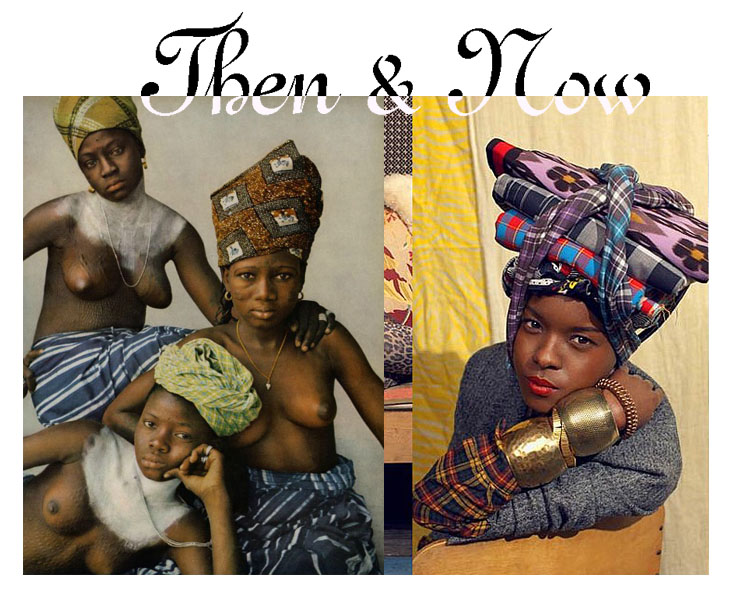
Then & Now

(left) The Quest for Beauty in Dahomey: A Photographic Essay by Irving Penn.Vogue. Dec 01,1967. Source: Vogue Digital Archive. (right) Suno, Fall 2009. http://www.sunony.com/

Posted in Then&Now | Tagged , , , | Leave a comment

Fashion in Black & White- Part III, Flowers

In the last two posts, I have introduced how fashion designers structure garments in black and white, and how they explore contrasting ideas of sexuality and feminine models through the use of black and white lace.

This week I’d like to show some examples that illustrate the use of flowers in black and white. Flowers, by nature, are seducers. They endure in the wild by using their beauty and scent to lure pollinating insects and birds. In our culture flowers are associated with opposing notions of both life and death, of both innocence and sinister seduction and of both everlasting and short-lived beauty. Most commonly they are associated with femininity and feminine sensibility. Fashion designers are fascinated by flowers, not just as decorative motifs. The shape of flowers and the meanings attached to them are for many designers a great source of inspiration. In fact several designers have a signature flower; Dior, for example, had the lily of the valley, while Chanel’s camellia is still used by Lagerfeld as the signature of the house.

The charged symbolism of flowers is furthered when designers represent them in opposing black and white. Whether represented in the silhouette of a garment, or rendered in printed or embroidered fabric, black flowers make a dramatic statement, especially when contrasted with white. Whereas white flowers are associated with purity and innocence, black flowers are inherently ambiguous and mysterious. Since they do not exist in nature, black flowers enchant the imagination of artists, poets and fashion designers.

Evening dress (worn by Gabrielle Chanel), House of Chanel, Designer: Gabrielle “Coco” Chanel. The Metropolitan Museum of Art, Gift of Gabrielle Chanel, 1955.
C.1.55.61.2

Chanel in her studio, 1937, making a corsage of fabric flowers. Photograph by Roger Schall.

Evening dress, detail.

Flowers are an inseparable part of Chanel’s legacy, and especially white ones. In this dress black is the perfect background for a corsage of white flowers. The graphic combination of black and white was favored by Chanel throughout her long career. Her romantic side, here exemplified in the hand-made flowers and delicate silk lace, never contradicts but rather complements her innate modern style.  Her style is often recognized by recurring themes, such as the modern, practical suits, the “little black dress,” and  key accessories such as the boater hat and the spectator shoe. The dress below underlines how much richer Chanel’s vocabulary really is. The fitted waistline and full skirt might seem at first to contradict Chanel’s preference for unstructured, loose-fitting silhouettes, yet the dress perfectly embodies her design philosophy. The sash is constructed with interior boning and gives way to a fluid, delicately embroidered fabric that follows the natural lines of the body. For Chanel, the body must always be comfortable and free to move, and the clothes must reflect a modern feminine ideal.

Floral evening dress designed by Coco Chanel as it appeared in Vogue June 1, 1937.

Evening dress, House of Chanel, Gabrielle “Coco” Chanel, 1937. The Metropolitan Museum of Art, Gift of Mrs. Harrison Williams, Lady Mendl, and Mrs. Ector Munn, 1946
C.I.46.4.22

The dress below is part of Charles James’s collection of black and white ballgowns. Like so many of his designs it is composed of a sculptured, rigid bodice, almost capable of standing on its own, and an enormous billowing skirt. It is a whimsical and romantic manifestation of woman as flower. Originally created for the Standard Oil heiress Millicent Rogers in 1949, this dress became famous when it was photographed by Horst P. Horst for Vogue in 1951.

“Petal” Ballgown
Charles James, 1951
The Museum at FIT
91.241.126

Vogue, November 1, 1951. Photograph by Horst P. Horst.

Ensemble
Rodarte, Spring 2007. Source: Style.com

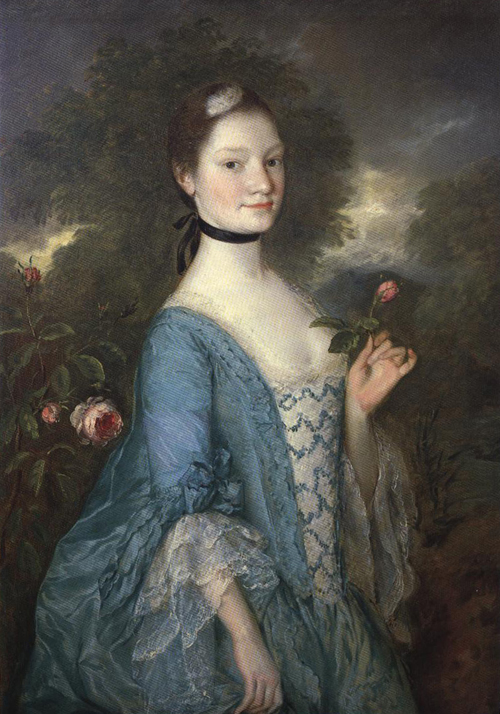
Recalling the same silhouette and taking inspiration from the eighteenth-century dresses depicted in the paintings of Thomas Gainsborough, sisters Laura and Kate Mulleavy designed this dreamy and delicate dress. The white flowers, meticulously made by hand, burst from under the skirt to evoke the restrained drama and fantasy of these paintings. What could have been a rather simple and direct interpretation is disturbed by a touch of black chiffon. Combined with black leather accessories, the attitude is distinctively Rodarte- strong, assured and somewhat subversive.

Thomas Gainsborough (1727 – 1788), Sarah, Lady Innes, c.1757. oil on canvas (lined). 40 in. x 28 5/8 in. (101.6 cm x 72.71 cm) Henry Clay Frick Bequest
Accession number: 1914.1.58

Evening dress. House of Dior 
Designer: John Galliano , Haute Couture, Fall 2010. Source: Style.com

Evening dress
House of Dior, Designer: John Galliano, 
Haute Couture, Fall 2010. Source: Style.com

“People forget how important plants, flowers and gardens were in the life of Monsieur Dior,” said Galliano of the inspiration behind the Fall 2010 haute couture collection. The floral and organic structures directly reference Christian Dior’s first collection for Spring 1947, which he named ‘Corolle’ (or ‘Petal’). Under Galliano’s passionate gardening these petals have grown to fantastical sizes and shapes. Galliano also studied photographs of flowers by Nick Knight and Irving Penn, influences evident in his study of surface and of light and dark shadows.

Dandelion, Irving Penn, 1973.

Flora, Nick Knight, 2001.

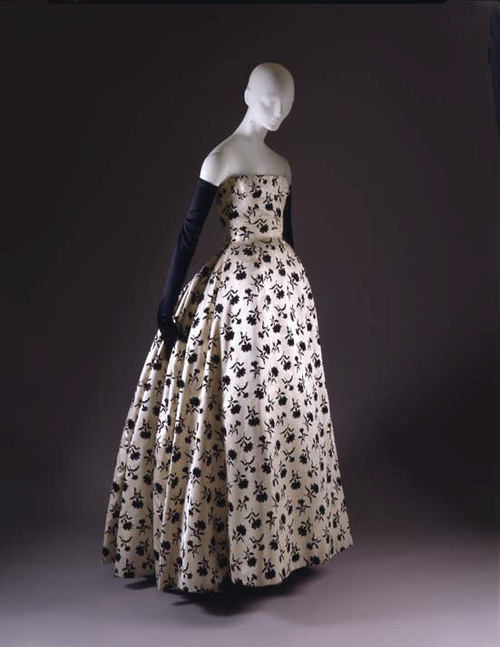
“Odette” ballgown, House of Dior. Designer: Christian Dior, Fall/winter 1953-54
White silk with flock printed black carnations
The Metropolitan Museum of Art, Gift of Mrs. Byron C. Foy, 1955
C.I.55.76.24

Christian Dior was often inspired by the flowers he loved. Here, his study of floral forms is extended to surface pattern and texture with flock printing, a technique that creates the illusion of woven velvet in the tradition of the Renaissance. Various historical references further the fantastical allure of this dress.  The graphic, yet whimsical black carnation  pattern on white, like the corset and padding built into the interior, evoke the late nineteenth-century designs of Charles Frederick Worth, the founder of the couture traditions Dior helped to renew  in the mid-twentieth-century.

Please come back again next week for the last part, Graphics, of this special four-parts post.

Posted in Research | Tagged , , , , , , , , , , , , , , , | 1 Comment

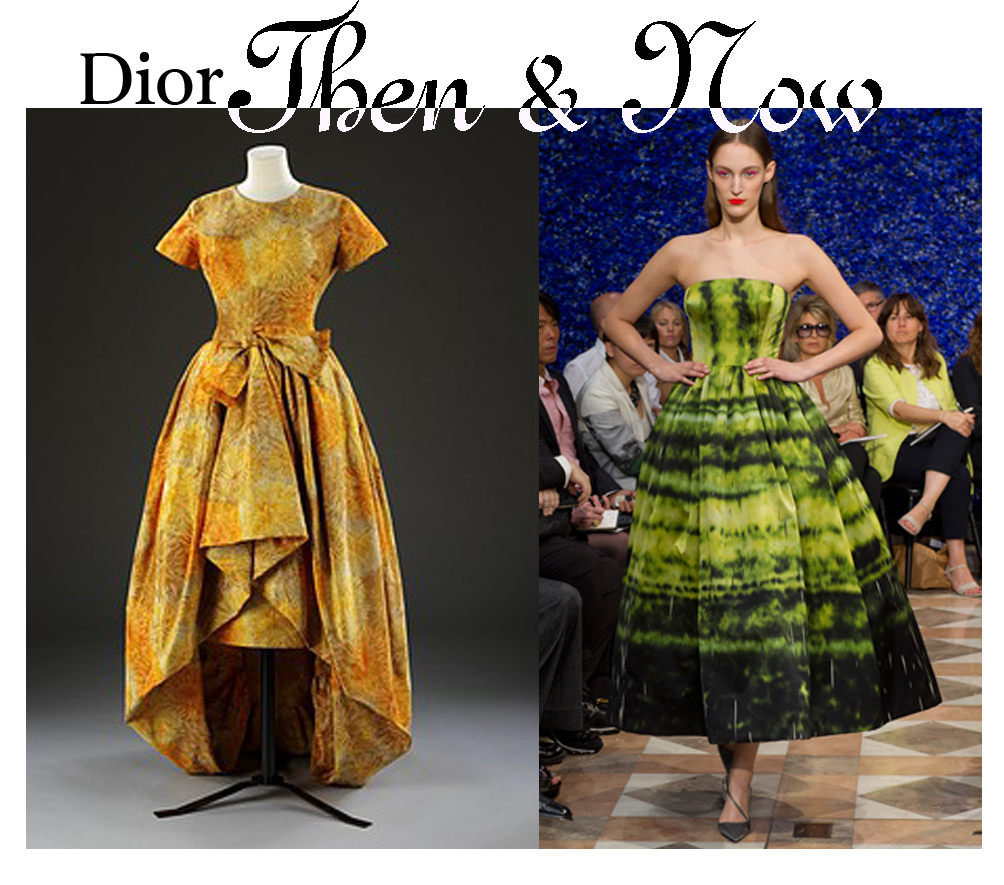
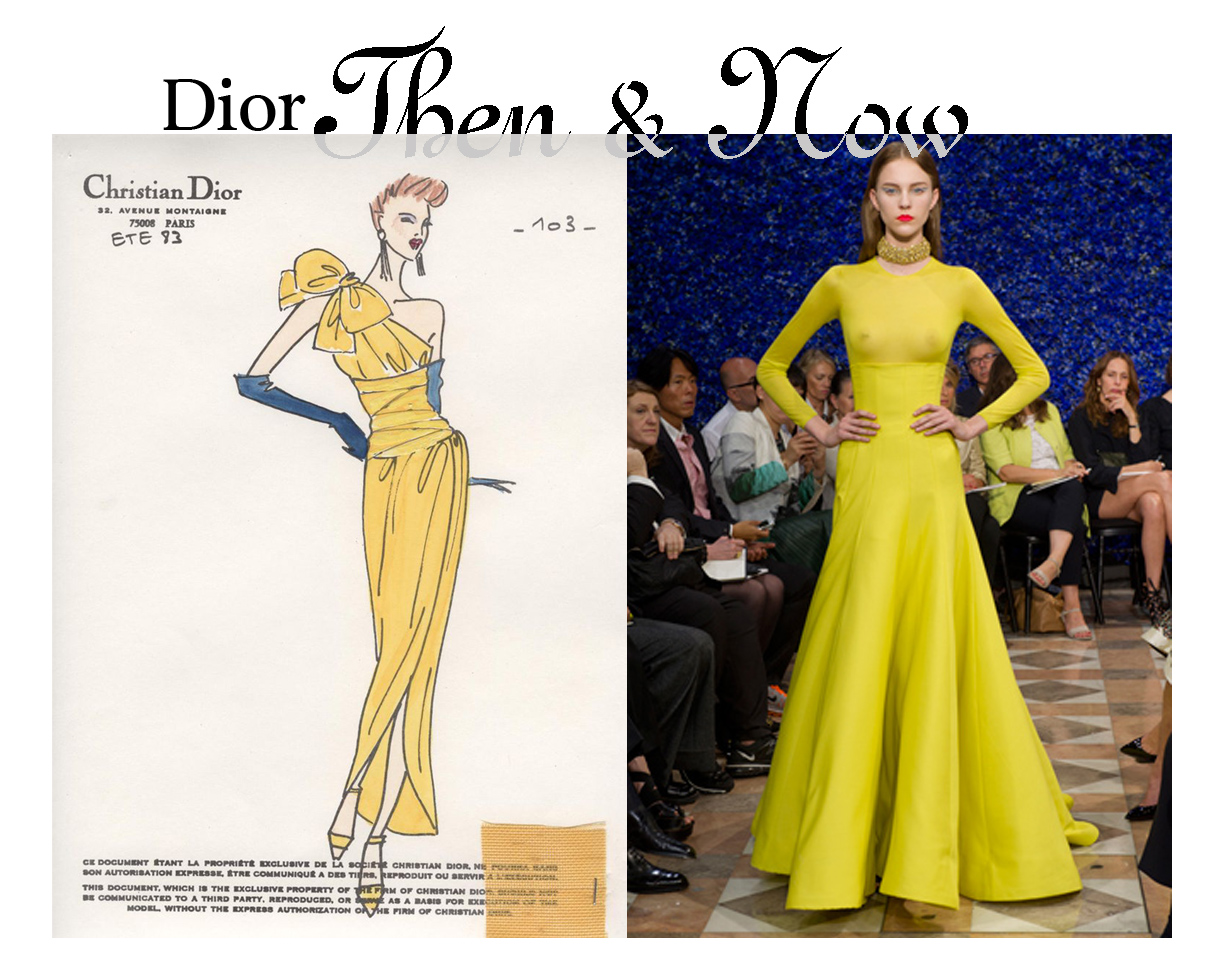
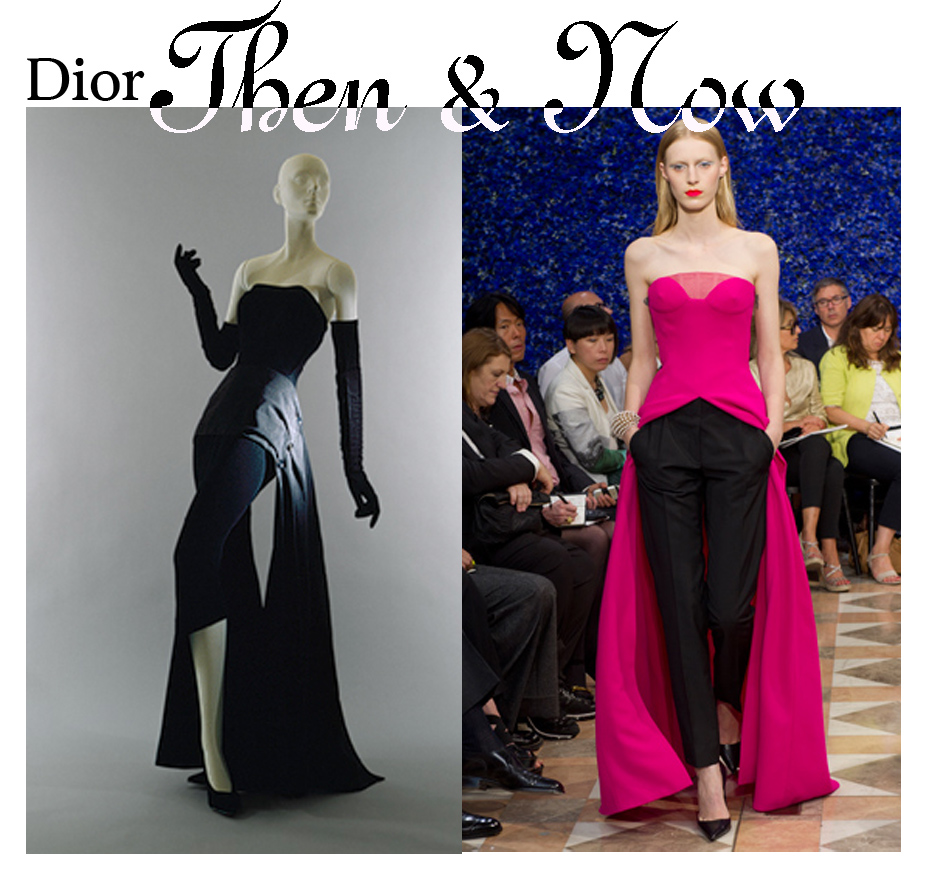
Then & Now Special: Raf Simons for Dior

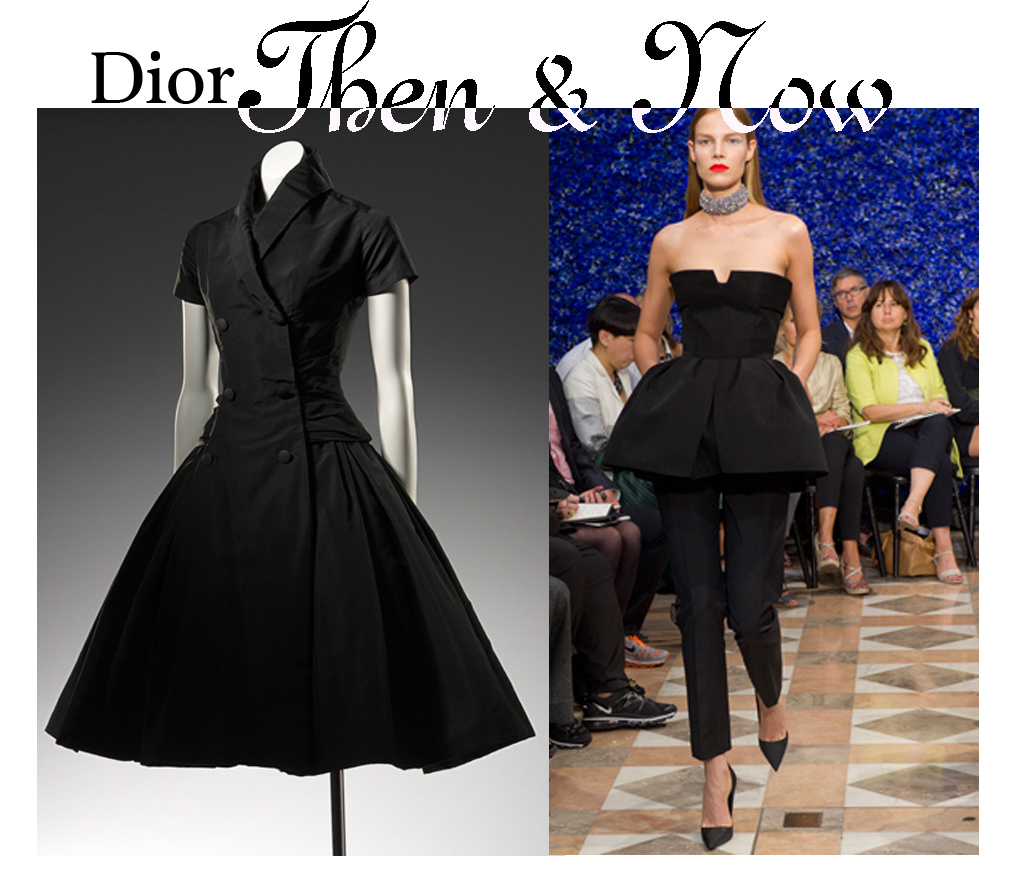
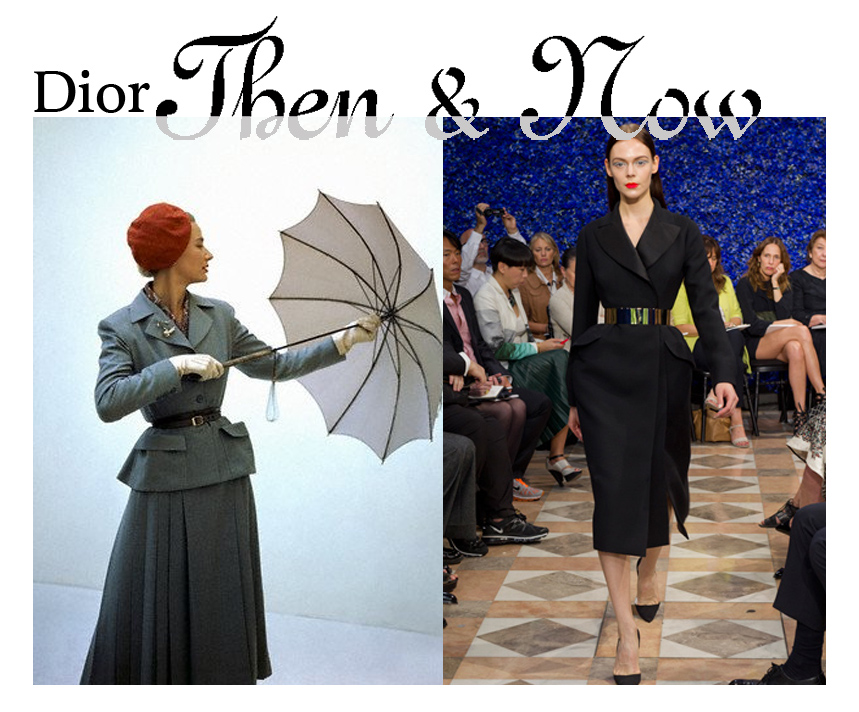
A few days ago Raf Simons debuted his much anticipated Christian Dior haute couture collection.  Style.com reported hysteria outside on the street, and a front row occupied by a  long list of leading designers, such Alber Elbaz, Marc Jacobs and Riccardo Tisci among others. Despite John Galliano’s downfall, his tenure at the House of Dior produced some amazing, unforgettable collections. Over the years it became evident that Galliano studied the work of Christian Dior relentlessly, his designs remained faithful to the tradition of the house but of course reflected his original vision.

Naturally Simons had to step into really big shoes, and he did so in a most elegant and sophisticated manner.  I’ve enjoyed watching his career evolve from a transgressive men’s wear designer to the couturier he is today. It’s been a beautiful journey.

I’ve put together this special Then & Now as a tribute to Simons, who is, in my opinion, one of the most important living designers. His debut collection stays true to the legacy of the house but offers an impressive personal interpretation. Although the cuts, silhouettes, prints, and fabric treatments heavily relay on the house’s archive, they seem refreshing and new- this is where is strength and talent truly shine.

(left)” Zelie” cocktail dress autumn/winter1954. House of Dior, designer: Christian Dior. (right)  Haute Couture Fall 2012, House of Dior, designer: Raf Simons. Image source: style.com

(left) Vogue, January 1949, Christian Dior suit (right) Haute Couture Fall 2012, House of Dior, designer: Raf Simons. Image source: style.com

(left) Dress, 1960. House of Dior, designer: Yves Saint Laurent.  V&A accession: T.127 to B-1974. (right) Haute Couture Fall 2012, House of Dior, designer: Raf Simons. Image source: style.com

(left) evening gown, Sprin/Summer 1983. House of Dior, designer: Marc Bohan. Image source: FIDM (right) Haute Couture Fall 2012, House of Dior, designer: Raf Simons. Image source: style.com

(left) Dinner Dress, Fall/Winter 1949-1950. MET, accession: 1989. 130.1ab. (right) Haute Couture Fall 2012, House of Dior, designer: Raf Simons. Image source: style.com

Posted in Then&Now | Tagged , , , , | 1 Comment

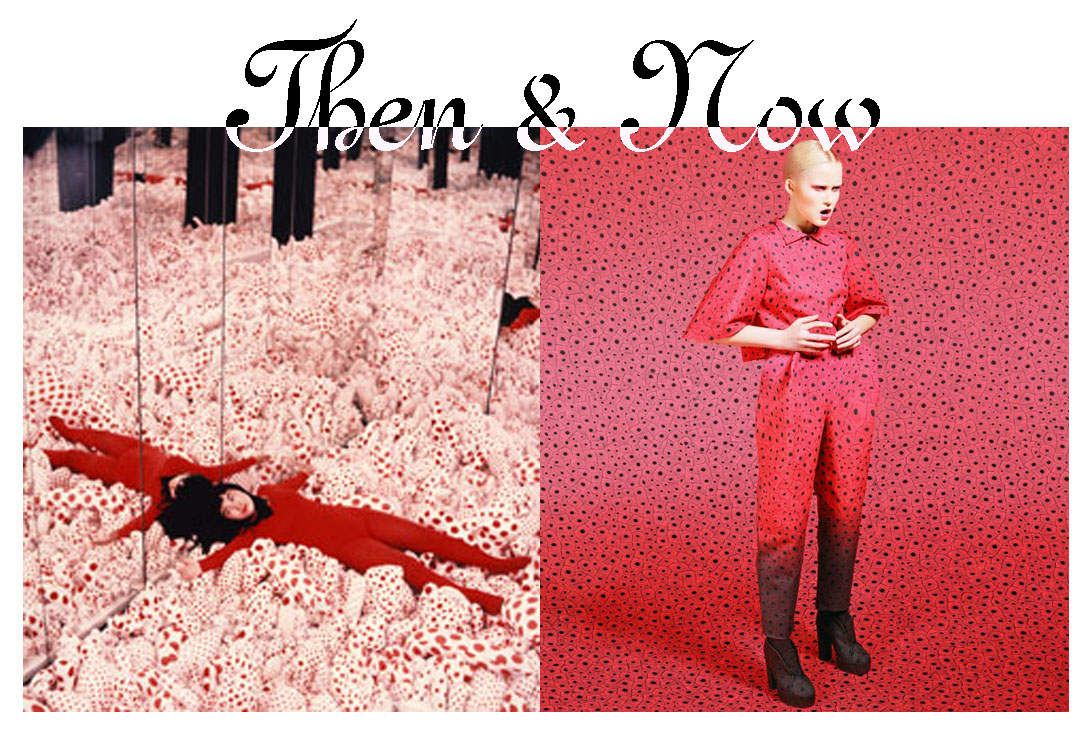
Then & Now

(left) Yayoi Kusama with Infinity Mirror Room — Phalli’s Field, Castellane Gallery, New York, 1965 / Image courtesy: Ota Fine Arts, Tokyo / © Yayoi Kusama, Yayoi Kusama Studio inc. (right) Designer: Masha Reva, photograph: Synchrodogs, style:Julie Pelipas, model: Lola Dikova. Published in Contributor Mag #5

Posted in Then&Now | Tagged , | Leave a comment

Jean-Paul Gaultier: Deconstruction in Fashion

L’enfant terrible of fashion, Jean-Paul Gaultier, was trained in the (not-so-terrible) “magnificent ruined city”[1] of the haute couture.  He was taught in houses that had once dictated the conventions of elegance, but that had lost their power: in 1970 he began as an assistant at Pierre Cardin, then worked briefly for Jacques Esterel, followed by two years at la grande maison Patou, before returning to Pierre Cardin in 1974. Finally, moving to the metropolis of the avant-garde, Gaultier presented his first eponymous collection in 1976.

The convergence of traditions has marked Gaultier’s career – the technique of the haute couture mixed with the style of the street, the use of cultural/historical references infused with humor – always within the framework of Parisian chic. It is no wonder that the theoretical framework of deconstruction can be applied to Gaultier’s oeuvre. Barbara Vinken describes his work as an “ongoing deconstruction of Paris fashion [as] a kind of surrealism against the grain, which consciously makes a fool of itself.”[2]

Jean-Paul Gaultier’s Fall/Winter 1993-94 collection, ‘Les Rabbins Chics,’ (figure 1) was inspired by traditional Hasidic men’s clothing. Male and female models wore Gaultier classics – black trench coats, tailored jackets and long skirts – paired with religious symbols of the Hasids, including Shtreimel (large fur hats worn on the Sabbath), Payot (side curls) and imitation Tefillin (boxes worn on the head that contain scrolls of parchment inscribed with verses from the Torah), accompanied by the woeful sounds a solo Klezmer violin.  Unsurprisingly, the show was considered fantastical by some, and an affront by others. In 1993, Rabbi Morris Shmidman discussed his community’s issues with the collection: “the whole thing is very offensive. To take men’s mode of clothing and make that into a modish thing for women is extremely inappropriate in this community.”[3] According to the Rabbi, what was improper about the collection was not the appropriation of sacred, traditional symbols, but rather the reversal of encoded gendered dress. Rabbi Shmidman’s comments touch on a key element of deconstructionist art, that it engages the viewer in active decoding of social constraints concealed behind an aesthetic form.

Image

Figure 1. Les Rabbins Chics, Autumn/Winter 1993-1994

While particular garments in the show were deconstructive, the fashion show and the styling are what invite the most obvious deconstruction. The juxtaposition of visual and textual elements – in this case high fashion with religious markers – produces a critical interrogative exchange. Gautlier’s collection at once highlights and silences both elements: the fashion is masked by the blatant and shocking use of Hasidic symbols, while the delicate nature of the Hasidic objects is called into question by the fashion show context. By appropriating obvious visual markers of Hasidic men and making them convincing as fashionable clothing on women, Gaultier’s collection unsettles the idea of an essential religious symbology and pushes forward the idea of what fashion (and particularly a fashion show) can accomplish as a form of critical discourse.

Gaultier’s Fall 2006 Menswear collection channeled previous shows, most notably ‘Une garde-robe pour deux,’ presented in 1985, where models dressed in clothes designed for the opposite sex, and ‘Et Dieu créa l’homme,’ also from 1985, when Gaultier first introduced the skirt for men. While the collection fell under the “Menswear” designation, in a Gaultier fashion, the presentation included both male and female models. Figure 2 illustrates the designer’s playful attitude towards gendered dress: the female model wears a three-piece suit, while the male model wears a floor-length skirt and sports long blond hair.  The gentle subversion of gendered dressing establishes a distance from the dominant thinking about gender and clothing. The collection undermines the ‘conceptual pairs’ that have become so ingrained in the fashion system: where femininity equals one thing and masculinity another, opposite thing. We are invited to explore, play with, enjoy and rethink essentialisms.

Image

Figure 2. Jean-Paul Gaultier, Fall 2006, Menswear Collection

Including women in a menswear show (and vice versa) disturbs the dominance of womenswear in our current fashion system. From runway shows to magazines, designs for women are prioritized, while menswear plays a (much quieter) second fiddle. As in this collection, Gaultier has often tried to tip the scales: “Entirely in this ‘courtly’ tradition, Gaultier is one of the first to make a fashion for men which is no less striking and extravagant than women’s fashion. With his work, the nineteenth-century male renunciation has definitely come to an end. Just like women, his men wear artificial fur, lurid colors, conspicuous cuts, skintight leggings. Even the codpiece has been resurrected to display the family jewels in their old European splendor.” [4] The use of both female and male models disturbs fashion’s hierarchy, as it challenges and then reasserts the differences between men’s and women’s fashions as created, rather than inherent.

Gaultier continues to explore deconstruction in his work. His Spring 2003 Couture show was well received for its “immaculate tailoring, aching beauty and playful sense of the absurd.”[5] Several pieces in the collection were trompe l’oeil – shirts and suits appeared to float in front of the model’s body, including the passe-passe (“trick”) suit (figure 3).  This suit jacket appears to hang in suspension, as if it has been added to this runway image in post-production. The garment might float away were it not for the placement of the model’s hands on her hips, “holding” the jacket in place. Interestingly, the suit jacket, with its nipped in waist and padded hips, is almost identical in silhouette to Christian Dior’s iconic “Bar” suit.  While Dior’s suit required a myriad of underpinnings and support structures tacked to the body, Gaultier’s garment accomplishes this same shape by tacking in front of the body (a literal moving forward of the idea of the jacket). As if to underline the reference to Christian Dior, inside the jacket’s breast pocket is a sprig of lily-of-the-valley, Dior’s lucky flower.

Image

Figure 3. Jean-Paul Gaultier, Spring 2003, Couture

Gaultier’s suit jacket subverts the automatic link between clothing and coverage, rethinking that “conceptual pair.”[6] It is the disruption of function that is deconstructive: “In the act of displacing both norms and function the work is freed from the reduction they demand. It is no longer an exemplification.”[7] The trompe l’oeil jacket cannot be dismissed, as fashion so often is, as “just clothes” because it does not engage in its function as clothing. This refusal to function reminds that fashion is not just about clothing/cloaking the body and disallows this overused condemnation of fashion. Gaultier’s jacket expresses both the past (Dior) and the future, refusing to be relegated to its “natural place” in both fashion discourse and fashion practice.

Gaultier has often been referred to as a postmodern designer, and certainly his penchant for mixing genres, styles, and epochs – sometimes without any apparent goal – betrays him as such. Chenoune likens Gaultier’s postmodern design to “some surrealist editor, [he] would cut and paste, matching up precisely those things that did not match… Eclectic mixes of this sort were to become his trademark.”[8] Insofar as deconstructive ideas involve change and are futural, uncertainty and even alienation often accompanies them. Gaultier’s work has often offended and elicited negative reactions. Vinken proclaims “according to the criteria of the taste that has been lovingly cultivated over centuries, [Gaultier’s] fashion is completely tasteless,”[9] while Chenoune points out that “Gaultier’s age finds him…disturbing.”[10] Perhaps this is the kind of outrage and confusion that accompanies the unveiling of a truly new, deconstructed form.

This essay was originally published in the Spring 2012 issue of Vitrine: A Printed Museum.


[1] Farid Chenoune, Jean Paul Gaultier, (New York: Assouline Publishing, 2005), 6.

[2] Barbara Vinken, Fashion Zeitgeist, (Oxford; New York: Berg, 2005), 119.

[3] Degan Pener, “Fantasy or Affront?” The New York Times, August 1 1993, p. V4.

[4] Vinken, 120.

[5] Sarah Mower, “Jean Paul Gaultier Spring 2003 Couture,” style.com, http://www.style.com/fashionshows/review/S2003CTR-JPGAULTI (accessed October 13, 2010).

[6] Andrew Benjamin, “Deconstruction and Art/The Art of Deconstruction” in What is Deconstruction, (New York: St. Martin’s Press, 1988), 38.

[7] Ibid, 43.

[8] Chenoune, 8-9.

[9] Vinken, 119.

[10] Chenoune, 10.

Posted in Uncategorized | Tagged , , , , , , | 4 Comments

Fashion in Black & White- Part II, Lace

Last week I introduced several examples that show how fashion designers use the combination of black and white to contrast parts of a garment or body and to explore sexual identities. This week I would like show another theme that fashion designers often like to convey through the use of black and white, lace.

In modern times lace is associated with lingerie, yet black lace and white lace evoke very different ideas. While white lace is associated with purity and innocence, black lace is considered sexy, powerful and mysterious. By layering black lace on a white ground or white lace on a black ground, designers trade on the tension created by the juxtaposition of these two contrasting concepts.

During the nineteenth century, with the advent of the industrial revolution, new machines produced high quality lace at lower cost. Previously only affordable to a privileged few, lace lavishly was used for entire garments as well as trimmings and a wide range of accessories, and was often further embellished with embroidery. In the twentieth century lace maintained its allure. Designers are drawn to the sensuality of lace, especially to notions associated with black and white lace. Lace patterns interpreted in techniques such as leather cutwork or stencil-printed fabric retain the delicacy of lace yet offer the drama of something new and unconventional.

Day coat, Paul Poiret, C. 1919
The Metropolitan Museum of Art, Gift of Mrs. David J. Colton, 1961
C.I.61.40.4

By 1910, Poiret defied the rules of fashion and suggested a new approach to couture. Drawing inspiration from the Orient he created extravagant clothes in new shapes and bold colors. This coat, on the other hand, testifies to his ability to fashion a restrained garment. The delicate white cutout leather is couched by hand onto the black coat to create an arresting graphic effect. The straight silhouette and double-button closure suggest inspiration from Chinese or Near Eastern robes, while the general look of black with white around the neckline and cuffs recalls European clerical dress.

Suit, House of Chanel. Designer: Karl Lagerfeld, 1991-92
The Metropolitan Museum of Art, Gift of Anne H. Bass, 1993. 1993.345.3a, b

At the helm of the House of Chanel, Lagerfeld’s strength has been his ability to expand Chanel’s design vocabulary. Here, using two distinctive elements of the house style, lace and the combination of black and white, he rejuvenates the classic Chanel suit. The placement of the lace and the way it shapes the waist brings to mind a corset, only in Lagerfeld’s provocative manner it is worn on the exterior.

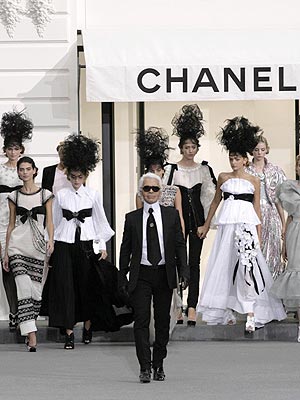
Designer Karl Lagerfeld always wears a black fitted suit with white shirt. Here he is seen with models at Chanel Spring 2009 runway show. Photographer unknown.

Evening dress, Charles James,
1952. The Museum at FIT, gift of Robert Wells in memory of Lisa Kirk.
91.241.137

The American couturier Charles James designed a dress that embodies two archetypes of woman in one, like the Chinese symbol of yin and yang, which represent a perfect harmony created by two polar powers. The black structured bodice signifies a strong, assertive and sexy woman, while the white lacey skirt represents the soft, innocent and romantic one.

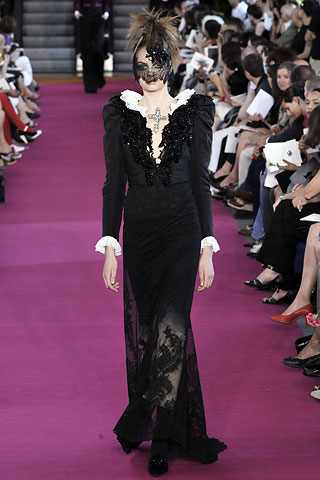
Evening ensemble, Christian Lacroix, Haute Couture Fall 2008
Source: Style.com

evening dress, detail.

evening dress, detail.

Christian Lacroix, a dedicated student of fashion and costume history, often  references several sources of inspiration, mixes them up and creates his own whimsical fantasy. Here, the white lace around the neckline and cuffs suggest seventeenth century dress. However, the long streamlined silhouette, as well as the overlay of black lace, evoke the style of the 1930s . The large stone-encrusted cross is a signature element Lacroix often uses; in this ensemble it ties all the seemingly disparate elements into one coherent look- at once ascetic and seductive.

This is the end of part II, please come back next week to read about how fashion designers interpret flowers in black and white.

Posted in Research | Tagged , , , , , , , , | 2 Comments

June Treasure of the Month- Lucile on Film

The site Glamour Daze is a wonderful source of primary materials, including rare films of fashion, makeup and hair guides. This month’s treasure is included in their feature “Evolution of women’s Dress 1914-1929.” The first section, 1914, shows clothes by British designer Lady Duff Gordon, mostly known as Lucile. I don’t remember coming across any filmed designs of her before, which makes this quite a rare gem.

Lady Duff Gordon with model in her New York design studio, 1916. source: http://www.lucileladyduffgordon.com/

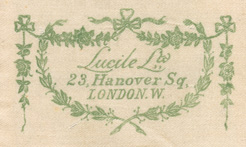
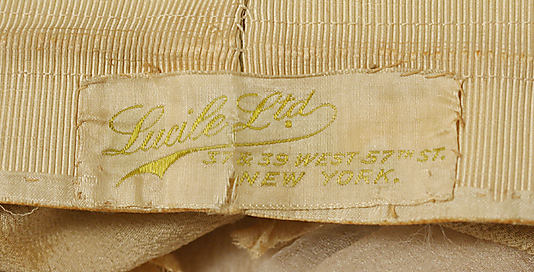
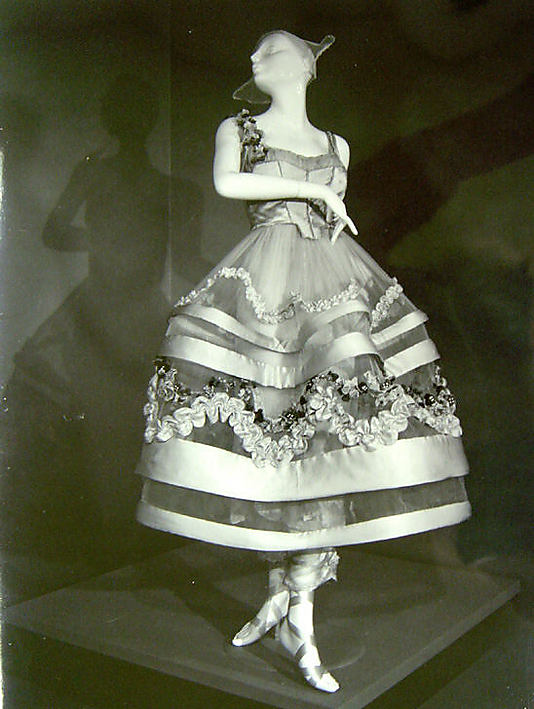
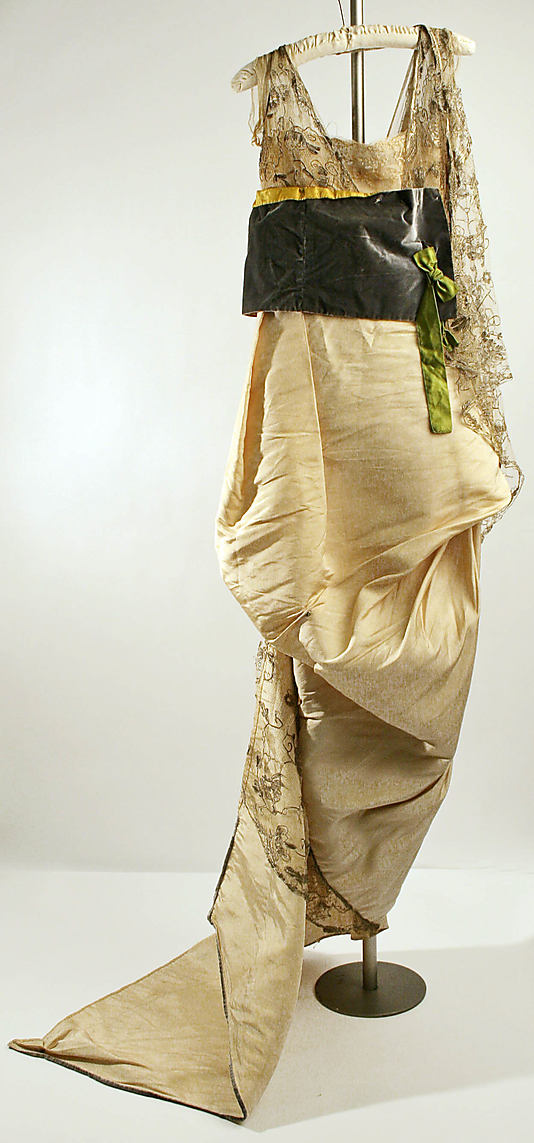
At the beginning of the twentieth century Lucile was one of the most innovative, forward thinking designers. Much like her contemporary, Paul Poiret, she designed clothes for the modern woman. Lucile offered an alternative to the sculptured, curvaceous silhouette that most other fashion houses of the period were showing. She was also one of the first to show her creations on slender, tall models, in many ways foreshadowing the modern ideal  fashionable body, and she is also often credited for being one of the first to stage fashion shows.

Source: The Metropolitan Museum of Art

Dance Dress, 1915. The Metropolitan Museum of Art, Gift of Irine Castle, 1947. CI47.57.3ab

Evening dress, 1914. The Metropolitan Museum of Art, CI44.64.43

The Special Collections and FIT Archive holds a beautiful collection of illustrations of wedding gowns designed by her.

Posted in Treasure of the Month | Tagged , , , , , | Leave a comment

Fashion in Black & White- Part I, Structure

‘Coco’ Chanel’s ” little black dress” is maybe the most famous fashion item of dress. Although some fashion scholars challenge the perception that Chanel was the first to create and promote the chic, simple, and elegant “little black dress”, she is certainly most famous for it. But the combination of black and white is another Chanel signature look that is sometimes forgotten. Chanel herself favored the black and white look, which originated from men’s wear. Karl Lagerfeld too, not only continues to explore the black and white Chanel suit in each and every collection, but also uniforms himself with a slim black and white suit. Jeanne Lanvin is another designer that often wore black and white, and combined it with large pearls necklace. The combination of black and white inspired many other fashion designers in the twentieth century, even those known for their bold use of color. This four-part post explores how fashion designers in the past hundred years manipulated the contrast of black and white to create a modern, timeless look for women. Each post will be dedicated to one theme, the first- Structure, followed by Lace, Flowers and finally Graphics.


“Black comprises everything. So does white. They possess absolute beauty: they are in perfect harmony” (Gabrielle “Coco” Chanel)

The body, like clothing itself, is subjected to changing fashions. With draped or tailored fabric, fashion designers reshape the body to make it more beautiful according to the ideals of the time. With panels of black and white, the form of a garment is effortlessly enhanced, drawing attention to certain parts of the body while obscuring others and shifting its proportions. Be it the dropped waistline of the 1920s, the nipped-in waist of the 1950s or the waistless  A- line of the 1960s- it is the drape, cut and fit of the clothes with which women achieve the ideal body of their era.

Evening Dress, House of Patou.
Designer Michel Goma, c. 1968
Museum at FIT 2001.100.1 

This evening dress is designer Michel Goma’s subtle interpretation of Op Art which reached its peak of influence on fashion in the mid-1960s.  Op Art black and white patterns which create an illusion of movement and disproportion, easily translate to fashion design. In this dress the inset of white and black silk creates an illusion of an elongated figure with a youthful high waistline while maintaining a simple A-line silhouette, which was very fashionable during the 1960s.

Evening Dress, House of Lanvin 
Designer: Jeanne Lanvin, Fall/Winter 1930-31. Brooklyn Museum Costume Collection at The Metropolitan Museum of Art, Gift of the Brooklyn Museum, 2009; Gift of Mrs. George B. Wells, 1957
2009.300.3182a, b

Throughout Lanvin’s career black and white emerges as one of her favorite color schemes, a combination she herself often wore. Although better known for using intricate embroidery and beadwork, Lanvin was also an expert of tailoring and draping. Here, black and white emphasizes the contrast between the structured bodice and the draped asymmetrical skirt.

Jeanne Lanvin in her office, 1936, wearing a black and white suit and a necklace of large pearls, two things she constantly wore.
Photograph by Roger Schall.

With the dramatic contrast of black and white, designers also blur the boundaries between femininity and masculinity. Men clad all in black, edged with white collar or cuffs, appeared as early as the fifteenth century.  By 1900, black suiting combined with white dress shirt, had become the uniform of professional men. This sophisticated and restrained look was adopted by twentieth-century designers seeking to convey new ideas of femininity. Although feminine ideals have evolved, tailored black and white clothes have endured as symbols of a confident and modern woman.

Ensemble, Boudicca.Fall 2006
Museum at FIT 2006.17.1

This tailored ensemble explores contrasting ideas of femininity and masculinity. The designers borrow elements from tuxedo suits, such as the crisp white blouse and black satin belt, and juxtapose them on a feminine silhouette, referencing both the flared shape of the 1950s and tutu skirts of Ballet dancers. The use of black and white not only points to the source of these elements but also underlines the blurred boundaries between feminine and masculine attributes.

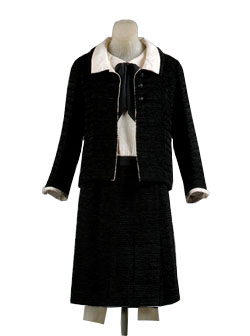
Cocktail ensemble, House of Chanel. Designer: Gabriel “Coco” Chanel ,1964. The Metropolitan Museum of Art, Gift of Mrs. Murray Graham, 1973
1973.297.2a, b

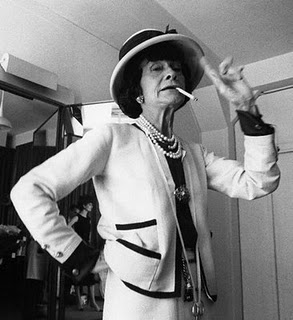
Chanel, c. 1960, Henri Cartier-Bresson/Magnum photos

Since the early days of her career Chanel was drawn to the practical elegance of men’s wear. Similar to men’s fashion, her basic designs slowly evolved through subtle changes of details, rather than drastic changes of style. In the cocktail suit above the textured fabric of the shirt and jacket’s lining, the satin waistband of the skirt, and the black tie are all Chanel’s reinterpretations of men’s tuxedo. Together, they make a strikingly modern appearance, which is both timely and timeless.

This is the end of part I, please come back next week for part II, Lace.

Posted in Research | Tagged , , , , , , , | 3 Comments