Job Op: Paid Internship

Haute couture and expensive ready-to-wear expert Claire Shaeffer is looking for an intern. She is located in Palm Springs, CA and have a home office. She has a collection of 1500+ garments and about 5000 books. She writes books and magazine articles, designs 2 patterns a year for Vogue,  makes dvds for Threads, and teaches 2 couture workshops ea. year (in Palm Springs).

Among other things the intern will be responsible for the following:

Accession garments and books. Each garment is photographed front, back, and label; then listed in an Access file with a short description. A ppt page is printed and hung with the garment; a second page is put into a notebook.

Make samples for articles. Ms. Shaeffer writes regularly for Threads and Vogue Pattern Mag. As well as Au Stitches. For many articles, she needs help with taking the photos and photoshop as needed.

Revise books—the current revision is Sewing for the Apparel Industry.

File—Ms. Shaeffer has 3 diff. files for Designers, Sewing Techniques, and Fabrics so there is often filing. All need major reviewing to discard duplicates and old stuff.

Alterations and mending—what ever needs to be done to the clothes and the collection.

Sew and take notes for the first sample for  Vogue Patterns.

For the workshops, Ms. Shaeffer furnish all fabrics and supplies. The intern will assist with making some samples beforehand and organizing“kits” for students as well as a small store of hard-to-find tools and supplies. The intern will also Respond to request for info about workshops and keep up with the number of students.

For the dvd or photo shoots, select and prepare garments for photos (steaming and dressing mannequin or dress forms), and make samples. The focus of the dvd in Sept. is Tailoring Details. It will have a short book to go with it.

In addition Ms. Shaeffer would like the intern to assist with organizing her Facebook page and setting up a website; She is also planning to write a book on the Chanel jacket.

The length of the internship can range from a month to a year. Some months are better than others and don’t necessarily begin on the 1st. Ms. Shaeffer pays $8/hr. and the intern would work about 40 hrs./wk. If you are interested, please send her your resume as well as two personal references. claire.shaeffer@gmail.com

Posted in Uncategorized | Leave a comment

Haute Couture techniques with expert Claire Shaeffer

By  Anna Yanofsky

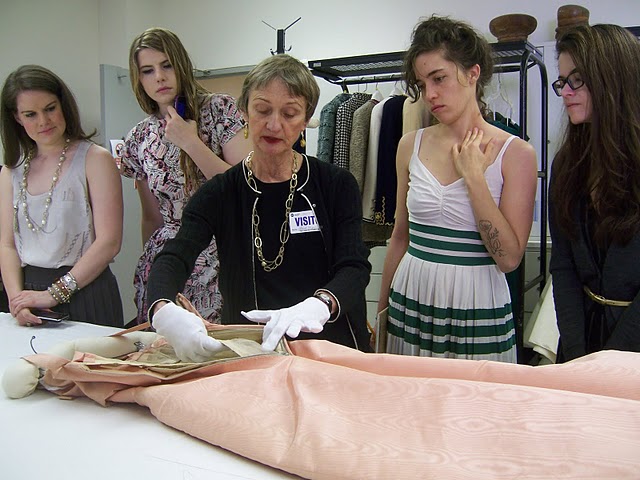
The only thing better than spending a long morning ogling a rack of couture garments, is doing so with an expert guide. In her many years as one of sewing’s premiere Haute Couture technique experts, teachers, and authors, Claire Shaeffer has led quite a number of slack-jawed fashion admirers through spectacular show-and-tell sessions, but the students of FIT’s Fashion and Textile Studies: History, Theory, and Museum Practice MA program may have been her most engaged crowd yet. On a recent Saturday morning, armed with a rack packed full of The Museum at FIT’s collection pieces, Shaeffer wasted no time showing the students just what makes a garment couture.

The basic definition of a couture garment is one that is made-to-measure in a couture workroom by a designer for a specific client. But, the real definition of haute couture lay in the intricate details that fashion’s moneyed elite pay a premium for. The first garment that Shaeffer pulled from the museum rolling rack was an excellent specimen of couture by one of her favorite couturiers, Mr. Christian Dior. The gown was a deep emerald green evening dress of rich silk satin with a delicate four inches of fine fringe trim. At first glance the gown was gorgeous, but with a little explication from Shaeffer, it became a marvelous work of craftsmanship. The petite mains, or workroom seamstresses had put so much skill into the dress. Under the direction of the head of the couture room’s dressmaking studio they created a gown with mitered seams that met at an angle at the corners of the full skirt and they placed small lead weights in discreet inner pockets at the bottom of the skirt so that the gown never lost its graceful line, no matter the wearer’s movement. Perhaps most impressively, the seamstresses created the lush four-inch fringe that trimmed the skirt by taking a length of the dress fabric and laboriously removing each individual weft thread from the weave. The result was stunning—and that was just the outside of the garment.

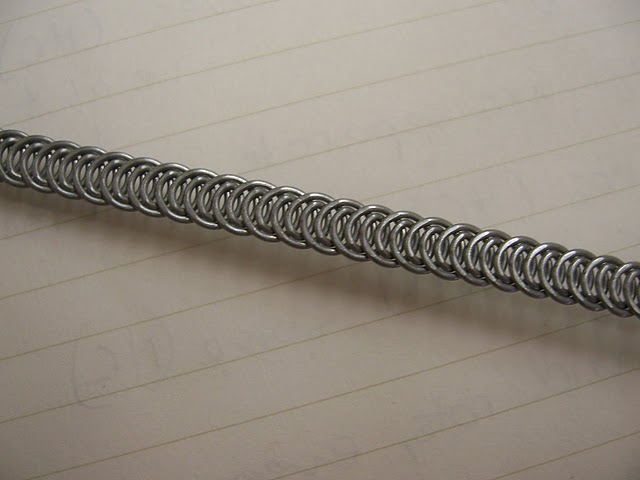
Couture, especially that created by the House of Dior, hides it’s most impressive work. Beneath the beautiful outsides are support systems that subtly and sturdily shape and shift a woman’s figure into the designer’s perfect silhouette. For the emerald Dior dress, that meant a corselette sewn directly to the skirt of the dress supported by cotton netting and lined over the bust with couture-grade boning. This was no ordinary boning. Shaeffer had an example of boning material with her, it was certainly not the common stiff strip of plastic found in off-the-rack clothing, but neither was it baleen (the part of a whale’s mouth used in corsetry often referred to as whale bone). Instead, it was a remarkably flexible strip of modern spiral steel boning, which allowed for a firm shape but as much comfort as the client could expect while dressed in Dior’s nipped-in waist style.

spiral steel boning

Shaeffer and the students examining a Balenciaga dress


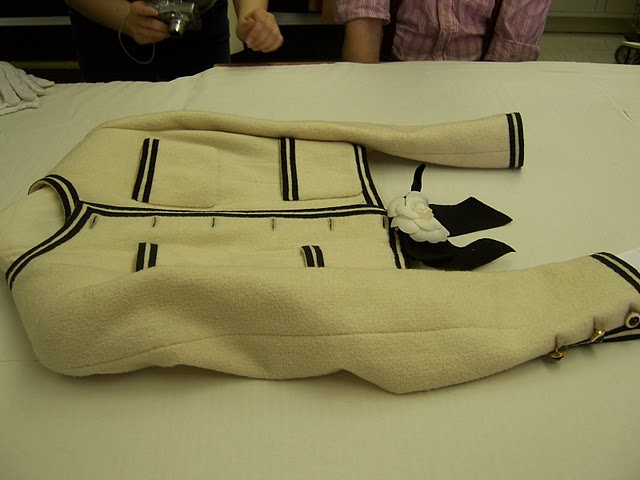
Shaeffer also spent time demystifying the allure of Chanel. The legendary French House of Chanel is supremely secretive about their techniques and have made it very clear that they are not fond of Shaeffer sharing their trademark tricks. However, Chanel’s resistance has not deterred Shaeffer’s persistence. Through the dissection of official copies of Chanel garments, she has been able to assemble a list of what signifies a real Chanel, and not a knockoff. The linings of Chanel suit jackets are put in by hand and quilted without interfacing. Collars are shaped expertly, so that they lay or stand with ease or authority. The sleeve vents have working buttonholes that are double bound, inside and out. And, most characteristically, a Chanel suit jacket will be edged inside with a brass chain to give the jacket weight to keep it perfectly shaped. While any one of these elements could be copied by knockoff makers, Shaeffer’s knowledge of all of them makes her quite good at spotting a fake. In fact, she had her suspicions of one of the suits in the museum’s collection, but she was polite enough to leave the matter open-ended.

Chanel suit jacket by Karl Lagerfeld

Even with four hours of instruction time, Shaeffer still had much more to share. In her more than 15 sewing books, one can spend endless hours studying her years worth of knowledge. For those up for the challenge, Shaeffer also offers intimate and challenging sewfaris, classes of ten or less students where she teaches her techniques hands-on. If you are curious about couture, Shaeffer is your ultimate source.

Posted in Uncategorized | Tagged , , , , , | 10 Comments

Interview with Clare Sauro, curator of the Drexel Historic Costume Collection

We are happy to bring you this interview by Ariele Elia, a recent graduate of the program, with alumna Clare Sauro. Sauro is curator of the Drexel Historic Costume Collection at the Antoinette Westphal College of Media Arts & Design. In the past she supervised the Accessories Collection and worked as Assistant Curator in the Costume Collection at the Museum at FIT where she also contributed to several exhibitions including The Tailor’s Art and Arbiters of Style: Women at the Forefront of Fashion . In 2005 she co-curated the exhibition Dutch at the Edge of Design: Fashion and Textiles from the Netherlands.

Ariele Elia: What is your position at the Drexel University Historic Costume Collection?

Clare Sauro: I am the only person employeed full time in the collection so I am primarily the curator, but I also serve as collections manager, registrar, and director in some capacities. My education at FIT, having to take basic conservation classes and registration classes, have paid off tremendously. I find myself having to do all of those functions on a regular day so I am not a traditional curator in that I have a collection and I put on an exhibition and interpret it for the public, I also do many other things.

AE: What can you tell about the collection?

CS: I have been here at Drexel a little over two years and when I arrived I was told we had about 7,000 objects and a good portion of those had been cataloged, I have since discovered we have a lot more than that and the cataloging is inconsistent. I am discovering new things all the time. We have some wonderful things from the early 20th century, in particular the teens, which are incredibly rare in museum collections because of the way garments were constructed. Often you find very light fabrics like chiffon or tulle with something heavy like wool or beading or velvet and therefore you get dresses that disintegrate. I am constantly surprised at how many objects we have from this time period. We even have a nice assortment of dresses from the mid teens, the war time crinoline period which is generally underrepresented in collection. Last summer I discovered a child’s riding habit from about 1799, I have never seen one of those before. I asked around but I haven’t heard of anyone else who has one. This collection is full of surprises and I look forward to being able to have a full inventory, it seems promising. Stay tuned more to come.

AE: Tell us about the online gallery

CS: It is called the Drexel Digital Museum Project . It was created for a funded free-standing project years ago, and contains objects from the collection as well as loans for specific exhibitions. I find that problematic and confusing. In the future, as we move to a new space, the collection will be more organized and my goal is to get an inventory done, resulting in a searchable database.

AE: As a curator what are some of the challenges you face?

CS: There is never enough time to do everything you want to do. The physical demands of taking care of the collections takes you away from doing the academic research and the writing that you would like to do. Finding that balance is difficult. I rely heavily on students which also can be quite a juggling act [watching them and managing them] and then they go on and get real jobs and graduate, I am happy for them but it means I have to retrain people.

AE: What was your path from graduating to where you are now?

CS: When I was still in graduate school I was lucky enough to get a part time job working at the Museum at FIT. I was hired to help with photographing new objects that came into the collection. I got to see a huge amount of garments and did dressing. In that time I also volunteered at the Brooklyn Museum, and I took contract work at The Metropolitan Museum of Art. I was also at the American Museum of the Moving Image for a little bit. It took me about two years to get a full time job after graduating. I think that’s fairly typical. Once I got into FIT I took a full time job in the registrar’s department at the receiving room, tagging new objects, packing up things for deaccession, it was a whole process of first in last out. I learned quite a bit and developed skills such as dealing with lenders for exhibitions and building relations with donors. From there I moved onto Curatorial Assistant and up to Assistant Curator.

AE: How did you get to Drexel?

CS: Well I heard rumors about how wonderful the collection was. I knew it was currently in a state of needing a great deal of attention and I think it is my nature to root for the underdog. I saw this as a fantastic opportunity to bring something back. I enjoy doing a little bit of everything, but some days I want to clone myself to do work. Part of the job was also to teach History of Costume, which I have found I absolutely adore. It was a bit of a gamble, but I am glad I followed my instincts.

AE: When you were in graduate school what were your interests?

CS: I was focused mainly on American fashion in the 30s and 40s. I was very interested in that period specifically American fashion because I felt it was neglected, my classmates were very couture based and 19th century based. They like Worth, the 19th century and post war couture. So me being kind of arbitrary I decided I would go with the Americans, ready to wear and also film costumes. I wrote my master’s thesis on Bernard Newman, who did the film costumes for Fred Astaire and Ginger Rogers. He started out in the couture salon at Bergdorf Goodman and then went to ready to wear, a study of his career points to what was going on in the American fashion industry at the time, and it meshed my interests together. My advice to graduate students is make sure you really like the topic of your thesis because it will really follow you. Make sure you really love what you do, you have to be tenacious, if you don’t love it you are just going to wear yourself out.



Posted in interviews | Tagged , , | 2 Comments

My Family Portrait

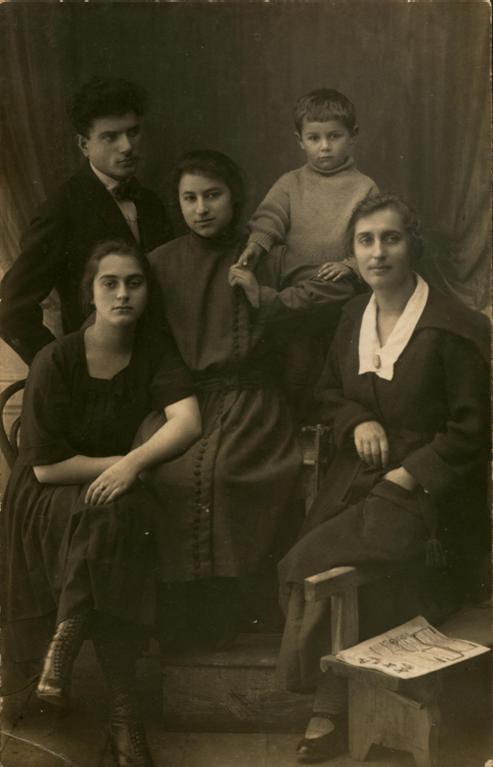
Sitting on the left side is my grandmother Rebecca, it was taken in Poland in 1923 when she was 19. Also in the pictures are her brother and sisters. It was only recently handed to my mother by her cousin, neither of us saw this beautiful picture before.

Sivan Oland

To enter My Family Portrait book giveaway see details here


Posted in My Family Portrait | Leave a comment

Some thoughts on the McQueen exhibition and related topics

A couple of days ago I finally found the time to see the McQueen exhibition at the Met. To avoid the long lines I arrived before ten AM on a weekday, I usually try to avoid crowded places but I thought it is about time I see the exhibition that everyone in the world seems to have already seen. I guess I was not early enough as I ended up waiting thirty minutes to get into the galleries which were packed with hundreds of people. I must admit that I did not survived through the end, and not only because my baby started to scream half way through. It was just impossible to enjoy it with so many people around. I found myself chilling on the roof of the Met in no time. From what I did see it is obvious that the design of the exhibition, as always the case with the Costume Institute’s shows, was stunning. The pieces were exhibited beautifully, especially the room where hats and accessories were showcased. However, were I found the exhibition lacked was in content. Except for wall texts, which were almost impossible to read because of the waves of people coming into the galleries, there were only quotations from McQueen himself. In my opinion an exhibition that lacks to point to McQueen’s sources of inspiration, techniques and design methods misses out  on the most important thing. Yes, the garments and accessories shown are remarkable, but without some insights from the curator on individual objects it is hard to learn something new on McQueen’s work and his legacy as one of the leading designers of our time.

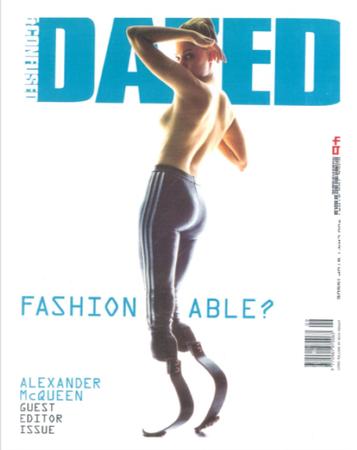
And on a related subject, I also went to hear Harold Koda’s conversation with McQueen’s model Aimee Mullins last Sunday. Mullins, beautiful and graceful, looked as if she stepped right out a McQueenish fairy tale. She discussed with Koda the place of unique body in the fashion world and raised the question of what is a “normal” body as perceived by fashion editors. Although I agree with her that fashion models have by no means average body, I disagree that unique types of body are becoming more acceptable by the fashion world and its image makers. In my point of view her collaboration with McQueen and other designers who created, in her own words, “interesting legs” for her benefit the designer and not the unique body. Had she not been famous and on friendly terms with most of them she would not have access to those designer’s legs. As far as I know the “ordinary” amputee, even if she or he can afford such luxury cannot go online and order Chanel legs. When McQueen used her as a runway model it served his design aesthetic and need to shock, I find it hard to believe he had the community of amputees (and its needs) on his mind. But I might be wrong.

The 1998 Dazed and Confused issue that featured Aimee Mullins for the Access-able shoot. Photographer : Nick Knight. Source: http://shop.showstudio.com

Another example of how the fashion world uses “unique” bodies, pretending to denounce its own obsession with skinny figure and lean long legs, is that of Beth Ditto on the cover of Love Magazine. “[Ditto] looks the wrong way … In a culture that debates women’s weights on a daily basis as their defining feature, well, isn’t it confounding and amazing to have an iconic figure in that culture who doesn’t have a 25-inch waist? Everything about the way that Beth looks reminds us not of her imperfections but our own … She is happy with who she is and the way she is. Don’t we all wish that we woke up in the morning and felt like that?” writes editor Katie Grand.  Yet, Emily Hill from The Guardian raises the important question whether Grand would have featured Ditto on the cover if she was fully clothed? I seriously doubt it. I recommend reading Hills review, as it perfectly captures the hypocrisy of fashion publications.

Beth Ditto on the cover of the first issue of Love Magazine, February 2009

As much as I want to believe in Mullins optimistic conclusion that unique bodies will, in the next five years, be accepted more and more as equally beautiful and legitimate, I think it will be a long while before these bodies will used by fashion designers and editors for any reason other than to shock and provoke.

Posted in Uncategorized | Tagged , , , , | Leave a comment

TSA Textile Study Tour to South Korea

THE TEXTILE SOCIETY OF AMERICA ANNOUNCES:
Traditional and Contemporary Textiles in South Korea

A STUDY TOUR, SEPTEMBER 15-26, 2011
Registration deadline July 1, 2011

The Textile Society of America Inc. offers study tours and professional development opportunities focused on textiles. This year’s Study Tour to South Korea offers a rich mix of traditional textiles and contemporary textile art, along with a unique cultural experience. The tour, led by Karen Searle, will highlight the contrast between ancient and contemporary that can be seen throughout the country, as well as the ways in which Korean artists look to tradition for their contemporary inspiration. The tour will be based in Seoul with visits to the cities of Cheongju, Seochon, and Damyang.

Tour Leader. Fiber artist and author Karen Searle has traveled frequently to Korea over the past 14 years. She has participated in international textile art exhibitions held in Daegu, Korea, as both an invited artist and an exhibition juror. She exhibited work in the First Cheongju International Craft Biennale exhibition in 1999 and has traveled throughout the country visiting universities, museums, fiber artists’ studios, and observing textile production on all levels, from cottage industry to mega-industry. She will be joined by some well-known Korean artists on parts of the tour.

More information and registration materials are available on the TSA website, www.textilesociety.org/tours
or contact Karen Searle, 651-642-9897ksearleart@gmail.com.
Subject: Textile Study Tour to South Korea

Posted in Uncategorized | Leave a comment

TSA Study Tour to South India

THE TEXTILE SOCIETY OF AMERICA ANNOUNCES:
TSA Study Tour to South India
October 23-November 6, 2011
Registration deadline July 29, 2011

The Textile Society of America Inc. offers study tours and professional development opportunities focused on textiles. This fall the TSA will offer a Study Tour to South India led by Indian textile scholar, Sandra Evenson.

Since the days of the Roman Empire, South Indian textile artisans have been weaving, painting, dyeing, and embellishing sumptuous textiles for the courts of kings and the markets of the world.  Handcrafted textiles continue to play an important role in daily life and are often associated with specific villages, where family life and the village economy are centered on traditional textile production. The focus of this tour is on these textile traditions and the textile villages where these fabrics are still produced by hand.

For costs, itinerary, and registration information, please visit http://www.textilesociety.org/events_tours.htm#tsastudytourtosouthindia.  As part of its educational mission, TSA is offering a $1,500 travel scholarship for one TSA member to participate on the trip. Please see the Awards section of the TSA website for details and application information.

For further information, contact
Michele Hardy, mhardy@ucalgary.ca
TSA Director of External Relations
Subject: Textile Study Tour to South India

Posted in Uncategorized | 1 Comment

My Family Portrait

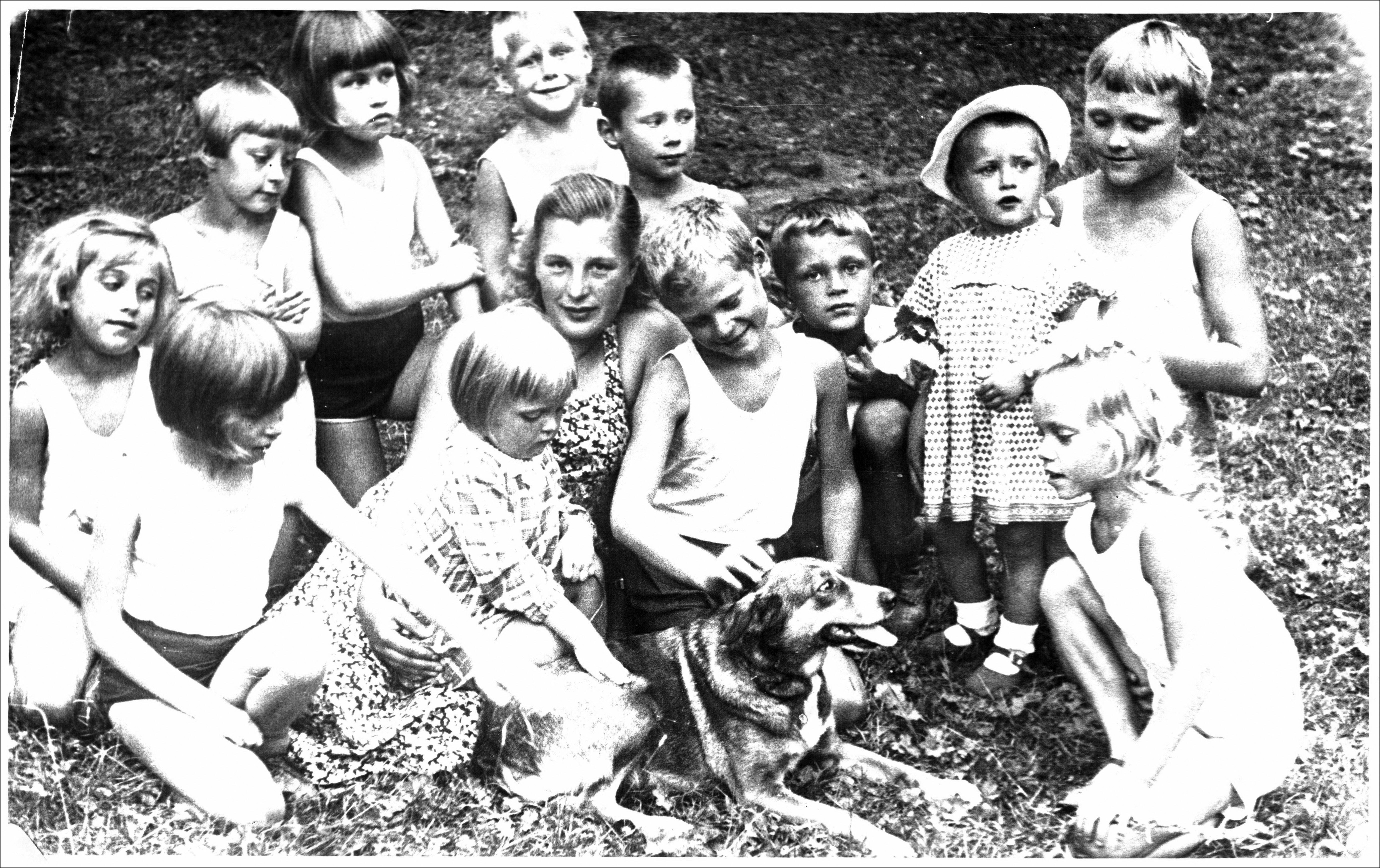
This photograph was taken in summer camp outside Moscow c. 1951-2. My mother is third from left with the dark bob and grumpy face. I find the composition of the picture very interesting, it captures a moment comprised of several layers- on the one hand the focal point is the dog, and most children are looking in his direction, on the other hand those kids who don’t look at him are equally intriguing, and this is before you mention the seductive look on the teacher’s face, it makes you wonder who took this picture….

Ruti Smoliakov

To enter My Family Portrait book giveaway see details here

Posted in My Family Portrait | Leave a comment

My Family Portrait

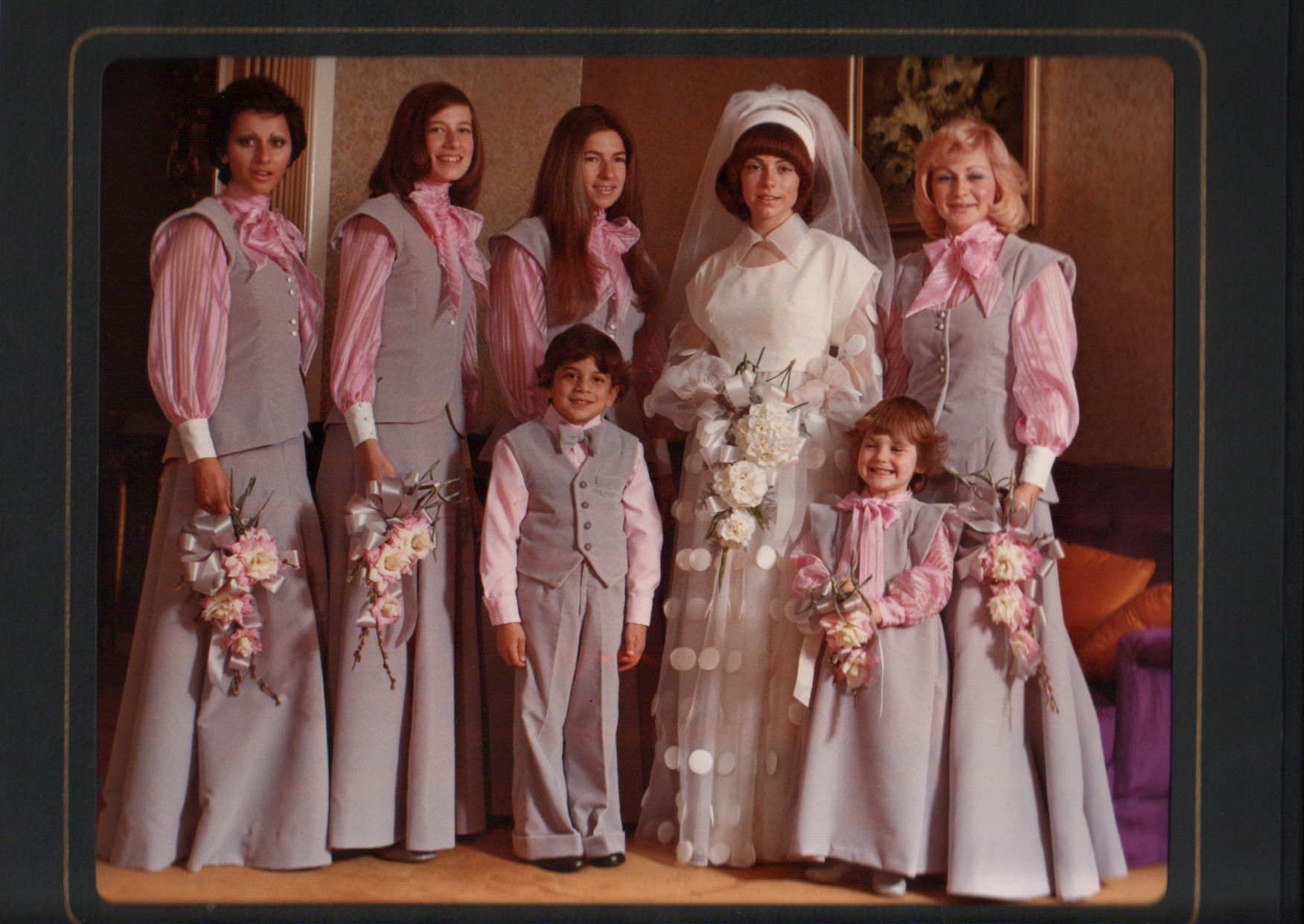
It took years for me to stop making fun of my parent’s wedding pictures. They got married in Australia in 1973, and just celebrated 38 years of marriage 2 days ago.
Over the years I’ve grown to appreciate the choices they made: Polka dots, white cuffs, heavy gray velvet, puffy sleeves and pink ribbons,  what’s not to LOVE? But still, looking at this picture I still think my Mom is the most beautiful bride ever.
Eli Korman


To enter My Family Portrait book giveaway see details here

Posted in My Family Portrait | Leave a comment

Then&Now

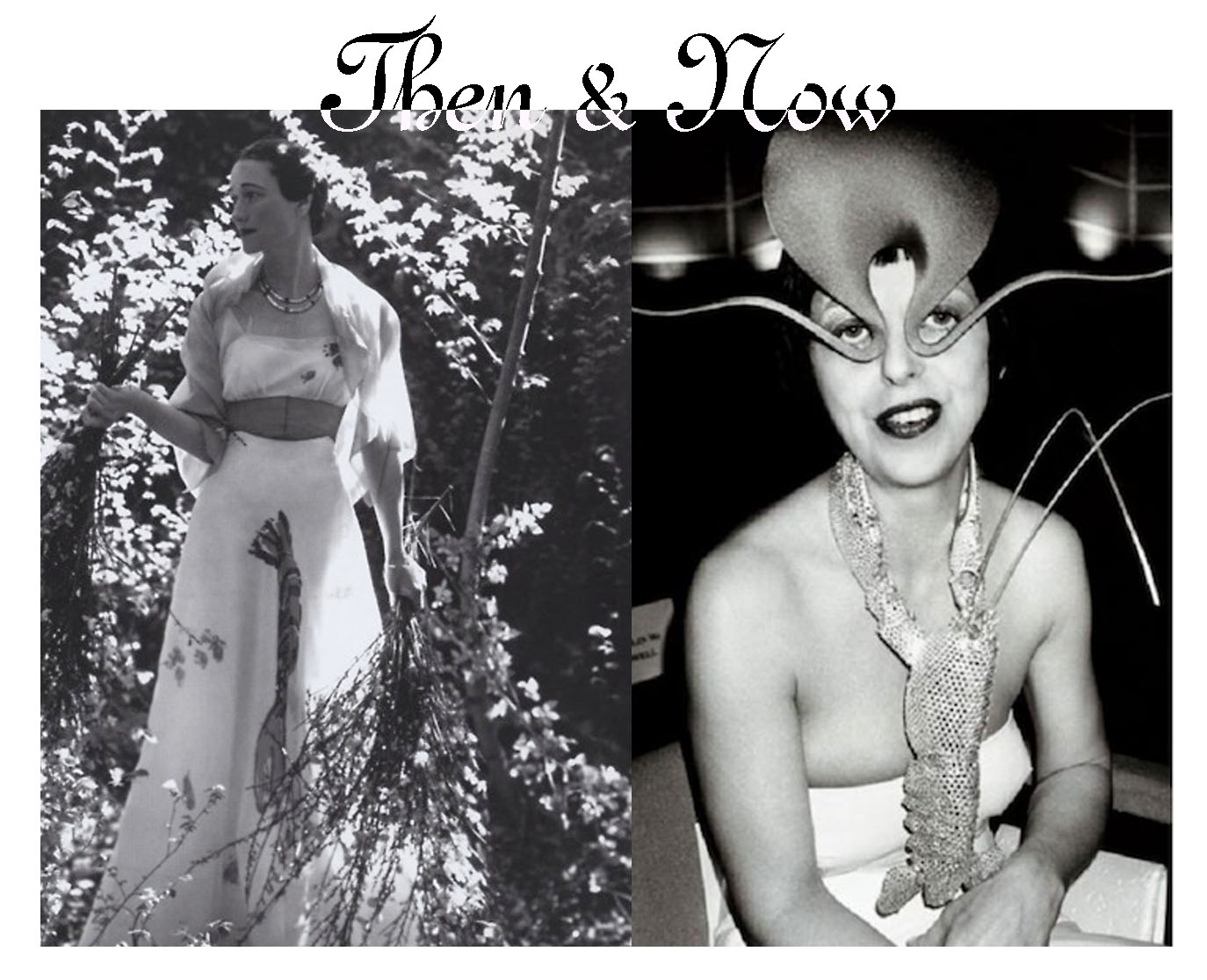
(left) Wallis Simpson, The Duchess of Windsor, in Elsa Schiaparelli’s Lobster Dress, 1937. (right) Isabella Blow in Philip Treacy.

Posted in Then&Now | Tagged , , , , , | Leave a comment