Guest Post: Fashion, Reconsidered

By Cary O’dell

Cary O’Dell’s work has appeared on PopMatters.com, Thoughtcatalog.com and Wornthrough.com.  His book, “June Cleaver Was a Feminist!  Reconsidering the Female Character of Early Television,” will be published in the fall by McFarland.  He works for the Library of Congress and lives in Culpeper, VA. 


At the risk of preaching to the converted, it’s time to take fashion seriously. It’s amazing how fashion (its product, people, and influence; its designers, magazines and models) is still largely scoffed at by the public and the press.  The criticism is ancient, recent, soft, loud and constant.

In 1991, in her well-known tome “Backlash:  The Undeclared War Against Women,” author Susan Faludi takes a dim view of fashion, painting it as an organized oppressor of women.  Referencing a previous ad agency survey, she writes, “The more confident and independent women become, the less they like to shop; and the more they enjoyed their work, the less they cared about their clothes.”

In the 2009 documentary “The September Issue,” “Vogue” editor Anna Wintour had to concede that her siblings–one who is the political editor for the UK’s “The Guardian,” two who work for world relief agencies–are simply “amused” by what she does for a living.

In October of last year, artist Leannie Van De Vyver constructed a pair of backward high heels as part of her “Scary Beautiful” art project.  The shoes, when worn, pitch the wearer forward at the knee but then demands them to lean backward to maintain their upright balance.  The footwear has been described as the “scariest shoes of all time.”  They temporarily cripple whoever wears them.  In Van der Vyver’s words, they are meant to challenge beauty ideals and upend fashion.  “The striving for perfection in beauty and fashion…is creating monsters,” the artist says.

“Scary Beautiful,” shoes by Leanie Van Der Vyver (Courtesy Leanie Van Der Vyver)

“Scary Beautiful,” shoes by Leanie Van Der Vyver (Courtesy Leanie Van Der Vyver)

Curiously, while the worlds of fashion regularly takes its hits, the wide world of  professional sports–with whom it shares some startlingly commonalities—is habitually celebrated and so incorporated into American and world culture that doing without it, or criticizing it, seems almost unthinkable.

It’s interesting though to compare the two.  Both sports and fashion are talked about in terms of “seasons.”  And their most famous foot soldiers (professional athletes in sports; models in fashion) have more in common than just their joint dating pool.  That we seldom see 5’2” fashion models is the same reason we seldom see 5’2” basketball stars (or six-foot jockeys).  Their bodies are just not built for the task.  For success in either industry, it helps to have a genetic leg up.  But no one holds Shaq’s, Kobe Bryant’s or Chris Paul’s height against them the way that the fashion industry’s top models are often regularly ridiculed for creating “unrealistic” images with their statuesque-ness.  (We’ve long used supermodels as a cultural catch-all for all that is wrong with young girls and women and the world.  From eating disorders to “heroin chic,” when in doubt, blame Kate Moss?)

Interesting too that in both careers, athlete and model, participants tend to peak early.  Somewhat alarmingly, the ages in both professions are becoming increasingly younger.  Olympic gymnast, Gabby Douglas, is 17; diving protégé Tom Daley is 18.  And though in the winter of 2011, the Council of Fashion Designers of America issued “guidelines” to ban the use of models under the age of 16 from participating in shows geared toward adult women, youth is still the word on the runways and in the modeling industry.


“Vogue,” April 2008, LeBron James and Giselle Bundchen (Courtesy Conde Nast)

“Vogue,” April 2008, LeBron James and Giselle Bundchen (Courtesy Conde Nast)

But, that said, thanks to the likes of Naomi Campbell, Iman, Lauren Hutton and the incomparable Carmen, the “retirement age” for models is being increasingly stretched.  The same however cannot be said for professional footballers, baseball or hockey players or others.  Michael Phelps retired from the pool at the grand old age of 27; Pete Sampras hung up his tennis racket at age 31.  In contrast, Naomi is still stalking the runways at age 42, Carmen is 81!

Carmen Dell’Orefice, recent photograph (Courtesy Carmen Dell’Orefice)

Carmen Dell’Orefice, recent photograph (Courtesy Carmen Dell’Orefice)


Economically as well, fashion and sports each generate billions of dollars in revenue.  Dozens of cities around the country have attempted to resurrect their local economies via the construction of new downtown stadiums meant to lure in tourists and merchants.  Often, though, these communities have been disappointed when the final figures don’t meet expectations.  So while sports is big business, is fashion actually bigger?

What appears on the runways is both the end and the beginning of a multi-billion dollar infrastructure dependent on these cut-and-died strips of cloth, these visions of revitalized hemlines and exotic colors.  Designers, cutters, beaders, seamstresses, models, modeling agencies, make-up artists, make-up companies, perfumeries, photographers, photography studios, magazines, websites and blogs, stylists, editors, hair stylists, manufacturers, writers, retailers, distributors, wholesales supplies (for thread, buttons, ribbons, zippers and the like), truck drivers, support designers, fabric mills, advertising executives and advertising agencies all spiral out from those few minutes of new clothes showcased on the catwalk.  The economic survival of them all hang, literally, by a thread.

Money comes into play again when another aspect of the sports vs. fashion analysis is considered.  Those who scoff at the price of a couture dress ($10,000+) or a Chanel bag ($5,000+) are usually the same who would never question the quarterback who is paid multiple millions to throw or catch a ball on a Sunday afternoon.  Peyton Manning, of the Denver Broncos, makes $18 million a year.  Dwight Freeney, a defensive end for the Colts, made $19 million last year.  To some fans, this is money well spent.  But for that kind of money, wouldn’t it be nice to have something to call your own, to wear rather than just watch?

Diverting from sports comparisons for a moment, the high cost of high fashion that is belittled by some is put into even better perspective when spoken about in relation to cars.  Those who believe a Dior or a Givenchy dress is an overpriced waste, should be given a test, a choice between owning two types of automobiles:  a basic but running roadster (like a perfectly working Pinto or Yugo) versus an Aston Martin or a brand-new Ferrari.  For most, the choice would be easy.  But therein lies the rub, and the parallel.  What’s the real difference between all these jalopies?  Like the clothes you wear, both vehicles will get you to where you need to go–just not in as much style.

With fashion so often in step with professional sports, why then is one viewed as the national pastime and the other often viewed as something shallow and sulfurous?  Early, radical feminist Virginia Woolf saw and stated clearly the traditional division of societal attitudes.  I paraphrase her:  this is the domain of men (sports, war) therefore it is important; this is the domain of women (fashion, home life) therefore it is unimportant.

Consider how true this is:  while just about every evening newscast contains roughly 7-10 minutes devoted to sports.  And just about every newspaper (those that are still around anyway) contains an entire section of their pages devoted to sport recaps and final scores.  Fashion, meanwhile, despite its prominence on the web and via such fashion-friendly outlets as the E! and Style networks, remains under-reported.   No major news outlet covers fashion consistently; Elsa Klensch has been off CNN since 2001.

Fashion would no doubt be held in better stead if not for the fact that over the years, usually in the name of feminism, many women (like Faludi above) have turned against it.  From the “Freedom Trash Can” erected at the Miss America protest in 1968 that became the receptacle of bras and high-heels, fashion in all its forms has often been on a feminist hit list.  But the idea that women are a mindless herd following fashion edicts is more anti-woman than any well-cut Chanel suit.  That a woman can’t be both fashionable and powerful is disrespectful to both fashion and the women who wear it.

Furthermore, the concept that all forms of womenswear is some sort of male-engineered attempt at torture or female impairment does not pass the test of common sense.  If skirts are America’s way of keeping women constrained or immobile, then why, historically and in other cultures, do men often don skirts or skirt-like garments?  Scottish men wear kilts.  Ancient Romans wore togas.  And the higher up male religious leaders become (consider monsignors and the Pope), the more likely they are to wear leg-less cloaks.

Liam Neeson in “Rob Roy” (Courtesy of United Artists)

Liam Neeson in “Rob Roy” (Courtesy of United Artists)

Placing the industry and philosophy of fashion into such comparative matrixes inevitably, ironically, elevates fashion, if only due to its far greater daily necessity:  after high school or college, few of us play any organized games ever again but we each have to get dressed every morning.  Knowledge of fashion, its power and meaning, seems far more essential sociologically too.  Clothing is part of the face and persona we present to the world.  Badly matched, unkempt, undersized, and even egregiously outdated clothes communicate the wrong message about our abilities and even our sanity.  We can get through adulthood without ever playing a baseball game or attending one, we cannot go through it naked nor ill-attired for the variety of roles we must play throughout our lives.  Hence, we can no longer allow fashion to be viewed as something frivolous and insignificant.
 

Posted in Uncategorized | Tagged , , , , , | 2 Comments

Mystery Monday

It’s the day after the Super Bowl. Did your team win?

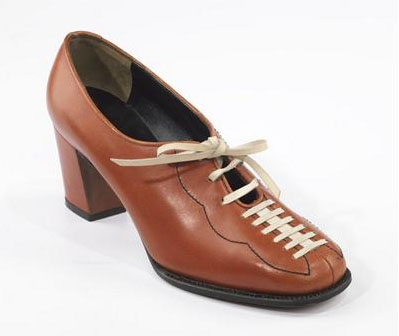
At next year’s party, instead of wearing your favorite football jersey, why don’t you consider sporting something similar to our latest mystery:

MM

Who designed this shoe?

Think you know? Submit your guess below; we’ll reveal the answer on Thursday!

Posted in Mystery Mondays | Tagged | Leave a comment

Mystery Monday: A Suit from La Belle Jardinière

Manufactured during the period now known as La Belle Époque (1871 – 1914), this suit from La Belle Jardinière is an example of the more affordable, ready-to-wear suiting options available to Parisian men.

Suit from Belle Jardinière, ca. 1900. Cotton and wool ensemble; jacket is 90.2 cm at CB. Accession number 2009.300.1003a–c at The Metropolitan Museum of Art.

Suit from La Belle Jardinière, ca. 1900. Cotton and wool ensemble; jacket is 90.2 cm at CB. Accession number 2009.300.1003a–c at The Metropolitan Museum of Art.

suit2suit3

Established in 1824, La Belle Jardinière was the first department store in Paris to consolidate all aspects of its operations – employee housing, workshops and sales floors – into one structure. This efficient use of resources allowed the company to provide ready-to-wear clothes at a modest price to those unable to afford a custom suit of unique design.

Sorrieu, Frédéric. Maison de la Belle Jardinière, nouveau magasin, vue perspective depuis le Pont-Neuf, after 1878. Color lithograph, 66 x 52 cm. Found at La Musée d'Orsay.

Sorrieu, Frédéric. Maison de la Belle Jardinière, nouveau magasin, vue perspective depuis le Pont-Neuf, after 1878. Color lithograph, 66 x 52 cm. Found at La Musée d’Orsay. In 1864, when the company was forced to vacate its original building, the store relocated to a beautiful new structure designed by the architect Henri Bendel.

The suits made by La Belle Jardinière were of a high quality and were a welcome addition to the middle-class wardrobe, but they were not a comparable option for those able to afford more expensive suiting. In Sex and Suits, Anne Hollander commented that ready-to-wear suiting played a particular role in society. “What we now call suits existed, but they were emphatically informal, or else noticeably lower-class. The gentlemen’s ‘lounge-suit,’ all parts made of a singular fabric, had originally been intended for leisured country life and very private city use, to be worn only at home and among intimates…. A gentlemen might travel in his comfortable lounge-suit; but it was certainly not acceptable at the bank or the firm, nor at church, nor at highly formal social events in the day-time, nor for anything at all in the evenings” (109).

Later in the same chapter, Hollander explains the elitism of the upper-class, and the strong reaction to the increased availability of suiting for the middle-class merchants. “It was during this period, when similar suits began to suit everybody, that ferocious sneering about ready-made suits began to seep into snobbish rhetoric. In life as well as literature, ‘ill-fitting’ and similar terms would describe the modest suits of persons with the wrong moral qualities, to signal their emotional maladroitness and instability, even their unscrupulousness, and automatically consign them to lower levels of being. ‘Off-the-rack’ itself became a term of deep opprobrium. As we know, ready-to-wear suits can fit perfectly and be made of beautiful stuff; but the rhetoric persists, even now” (110).

So, as ready-to-wear suiting became popular, the wealthiest class cast a discerning eye upon the fit, fabric, and source of these affordable waistcoats, slacks and jackets. They continued their search until they found something to disdain.

Quotes from: Hollander, Anne. Sex and Suits. New York: Kodansha International, 1994, pages 65 – 67.

Posted in Mystery Mondays | Tagged , , , | Leave a comment

Mystery Monday

As a new semester begins and we find ourselves returning to a strict schedule of classes, studying, and research, time is very much on our minds. While we settle into our comfortable but hectic routines, here is another mystery:

MM

From what era is this suit? Why is this type of suit significant?

Think you know the answer? Submit your guesses below; we’ll share all the details on Thursday!

Posted in Mystery Mondays | Tagged | 2 Comments

Mystery Monday: Jack Potter’s Drawing and Thinking

I thought someone might mention the names Vuillard and Toulouse-Lautrec this week!

Potter, Jack. Mimi Monette, interior with brown background. Conté and watercolor, 45 x 61 cm. Accession number 2009.143 at the Museum of Fine Arts, Boston.

Potter, Jack. Mimi Monette, interior with brown background. Conté and watercolor, 45 x 61 cm. Accession number 2009.143 at the Museum of Fine Arts, Boston.

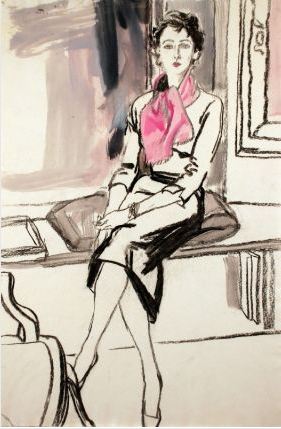
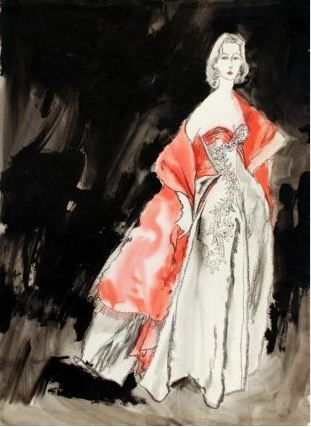
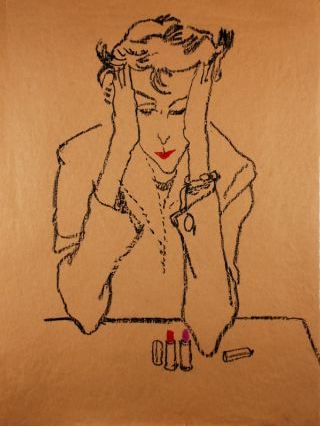
Jack Potter (1927 – 2002), best known for his fashion illustrations in the 1950s, found inspiration in the work of Toulouse-Lautrec and Vuillard. Though his style is reminiscent of these famous artists, Potter’s bold use of black and restrained use of bright colors like orange, red, and fuchsia were a great departure from contemporary fashion illustrations. In 1950, his expressive style quickly became a prominent feature in the most respected fashion publications and his signature style soon became the medium companies like North East Airlines, United States Ship Lines, Ponds and Coca-Cola used to promote their brands.

Potter, Jack. Mimi Monette wearing a pink scarf. Conté and watercolor, 56.5 x 38 cm. Accession number 2009.140 at tje Museum of Fine Arts, Boston.

Potter, Jack. Mimi Monette wearing a pink scarf. Conté and watercolor, 56.5 x 38 cm. Accession number 2009.140 at tje Museum of Fine Arts, Boston.

Potter’s skilled fashion illustrations depict stylish women in everyday settings, and it is these minimalistic domestic scenes that create the ideal backdrop for a bright silk scarf, a luxurious cape, or a dramatic bow at the waist. With Potter’s bold color choices and quick, expressive lines, a woman at a desk or a woman standing by a window becomes transformed; she is suddenly beyond time, beyond place – she is always Fashion!

Potter, Jack. Mimi Monette, interior with orange background. Conté and watercolor, 52 x 45.5 cm. Accession number 2009.141 at the Museum of Fine Arts, Boston.

Potter, Jack. Mimi Monette, interior with orange background, 1950s. Conté and watercolor, 52 x 45.5 cm. Accession number 2009.141 at the Museum of Fine Arts, Boston.

By 1957, Potter’s  illustrations had appeared in Ladies’ Home Journal, Jardin de Modes, The New York Times Magazine and Cosmopolitan for almost seven years, but Potter still found his commercial success lacking. Suddenly leaving his established career, Potter began teaching at the School of Visual Arts in New York City, where he remained for the next 45 years. For those many years, Potter found satisfaction in teaching students to view the world with a fresh perspective in a course titled ”Drawing and Thinking”.  Yes, this innovator much preferred teaching to drawing.

Why? Potter once told a friend that clients ”want me to do the same thing every time.”

Potter, Jack. Woman in strapless gown with red shawl, late 1950s. Conté and watercolor, 78 x 56 cm. Accession number 2009.8 at the Museum of Fine Arts, Boston.

Potter, Jack. Woman in strapless gown with red shawl, late 1950s. Conté and watercolor, 78 x 56 cm. Accession number 2009.8 at the Museum of Fine Arts, Boston.

Potter, Jack. Woman contemplating lipstick, 1950s. Conté on paper, 60.5 x 46 cm. Accession number 2009.145 at the Museum of Fine Arts, Boston.

Potter, Jack. Woman contemplating lipstick, 1950s. Conté on paper, 60.5 x 46 cm. Accession number 2009.145 at the Museum of Fine Arts, Boston.

For more images of Jack Potter’s illustrations, please visit the Museum of Fine Arts, Boston.

Source: Heller, Steven, “Jack Potter, 74, Illustrator Who Turned to Teaching, Dies.” The New York Times, September 23, 2002. Found online: http://www.nytimes.com/2002/09/23/arts/jack-potter-74-illustrator-who-turned-to-teaching-dies.html
Posted in Uncategorized | Leave a comment

Mystery Monday

Last week’s mystery was about drawing inspiration from the past, and this week’s mystery is about the drawings of the past:

MM

Who drew this fashion illustration?

Think you know? Submit your guess below; we’ll tell you all about this illustrator on Thursday!

Posted in Mystery Mondays | Tagged | 2 Comments

Mystery Monday: Owen Jones

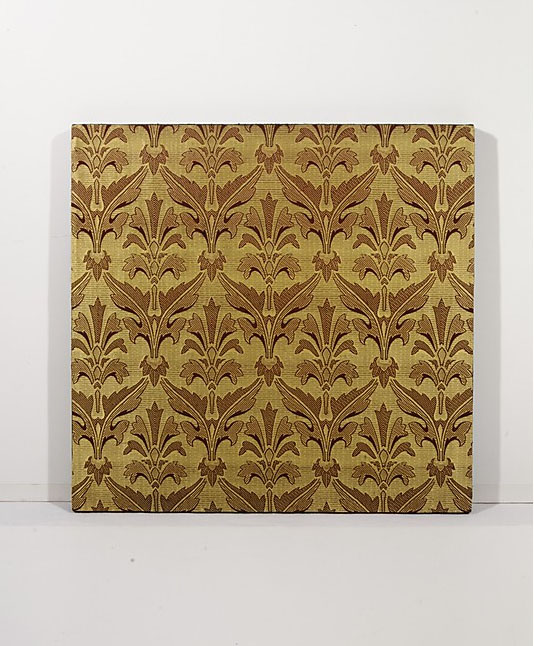
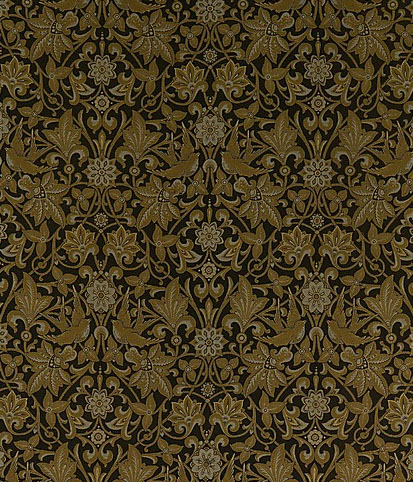
Yes, Owen Jones designed this textile.

Jone, Owen, "Italian". Silk textile, 45.1 x 47 cm. Manufactured by Warner & Sons. Accession number 2000.46 at The Metropolitan Museum of Art.

Jones, Owen. Italian, 1873.  Silk textile, 45.1 x 47 cm. Manufactured by Warner and Sons. Accession number 2000.46 at The Metropolitan Museum of Art.

Jones (1809 – 1874) was an architect, a designer, and the author of  The Grammar of Ornament. Published in 1856, The Grammar of Ornament contains a series of chromolithographs tracing the development of patterns through time and different cultures. In addition to the illustrations, the publication features a list of 37 design propositions including the following:

1. The Decorative Arts arise from, and should properly be attendant upon, Architecture.
3. As Architecture, so all works of the Decorative Arts, should possess fitness, proportion, harmony, the result of all which is repose.
4. True beauty results from that repose which the mind feels when the eye, the intellect, and the affections are satisfied from the absence of any want.
23. No composition can ever be perfect in which any one of the three primary colours is wanting, either in its natural state or in combination.
37. No improvement can take place in the Art of the present generation until all classes, Artists, Manufacturers, and the Public, are better educated in Art, and the existence of general principles is more fully recognized.

OrnamentOwenJones

A detail from The Grammar of Ornament. The complete publication is available online as part of the University of Wisconsin’s Digital Library for the Decorative Arts and Material Culture.

Jones was fascinated by the designs and patterns of ancient civilizations. His highly influential chromolithographs were the result of careful study of the architecture and design elements found in famous archeological sites and historically important buildings in Europe, the Middle East, Africa and Asia. Of the many design styles he recorded, Jones was most captivated by the geometric Islamic and Indian architectural details he discovered through travel and while viewing European exhibitions. According to the Victoria and Albert Museum, “the section devoted to ‘Indian Ornament’  [in The Grammar of Ornament] took its examples from objects shown in 1851 and at the 1855 Paris Exhibition. In comparison to the ‘fruitless struggle after novelty, irrespective of fitness’ that he found in European manufactures, Jones found in the Indian work, ‘all the principles, all the unity, all the truth, for which we had looked elsewhere in vain.'”

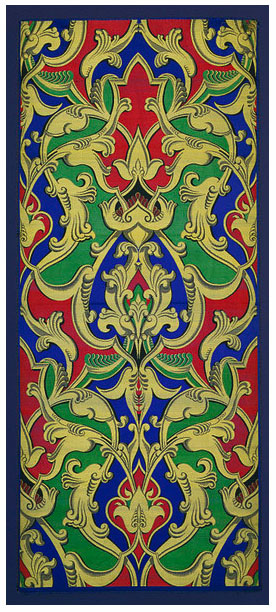
Not surprisingly, Jones’s illustrations were widely copied by other designers who found inspiration in the pages of colorful geometric designs. This was not the first time his illustrations had inspired others; in March 1936, before publishing The Grammar of Ornament, Jones published a series of color plates on the designs and decoration of the Alhambra Palace in Spain. The chromolithographs were published in two volumes in 1842 and 1845 called Plans, Elevations, Sections and Details of the Alhambra, and were very likely the inspiration of this textile design:

Alhambresque, 1855. Woven silk with satin binding, 127 x 55.6 cm. Possibly woven by Owen Jones. Likely woven by Daniel Keith & Company. Accession number T.132-1972 at The Victoria and Albert Museum.

Alhambresque, 1855. Woven silk with satin binding, 127 x 55.6 cm. Possibly designed by Owen Jones. Likely woven by Daniel Keith and Company. Accession number T.132-1972 at The Victoria and Albert Museum..

Jones served as the interior decorator of the Great Exhibition, filling the great glass hall with bold designs rendered in blue, red, and yellow.  While his vision was not immediately well-received, visitors to the Great Exhibition eventually embraced Jones’s design choices. Like Jones, the textile firm Daniel Keith and Company was also an important part of the Great Exhibition. According to the Victoria and Albert Museum, Daniel Keith and Company “exhibited a range of woven tissues, brocades, brocatelles (sumptuous, rigid, ribbed fabrics suitable for battening to walls) and silk damasks at the Great Exhibition of 1851 in London.” Daniel Keith and Company recognized the importance of historic design motifs when creating Alhambresque and similar textiles.

Another manufacturer, Warner, Sillett and Ramm, began producing textiles with the designs of Owen Jones in the 1870s. As the Spitalfield’s firm evolved from Warner, Sillett and Ramm into Warner and Sons, the successful collaboration between Jones and Benjamin Warner continued. Together they produced a series of textiles with designs evoking the Renaissance as well as the more stylized patterns to which Jones was so partial.  While continuing to find inspiration in Islamic design motifs, Owen Jones also created motifs using the colors and patterns popular in sixteenth- and seventeenth-century Florence; examples of these textiles include our mystery textile and the textiles found below:

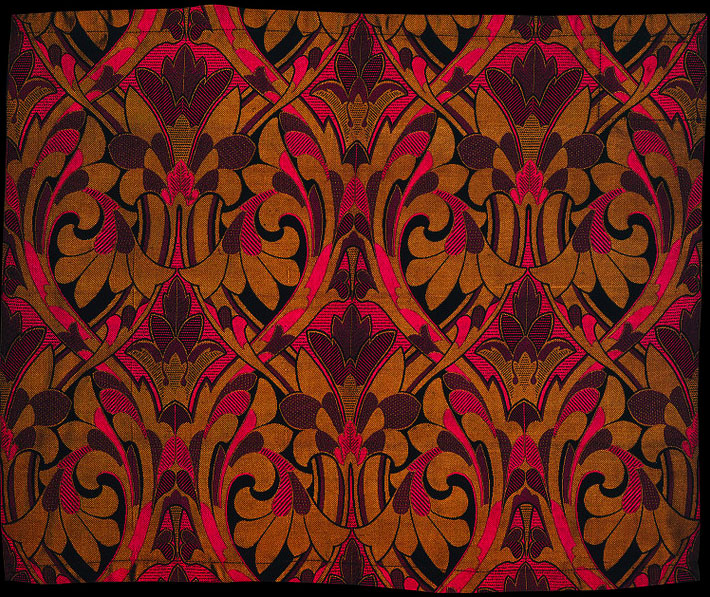
Jones, Owen. Jacquard-woven silk, designed in 1872. Woven in Spitalfields, 45.2 x 54.5 cm. Manufactured by Warner and Sons. Accession number T.94A-1930 at The Victoria and Albert Museum.

Jones, Owen. Jacquard-woven silk, designed in 1872. Woven in Spitalfields, 45.2 x 54.5 cm. Manufactured by Warner and Sons. Accession number T.94A-1930 at The Victoria and Albert Museum.

This textile features acanthus leaves, a common design element in ancient Egyptian and Greek art and architecture. This motif continued to be popular during the Renaissance and in later centuries as it remained a potent symbol of royalty and tradition.

Jones, Owen. Detail image of "Chandos", 1873. Silk textile, 175.3 x 66 cm. Manufactored by Warner & Sons. Accession number 2003.267 at The Metropolitan Museum of Art.

Jones, Owen. Detail image of Chandos, 1873. Silk textile, 175.3 x 66 cm. Manufactored by Warner & Sons. Accession number 2003.267 at The Metropolitan Museum of Art.

While Chandos was produced in 1873, Warner purchased the design from Jones around 1868, two years before his Spitalfield’s firm began operations.

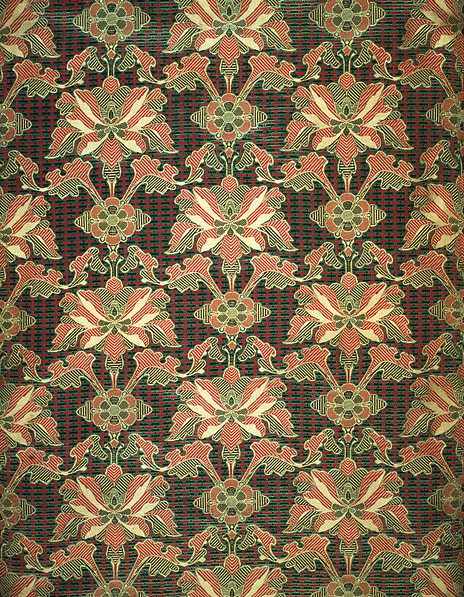
Jones, Owen. Sultan, 1870-74. Jacquard woven silk,  73.5 cm. x 52 cm. Manufactured by Warner and Sons. Accession number T.163-1972 at the Victoria and Albert Museum.

Jones, Owen. Sultan, 1870-74. Jacquard woven silk, 73.5 cm. x 52 cm. Manufactured by Warner and Sons. Accession number T.163-1972 at the Victoria and Albert Museum.

In summation of Owen Jones’s appreciation for historic design, here is Proposition 36: “The principles discoverable in the works of the past belong to us; not so the results. It is taking the ends for the means.”

For more information on the life of Owen Jones, please see this article.

Posted in Mystery Mondays | Tagged , , | Leave a comment

Mystery Monday

In textile design, history repeats itself as the next generation discovers the patterns of the past, when the result of this analysis leads not to innovation but to replication. While some view these patterns with disappointment, these facsimiles of historic patterns do provide unique clues about the time and place in which they were created; these reproductions provide insight into the life and mind of the designer and the other individuals involved in the production process.

silktextile

So, who designed this silk textile?

Think you know the answer? Submit your guess below; we’ll tell you all about this creative individual on Thursday!

Posted in Mystery Mondays | Tagged | Leave a comment

Mystery Monday: Charles James, American Couturier

Readers, thank you for your patience this past week. Here is the solution to last Monday’s mystery:

Happy New Year, Readers!

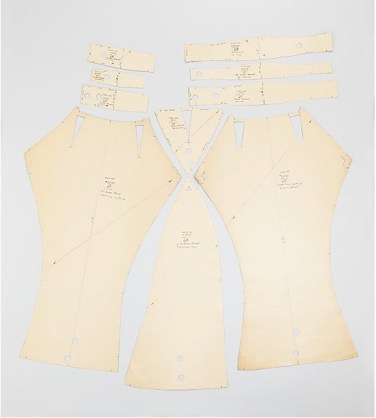
There were some great guesses this week, including the correct answer: Charles James.

"Diamond" flat skirt pattern, 1952. From the Brooklyn Museum Costume Collection at The Metropolitan Museum of Art, accession number 2009.300.2810a–j. Gift of Mrs. John de Menil, 1957.

James, Charles. “Diamond” flat skirt pattern, 1952. From the Brooklyn Museum Costume Collection at The Metropolitan Museum of Art, accession number 2009.300.2810a–j. Gift of Mrs. John de Menil, 1957.

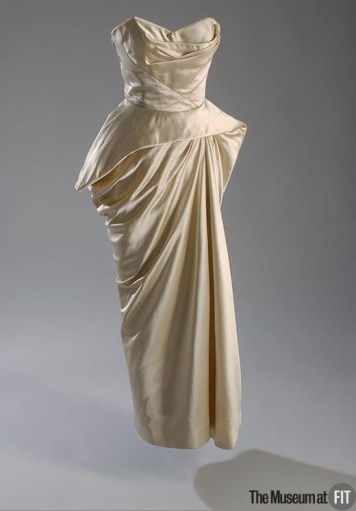
Historians have described Charles James (1906 – 1978) as an artist, a sculptor, and the only true American couturier, and his beautiful designs are veritable inspirations for this high praise. His understanding of complex pattern making and draping is evident in the perfect posture of his highly structured and carefully draped gowns, jackets and skirts.

Some of James’ most memorable designs, his evening gowns from the 1940s and 1950s, began as a distinctive infrastructure that James surrounded by elegantly draped fabrics. This practice of embellishing a rigid, sculpted form was a comfortable design process for James, who worked as a milliner in Chicago under the name Charles Boucheron before moving to New York, where he ventured into dress design with the skills he had crafted while folding and shaping hats.

James, Charles. Ivory silk satin evening dress with boning, c. 1952. From The Museum at FIT, object number 70.1.1.

James, Charles. Ivory silk satin evening dress with boning, c. 1952. From The Museum at FIT, object number 70.1.1.

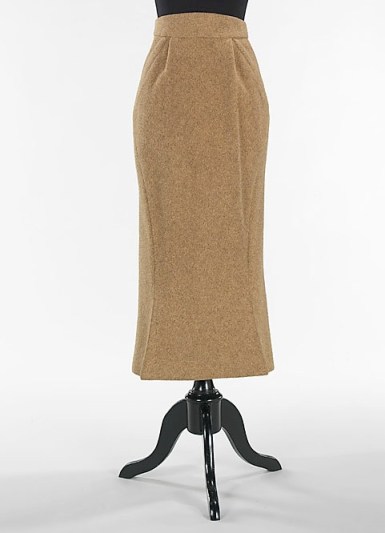
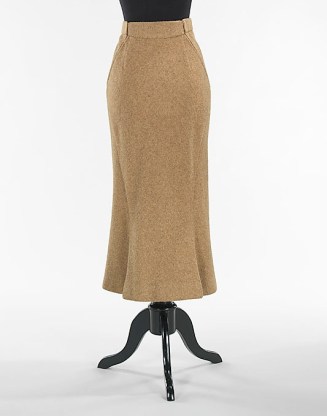
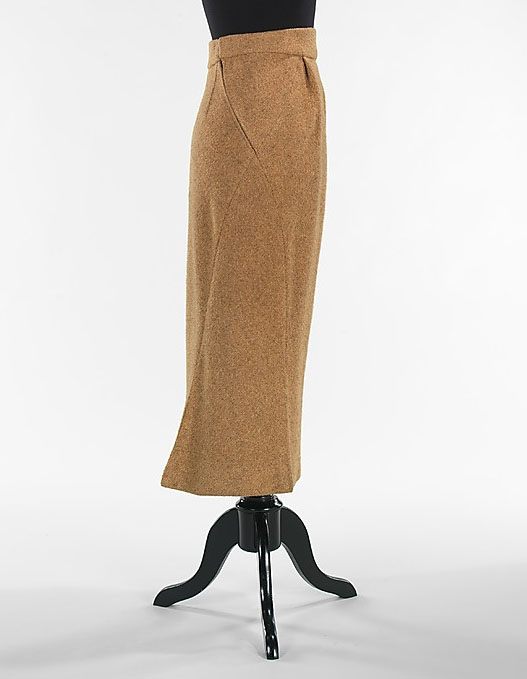
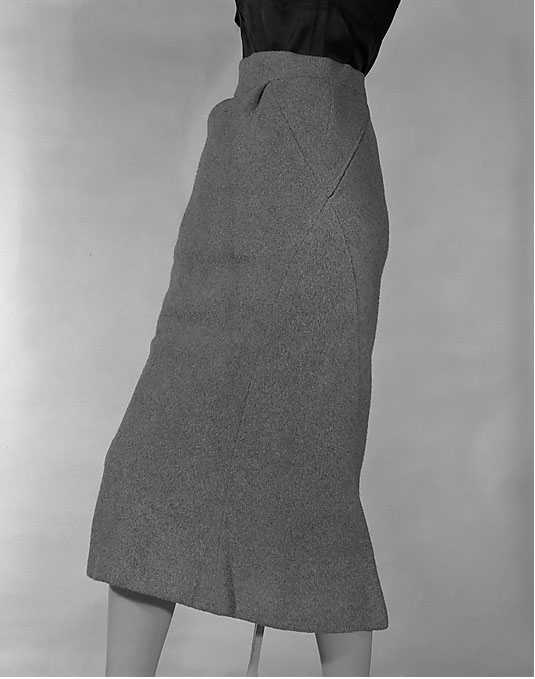
The image for this week’s mystery is a pattern for a more humble garment, a wool skirt, but James’ skilled pattern elevates the skirt above its role as day wear. The clever darting and seaming, the subtle shaping of the waistband, and the multifaceted flare at the hem transform this skirt into a tribute to a woman in motion. The seam lines clearly accentuate the female shape, celebrating the hips and rear, and the flared hem and the darts subtly reference the stripes and fins on a sports car while facilitating mobility and providing comfort. Though demure in fabric and hue, this skirt is a masterpiece, both concealing and revealing the shape of the confident female found within.

James, Charles. Wool skirt manufactured by William Popper, 1952. Part of the Brooklyn Museum Costume Collection at The Metropolitan Museum of Art, accession number 2009.300.821.

James, Charles. “Diamond” wool skirt manufactured by William Popper, 1952. Part of the Brooklyn Museum Costume Collection at The Metropolitan Museum of Art, accession number 2009.300.821.

skirtbackskirt sideskirtphoto

Interested in learning more about Charles James’ design process? The Metropolitan Museum of Art has a wonderful collection of James’ work. According to the museum, the collection includes “sewn muslins and flat patterns that represent James’ design process from original concept to the finished garment…. In some cases, the garments are accompanied by materials that represent all of James’ design phases-two flat patterns (paper and muslin), and two sewn muslins (half and full).” Photos of some of these items are available online, while others may be viewed upon request.

As we begin 2013, let’s celebrate inspiration and innovation, the old and the new, and the past and the future. And another year of mysteries!

Have a mystery you’d like to submit? Contact us! We’d love to hear from you.

Posted in Mystery Mondays | Tagged , , , , | Leave a comment

Designer Highlight: Muriel King

Muriel King modeling her own design. Vogue, April 15, 1933. source: Vogue digital archive

Mostly forgotten today Muriel King, an illustrator turned designer, was on the rise during the 1930s.

She was born in 1900 in Bayview, Washington. While attending university as an art student, she designed theater costumes. She later moved to New York City where, at the beginning of the 1920s, she worked as a fashion illustrator for magazines such as Vogue and Harper’s Bazaar for the leading department store Bonwit-Teller.

She entered the world of fashion design in 1932 when she opened her couture salon on East 61st street. That same year she was chosen by Lord & Taylor to design an exclusive ready-to-wear line. The following year B. Altman sold an entire collection ranging from evening gowns, bathing suits and even skating outfits, all designed by King herself.

Muriel King, sketch of an evening dress, design sold at Hattie Carnegie, 1936. Muriel King Archive, Special Collections, Gladys Marcus Library at FIT

It was her background as artist and illustrator that informed her sense of color and shape. Her designs were fluid and streamlined. King had a modern sensibility that emphasized clean lines and long-lasting elegant simplicity. Her ability to identify a change in the taste and the needs of young American women helped her not only to survive the Great Depression, but also to become a great success at a time when most other houses had to close down.

King was not the only designer during the 1930s to promote the “day-into-evening” dressing, but she certainly was one of the most successful at it. She designed her dresses clean of any unnecessary trimmings and embellishments, and with the aim that the client will be able to use it for at least five years without appearing dated or unfashionable. The accessories she created to go with them transformed the dresses and updated them from season to season.

Dress designed by Muriel King. Vogue, July 15, 1932.

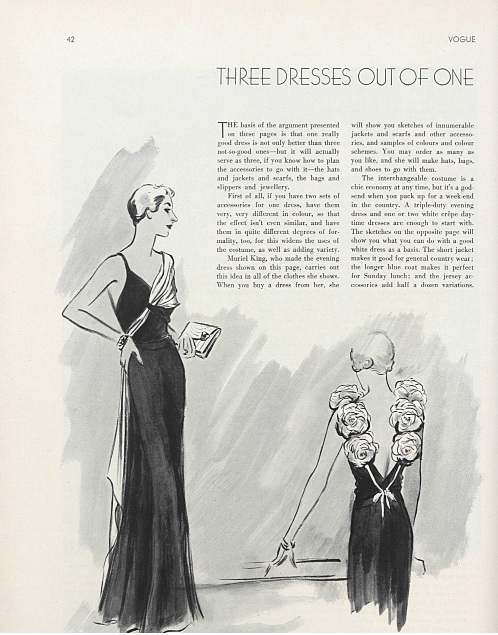
This approach to fashion design was right for its time, Kings dresses were by no means inexpensive, yet during these years of great economic hardship women flocked to her for the versatility of the clothes and their long-lasting chic. As this article in Vogue from 1932 states:

        Muriel King who made the evening dress shown on this page, carries out this idea in all   the clothes she shows. When you buy a dress from she will show you sketches of innumerable jackets and scarfs and other accessories, and samples of colours and colour schemes. You may order as many as you like, and she will make hats, bags, and shoes to go with them.

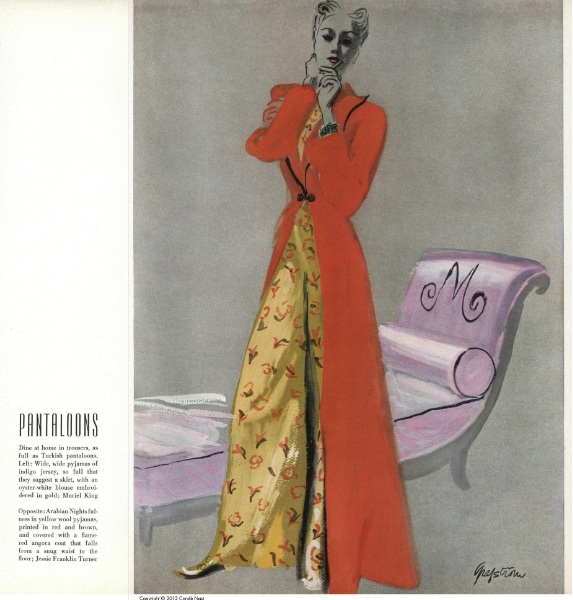
King lacked formal training in fashion design, which is quite surprising when studying her exquisitely crafted garments. Instead of draping or cutting like some designers, King beautifully illustrated in watercolor, the designs were then interpreted by her team into pattern and cut.

Day jacket, wool flannel with passementerie trim and metal buttons, 1935, USA. Gift of Muriel King. MFIT

Day jacket, wool flannel with passementerie trim and metal buttons, 1935, USA. Gift of Muriel King. The Museum at FIT

Evening Ensemble, c.1935. The Museum at FIT, 76.20.2

According to the Museum at FIT this jacket and skirt are “made from a simple striped fabric that King had cut and reassembled at a 45 degree angle. This technique, known as “mitering,” was popular with leading couturiers. This and other examples that exist at the Museum at FIT are complex in construction and are masterfully executed, despite the fact that King did not have formal knowledge in pattern making or that she did not drape or sew.

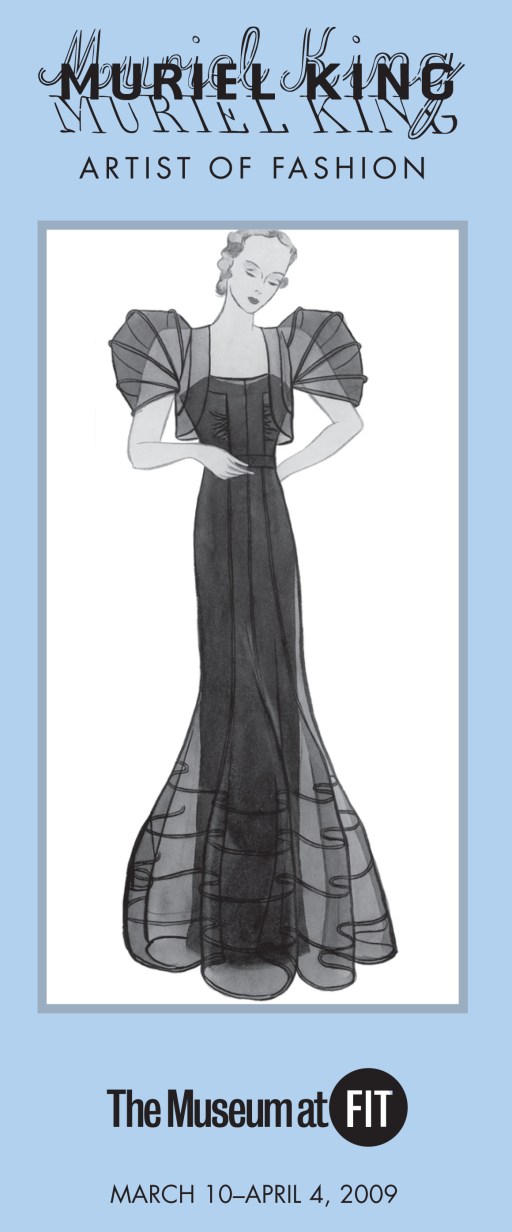
In 2009 the graduate students of this program, in collaboration with the Museum at FIT, curated the first exhibition to solely focus on King’s work and life. The exhibition featured garments from the museum’s permanent collection along side King’s beautiful illustrations which are housed the Gladys Marcus Library’s Special Collections and FIT Archives.

Lucille Ball in Stage Door (1937)Costume design by Muriel King. Source: classicfilmheroines.tumblr.com

Lucille Ball in Stage Door (1937)
Costume design by Muriel King. Source: classicfilmheroines.tumblr.com

Layout 1

A similar design to that worn by Lucile Ball on the cover of the brochure of the exhibition Muriel King: Artist of Fashion. Ilustration by Muriel King from Muriel King Archive, Special Collections, Gladys Marcus Library at FIT.

In the 1940s King left New York and moved to Hollywood where she created costumes for film. Until her retirement in the 1950s she continued to design lines for various department stores. The last two decades of her life were dedicated to painting, although she became famous as a fashion designer she always saw herself as an artist.

Vogue October 15, 1937.

Vogue. October 15, 1937.

Sources:

Calahan, April. Muriel King: The Artist of Fashion, exhibition catalog

The Museum at FIT, collections database

Vogue Archives


Posted in Uncategorized | 10 Comments