2012 in review

The WordPress.com stats helper monkeys prepared a 2012 annual report for this blog.

Here’s an excerpt:

19,000 people fit into the new Barclays Center to see Jay-Z perform. This blog was viewed about 59,000 times in 2012. If it were a concert at the Barclays Center, it would take about 3 sold-out performances for that many people to see it.

Click here to see the complete report.

Posted in Uncategorized | Leave a comment

Mystery Monday

A new year, a new you?

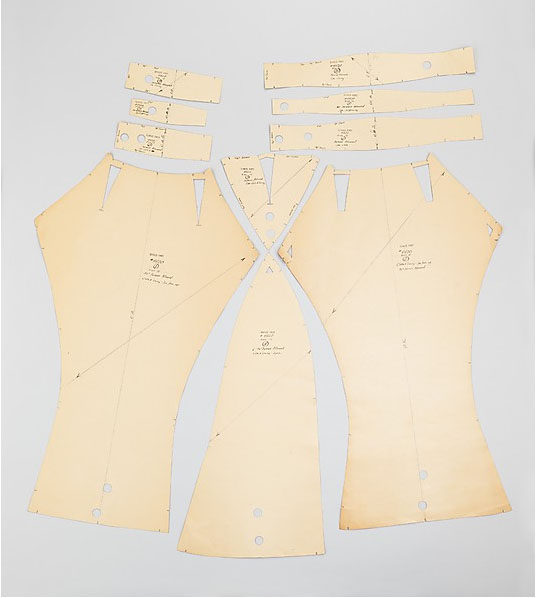
As you think about the upcoming year, are you planning to learn a new skill or to break a behavioral pattern?  While you draft your goals, take a moment to marvel at this skillful pattern design, this elegant evolution of the basic skirt:

patternWho created this skirt pattern?

Think you know? Submit your guess below; we’ll tell you all about its designer on Thursday!

Posted in Mystery Mondays | Tagged | 4 Comments

Mystery Monday: The Gazette du Bon Ton and Georges Doeuillet

Marty, Andre-Edouard. "Les Deux Nigauds -- Robe de reveillon de Doeuillet", 1914. Plate VII from Gazette du Bon Ton, Volume 2, No. 1, Christmas 1913 - Janary 1914. From the Minneapolis College of Art and Design, Accession number 1758

Marty, André-Edouard. “Les Deux Nigauds – Robe de réveillon de Doeuillet”, 1914. Lithograph with hand-applied color, 25.4 cm x 19.1 cm. Plate VII from the Gazette du Bon Ton, Volume 2, Number 1, Christmas 1913 – January 1914. From the Minneapolis College of Art and Design, accession number 17581. Copyright 2008 Artists Rights Society.

The publication? Gazette du Bon Ton
The designer? Georges Doeuillet

The illustrations of the Gazette du Bon Ton, a French fashion magazine, are classic examples of the Art Deco style of illustration. With wonderous scenes filled with Biblical and mythical characters and the most modern of interiors, these illustrations captured the fanciful mood of fashion in the 1910s and 1920s.

Our mystery image is an illustration by André Édouard Marty, an artist best known for his work during this period. His bold use of lines and saturated color are signature characteristics of his photomechanical lithographs with hand-applied color, best known as pochoir. These techniques effectively display the modern concept of Doeuillet’s couture creations but the illustrations belie the intricacy and delicate details of Doeuillet’s designs. Marty’s vibrant but flat illustrations all but erase Doueillet’s masterful use of fabric, the subtle draping of his dresses, and his elegant use of netting at the neckline and sleeve’s edge.

Doeuillet began his career as a silk merchant. As a designer, his masterful understanding of fabric allowed him to create dramatic silhouettes, which he punctuated with jeweled ornaments at the waist and hem to create a tactile combination of smooth silk and cold metal, glass and stone. Here is an example of one of Doeuillet’s designs complete with a pair of detailed dress ornaments:

Doeuillet, Georges. Evening dress with black net, blue satin and taffeta moiré and ornamentation, 1910 - 1913. Copyright the Metropolitan Museum of Art.

Doeuillet, Georges. Evening dress with black net, blue satin and taffeta moiré and ornamentation, 1910 – 1913. Copyright the Metropolitan Museum of Art.

Doeuillet, Georges. Evening dress with black net, blue satin and taffeta moiré and ornamentation, 1910 - 1913. Copyright the Metropolitan Museum of Art.

Doeuillet, Georges. Evening dress with black net, blue satin and taffeta moiré and ornamentation, 1910 – 1913. Copyright the Metropolitan Museum of Art.

In addition to the illustration of kissing fools under the mistletoe, this volume of Gazette du Bon Ton contained a fanciful series of Christmas themed fashion plates by other talented artists including Ludwik Strimpl, Javier Francisco Gose, Paul Méras, and Charles Martin.

Strimpl, Ludwik. "L'Encens, le cinname et la myrrhe – Robes du soir", 1913. Lithograph with hand-applied color, 25 cm x 38.5 cm. Plate I from Gazette du Bon Ton, Volume 2, Number 1. From the Minneapolis College of Art and Design, accession number 17582.

Strimpl, Ludwik. “L’Encens, le cinname et la myrrhe – Robes du soir”, 1913. Lithograph with hand-applied color, 25 cm x 38.5 cm. Plate I from the Gazette du Bon Ton, Volume 2, Number 1, Christmas 1913 – January 1914. From the Minneapolis College of Art and Design, accession number 17582.

Evening Dress from an unidentified designer, 1916 - 1918. Net and taffeta, brocaded with silks, and trimmed with gilt lace. From The Victoria and Albert Museum, accession number T.165-1960.

Evening Dress from an unidentified designer, 1916 – 1918. Net and taffeta, brocaded with silks, and trimmed with gilt lace. From The Victoria and Albert Museum, accession number T.165-1960.

This illustration employs rich colors and an imaginary, exotic location to emphasize the dramatic dresses and accessories in vogue during this period. Designers like Paul Poiret found inspiration in the luxurious silks, feathers and trims, choosing to complete their elegantly draped creations with turbans, capes and dramatic head pieces. According The Victoria and Albert Museum, this dramatic style of illustration was characteristic of other artists whose illustrations appeared in the Gazette du Bon Ton, including Georges Lepape and Charles Martin, seen below:

Martin, Charles. "L'Abre Merveilleux - Costume d'enfant pour Noel", 1914. Lithograph with hand-applied color, 25.4 cm x 19.1 cm. Plate III from Gazette du Bon Ton, Volume 2, Number 1, Christmas 1913 – January 1914. From the Minneapolis College of Art and Design, accession number 17555.

Martin, Charles. “L’Abre Merveilleux – Costume d’enfant pour Noel”, 1914. Lithograph with hand-applied color, 25.4 cm x 19.1 cm. Plate III from the Gazette du Bon Ton, Volume 2, Number 1, Christmas 1913 – January 1914. From the Minneapolis College of Art and Design, accession number 17555.

Gose, Javier Francisco. "Les Préparatifs de Noel – Robes d'après-midi de Redfern", 1914. Lithograph with hand-applied color, 25.4 cm x 19.1 cm. Plate IV from Gazette du Bon Ton, Volume 2, Number 1, Christmas 1913 – January 1914. From the Minneapolis College of Art and Design, accession number 17577.

Gose, Javier Francisco. “Les Préparatifs de Noel – Robes d’après-midi de Redfern”, 1914. Lithograph with hand-applied color, 25.4 cm x 19.1 cm. Plate IV from the Gazette du Bon Ton, Volume 2, Number 1, Christmas 1913 – January 1914. From the Minneapolis College of Art and Design, accession number 17577.

As you celebrate with family and friends this season, we at On Pins and Needles wish you happiness and good cheer. Mystery Monday will return on January 31, just in time to celebrate the arrival of the coming year.

Joyeux Noël! Joyeuses fêtes!

Posted in Mystery Mondays | Tagged , , , | Leave a comment

Mystery Monday

The end of the semester has arrived, allowing us to trade our thinking caps for party hats without any sense of guilt or irresponsibility!

Those of us who celebrate Chanukah
have already traded our microscopes for the menorah,
and sleepless nights for The Festival of Lights. But for some of us….

It’s the week before Christmas and all through the Goodman Center,
we have traded textile analysis for tinsel,
erudition for egg nog,
supplementary readings for sacred hymns,
thread count for gingerbread,
time logs for Yule logs,
and PowerPoint for that perfect party dress.

With presentations applauded and final papers printed and submitted,
We’ve traded frantic evenings typing on our Macs
for midnight snacks of cookies and milk;
we’re now discussing the past and presents instead of fragments of silk.
We traded SharePoint for evenings shared with family and friends,
and readings of Emery, Watson, and Hollander
for poems citing Prancer, Dancer and Donder.

In the spirit of celebration, here is the latest mystery:

MMChristmas

From what publication is this clever illustration?
Who designed the featured dress?

Do you know the answer? Submit your guess below; we’ll tell you all about this illustration on Thursday!

Posted in Mystery Mondays | Tagged | Leave a comment

Mystery Monday: Pliny the Elder’s Natural History

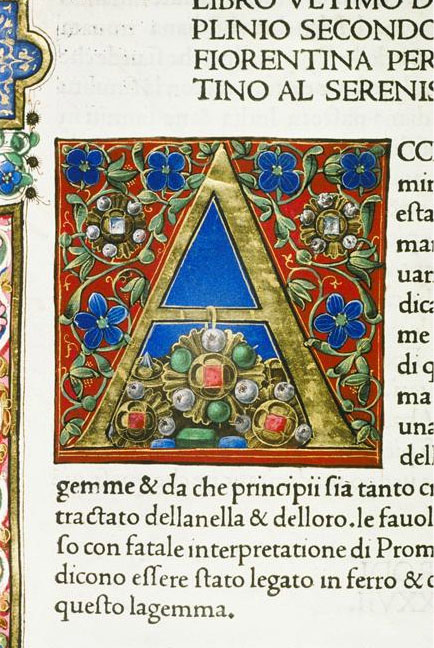
Book XXXVII

Book XXXVII of Pliny the Elder’s Natural History, text completed in 1476 and illuminations completed c1480 in Venice. Printed on vellum, 414 x 280 mm. This is a translation by Cristoforo Landino of the original text into lingua fiorentina. Copyright Bodleian Library, University of Oxford.

In Natural History, first published around 77-80 CE, Pliny the Elder identifies the origin of sericulture as the strange and distant Land of the Seres. Pliny is only one of many western writers who held this opinion:

“Virgil’s Georgics reports enigmatically that the Seres ‘comb off’ a fine down from the leaves of Ethiopian trees, while Pliny attributes the same process in his Natural History to a remote, wild, and savage people known as the Seres who reside vaguely beyond the distant desert lands of the Scythians. Ovid ascribes to these distant people a swarthy complexion (colorati), and the Greek geographer Pausanias writing in the second century reiterates prior claims that the Seres are an Ethiopian race while also noting that they have been called Scythians crossed with Indians…. Ptolemy locates the region of the Seres imprecisely above ‘Sinae,’ claiming that both the Seres and the Sinae constitute the easternmost people of the inhabited world, and further detailing the Seres as occupying unknown lands at the edge of the earth” (7-8).

Approximate extent of Scythia and the Scythian languages (orange) in the 1st century BC. Found online at thefreedictionary.com

Approximate extent of Scythia and the Scythian languages (orange) in the 1st century BC. Found online at thefreedictionary.com

Pliny believed that silk had a corrupting influence on society; he believed that it introduced a wild, unrestrained element into Roman culture. “Trade with this unknown land of the Seres located on the eastern edge of the world generated for Pliny the image of textile production through which Roman women might clothe other Roman women in flimsy fabric as dangerous to ‘civilization’ as wild animals might be. ‘The Seres,’ though ‘mild in character,’ Pliny avers, ‘resemble wild animals, since they shun the remainder of mankind, and wait for trade to come to them'” (9).

So, what did the Chinese believe about this mythical land of the Seres? Legend holds that it was an equally wild place – a land ruled by women who practiced human sacrifice, a land devoid of the knowledge of silk production.

“From the other side of the Chinese border, a counter myth proliferates concerning an equally strange and unknown region, located somewhere south of the capital of neighboring Khotan and south of the Pamir Mountains, seemingly on the route westward from the ‘Land of the Seres.’ Recorded in a seventh-century Chinese dynastic history known as the Beishi, this odd region is not a land of silk but a kingdom governed by women in which the men, devoted solely to military affairs, are ruled by a principal queen and a surrogate queen. Characterized as practicing human sacrifice to forest divinities, the long-hair inhabitants of the ‘land of women’ wear leather shoes and enjoy hunting…. The category of the ‘unknown,’ associated in early Greco-Roman accounts with distant foreigners who make mysterious silk, shifts the Chinese account to an equally mysterious province of women” (8).

The beautiful silk thread and textiles held great mystery for ancient writers. Their lack of understanding of sericulture led to curious legends of a wild, exotic locale, a degraded place at the very edge of the known world. It is curious that these ancient historians believed that fine quality silk fabrics could be produced in such a primitive culture.

How I would love to ask the Scythian Chieftain about this legendary Land of the Seres!

All quotes from the following text:
Burns, E. Jane. Sea of Silk: A Textile Geography of Women’s Work in Medieval French
Literature. Philadelphia : University of Pennsylvania Press, 2009.
Posted in Mystery Mondays | Tagged | Leave a comment

Mystery Monday

A is for answer and Q is for question:

mmThis is a page from a frequently referenced historical work. Within it, the author describes the origins of silk in a mysterious and distant land.

Who authored this text?
To what land and people group does he attribute the secrets of silk production? 

Do you know the answer? Submit your guess below; we’ll tell you all about this mystery on Thursday!

Posted in Mystery Mondays | Tagged | 2 Comments

Fashionista Friday – the Capel Sisters

Fashionista Friday – the Capel Sisters

Sisters Capel

Sir Peter Lely, Mary Capel (1630-1715), Later Duchess of Beaufort, and Her Sister Elizabeth (1633-1678), Countess of Carnarvon, oil on canvas, Metropolitan Museum of Art.

The Countess of Carnarvon is so fashion-forward she has an iPad…

I kid!

But the sisters Capel certainly do look picture-perfect in this mid-seventeenth century portrait, don’t they?  On the left, Mary Capel, later the Duchess of Beaufort, wears a chocolate-brown satin gown over a white shift with voluminous sleeves.  On the right, Elizabeth Capel, later the Countess of Carverdon, wears a similar dress in a gold hue.  Both are draped in additional yardages of silk.  Their hair is pulled back on top with curls falling to their shoulders, a look in vogue at the time.  Very little adornment is worn, save for a single pearl choker on Mary.

Both women are dressed in the height of fashion—but it is an invented fashion for portraiture.  In the second part of the century, this mode of deshabille in portraiture stemmed partly from a Restoration ideal of women’s sensuality.  The breast was the premier erogenous zone of the time: note the low bodice and wide-set shoulder straps that show off their chests.  Their red lips and flushed cheeks are additional symbols of sensuality.  This deliberate look of undress emphasized the softness, femininity, and therefore, power, of the Capel sisters.

For reference, here is a typical dress from circa 1660.  Note the wide neckline but a more modest coverage of the bosom.

silver tissue-8_v_Variation_1

Silver tissue dress, ca. 1660, silver tissue trimmed with cream parchment lace, Fashion Museum of Bath.

In the beginning of this fashion, most ladies chose to be painted in a dressing gown unsuitable for public wear but cleverly decorated with closures down the bodice front.

477px-Elizabeth_Capell,_Countess_of_Carnarvon_by_Peter_Lely

Sir Peter Lely, Elizabeth Capel, Countess of Carnarvon.

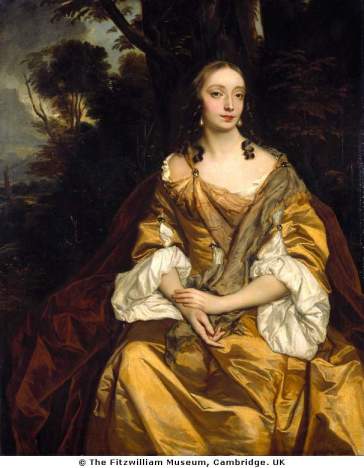
Swags draped across the body reminiscent of Classical looks were also popular.
lely_parsons_large

Sir Peter Lely, Portrait of a Lady, ca. 1665. oil on canvas,
Fitzwilliam Museum, Cambridge.

Sometimes the “gowns” worn were nothing more than fabric carefully pinned to imitate a real dress, as on the portrait of Queen Mary II by Peter Lely.

NPG 6214; Queen Mary II by Sir Peter Lely

Sir Peter Lely, Queen Mary II, 1677, oil on canvas, National Portrait Gallery.

As the trend continued, the look became more and risqué.
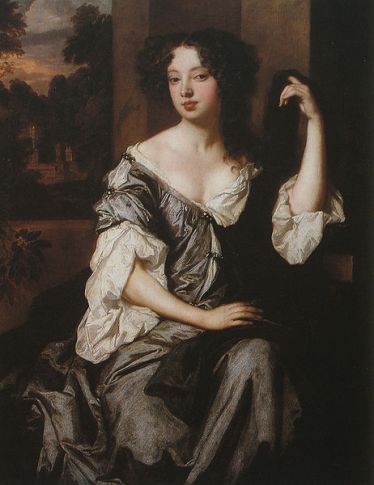
Louise_Querouaille_1671_Peter_Lely

Sir Peter Lely, Louise de Kerouelle, ca. 1671.

Until finally those false dresses couldn’t hold themselves up any longer and fell off the shoulders.
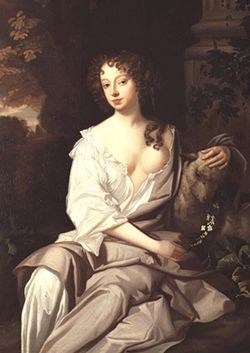
105035_003

Sir Peter Lely, Eleanor Gwyne, ca. 1670.

Clearly, respectable women didn’t walk around half-naked.  There was a distinction between formal and intimate wear, and it was truly a mark of prestige to have a portrait taken in so private a manner.

But what of that iPad-looking thing?
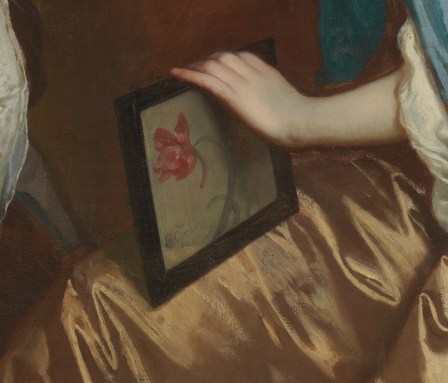
 DP169633a

It seems like the sisters were noticed for their accomplishments as well as their beauty, power, and sensuality.  Mary points to a sprig of greens; she was an avid botanist.  Elizabeth, an artist, holds up one of her own paintings, a study of a tulip, with her name signed under a coronet.  One of her works still exists today, a still life in the Royal Collection.

Resources
Baetjer, Katharine. “British Portraits: In The Metropolitan Museum of Art.” The Metropolitan Museum of Art Bulletin, v. 57, no. 1 (Summer, 1999).
Ribeiro, Aileen.  The Gallery of Fashion.  Princeton, NJ: Princeton University Press, 2000.
“Sir Peter Lely (Pieter van der Faes): Mary Capel (1630-1715), Later Duchess of Beaufort, and Her Sister Elizabeth (1633-1678), Countess of Carnarvon (39.65.3)”. In Heilbrunn Timeline of Art History. New York: The Metropolitan Museum of Art, 2000–. http://www.metmuseum.org/toah/works-of-art/39.65.3 (October 2006) (accessed December 6, 2012).
Posted in Fashionista Friday | Tagged , , , | Leave a comment

Mystery Monday: The Oorijzer

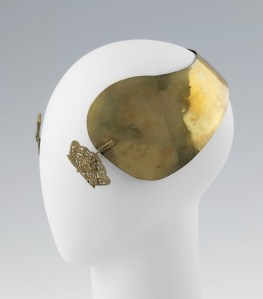
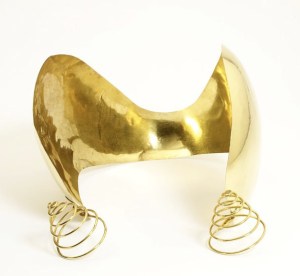
Brass ear iron, fourth quarter of the Nineteenth Century. Copyright the Metropolitan Museum of Art.

Brass ear iron, fourth quarter of the nineteenth century. Copyright the Metropolitan Museum of Art.

Yes, this headdress is called an oorijzer, Dutch for “ear iron”.

The Oorijzer is unique to the Netherlands and is an important element of national costume and tradition. It began a as humble accessory, a type of peasant jewelry worn by the women in northern Netherlands in an area called Friesland. First created to secure expensive lace skullcaps from the gusts of strong sea winds, the simple iron band developed into an ornate headdress, serving to displaying family wealth in the form of precious metals and detailed filigree.

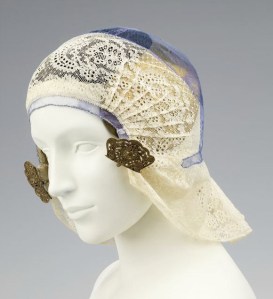
According to The Metropolitan Museum of Art, “the shape and style of the ornaments were indicative of their status, their husband’s or son’s profession, their locality, or even their religion. This example, also pictured with the traditional lace cap is made of brass, as opposed to the more expensive silver or gold.”

The same brass Ear Iron with a typical Skullcap. Copyright The Metropolitan Museum of Art.

The same brass ear iron with a typical Skullcap. Copyright The Metropolitan Museum of Art.

According The Victoria and Albert Museum, the Netherlands isolated location contributed to the development of the oorijzer, which varies in shape and size according to region.

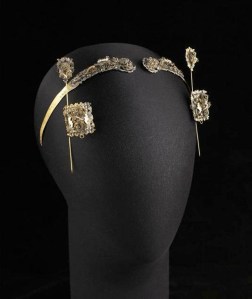
Gold filigree ear iron, mid eighteenth century.

Gold filigree ear iron with three sets of earrings (one shown), mid-eighteenth century. Attributed to van Loenen. Copyright the Victoria and Albert Museum.

“This oorijzer, and its accessories, are typical of Zeeland. The decorative spirals on the ends of the oorijzer are called krullen, and were often the only part which was visible when worn. They were used as a base from which to hang pairs of bellen, which hung down like earrings, either side of the face.”

eariron2caption

Eighteen-carat gold ear iron, fourth quarter of the nineteenth century. Copyright the Metropolitan Museum of Art.

caption3

Silver ear iron, fourth quarter of the nineteen century. Copyright The Metropolitan Museum of Art.

caption 5

Eighteen-karat gold ear iron ornaments, first half of the nineteenth century. Copyright The Metropolitan Museum of Art.

It can be difficult to spot an oorijzer in a Dutch painting, as many women wore multiple lace caps, obscuring whatever metal was once visible. To view a collection of illustrations, paintings and photographs featuring the oorijzer, please visit Folk Costume & Embroidery. This blog post features many helpful images of the traditional Friesland costume, which includes an unusually large ear iron.

What I find most striking about the ear iron is not its practicality or the beautifully intricate bellen, but the wonderful juxtaposition of the oorijzer and the detailed lace skullcap. The soft draping and skilled handwork of the lace provides a wonderful warmth to the hard, metallic surface of the ear iron, which appears subtly through the sheerest parts of the lace. While modest and practical, the ear iron and lace cap have an alluring quality found in the study of contrasts, which is an important element to both traditional and modern design.

Resources:
1. Newman, Harold. An Illustrated Dictionary of Jewelry. London: Thames and Hudson, 1987.
2. Online Collections Database, The Metropolitan Museum of Art (accessed through Artstor)
3. Online Collections Database, The Victoria and Albert Museum
2. Snowden, James. The Folk Dress of Europe. New York: Mayflower Books, 1979.
Posted in Mystery Mondays | Tagged , | 2 Comments

Fashion and Technology at the MFIT

Ariele Elia, graduate of our program and contributor to this blog, co-curated along side Emma McClendon, the recent exhibition Fashion and Technology at the MFIT History Gallery. The exhibition opened on December 4 and will run through May 8, 2013.

Jean Paul Gaultier, jumpsuit, multicolored nylon and spandex with Op-Art cyber graphic print, 1996, France, museum purchase.

Jean Paul Gaultier, jumpsuit, multicolored nylon and spandex with Op-Art cyber graphic print, 1996, France, museum purchase.

Here is the curators’ write up for the exhibition:

Fashion and Technology examines how, throughout history, fashion has engaged with technological advancement and been altered by it. Time and again, fashion’s dynamic relationship with technology has both expanded its aesthetic vocabulary and streamlined its means of production.

In recent years, designers have made technology a focal point of their collections, but as early as the mid-18th century, technological advancements were shaping fashion design and fabrication. The development of aniline dyes, the sewing machine, synthetic fibers, and zippers have all sent fashion in new directions. More recently, so have wireless circuitry and the creation of fashion design software. Technologies outside of the fashion industry also contribute to change within it. These include global transportation, the internet, blogging, online retailing, and the increased speed of global communication through digital platforms and social-media outlets.

The goal of this exhibition is to analyze the impact of technologies on the nature of fashion and its design, and to question whether these developments push the industry forward or ultimately set it back.

Fashion and Technology begins with a display of examples from the 18th and 19th centuries, such as a 1780s suit made with a machine-knit textile, and an 1860s dress produced using synthetic dyes. From there, it showcases prominent developments from different time periods, travelling chronologically all the way to the present day.

Pierre Cardin, dress, fuchsia “Cardine” textile with molded 3D shapes, 1968, USA, gift of Lauren Bacall.

Pierre Cardin, dress, fuchsia “Cardine” textile with molded 3D shapes, 1968, USA, gift of Lauren Bacall.

The exhibition features objects exclusively from The Museum at FIT’s costume collection alongside a selection of textiles and accessories that highlight the multifaceted nature of technological developments. The use of video monitors and computers will enhance the exhibition, offering the opportunity to showcase works by small, cutting-edge design teams, such as the Dutch label Freedom of Creation, alongside pieces by fashion icons such as Elsa Schiaparelli, André Courrèges, Issey Miyake, and Nicholas Ghesquière for Balenciaga.”

And here is some of the press coverage they received: Style.comW Magazine Craveable, and Cool Hunting

We are SO so proud!

Posted in Exhibition | Tagged , , | Leave a comment

Mystery Monday

Monday has arrived, and so has another mystery:

MM

What is the name of this headpiece?
Is it purely decorative? If not, what is its purpose?

Think you know? Submit your guesses and we’ll reveal the answer on Thursday!

Posted in Mystery Mondays | Tagged | Leave a comment