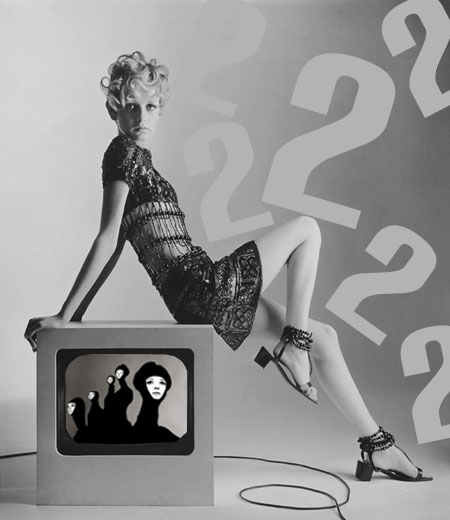
To celebrate our second birthday we are giving away two original vintage covers of Vogue and/or Harper’s Bazaar toone lucky reader.
To enter, go to our Facebook page (link on the right), like us and tell us what is your favorite fashion book. It can be fiction, biography, autobiography, or any other genre- as long as it relates to fashion or fashion-makers, or teaches us something on the fashion of its time.
One lucky winner will be selected randomly and will be announced September 15. We welcome more than one entry per person.
After the winner is announced the complete list of all entries will be posted here on the blog and will remain a resource for all fashion-lovers out there!
If you are not on facebook just send your entry through our Contact Us.
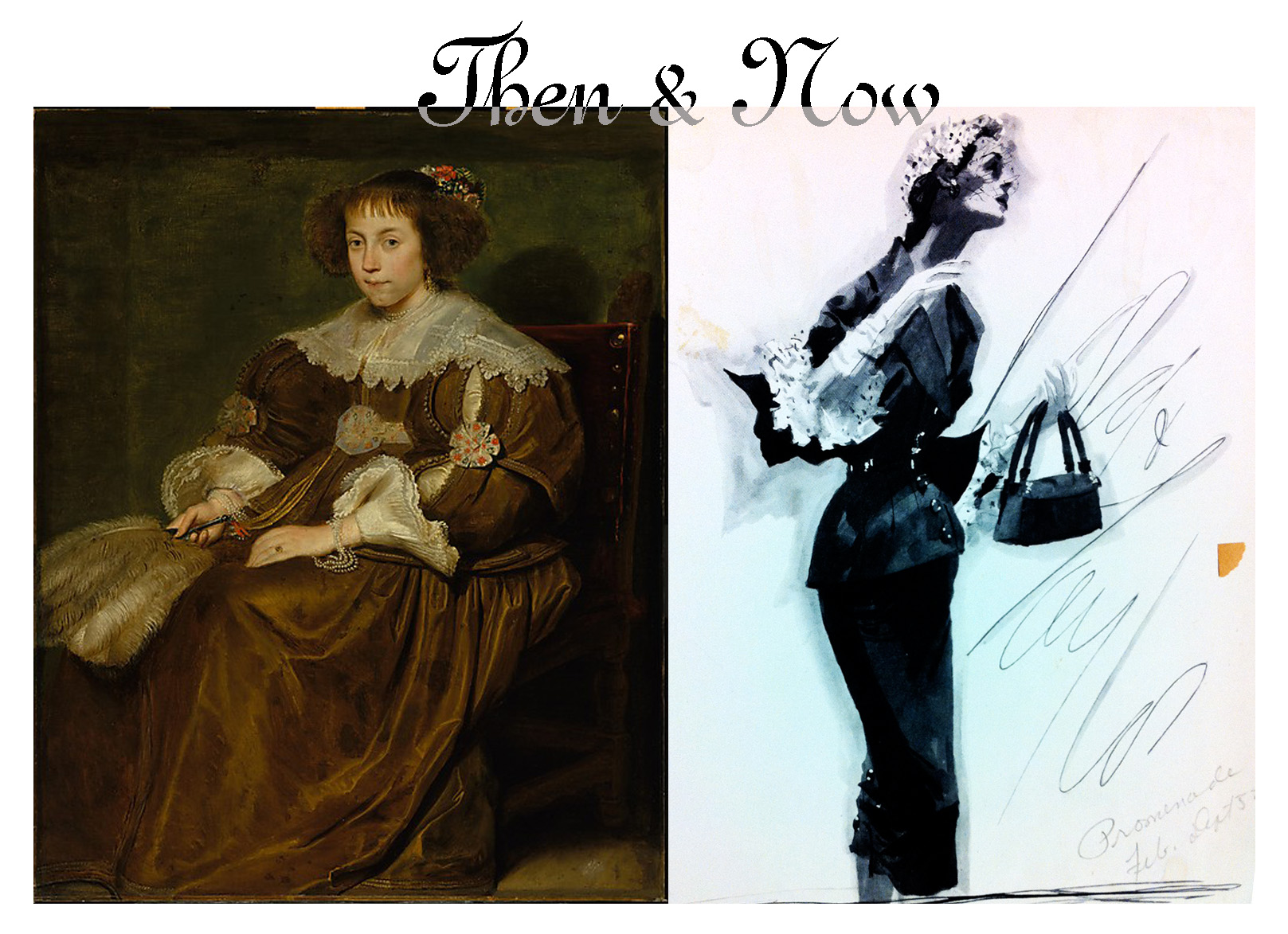
(left) Cornelis de Vos (Flemish, Hulst 1584/85–1651 Antwerp), Portrait of a Young Woman, Oil on canvas. The Metropolitan Museum of Art. Accession Number: 71.46. (right) Jacques Fath (Designed in America for Joseph Halpert), Lord & Taylor ad, published September 1952. Special Collections and FIT Archives.
In the previous part I and part II, I suggested some explanations to why the broad shoulders associated with the 1940s made a come back in the 1980s. I was curious to understand if the influence of war years on the style of the earlier decade was also reflected in the later one,I found that by the 1980s elements of military attire- such as D rings, camouflage patterns, cargo pockets and of course the trench coat- were inseparable part of sportswear design, typically with little to no trace of the original function. The fashion designers who created the quintessential 1980s look were post-modernists- they juxtaposed seemingly disparate notions and mixed inspiration from several sources.
This third and last part will examine men’s fashion from the same period in order to find if the design of their clothes was influenced by the same trends, and to what extent men’s wear designers too, looked at the 1940s and military attire for inspiration.
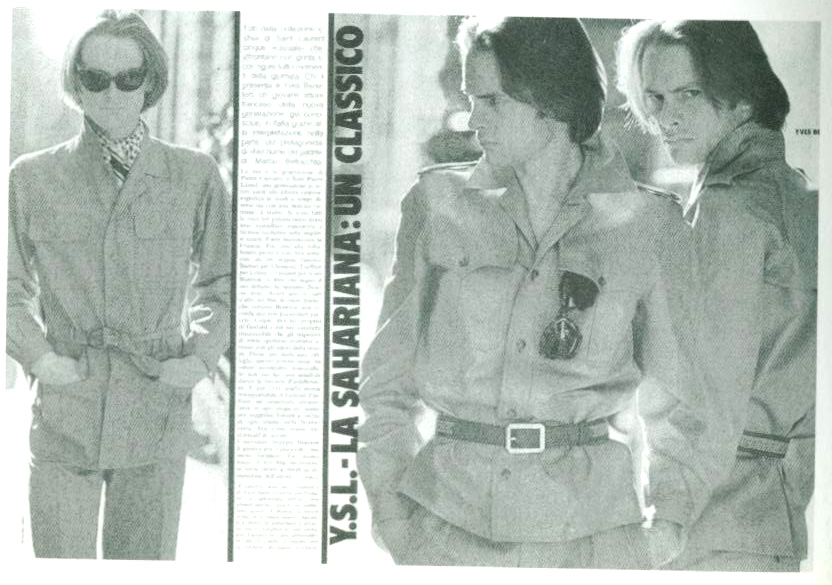
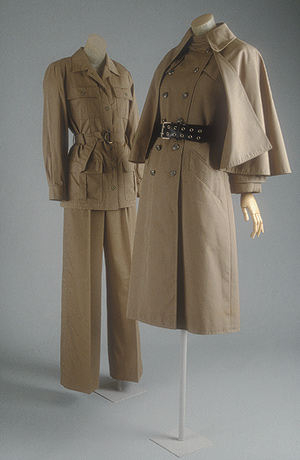
Last week I discussed Saint Laurent’s women’s collections of the early 1970s which already feature the1980s characteristic- broad shoulders. However, Saint Laurent’smen’s wear silhouettes of the same period are still slim and narrow at the shoulders. Yet, it is interesting to note a clear military influence in both his men’s and women’s lines. Two examples from L’Uomo Vogue illustrate how Saint Laurent appropriated elements from Colonial khaki uniforms in his men’s sportswear; these examples directly correspond with Saint Laurent’s Safari suits for women, and demonstrates how the designer projected one vision for both men and women- another new and innovative concept at that time.
“By Saint Laurent”, in L’Uomo Vogue, n. 18, July 1972, p.93. Photo Oliviero Toscani. Scanned from the book Uniform:Order and Disorder [Milano: Charta, c2000]
“YSL- La Shariana: un classico,” in L’Uomo Vogue, n.29, April 1974, p.197. Photo Richard Imrie, scanned from the book Uniform: Order and Disorder [Milano: Charta, c2000], 338.
Women’s Pantsuit, spring/summer 1970 Designed by Yves Saint Laurent. The Metropolitan Museum of Art. Gift of Barbara and Gregory Reynolds, 1984 (1984.598.96a–c)
The origin of broad shoulders in women’s fashion in both the 1940s and the 1980s can be traced back to men’s wear, and specifically to men’s army attire. Women of both decades experienced significant changes in their social roles- in the 1940s positions that were previously occupied by men, were-with the onset of war- open to women; similarly, in the 1980s more and more women occupied executive-level positions which in the past were a men-only club. Some fashion historians believe that women found it was easier to be accepted into the formally men-only professions by implementing traditional men’s tailored style which eliminated any trace of femininity.[1] In his book Uniforms: Why We Are What We Wear, Paul Fussell suggests that male shoulders, as chest hair, is an important masculine sexual characteristic, and therefore “well-developed shoulders are important for male self-respect and pride…..Military emphasis on shoulders thus accentuates the masculinity and presumed bellicosity of uniform wearers.”[2] It is possible that women of both the 1940s and the 1980s stated their new social identity through their new chosen style of dress; by assuming the feature that symbolizes power in male dominated environment- “well developed” shoulders- they signaled their capability to take part in it.
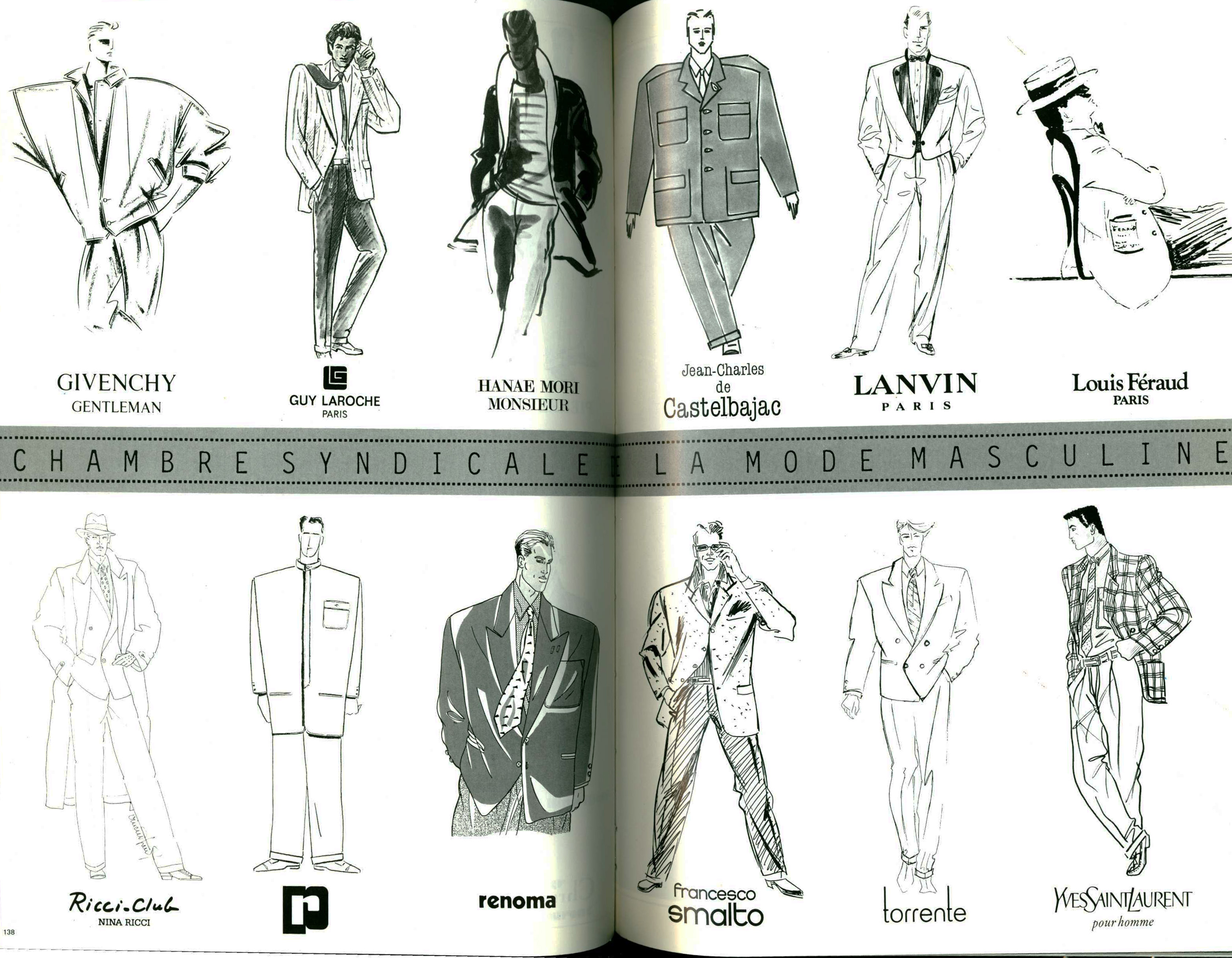
Broad shoulders and soft tailored suits were fashionable during the 1980s and were offered by most major designers for both formal and informal events. Scanned from Vogue Homme September 1986.
Even a quick glance in men’s fashion magazines from the 1980s will reveal that the broad shouldered silhouette prevailed men’s fashion as well. While it is likely that the change of silhouette that occurred in the 1980s in men’s fashion is a mere reflection of the changes in women’s fashion, or rather the answer to it, it is also likely that men’s wear designers did not merely copy women’s fashion, but as part of the 1940s retro trend, chose to examine men’s fashion from the period. On of the most memorable silhouette of the 1940s is of course that of the zoot-suit.
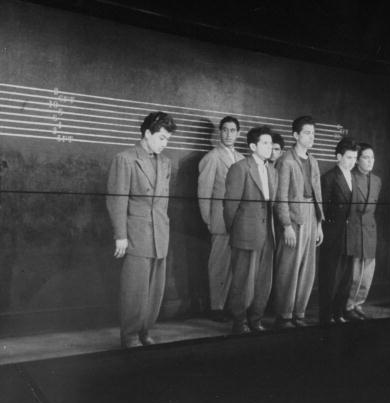
Men in police line up wearing zoot suits. January 01, 1942 photo: Peter Stackpole/Time & Life Pictures/Getty Images
The term zoot-suit originated from the late 1930s’ jazz culture and night life of Harlem and it meant “something worn or performed in an extravagant style, and since many young blacks wore suits with outrageously padded shoulder and trousers that were fiercely tapered at the ankles, the term zoot-suit passed into everyday usage.”[3] The zoot-suiters phenomena started with young blacks and Mexicans, predominantly from a lower social-economic background, who wore knee-length jacket or coat, padded at the shoulders, and pleated-front pants tapered to narrow cuffs. The suits were often made of rayon in bold colors or pinstripes, and were sometimes worn with a bow tie, suspenders and elongated chain dangling down over the pants. In the early 1940s this extravagant and excessive look aroused grievance by those who found this new fashion, which was not in accordance with the strict restrictions and rationing of war time, distasteful if not subversive. But, it is exactly that exaggeration and self adornment that the fashion designers of the 1980s responded to. It was not only the very wide shoulders they adopted, but also the pleated pants and the over-all softer look achieved by draped jackets and pants.
Jerome Mendelson. January 1, 1942. Life Magazine. Photo: Marie Hensen.
In its reincarnation, the zoot-suit was assimilated into an eclectic look that projected the flamboyant and somewhat teasing attitude of the wearer. In the photograph below, published in L’Uomo Vogue in December 1981, a tartan suit with broad shoulders and pegged trousers is paired with army boots, black bow tie, cummerbund. and a patterned shirt evoking zoot-suit, tuxedo suit and the punk movement of the late 1970s- all rolled into one. While the roots of the zoot-suit, with its social context and the ethnic background of its original wearers, is no longer evident in this image it is its rebellious and anti-establishment attitude that endured.
Anthony in Tartan suit. Fashion editorial published in L’Uomo Vogue, December 1981. Photo: Amy Arbus. Scanned from: Jocks and Nerds: Men’s Style in the Twentieth Century. By Richard Martin and Harold Koda [New York: Rizzoli, 1989], 209.
What I find most fascinating and relevant in this photograph are the multi-layers of seemingly contradicting meanings. It is interesting to note that the outfit in the image was not created by one fashion designer, but rather by a stylist or the wearer himself. First, what might seem out of place in this image is the pairing of suit with army boots. Nonetheless, the suit itself is a hybrid between a tuxedo and a zoot-suit, each in turn is a type of uniform- the tuxedo is the uniform for formal events, and the zoot-suit was “more than a drape-shape of the 1940s….it was in the most direct and obvious ways, an emblem of ethnicity and a way of negotiating an identity.”[4] In other words, the individuality of the wearer (in this case Anthony) is achieved by mixing three different uniforms from three different worlds; each holds a distinct and separate meaning.
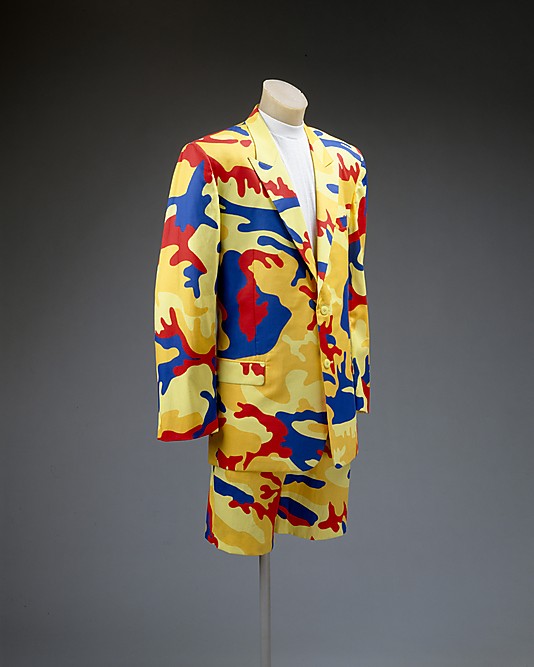
Last week I discussed how functional elements from military uniforms lost their original purpose and became merely decorative. A camouflage printed cotton suit, designed by Stephen Sprouse in 1988, is just one example of how far removed elements “borne out of necessity” have became. Sprouse, who used Andy Warhol’s camouflage print, appropriated bright and contrasting colors that do just the opposite of camouflaging- they make the wearer stand out, announcing his individuality. Sprouse does not print a t-shirt or even a sports jacket, but rather a suit- the symbol of the uniformed man. What is even more interesting in Sprouse’s design is the shape of the suit itself; although paired with shorts, the jacket is surprisingly quite conventional.
Stephen Sprouse, suit, 1988. The Costume Institute at The Metropolitan Museum. Gift of Michael Macko, 1991. Accession Number: 1991.35.1a, b
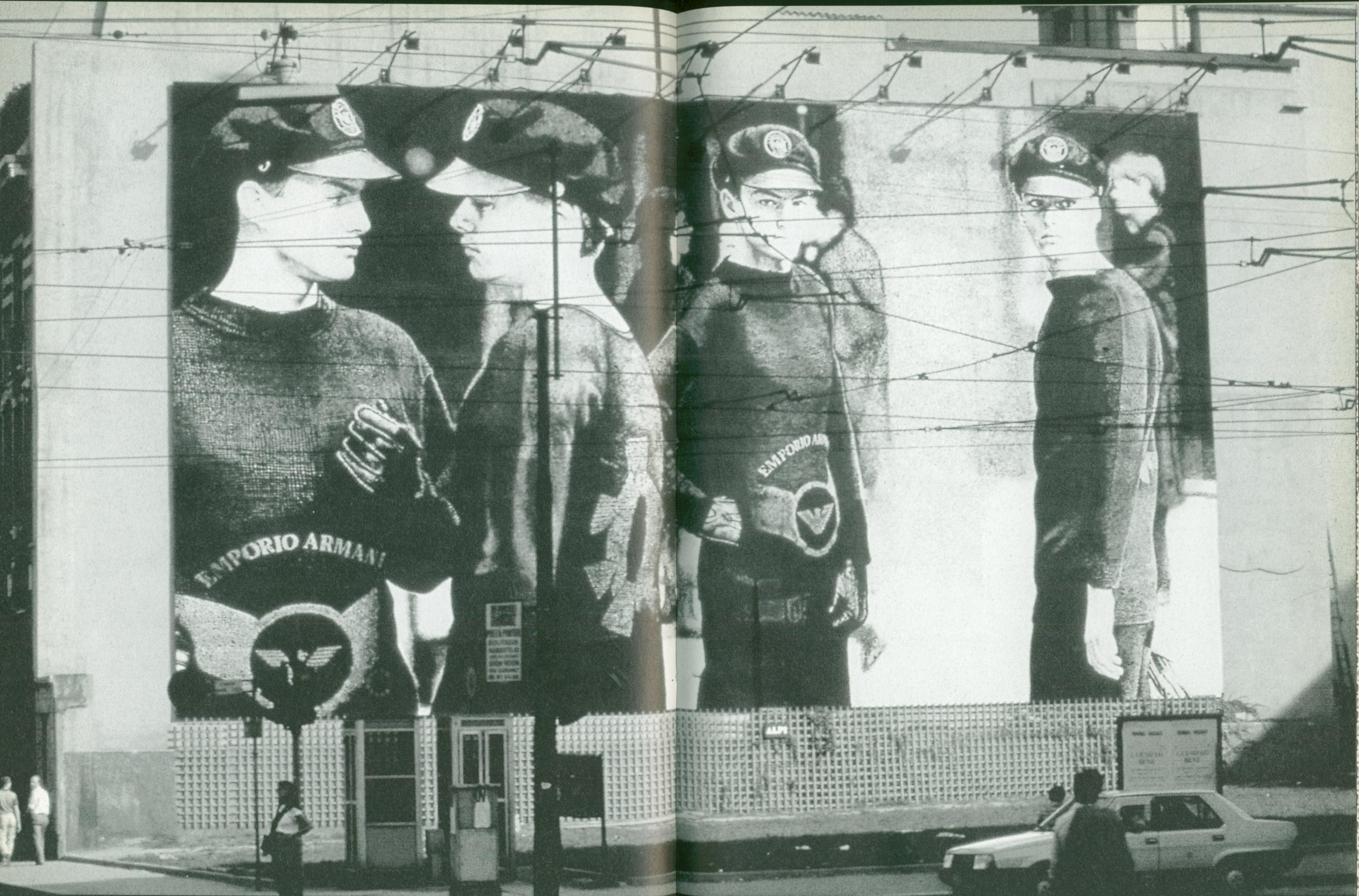
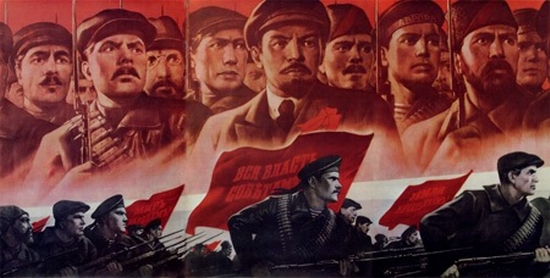
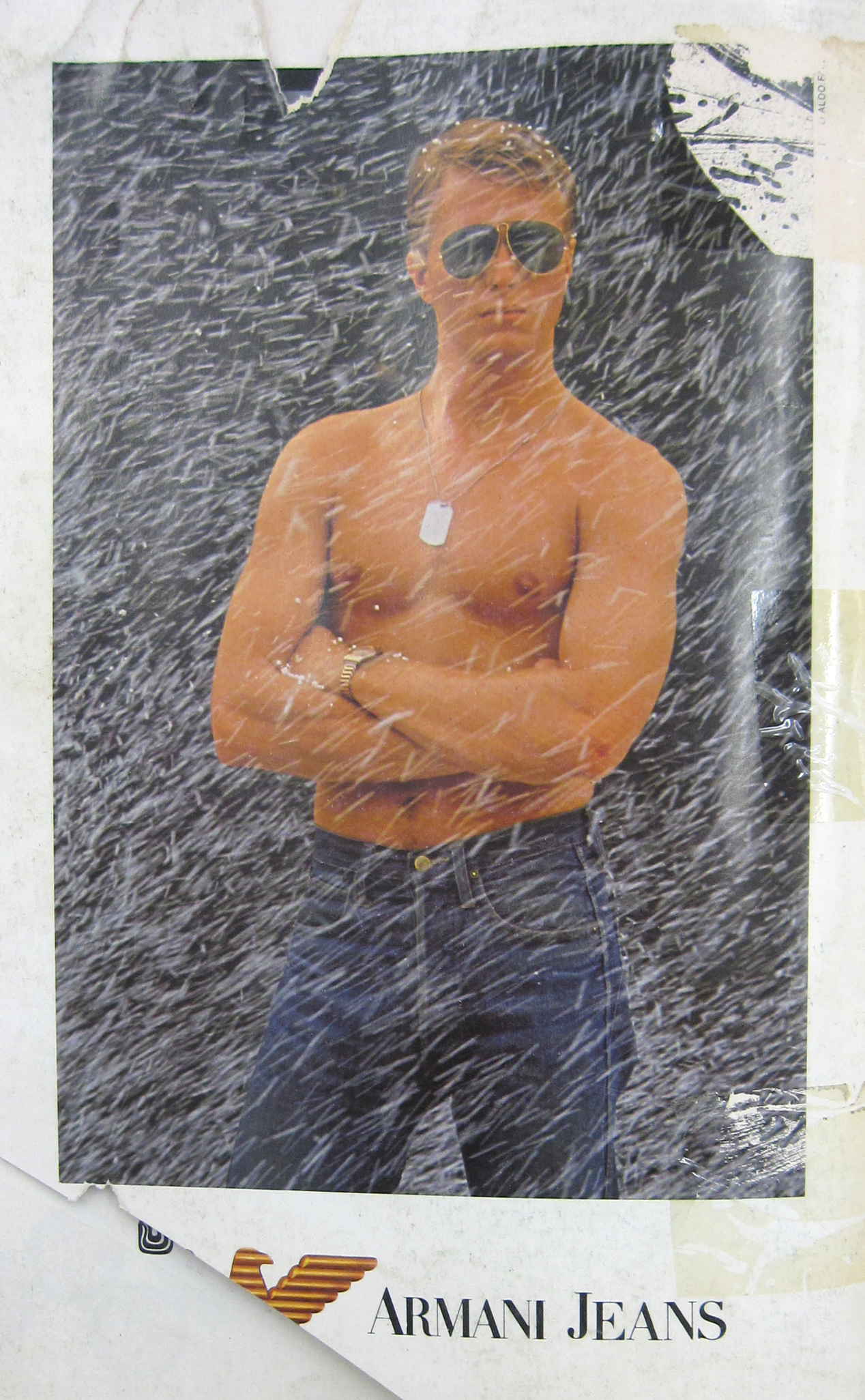
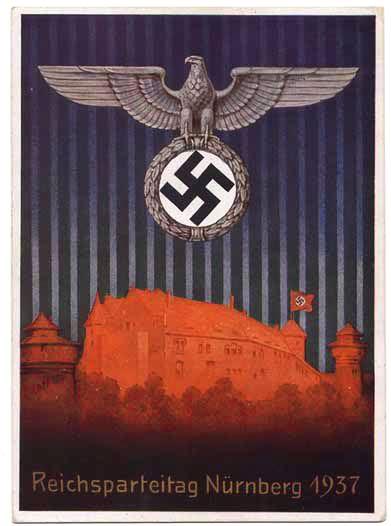
I would like to argue that in addition to design elements – such as camouflage prints, belts, pockets, double stitching – and garments –such as the trench coat, cargo pants, bomber jacket and aviator sunglasses and cap- visual imagery which originated from the military, and specifically World War II, dominated mainstream fashion editorials and advertisements in the 1980s. One example is a billboard advertisement for Emporio Armani Autumn/Winter 1985/1986 collection (figure 11). The pixilated black and white photograph depicts four young men uniformed in matching caps, leather gloves and sweaters printed with the famous Armani eagle logo. The image is set like a snap-shot, slightly out of focus, not all of the models are looking into the camera- they seem to be caught in the action rather than model the clothes. The Armani logo disturbingly resembles Nazi emblems, especially in such a uniformed context. In addition it is the size of the billboard and of course the austere nature of the clothes that evoke Stalinist statues and Soviet icons. Yet the image does not convey power or arouse fear, even to the contrary. It is not the clothes themselves that Armani is selling, but through familiar signs and codes he is offering the idea behind them- that of belonging by way of uniformity.
Emporio Armani billboard, autumn/winter 1985/1986. Scanned from the book Uniform: Order and Disorder [Milano: Charta, c2000], 310-311
Soviet propaganda poster
Advertisement. Vouge Italia, Milano: Edizioni Condè Nast S.p.A September 1982.
Nazi propaganda poster from 1937
Armani’s famous eagle logo
I would like to suggest that like the familiar imagery appropriated in the Emporio Armani advertisement, it is not the essence to which designers and advertisers responded to but rather the image itself. According to scholar Jennifer Craik, in the 1960s “fashion photography, popular music and radical films became bedfellows. Their shared practices rested on subversions and cannibalization. Uniforms and military motifs were perfect sources of appropriate imagery for burgeoning youth culture.”[5] But, much like the garments and design elements that came to dominant the sportswear world, this imagery that originated from military conflicts was diluted by the time it reached fashion magazines and advertisements in the 1980s. Armani is not making a statement or denouncing the acts of his country’s leaders during World War II- he is fabricating an image with which he hopes to appeal to potential consumers, and he uses imagery which, by this time, was already used and reused for two decades. As opposed to Saint Laurent’s Liberation couture collection from 1971, Armani’s imagery is so familiar, it is not longer subversive.
[1] See for example Deirdre Clancy, Costume Since 1945 Couture, Street Style and Anti-fashion, [New York: Drama Publishers, 1996], 168.
[2] Paul Fussel, Uniforms: Why We Are What We Wear [Boston: Houghton Mifflin Company, 2002], 11
[3] Stuart Cosgrove, “The Zoot-Suit and Style Warfare”. History Workshop. No. 18 (Autumn, 1984) [Oxford University Press], 78 http://www.jstor.org/stable/4288588 [accessed12/08/10]
[4] Stuart Cosgrove, “The Zoot-Suit and Style Warfare”, 78.
[5] Jennifer Craik, Uniforms Exposed From Conformity to Transgression, 192.
Selected Bibliography
Bonami, Francesco, Frisa , Maria Luisa, Tonchi, Stefano, eds. Uniform: Order and Disorder, Milano: Charta, c2000.
Richard Martin and Harold Koda,. Joks and Nerds: Men’s Style in the Twentieth Century. [New York: Rizzoli, 1989], 193.
Hollander, Anne. Seeing Through Clothes. New York: Viking, 1978.
_____________. Sex and Suits.New York: Alfred A. Knopf, Inc. 1994
(left) “Solitude,” from French journal of political satire Le Témoin [The Witness], created and illustrated by Paul Iribe, 1933-1935. source (right) Chelsea Brown illustration, 2012. via trendland.
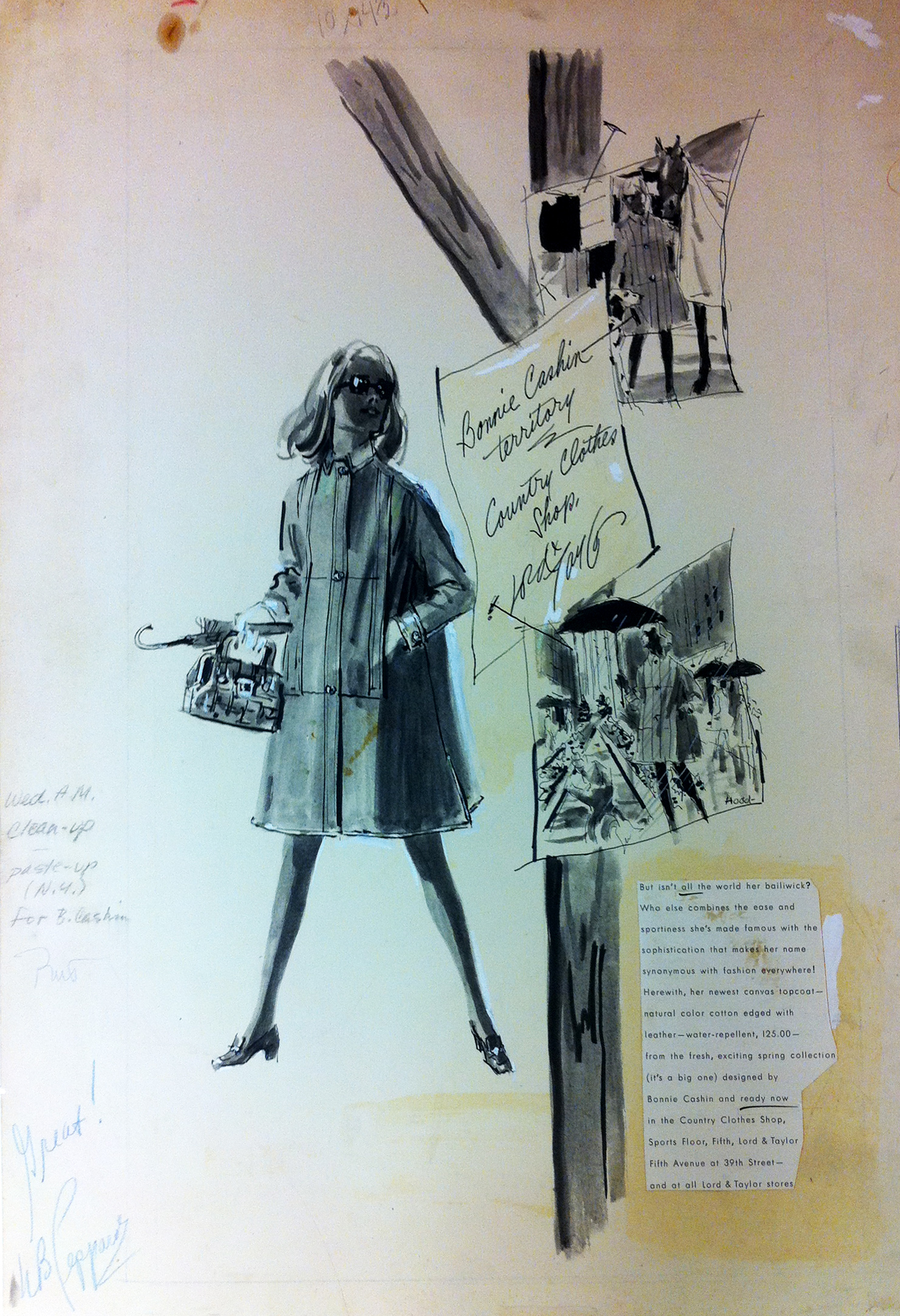
For the better part of the 20th-century, department stores used illustration rather than photography in advertising, fashion magazines, and newspapers. Some illustrators were on staff at the stores, some worked for advertising agencies, and some were self-employed with contracts to provide drawings for stores. Illustrations shown here were created for Lord & Taylor between the 1940s and 1989 and are included in the Frances Neady collection in the Gladys Marcus Library’s Department of Special Collections and FIT Archives.
In the ’40s and ’50s, Lord & Taylor had some of the most notable illustrators in the business, among them Dorothy Hood, Carl Wilson, Helen Hall, Arnold Hall, Jean Karnoff, Susan Abbott, and Betty Offt. Hood’s work is remarkable for creating a distinctive character for Lord & Taylor – the “Hood Girl.” Hood is often incorrectly credited as the originator of the store’s script logo, however, she was the first to fuse the logo with illustration as early as 1947. Lord & Taylor encouraged illustrators to incorporate the logo in their drawings for ads, resulting in a logo written afresh by each artist’s hand.
The Frances Neady collection contains over 300 illustrations by prominent 20th-century fashion illustrators such as Antonio, Kenneth Paul Block, René Bouché, Eric, Joe Eula, Esther Larson, Mats Gustafson, and Ruben Toledo. These are the works of primary practitioners who demonstrate originality and individuality in their field. Many of these illustrations have been reproduced in American and foreign publications such as Vogue, Harper’s Bazaar, Femina and L’Officiel. Some of these artists created powerful visual identities for their clients, such as Dorothy Hood for Lord & Taylor, George Stavrinos for Bergdorf Goodman, and Jay H. Crawford for Bonwit Teller. This collection is a testament to the importance of these artists within the history of fashion. It parallels the impact of fashion photography on the field, encompasses work from 1920 to the present, and offers a view of history through aesthetic, cultural, and social shifts preserved in the idealized vision of fashion illustration. This collection was established in 1983 by Rosemary Torre and Frederick Bennett as a memorial to Frances Neady, an inspiring and dedicated teacher of fashion illustration, who served on the faculties of FIT and the Parsons School of Design for 40 years.
The Department of Special Collections and FIT Archives’ mission is two-fold. Regarding Special Collections, it acquires, preserves, and provides access to a wide range of primary research materials in original formats and across many languages and geographical spectra. All acquisitions support one or more curricula offered at FIT. Regarding the College Archives, the Department acquires, preserves, and provides access to College records permanently-scheduled or of enduring value created in the course of College business by administrators, staff, faculty, and students. These efforts support myriad goals in and across FIT units as well as research from those outside the FIT community.
In order to view these original works or other Special Collections materials please email: fitlibrary.sparc@gmail.com or call 212.217.4385 for an appointment.
This is the last and final part of the special four-parts post Fashion in Black & White. In the past three weeks, I have attempted to show that the combination of black and white is a theme most, if not all, major designers have explored. Through the themes Structure, Lace and Flowers, I tried to illustrate that black and white dominant fashionable appearance for over a hundred years. This week I’d like to show examples in which designers use the graphic nature of these two colors.
Every design starts with a line, whether on paper, on a dress form, or a human body. Although the many meanings attached to black and white appeal to fashion designers, it is first and foremost the visual effect that inspires them. The graphic nature of black against white manipulates the eye, drawing its attention to where the designer wants it to look. The lines and planes of black and white are for many designers the basis for innovative and modern design.
Fashion often takes inspiration from ideas previously explored in painting and graphic art. The impasto brushstrokes of Impressionism, the linear symmetry of Art Deco, the optical illusions of Op Art are all part of a graphic vocabulary that constantly reenters fashion. Since fashion designers create in a three dimensional medium, they can further experiment with these visual means. In fashion, the body rather than the fabric is the surface, the canvas for a creation. The dimensionality of the body is used by fashion designers to emphasize the graphic intensity of black and white.
One of my favorite designers is Dries van Noten. He is of course known for his use of bold, colorful prints, but in 2009 he created a group of beautiful designs in black and white with only subtle hints of yellow and gold in some of the garments.
Dress, Dries van Noten, Spring 2009. Source: Style.com
A simple shirtdress is the starting point of this dress, yet the body underneath appears to alter its appearance, shaping the print and dictating the flow of lines as it moves. It is an example of van Noten’s notable, apparently effortless chic. In fact it is carefully crafted; the print is placed so that the diminishing density of black versus white draws the eye to a point, a technique borrowed from Op Art. The effect is furthered by the twist of fabric, beautifully draped from the waistline, where all the lines of the print appear to coincidentally meet.
Another design that was influenced by an art movement is seen below, and was made by designer Jeanne Lanvin.
Evening Dress, House of Lanvin. Designer: Jeanne Lanvin c. 1924. The Metropolitan Museum of Art, gift of Mrs. Carter Marshall Braxton, 1980. 1980.92.1a-c
This striking dress demonstrates Lanvin’s ability to bring together decorative and modern motifs with exquisite technique. The graphic Art Deco pattern is created by applying cut black fabric with hidden hand-stitching .The black waistband emphasizes the dropped waistline and straight silhouette typical of the 1920s.
For their Fall 2008 collection, design duo Rodarte took inspiration from the sculptures of Eva Hesse, an artist known for her innovative use of materials. Below, their elaborate hand-dyeing technique emphasizes the deconstruction and manipulation of fabric for which they are known. The black dye follows the draping of the fabric, and seems to run through the sheer, delicate white chiffon as the wearer walks and moves. The smeared fabric, the meticulous construction, the cobweb stockings and the spiked platform shoes all come together in a design that is a careful study of contrasts.
Ensemble, Rodarte, Fall 2008. image: Style.com
Eva Hesse, Atelier, 1965
In the early 1960s fashion magazines, and most notably Vogue led by editor Diana Vreeland, embraced a new visual language. Fashion designers, photographers, painters and other visual artists of the period experimented with graphic lines and contrasting shapes in black and white. It was not only fashion photography that changed forever, but also the posture and attitude of models and the way fashion was presented. The youthful and linear style of designer André Courrèges was a perfect fit for those times. The A-line silhouette of the dress below blurs the curves of the body, an effect enhanced by a plane of white fabric and a frame of black trim. The graphic quality of the dress lends itself to the new fashion photography.
Dress, André Courrèges, 1965 The Metropolitan Museum of Art, gift of Kimberly Knitwear Inc., 1974 1974.136.9a, b
Clothes by Courrèges, photograph by William Klein, 1965.
Dress, Yves Saint Laurent Fall/Winter 1965-66 The Metropolitan Museum of Art, Gift of Mrs. Disque D. Deane, 1968 C.I.68.60.1
This dress, from the renowned Mondrian collection is another example of Saint Laurent’s contribution to the fashion and art dialogue. The patchwork of black bands and white planes recreates the tension between line, form and color in Mondrian’s work. The dress is flat like the canvas of the painter; it comes to life only with the movement of the body. While the rest of the collection also employs planes of primary colors, this black and white dress alludes to Mondrian’s later minimalist work.
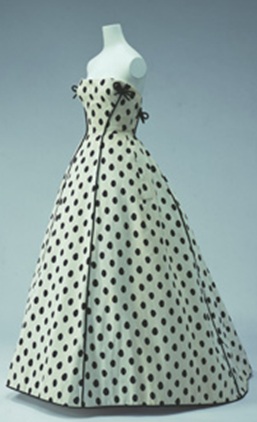
Evening dress, Jacques Fath, 1953 Printed white cotton piqué, black piping Kyoto Costume Institute AC7594 92-23-2
The design of this dress is typical of the larger-than-life style of designer Jacques Fath. He was an unconventional couturier for his time, neither shy nor reserved as some of his contemporaries; he liked to work with loud music playing in the background and to host lavish dance parties with his wife and muse, Geneviéve Boucher de la Bruyère. Although often firmly constructed in keeping with the 1950s silhouette, his designs retained a certain playfulness, here exemplified in the use of oversized black polka dots.
Here are two more examples of elegant yet playful designs with polka dots.
Jacques Griffe Dress,Bergdorf Goodman Collection at Special Collections and FIT Archive Reference code: US.NNFIT.SC.20
Jean Desses Day Ensemble, Bergdorf Goodman Collection at Special Collections and FIT Archive. Reference code: US.NNFIT.SC.20
I’d like to finish the last post in the series with the image below, from Israeli swimwear brand Gottex. I have recently completed my thesis on the history of the company, as well as of the design and marketing methods it employed for may years.
Since its early days in the 1960s Gottex showed many graphic designs in black and white. Designer Lea Gottlieb continued to design black and white groups every year until she left the company in 2001. This is a great example to how she often interpreted animal skins in a graphic way, a trend that begun in the 1960s and which she continued to expand over the years. And this is another example from designers Rudi Gernreich and Dolce & Gabbana.
Last week I tried to show that although it is easy to see the direct influence of military on 1940s fashion, uniform-inspired fashion was not necessarily carried into the 1980s simply as part of a 1940s retro. While designers of the 1980s adopted the broad shouldered silhouette of the 1940s, they also poured into the mix ethnic elements that were influenced by current events, as well as military iconography that originated from the youth movement of the 1960s. It is interesting that during this decade, and especially in the earlier years, many editorials and ads in fashion magazines used imagery that evokes World War II to promote fashionable product.
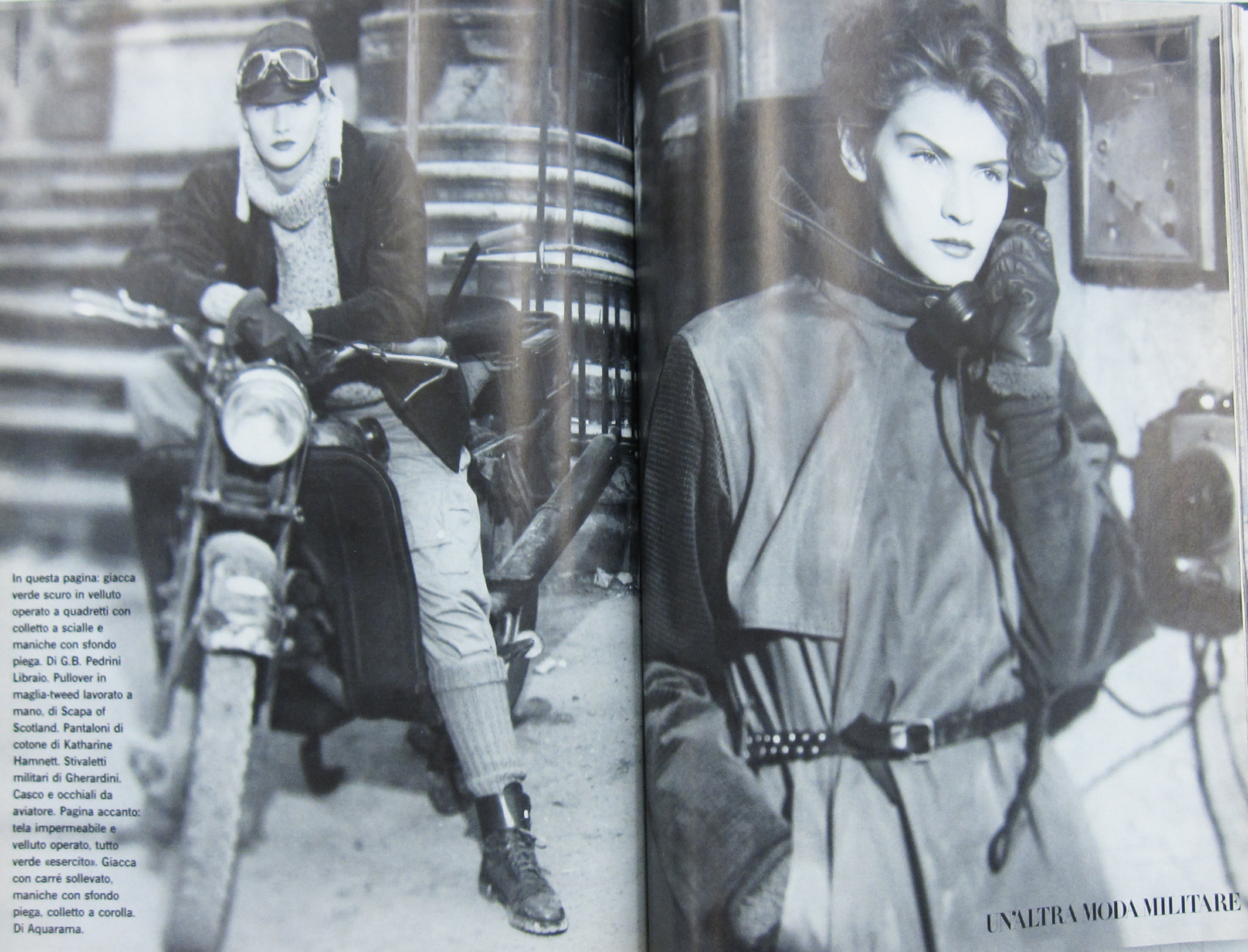
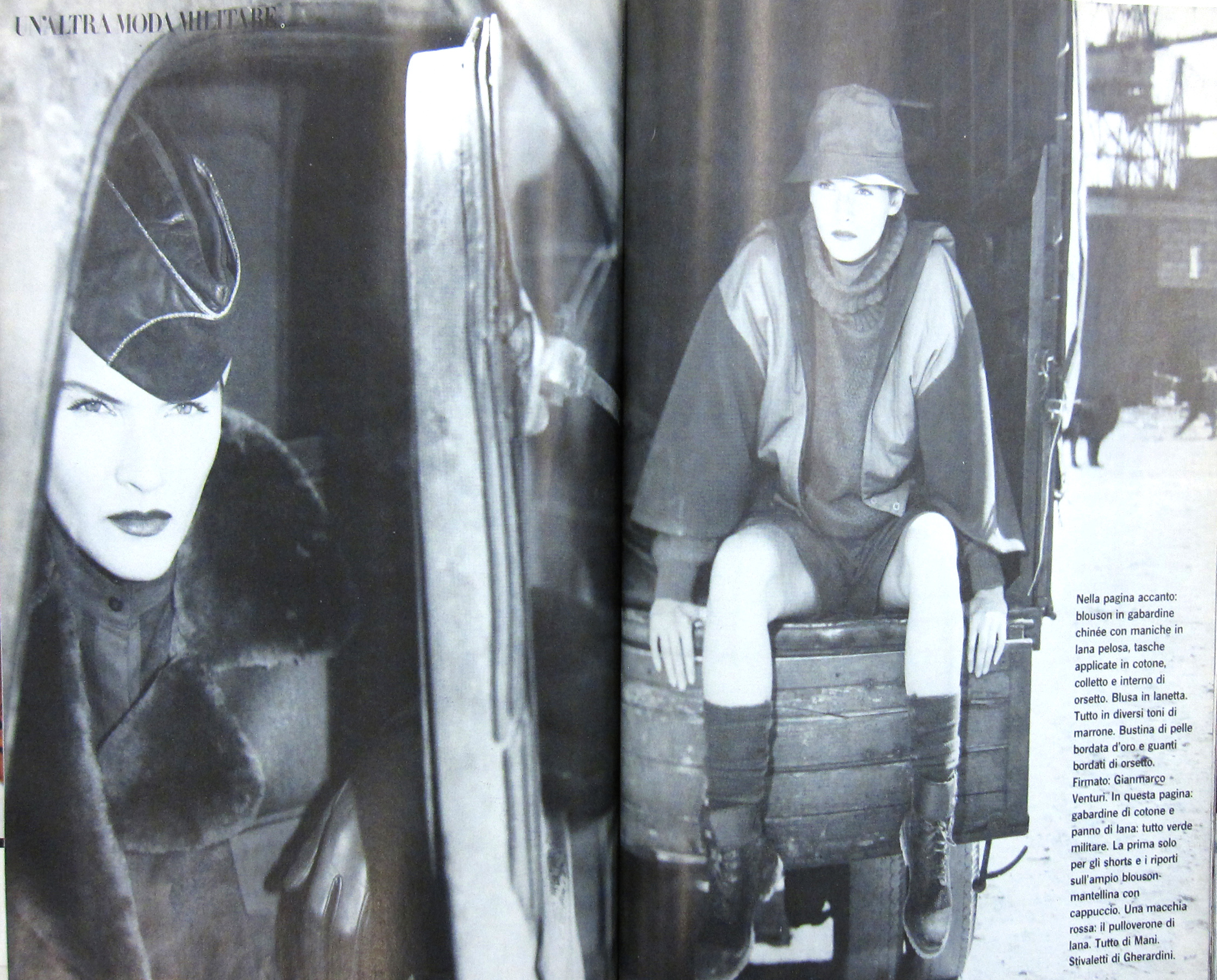
My research focused on Vogue Italia because brands such as Armani and Versace were extremely successful and directed the look of the decade internationally. In September of 1982 the magazine published a black and white editorial titled “Un’altra Moda Militare”(Another Military Fashion). This thirteen pages-long editorial shows that romanticizing the 1940s war years, as Yves Saint Laurent did a decade earlier, was quite common in fashion magazines of the period.
“Un’altra Moda Militare” fashion editorial, scanned from Vogue Italia, September 1982, p.717-729
The models, in glamorous 1940s Hollywood-style hair and makeup, are photographed against a backdrop of bombed buildings and deserted streets. Each is wearing at least one military-style element, such as the trench coat, aviator cap or sunglasses, leather boots, and even a medal decorated beret. The looks and poses are meticulously stylized; one would not mistake these for real pictures of World War II. There is a stark contrast between the subject of the pictures and the way in which it is represented. The clothes of heavy woolen fabrics and leather, and the background which is set to look like a destroyed city, contrast with the romanticized hair and make up styling and the soft camera lens. Clearly, this is not an attempt to face war memories of Fascist Italy’s collaboration with the Nazis, or an attempt to recreate a true image of women in war time. But rather, the background is there only to make the image more authentic so the clothes will appear more desirable, and therefore become more saleable.
“Un’altra Moda Militare” fashion editorial, scanned from Vogue Italia, September 1982.
“Un’altra Moda Militare” fashion editorial, scanned from Vogue Italia, September 1982.
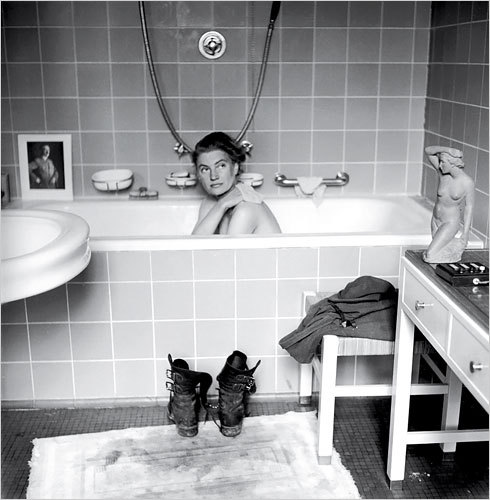
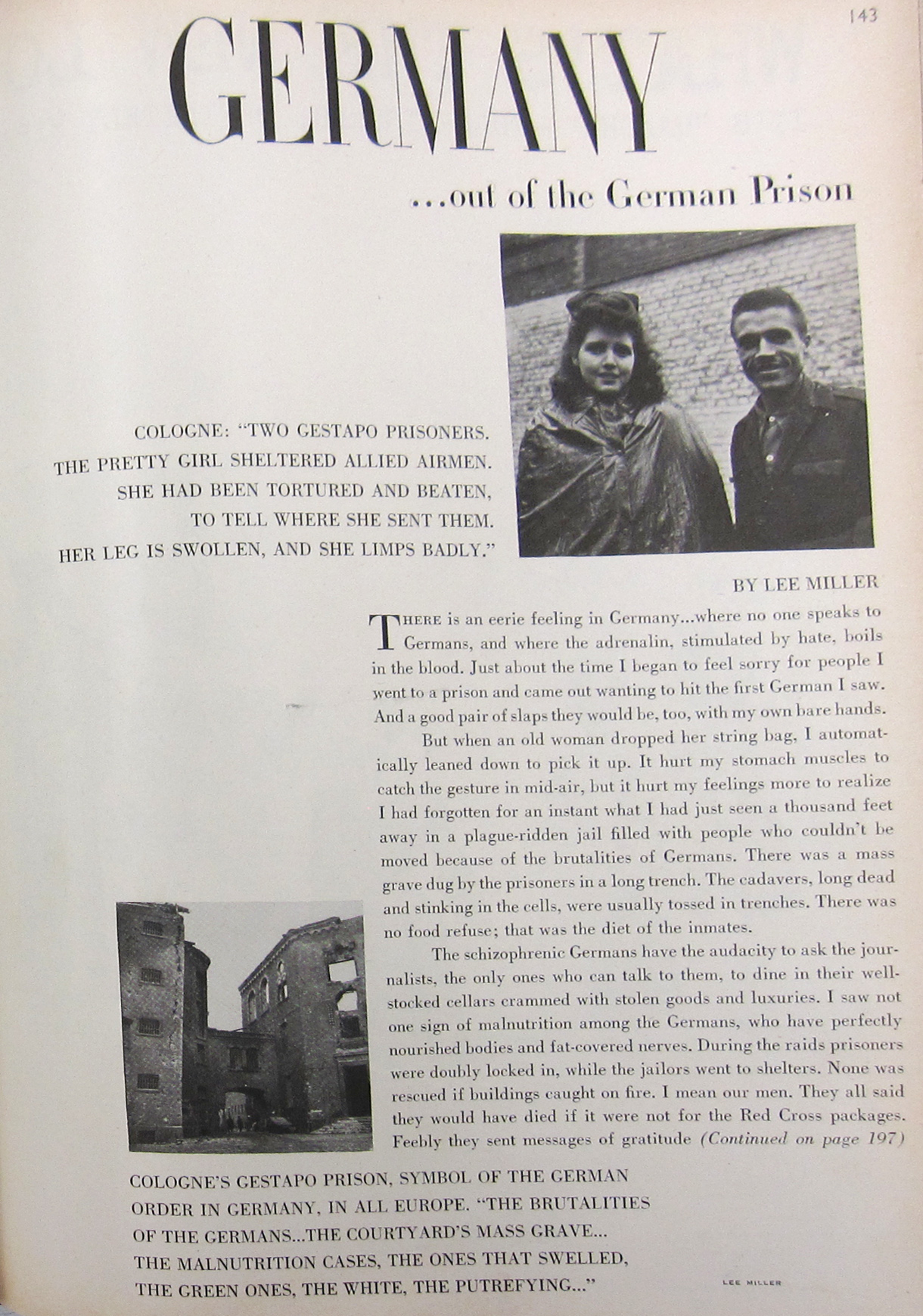
It is, of course, interesting to compare how fashion magazines in war time confronted the problem of reporting on current events, yet continuing to promote fashion. The photographer Lee Miller, American Vogue‘s war correspondent, who accompanied the Allied Forces was one of the firsts to send out pictures of the concentration camps Buchenwald and Dachau, as well as pictures from occupied Germany. One of the most famous pictures of that period was of her in Hitler’s bathtub in his Munich residence, taken by Life Magazine photographer David E. Scherman.
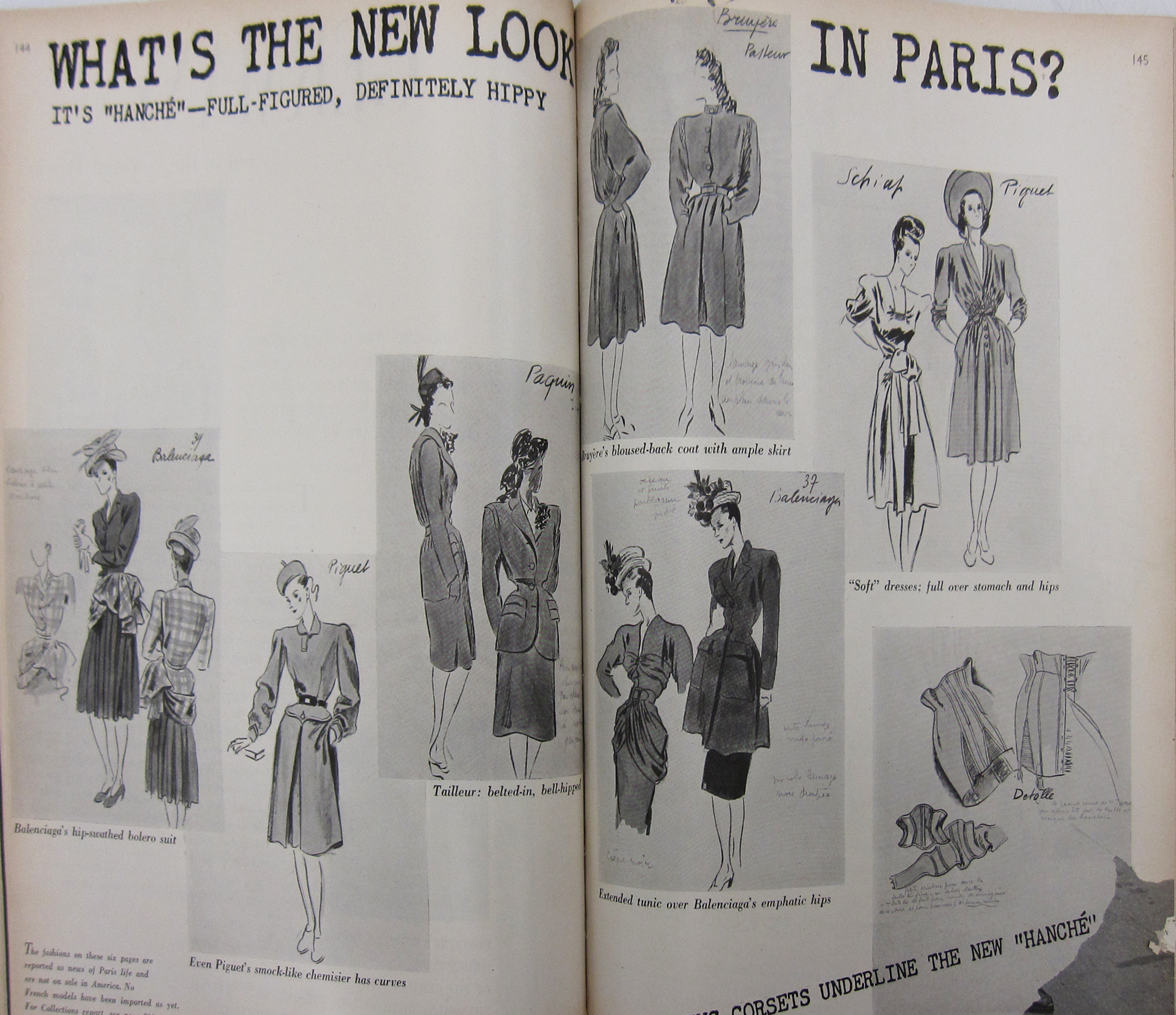
Miller’s report, accompanied by explicit pictures of starved bodies, injured soldiers, and beaten prison guards, was published by American Vogue, June 1945, in an article titled “Germany… out of the German Prison.” It is a stark contrast to the 1980s editorial in Vogue Italia. But, more interestingly it is also quite different from the Paris fashion report that was published in the following page, spanning five more pages and including illustrations. Although Vogue‘s report is brave and serious, it reveals the split-personality of women’s fashion magazines at that time. On the one hand reality cannot be ignored, on the other women were still expected to care about fashion and to consume it.
Lee Miller’s report from Germany, scanned from American Vogue, June 1945, p. 143-44
The following page introduces the newest fashion from Paris. Scanned from American Vogue, June 1945, p.145-6.
As the editorial in Vogue Italia suggests. the 1980s version of war or military iconography was watered-down, fashion designers of the 1980s often stripped these elements of their original context. By doing so they stripped them of their political and ideological meaning and turned them to mere decorative elements. Fashion editor Stefano Tonchi notes that:
…shiny black leather boots, riding pants, jackets with hussar braiding, coats with epaulettes decorated with gilded fringe, capes and mentals, coats of arms, decorations, metal eagles and gold buttons are all decisive elements. Freed of their practical function- the epaulette, for example, was created as protection against blows of the sword- these elements have assumed a symbolic and at time ideological value, but to an increasing extent they are merely decorative, to the point of becoming simply the surface on which to place a logo or a set of initials: the Armani eagle, the crossed C’s of Chanel, or the Versace’s medusa
But while the specific function of these military design elements may no longer be necessary, their stylistic language serves the clothes, or the way they appear at least. Last week I showed an image from Elle magazine, where this point is made clear. The model, leaning on a black stretch limo, is wearing a satin trench coat and black aviator sunglasses. Her head is covered by a tight stretch hood and her bare legs are exposed- one of them on top of a black suitcase from which the Soviet Union’s flag is hanging. It is suggested to the viewer that under the coat the model is wearing onlya short bodysuit- the trench coat therefore no longer serve its intended function, that of providing warmth and protection.
Elle Magazine, mid-1980s (exact year unknown). Scanned from the book Elle Style: the 1980s [Filipacchi Publishing, c.2003]
While the adoption of military-like fashion in the 1940s was in great part due to necessity, and therefore served a purpose and function- newly added pockets, pants instead of dresses- fashion designers of the 1980s used uniforms, or excerpts of it, only to convey an idea and a desirable image.
This photograph uses the eroticism associated with uniform, especially when worn by a woman. The model’s posture displays a provocative, unashamed sexuality, and although the setting evokes spy movies, clearly she is not attempting to blend in. This brings to mind role playing and cross dressing. In the essay “Eros and Uniform,” author Richard Buckley proposes that by “Idealizing the masculine form, uniform represent power, simultaneously inspiring emotions of security, awe, fear, repulsion and desire…because of their association with a sense of authority and force- soldiers, policemen and prison guards- uniforms are related to sexual potency, Affording the wearer a sense of anonymity, they can intensify or subvert conventional gender role playing.”
This model is at the same time anonymous (sunglasses, head cover, gloves) and exposed (bare legs, chest thrust forward), she is both masculine and feminine. In many ways this photograph is 1980s quintessential, not only for the overt sexuality, but also for diffusing seemingly foreign concepts in a way that no longer relates to just one or the other. The juxtaposition of opposites is characteristic to postmodernism, and what makes the fashion of the 1980s, and its relating imagery, unique.
Next week’s post in the series Uniformed Individuality, will focus on men’s fashion of the 1980s. I will try to trace the uniform, military and 1940s influences in the men’s department as well.
Today’s post is by Victoria Pass, she received her PhD from the University of Rochester in May 2011 and she is currently teaching at the Maryland Institute College of Art. Her dissertation, Strange Glamour, examines fashion and art in the 1920s and 1930s. Her research examines fashion in the context of art, politics, gender, and race and she is currently working on a projects on African influences on modern fashion- a paper she recently presented at the Women in Magazines conference at Kingston Universality (UK).
Central to understanding Schiaparelli as a precursor to punk is the Surrealist concept of Convulsive Beauty, which was formulated by Andre Breton. Breton defined convulsive beauty as an aesthetic of shock. In Schiaparelli’s clothing and accessories convulsive beauty disrupts the stable gendered identity of the wearer, and conventional notions of attraction. Breton defined convulsive beauty as a series of strange encounters, or paradoxes. The classic example of convulsive beauty is the chance encounter of a sewing machine with an umbrella on a dissection table. Breton’s description of convulsive beauty also links aesthetic pleasure to erotic pleasure. Shock affects a viewer in a visceral way. It is a bodily reaction. It is what makes convulsive beauty convulse.
George Saad, Schiaparelli’s and Dalí’s High Heel Hat worn with her Lip Suit, L’Officiel, October 1937
Man Ray, Elsa Schiaparelli, 1932
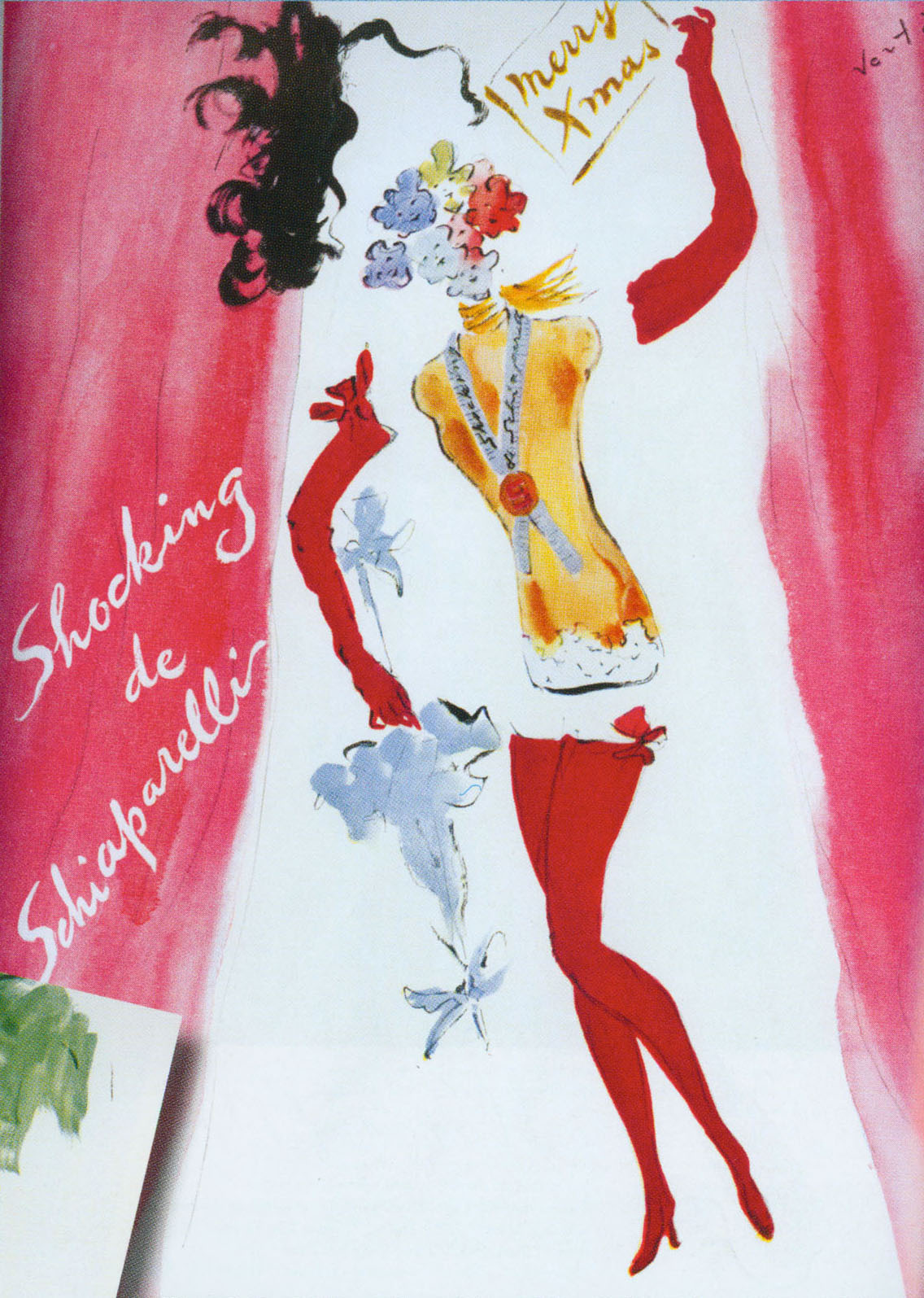
Shock became practically a second signature for Schiaparelli in 1937 when she created her signature shade, shocking pink, and the perfume Shocking and the name for her autobiography, Shocking Life. The bottle for Shocking, designed by Leonor Fini was based on the torso of Mae West, and had a sex appeal that was certainly shocking to some.
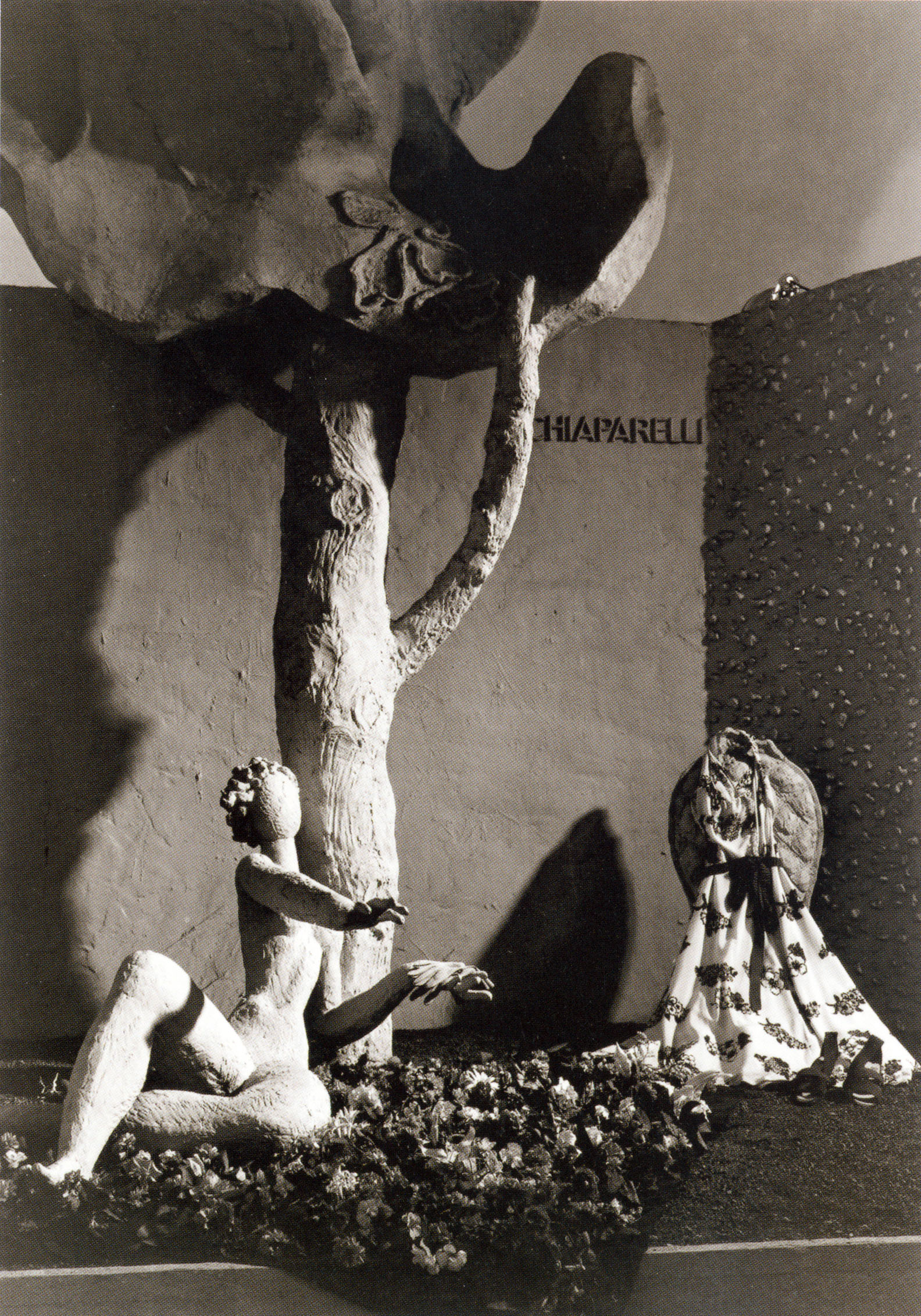
Schiaparelli continuously courted scandal throughout her career. In June 1937 at the Paris Exposition Internationale des Arts et Techniques dans la Vie Moderne Schiaparelli gleefully upturned the decorum of the Pavillon de l’Elégance’s display by the most prominent couturieres in Paris. Their work was exhibited on mannequins designed by Robert Couturier in an Arcadian landscape devised by Émile Aillaud.[i] The style of the display had been influenced by the biomorphic branch of Surrealism. Schiaparelli did not see beauty in these Surreal mannequins. She thought that they were “in some respects hideous. All one could do was to hide their absurdity under voluminous skirts.”[ii] The mannequins looked like the hysterical women who fascinated the Surrealists. Their massive arms gesticulated wildly with splayed fingers. These mannequins would not do for Schiaparelli:
Wols, Schiaparelli’s display at Le Pavillon de l’Elégance, 1937
I naturally protested…Could I use Pascale, my wooden figure, and thus retain the atmosphere of the boutique Fantastique? Certainly not, cried the pundits. That would be conspicuous and revolutionary. So after much discussion I went and made my own show myself. I laid the dreary plaster mannequin, naked as the factory had delivered it, on some turf and piled flowers over it to cheer it up. I then stretched a rope across an open space and, as after washing day, hung up all the clothes of a smart woman, even to panties, stockings, and shoes. Nothing could be said. I had carried out most strictly the decrees of the Syndicat de la Couture, but in such a way that on the first day a gendarme had to be sent for to keep back the crowds![iii]
Schiaparelli’s vignette excited the crowds because she had disrupted the elegance of the space by making her mannequin look like a corpse. Harper’s Bazaar described the scene on opening day: “Schiaparelli stretches a nude figure on the ground, partially covered by a rug of flowers. On the opening day, someone threw a visiting card on the blanket with condolences, so now that lady has been jerked up to a sitting position, with her discarded dress and hat thrown on a garden chair.”[iv] Even this more sanitized version of Schiaparelli’s stunt was provocative—so provocative that her display did not appear in any of the major French fashion magazines which reproduced a number of the other couturiers’ vignettes.[v] Schiaparelli played with the Surrealist and uncanny possibilities of the mannequin, “half-alive and half-dead.”[vi] Schiaparelli emphasizes the uncanny by showing the mannequin as a corpse.
What is particularly instructive about this incident is the way in which Schiaparelli uses the surrealist trope of the uncanny mannequin to her own ends. Her display reflects on the cycles of fashion, and the immanence of death in the fashion system. It also, in typical Schiaparelli fashion, serves as a shocking publicity stunt. In the Surrealists hands, several months later, mannequins became the victims of sexual violence at the Exposition Internationaledu Surréalisme. One of the organizes, the photographer Man Ray claimed that,
in 1937 nineteen nude young women were kidnapped from the windows of the large stores and subjected to the frenzy of the Surrealists who immediately deemed it their duty to violate them, each in his own original and inimitable manner but without any consideration whatsoever for the feelings of the victims who nevertheless submitted with charming goodwill to the homage and outrage that were inflicted on them, with the result that they aroused the excitement of a certain Man Ray who undid and took out his equipment and recorded the orgy…[vii]
Clearly the Surrealist’s provocation was tinged with sexual violence, where Schiaparelli’s display obliterates the misogyny inherent in original source.
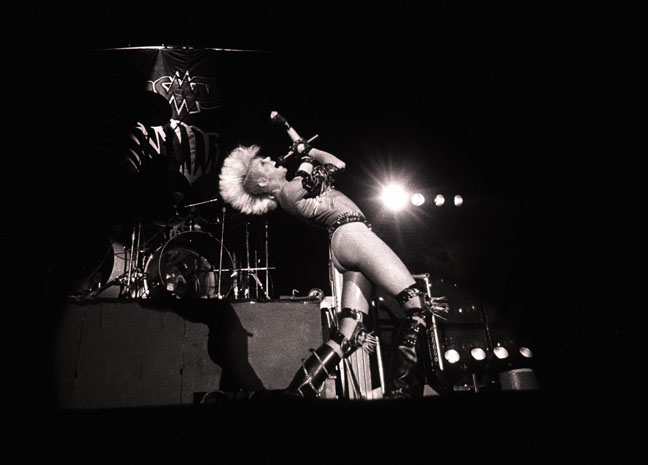
This is a critical point to understanding Schiaparelli as a predecessor for punk, since this is precisely the practice of many punk women, both famous and anonymous. Wendy O. Williams, for example used the hyper masculine styles of punk men to make her highly sexualized body into a literal weapon, all spikes and jagged edges. Men could look, but touching her might prove fatal.
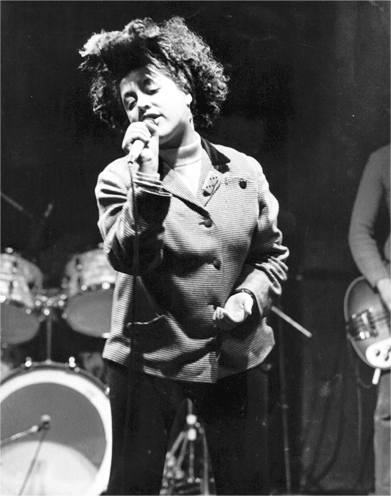
Poly-Styrene of the short lived X-Ray Specs, took a completely different approach, appearing on the highly masculinized punk stage in candy colored ensembles that entirely covered up her body. The prim suits and cardigans are in high contrast to her aggressive style as a performer and wild hair.
Poly Styrene, front-woman for X-Ray Spex
Poly-Styrene used the play of opposites to create a shocking and disorienting affect. According to Breton’s account in his novel Nadja, sometimes the shocks of convulsive beauty can be inconsequential.
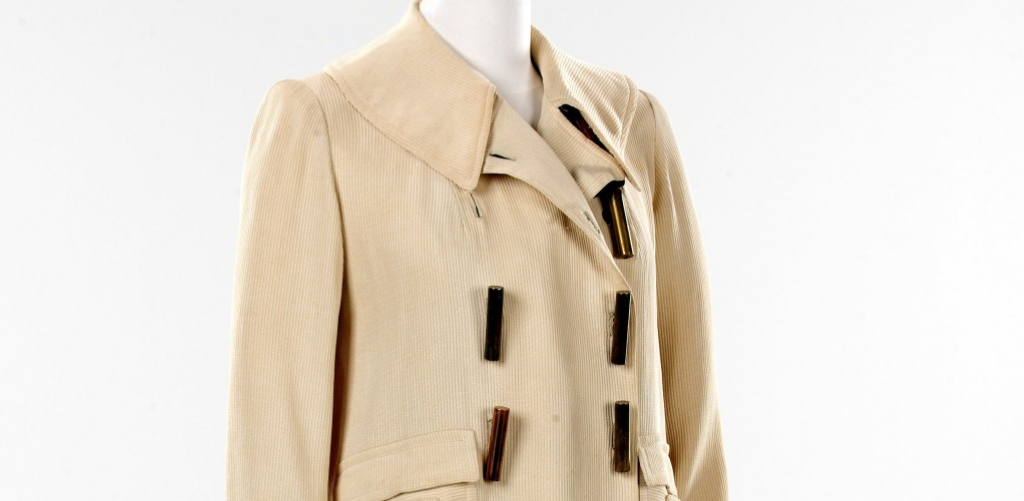
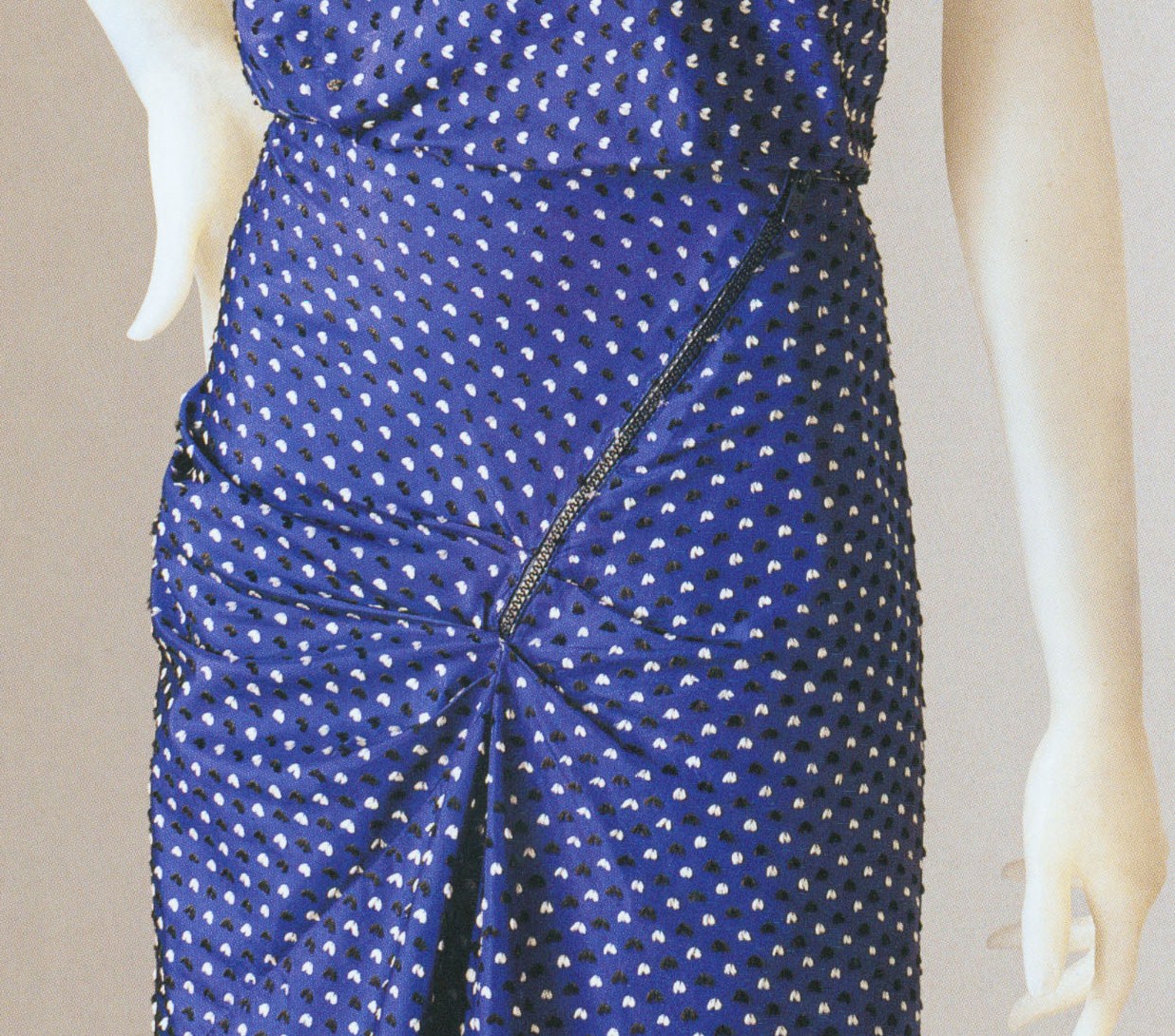
In the case of Schiaparelli’s work was can see this in whimsical details such as buttons shaped like cow heads, mermaids, or pianos or in a necklace which gives the appearance of bugs crawling around the wearer’s neck . In other cases though, Schiaparelli’s details were more akin to Breton’s capital-S Shocks: bullet casings used as buttons on a cream colored coat with details from men’s hunting clothes (1932-5) or a zipper placed provocatively across the front of a skirt (Winter 1935-36).
Elsa Schiaparelli, Coat with Bullet Casing Buttons, 1932–35 (New York: Brooklyn Museum Costume Collection at The Metropolitan Museum of Art, 2009.300.1212)
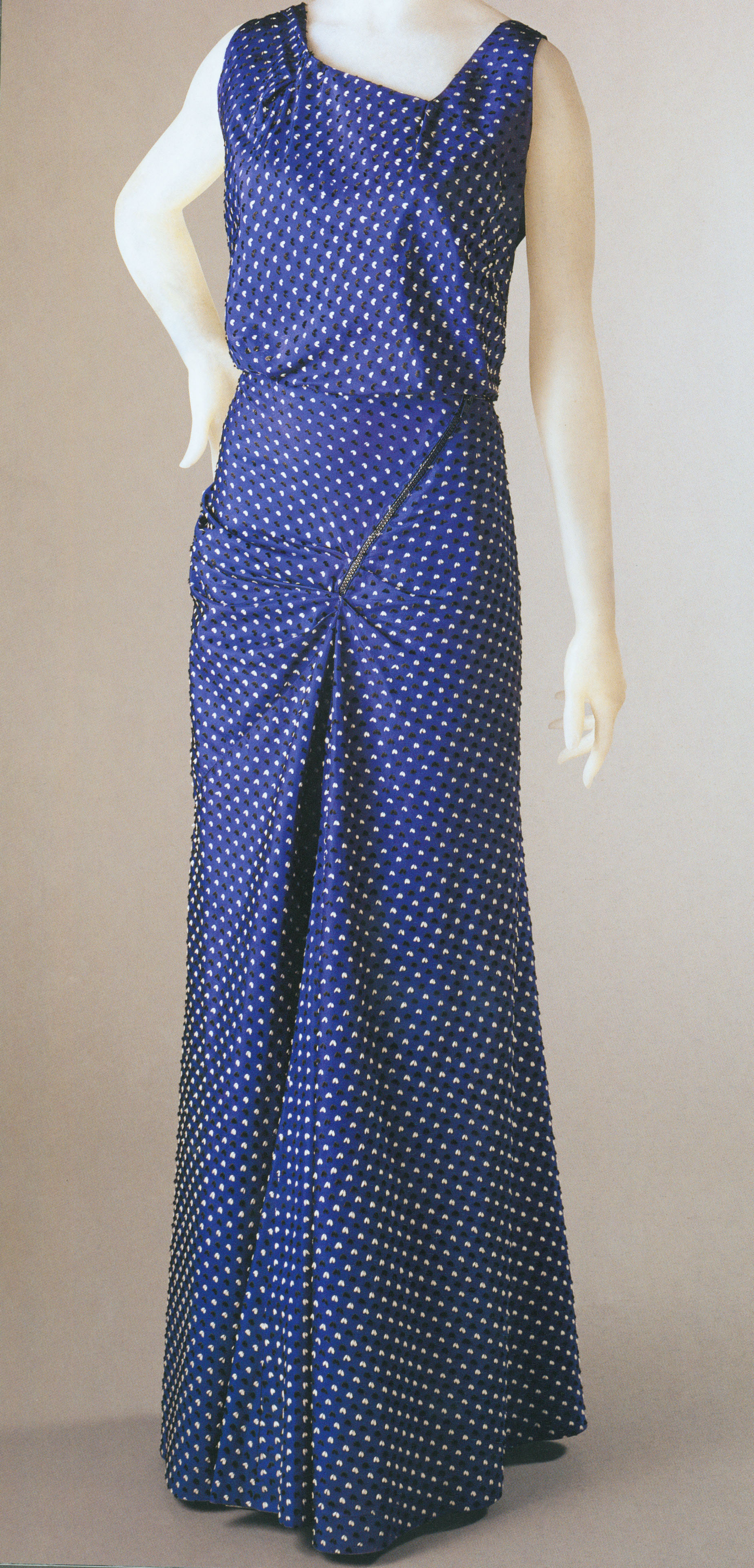
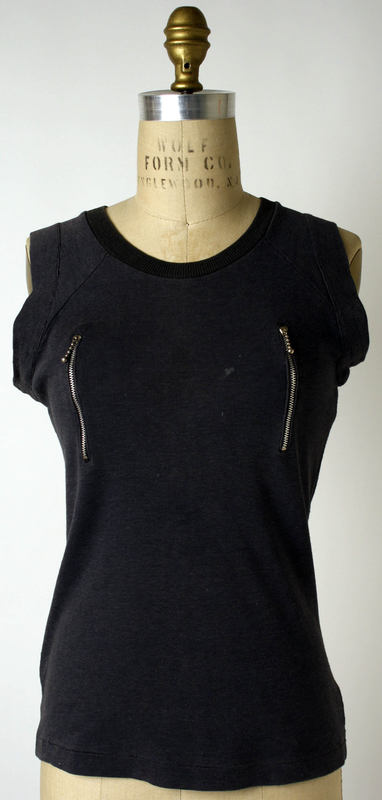
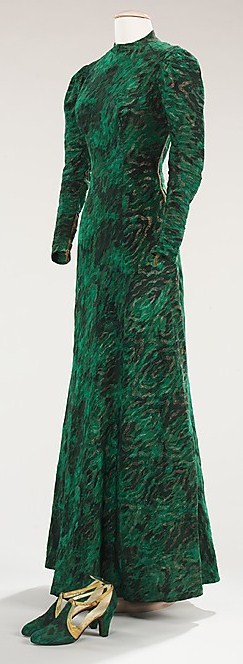
In the mid 1930’s Schiaparelli made zippers popular, not only as fasteners, but as embellishment on her clothes. As with their use on Punk clothing, zippers served as a provocation for Schiaparelli, they encouraged touch and interaction. In her autobiography, Schiaparelli recalled that, “what upset the poor, breathless reporters the most were the zips. Not only did they appear for the first time, but in the most unexpected places, even on evening clothes. The whole [Winter 1935-36] collection was full of them.”[viii]
Attributed to Vivienne Westwood , T-shirt, ca. 1971 (New York: Metropolitan Museum of Art, 1997.59.18)
Elsa Schiaaprelli, Evening Gown with matching shoes by André Perugia, 1933–35 (New York: Metropolitan Museum of Art, 2009.300.1168a–c)
Looking at her blue taffeta dress alongside this punk t-shit, probably designed by Vivienne Westwood, it becomes clear that the playfulness of the zipper can just as easily morph into a more threatening statement referring to the Venus fly trap or even the vagina dentate in the case of Schiaparelli’s dress.
Both the Westwood and Schiaparelli garments draw attention to the erogenous zones of the wearer, while at the same time making the viewer self-conscious of his gaze through the tease of the zipper. Many of Schiaparelli’s garments were designed to call attention to the sexual gaze of the viewer.
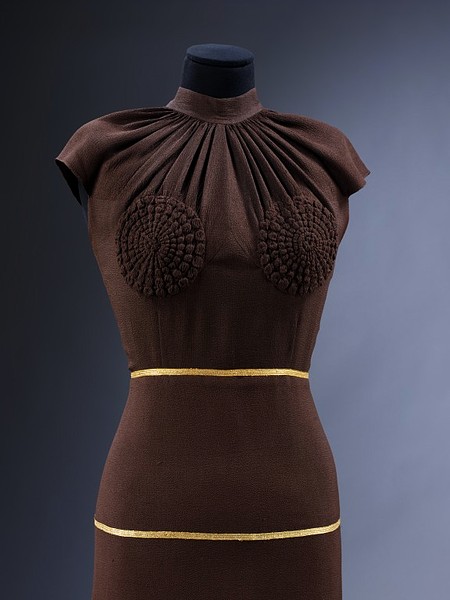
Elsa Schiaparelli, “Falsies” evening dress, brown wool crepe with gold braid, 1936 (London V & A, T.36-1964)
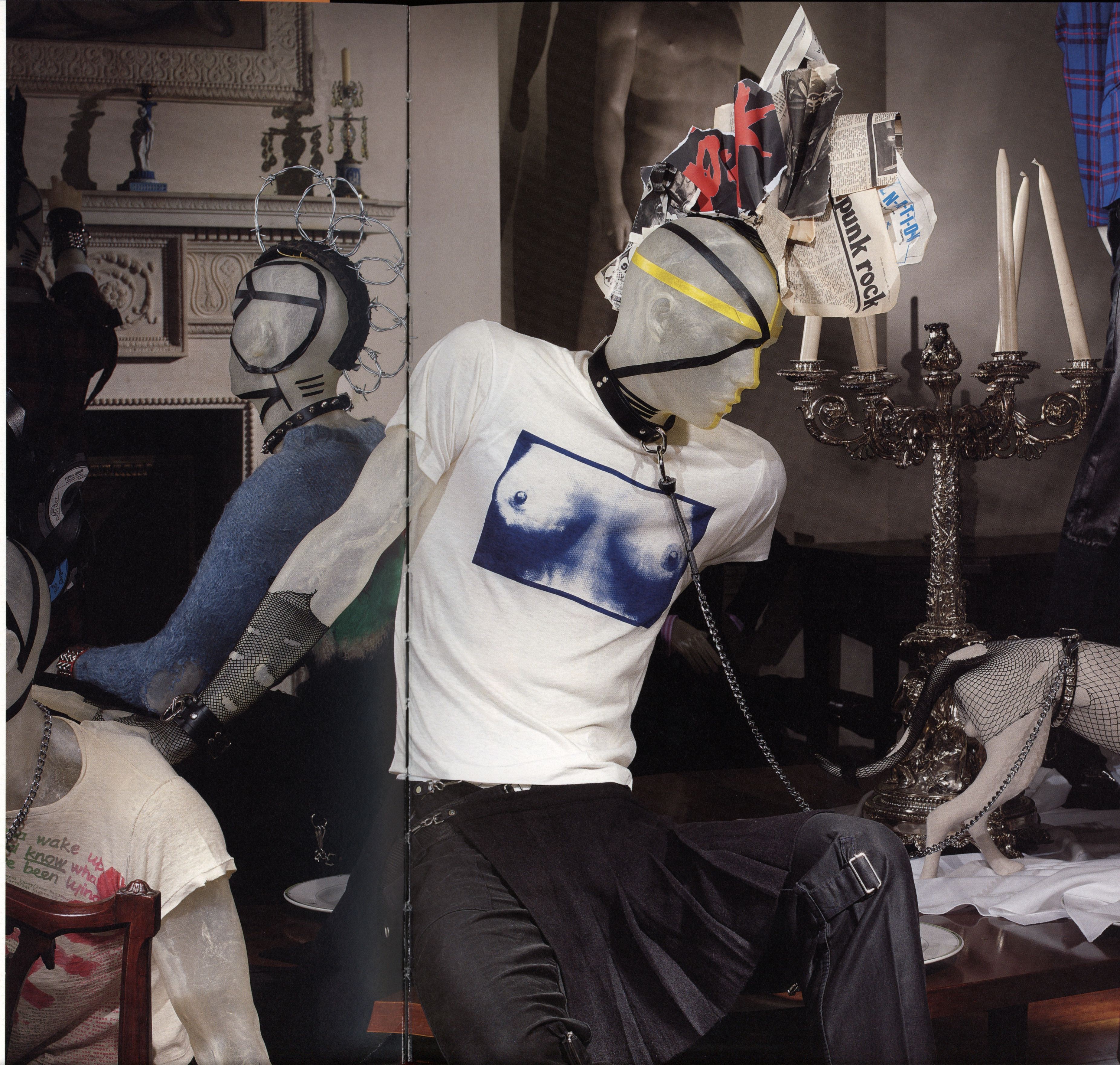
Malcolm McLaren and Vivienne Westwood, ensemble worn by Adam Ant c. 1977-8, AngloMania: Tradition and Transgression in British Fashion , The Costume Institute at the Metropolitan Museum of Art, New York, 2006 (photograph by Joseph Coscia, Jr.)
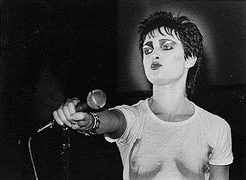
Ray Stevenson, Siouxsie Sioux in “Tits” T-shirt by Malcolm McLaren and Vivienne Westwood ,1976
For example, in 1936 she designed a series of dresses on which she appliquéd decorative padding over the breasts. This decorative detail mimicked the padding often sewn into a custom couture gown to enhance the breasts. This was a particularly humorous gesture at a time when larger breasts were coming back into fashion and women were using “falsies.” More than just a clever joke, this gown confronted viewers who looked at the wearer’s chest, with fake breasts as opposed to the real thing. Not only is the viewer made aware of his own sexualized gaze, but also of the ways that fashion literally constructs the body. We can see precisely the same gesture in a t-shirt from Vivienne Westwood and Malcolm McLaren’s punk shop, printed with the photographic image of breasts. The shirt as worn by Adam Ant around 1977, recreated in The costume Institute’s exhibition Anglomania, works in the context of a shocking gesture of gender bending, paired with a combination of a kilt and bondage trousers. Worn by Siouxie Sioux, the shirt calls attention to the sexualized gaze of an audience member looking at her breasts. The shirt confronts the viewer with their fantasy of seeing through the shirt to the breasts beneath, making him self-conscious of his gaze.
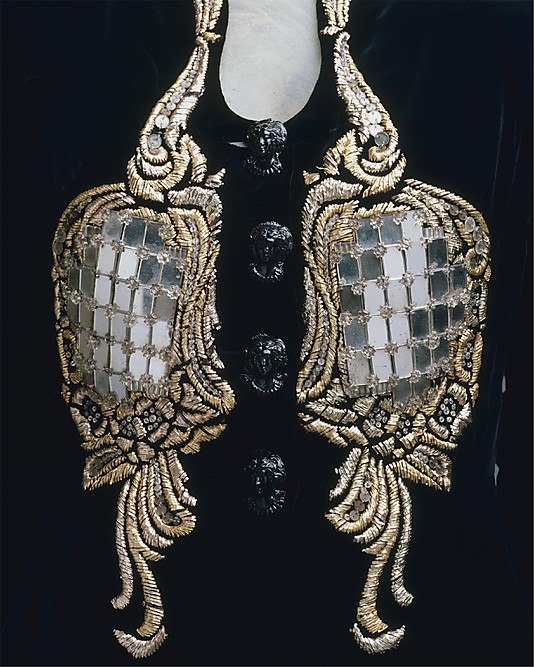
Elsa Schiaparelli, Mirror Jacket, Winter 1938–39 (New York: Metropolitan Museum of Art, C.I.50.34.2
There were many other ways in which Schiaparelli created garments which addressed the sexual gaze. Mirrors were one favorite device of the designer. For instance, a dinner suit with lavish embroidery by Lesage her winter 1938-39 collection, depicted two shattered mirrors surrounded by gold embroidery in the form of baroque frames over the breasts of the wearer. The Mirror Jacket intervenes in the conventional roles of the woman as object looked at, intercepting the viewer’s gaze and turning it back onto him. The woman turns from object into a subject staring, or perhaps winking back at the man who tries to ogle her breasts. We can see the kinship of Schiaparelli’s designs to the gesture of punk fashion in a number of places, all centered around using fashion to return the objectifying gazed.
For Winter 1949-1950 she created a series of dresses which tease viewers with revealing décolletage. This slinky evening gown in a dark maroon color called “Forbidden Fruit,” appears to be slipping down to reveal a pale pink brassier embroidered with gold and laden with crystals.
Nina Lean, Model Shari Herbert wearing Schiaparelli’s “Forbidden Fruit” evening gown, in Time, October 10, 1949
A dress for day with a low v-neck reveals a bright turquoise brassiere underneath. These dresses were designed as the popularity of Dior’s new look reached it’s zenith. Schiaparelli was vehemently opposed to the return to order and femininity represented by the wasp waists and full skirts of the new look. The Chicago Tribune explained, “while the rest of the world tries vainly to invent a brassiere which doesn’t show with the deep V necks, Schiaparelli publicizes this intimate little harness in bright gay colors, and even sports several in velvet with fur trim.”[ix] The revealing dresses of the Winter 1949-50 collection mocked the new styles of Dior. Schiaparelli turned these highly feminine looks into provocation, once again finding ways to stare back at the sexualized male gaze.
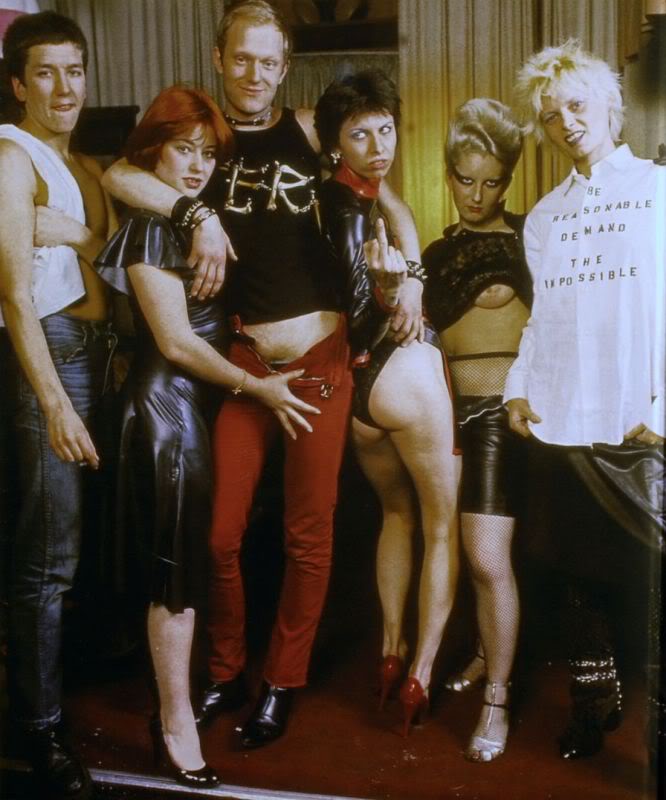
Sex, Malcolm McLaren & Vivienne Westwood’s shop open from 1974-76, London (from left: Steve Jones, unknown, Alan Jones, Chrissie Hynde, Jordan, and Vivienne Westwood)
Her looks clearly presage the “underwear as outerwear” looks of punk, and help to reveal the transgressive potential of these looks and their aggressive sexuality.
The purpose of this comparison between Schiaparelli and punk is not necessarily meant to suggest that punks were looking to her for inspiration, but rather that we can see both punk style and Schiaparelli’s work in a different way by looking at them side by side. What is most instructive about this comparison are the similarities between these two historical moments. I think that both the shock tactics of Schiaparelli and the provocations of punk were in part a response to the failed utopianism of the periods that preceded them, the Jazz age of the New Woman, and the Hippie movement of the 1960s. Both periods held the promise sexual liberation, gender equality, and lasting social change but did not deliver. Both Schiaparelli, and the particularly the women of punk in the 1970s were responding to this hopeless utopianism with provocative fashion which upended gender convention in far more radical ways than did the flappers or hippies.
Thanks to Anne Cecil who suggested the topic for this essay, and who gave me the opportunity to present it as part of the Punk area at the Popular Culture Association conference in San Antonio, TX, April 2011.
[i] Alyce Mahon, “Displaying the Body: Surrealism’s Geography of Pleasure,” in Surreal Things : Surrealism and Design, ed. Ghislaine Wood (London: V&A Publications, 2007), 134.
[ii] Elsa Schiaparelli, Shocking Life: The Autobiography of Elsa Schiaparelli (New York: E.P. Dutton and Co., Inc., 1954; London: V & A Publications, 2007), 73.
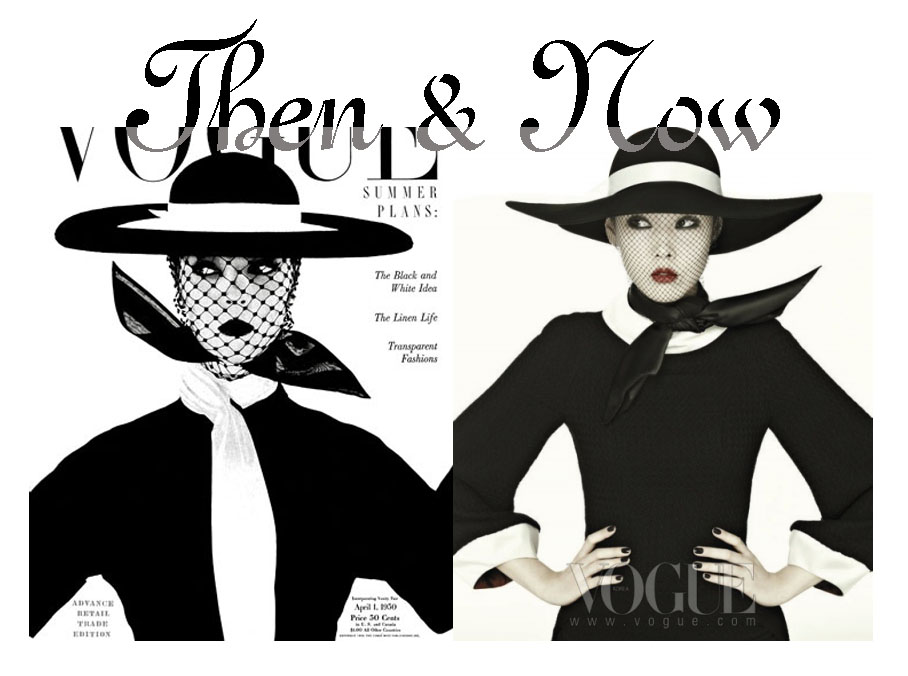
(right) “The Black and White Idea”, Vogue, April 1, 1950, front cover; photographer: Irving Penn. (left)Vogue Korea, 15th anniversary special issue, August 2011. source: fiercerthanyou.com
Icon: The Shirtwaist Dress in Good Housekeeping and other media
Presented at Women in Magazines Conference at Kingston University, London, on 22-23 June 2012
Heather Vaughan is an independent writer and fashion historian, whose work focuses on the study of dress in the late 19th through the 20th century. After obtaining her Master of Arts degree in Visual Culture Costume Studies from New York University, she focused on writing and researching fashion and costume in media. She is primarily known for her research on film design pioneer Natacha Rambova, and her contribution to the academic dress studies blog, Worn Through. Vaughan has been published internationally on various topics- including the Shirtwaist dress- in a variety of academic journals and books. More information can be found at her blog www.fashionhistorian.net/blog
Today’s period films typically show the 1950s housewife in the uniform of her profession: a shirtwaist dress. The shirtwaist itself encompasses the 1950s ideal of conformity and domesticity with a variety of media reinforcing these notions over time. In the 1950s magazines, television, books, and films all had varying degrees of influence over women’s fashion choices.
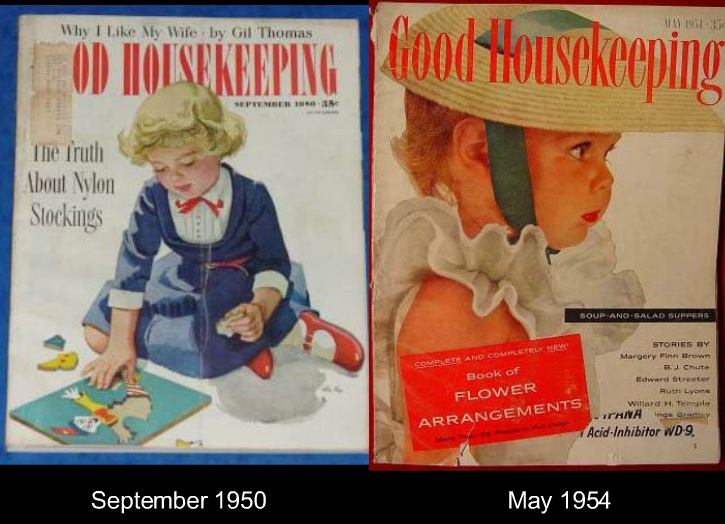
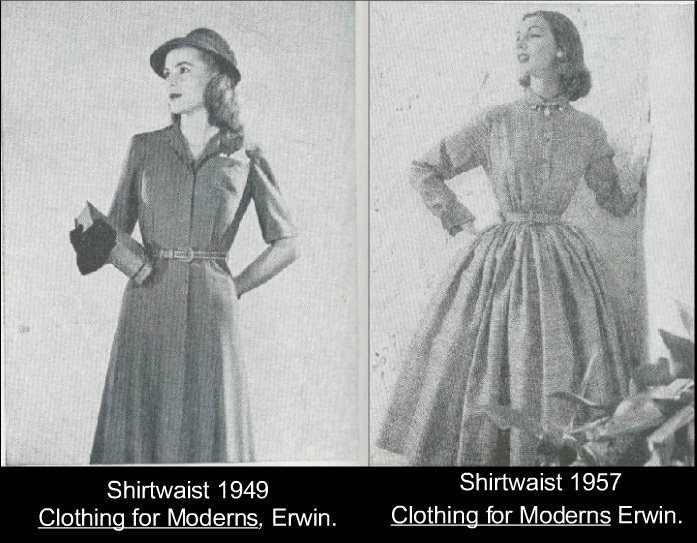
Magazines, however, had the strongest influence at the inception of the 1950s shirtwaist style, just after World War II. Historian and documentary filmmaker David Halberstam explains, “Women turned to magazines to learn how to adapt to their new roles in the land of plenty.” Good Housekeeping was a practical lifestyle magazine that women utilized to inform and influence their fashion decisions. Good Housekeeping’sposition and reputation sold women the 1950s shirtwaist and the idealized figure it came to represent. Tracing the path of the shirtwaist—from its pre-war form, to the 1947 New Look revision by Haute Couture designer Christian Dior, to its gradual appearance in this new form in Good Housekeeping—shows the beginnings of its development as an icon. Its presentation in both magazines and other media caused the style to permanently represent idealized motherhood and domesticity in the American mind.
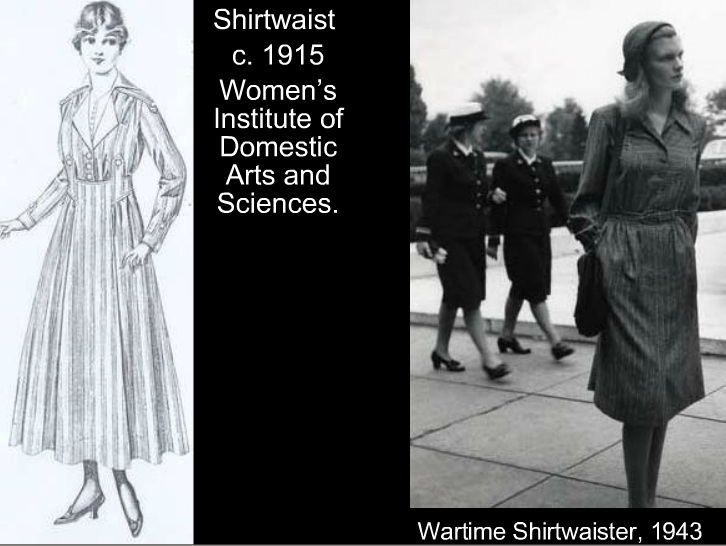
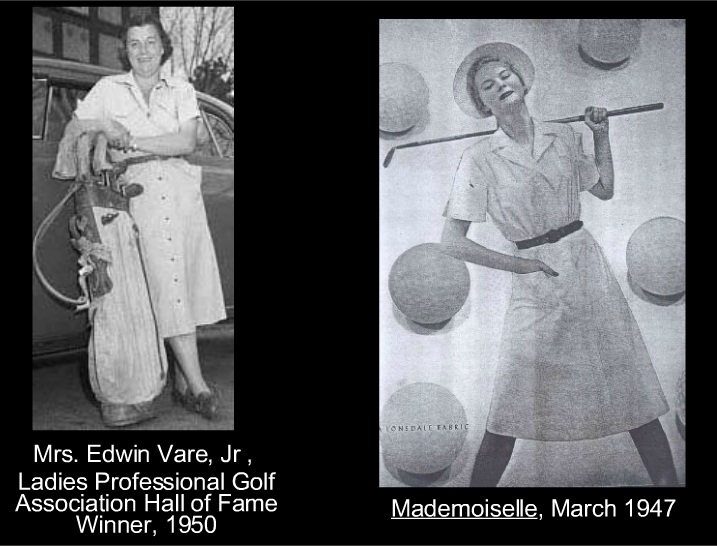
Just prior to Dior’s New Look, the 1940s “wartime shirtwaister” was prevalent. Author Angela Partington explains that this version was based on the Utility look.[i] It focused the silhouette on “square shoulders and short, straight skirts,” which is just the reverse of the soft, rounded shape of the New Look. This Utility style shirtwaist was popular and appeared in advertisements in American magazines such as Good Housekeeping, Seventeen, and Mademoiselle in early 1947.
Many of these dresses appeared as golf or other sporting related clothing due to their comfort and practicality. Partington explains that the Utility look remained popular via the shirtwaist, but acknowledges that it changed form. “The wartime shirtwaister[s] . . . flourished in the form of 1950s dresses which became almost symbolic of the housewife, and were invariably used to dress her in advertisements for household goods”.
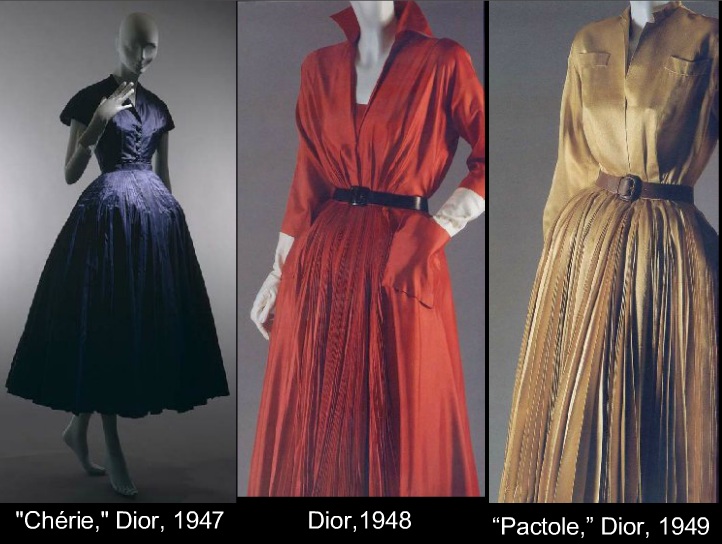
Christian Dior’s influence on the iconic 1950s shirtwaist began with his New Look collection in the spring of 1947 that almost single-handedly defined the post-war silhouette. Although other designers such as Claire McCardell were working with similar skirt shapes at the time, the fashion media credited Dior with the inception of the “New Look.”
While Dior did influence ready-to-wear styles, it is incorrect to say that his version merely “trickled down.”[ii] If anything, an opposite scenario caused the shirtwaists popularity. Dior took the already well-established form of the shirtwaist and created a new, haute couture version. As noted by Harold Koda and Richard Martin, Dior had a, “willingness to work with an established form but to complicate its construction and render it idiosyncratic”. The new style then slowly began to influence all price points and classes to create the new form, while obliterating the old one.
Notes
1 Historian Patricia Warner looked at the impact the Depression had on the 1930s shirtwaist in relation to sportswear in her article “The Americanization of Fashion: Sportswear, the movies & the 1930s.” (Twentieth-Century American Fashion By Linda Welters, Patricia Anne Cunningham), 93-95.
[i] “The Utility scheme was introduced by the Board of Trade in 1941 to ensure that low- and medium-quality consumer goods were produced to the highest standards at ‘reasonable’ prices, consistent with the restrictions on raw materials and labour.” For further details see Mendes & de la Haye,120-121.
[ii] Grant D. McCracken explains the specifics of the trickle down theory in his essay “The Trickle-Down Theory Rehabilitated:” The trickle-down theory, first stated by Simmel (1904), was an ingenious account of fashion change. The theory holds that two conflicting principles act as a kind of engine or motive force for innovation. Subordinate social groups, following the principle of imitation, seek to establish new status claims by adopting the clothing of super ordinate groups. Super ordinate social groups, following the principle of differentiation, respond by adopting new fashion (40).















 ON PINS AND NEEDLES